Turning Final Photos Into a Tribute Album
After a loss, almost everyone reaches the same evening. The service is over, the casseroles have stopped arriving, the relatives who flew into Palm Springs have flown home again, and you are sitting at the kitchen table with a laptop and a phone, scrolling through years of photographs. Somewhere in there are the last pictures — the final birthday on the patio, the morning light through the hospice window, the day at the table when everyone was still together and no one knew it would be the last time. And the question forms quietly: what do I do with all of this?
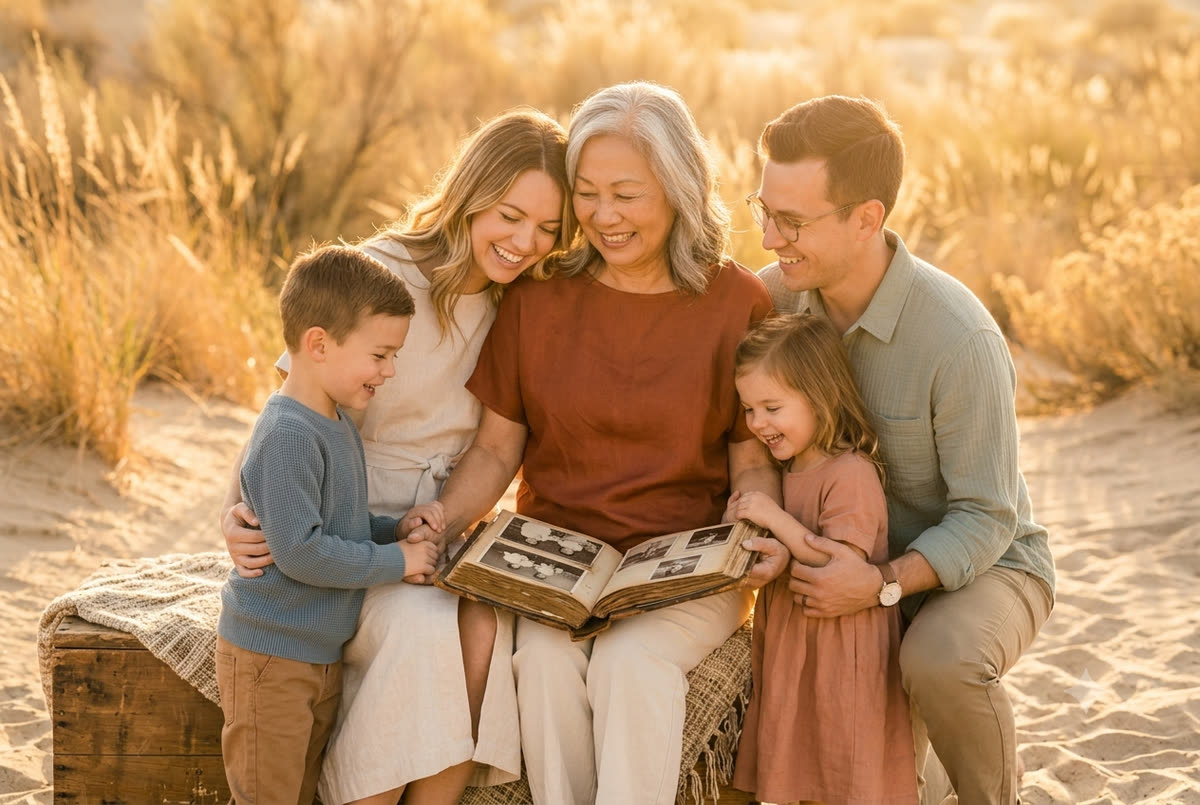
A memorial photo album is one of the kindest answers I know. Not a folder of files that no one opens, and not a slideshow that plays once at the reception and is never seen again — but a real, held-in-the-hands book that gathers a person's images into something with a beginning, a middle, and an end. This is some of the most meaningful work I'm asked to help with, and I want to walk you through how to actually make one: what to gather, how to choose, how to order it so it tells the truth about a life, and how to print it so it lasts longer than any of us will.
What a memorial album is — and what it isn't
A memorial album, sometimes called a tribute album or a remembrance book, is a printed photo book made to honor someone after they've died. At its simplest it's a curated collection of photographs of one person, arranged with care and printed to keep. At its fullest it's a small biography told in pictures, with their own words and the words of the people who loved them threaded through.
It helps to know what it is not, because the misconceptions cause a lot of unnecessary worry:
- It is not a scrapbook you need craft supplies and a free weekend for. Modern albums are designed digitally and printed by a lab.
- It does not require professional photos. Most of the images in a good memorial album were taken on phones, by family, over many ordinary years. That's exactly as it should be.
- It is not something you have to finish quickly. There is no deadline. Some families make one in the weeks before a memorial; many more make it months later, when the fog has lifted enough to choose.
- It does not have to be sad. The best ones are full of life — the laugh, the bad jokes, the garden, the grandkids — with the goodbye held gently inside the larger story rather than being the whole story.
If you're earlier in this journey and the person is still with you, the kindest version of this is to make the album together, while they can tell you who's in each picture and what was happening. I've written separately about recording the stories behind your photographs before they're lost, and it pairs naturally with this.
Start by gathering, not choosing
The most common mistake I see is trying to curate and collect at the same time. It's overwhelming, and it stalls people for months. Separate the two jobs. First, gather everything into one place without judging any of it. Choosing comes later, and it's much easier once the material is all in front of you.
Where the pictures usually hide:
- Your own phone and computer — the obvious place, and usually the deepest well for the last several years.
- Other family members' phones. This is the big one. Your sister has the photos from her house; the grandchildren have the ones you've never seen. Send a simple group message: "I'm making a book for Mom. Please send me any photo you have of her — favorites especially, but don't filter too hard." Set up a shared album or a single folder so everything lands in one spot.
- Old prints in boxes, drawers, and closets. The pre-digital decades live here. You don't need a scanner for every one — a clean, well-lit photo of a photo on your phone is often enough to start, and a good lab can scan the keepers properly later.
- Social media. Years of Facebook and Instagram are an accidental archive. The captions people wrote at the time are often as valuable as the images.
- Email and texts. Search a name and you'll be surprised what surfaces — the snapshot a friend sent, the picture from a trip you'd forgotten.
Don't worry yet about quality, duplicates, or order. A pile of three hundred images you can actually see is the goal of this stage. The "final photos" — the last sessions, the last holidays, the last good day — will naturally be among them, and we'll give those a thoughtful place rather than letting them dominate.
Choosing the photographs that belong
Once everything is gathered, the real work begins, and it's gentle work. Pour a cup of coffee, and go through slowly. I tell families to make a simple "yes" pile first — the images that make you stop, smile, or catch your breath. Don't agonize over the maybes on the first pass.
What earns a place in a memorial album:
- The picture that looks like them. Every family has one or two images where the person is unmistakably, completely themselves — the real smile, the characteristic gesture, the way they stood. These are the anchors of the whole book. If you've ever heard someone say "we have a thousand photos and not one looks like him," this is the gap a tribute is built to close.
- Variety across a whole life. A baby photo. A wedding. The working years. The hobby they were known for. The dog. The grandchildren. A life is long, and the album should feel like one.
- The relationships. Them with each child, each sibling, each close friend. These are the pages people will search for themselves in.
- The hands and the details. A worn wedding ring, the apron, the garden gloves, the handwriting on a recipe card. These quiet images often move people more than the posed ones.
- The ordinary days. The morning coffee, the reading chair, the laughing-too-hard photo. Everyday life is what we miss most, and it's what most families under-include.
A few honest cautions while you choose. Resist including ten near-identical frames from the same afternoon — pick the single best and move on. Be careful with images from a final illness; one or two tender frames can be exactly right and deeply honest, but a run of difficult medical images usually serves grief better than memory. And don't let perfect technical quality be the gate. A slightly blurry photo of a real moment beats a sharp photo of nothing.
Giving the "final photos" their right place
If you have professional final portraits — from a legacy session or end-of-life sitting — or simply the last meaningful pictures the family took, these deserve particular thought, because they carry a lot of weight.
My strong advice is to weave them through the book rather than ending on them. An album that builds a whole life and then closes on a hospital bed leaves people in the hardest moment. An album that closes on a favorite portrait, a hand held, a face turned toward good light, or a wide shot of the whole family gathered, lets the reader set the book down in a place of love. The final photographs belong inside the story — often near the close, but as part of the larger arc, not the last note.
I think of it the way a good eulogy works: it acknowledges the ending honestly, then returns you to the person's life and lets that be the lasting impression.
Shaping the story: how to order an album
This is the part that turns a collection into a tribute, and it's simpler than it sounds. An album reads like a story, so give it a shape. A few structures work beautifully:
Chronological is the most natural and the easiest to follow. Begin with childhood and move forward through the decades. The reader watches a whole life unfold, which is quietly powerful. Most memorial albums I help with use this spine.
Thematic groups by the chapters of who they were rather than by year: Family. Work. The Desert Years. Faith. The Lake House. Travels. This suits a long, full life where strict chronology would feel cramped, and it lets each grandchild find "their" section.
Bookended opens with a single, strong portrait and a few words — a favorite saying, a line of scripture, dates — then tells the life, and closes with another resonant image and a short blessing or thank-you. The bookends give the whole thing a sense of ceremony.
Whichever you choose, a few craft notes that make a real difference:
- Let the best images breathe. Give your strongest photographs a full page or even a full spread to themselves. Crowding twelve pictures onto a page makes none of them count.
- Vary the rhythm. A full-bleed portrait, then a page of smaller everyday snapshots, then a quiet single image. The pacing is what keeps a reader turning.
- Open and close strong. The first spread and the last spread are the two pages people remember. Spend your best images there.
Words make it a tribute, not just a book
Photographs carry the feeling; words carry the meaning. You don't need to write much, but a little text transforms a memorial album from a picture book into something a great-grandchild will read and actually know this person.
What to consider including:
- Their own words. A saying they repeated, a line from a letter or a card, a recipe in their handwriting photographed and printed as-is. Nothing brings someone back like their own voice on the page.
- Captions with the real story. Not "Christmas 1987," but "The year Dad insisted on deep-frying the turkey and set off every smoke alarm in La Quinta." Specifics are everything.
- Short remembrances from the family. Ask each child or grandchild for two or three sentences — a favorite memory, what they'll carry. Scatter these beside relevant photos. If you collected tributes for the service, those passages can live on here.
- A dedication. A single opening line. "For Eleanor, who never met a stranger." It sets the tone for the whole book.
- The bookkeeping of a life, if you want it — birth and passing dates, where they were born, the names of the people they made. Future generations will be grateful you wrote it down.
Choosing a format and a lab
Once the images and words are chosen, the physical book is the easy part. A few practical decisions:
- Size. A 10x10 or 11x14 album sits beautifully on a coffee table and gives portraits room. Smaller 8x8 books are lovely and affordable when you're ordering copies for many relatives.
- Cover. A photo cover, a linen cover with a small inset image, or a clean cloth cover with the name embossed. For a memorial book I lean toward something understated and timeless rather than a busy collage.
- Paper. This matters more than people expect. Lay-flat binding, where a photograph can span a full spread without disappearing into the gutter, is worth the small extra cost for an album like this. Thick, matte, archival pages feel substantial and age well.
- Where to print. Professional photo labs — the kind photographers use — produce noticeably better books than the discount drugstore services, with truer color and bindings that survive being handled for decades. This is the one place I'd gently encourage spending a little more. You're making an heirloom, not a paperback.
If you'd like to go deeper on the craft of the physical object, I've written more about building an heirloom album from old photographs and about albums and wall art as lasting keepsakes.
Order more than one copy
Please plan for this from the start. The single most common regret I hear is that a family made one beautiful book, and then three siblings all wanted it. Most labs let you reprint identical copies at a reduced price when you order together. A copy for each child, and sometimes one set aside for each grandchild, means no one is left without and no one has to ask. It also protects the work — if one book is lost to a move or a flood, the others carry it forward.
Doing this while grieving — be gentle with the timeline
I want to say this plainly, because the practical advice above can make it sound tidier than it feels. Making a memorial album is emotional work. You will sit down to choose photographs and instead spend an hour inside one afternoon from 2009. That is not a detour from the task — that is the task. Many people find the project itself is part of how they grieve, a way to spend deliberate, loving time with someone instead of only missing them. I've written before about how photographs help us carry grief, and an album is one of the clearest examples.
Some honest guidance on pace:
- Let the timeline be generous. If a memorial is days away and you need something for the service, make a small simple book or a print display now, and the full album later. Don't try to do your best work in your worst week.
- Set a soft deadline if open-endedness stalls you — a first anniversary, a birthday, the next holiday when everyone gathers. A gentle target helps without pressuring.
- Do it in sittings, not a marathon. An hour at a time, with permission to stop when it gets heavy.
- Invite the family in, but keep one editor. Gathering and remembering are wonderful done together; the final choosing and ordering go more smoothly with one person holding the thread.
A few mistakes worth avoiding
- Drowning the book in too many photos. Two hundred images chosen with love beats six hundred dumped in. Restraint is a form of respect.
- Ending on the hardest image. Close on life and love, not on the final decline.
- Leaving it as files. A folder on a hard drive is not a tribute. The whole point is something held, opened, and passed hand to hand.
- Skimping on the print. This is the one object meant to outlast everyone in it. Make it well.
- Going it completely alone when you don't have to. If the gathering or the choosing feels like too much, it's perfectly fine to bring in help — a family member, or a photographer who does this kind of work.
When you're ready, I'm glad to help
Sometimes families come to me having already gathered their photographs and simply needing a steady hand to shape and design the book. Sometimes they bring boxes of old prints that need scanning and gentle restoration first. Sometimes the album grows out of a final portrait session we made together while their loved one was still here — usually right in their own living room, or out in a garden or a neighborhood park they loved, wherever they felt most like themselves. There's no single right way in, and there's no wrong time to begin.
If you're somewhere in this — holding a phone full of last photographs and unsure what comes next — you don't have to figure it out by yourself. Bring me what you have, even if it's a chaotic folder and a head full of half-formed ideas, and let's talk through what this book could be. I'll help you find the shape of it, and we'll build something your family will be glad to hold for a very long time.