What to Expect From a Legacy Session
When someone reaches out about a Legacy session, the first thing they usually want to know is not the price or the package — it's "what actually happens?" That is a fair and important question, and I think the not-knowing is part of what makes families hesitate. So let me take the mystery out of it. This is a plain, honest account of how a Legacy session unfolds here in the desert: how we plan it, what the hours in the room feel like, and what lands in your hands afterward. My hope is that by the end of this you'll feel less like you're stepping into the unknown and more like you already know me a little.
A quick word on the name. I call this work "Legacy" rather than "end-of-life" photography, and not to soften something that deserves honesty. I call it Legacy because that is genuinely what it is: portraits made to carry a person forward — their face, their hands, the way they laugh at their own jokes — so the people who love them have something true to hold. Sometimes a Legacy session happens because health is fading. Sometimes it happens simply because a family realizes that three generations are rarely in the same room, and they don't want to keep assuming there will be a better time. Both are the same impulse, and both are welcome here.
Before the camera comes out: the conversation
Every Legacy session begins with a conversation, never a booking form filled out in silence. When you contact me, I want to understand your situation before I suggest anything — who your person is, how they're doing, who else you'd love in the frame, and what's prompting this now. That talk might happen by phone, by email, or in person over coffee in Palm Desert, whatever is easiest for you in what may be a stretched and tender week.
In that first conversation we're really sorting out a few things together:
- Timing. Is this something we can plan a few weeks out, or is health changing in a way that means we should move quickly? I keep room in my calendar for sessions that can't wait, and I'll tell you honestly if I think sooner is wiser.
- Place. Where is your person most themselves and most comfortable? Most often that's their own home, sometimes a care community, occasionally a nearby park, garden, or shaded patio if they're up for a little time outside.
- People. Just your loved one alone? A spouse? The grandchildren? Family flying in? The shape of the session bends around this answer.
- Hopes and worries. What you most want to remember — and anything you're anxious about, from a hospital bed in the background to a relative who hates being photographed. The more you tell me, the more gently I can work.
Nothing in this conversation is binding. Plenty of families talk with me weeks before they're ready, just to know the option is there. That's completely fine.
What we decide together ahead of time
Once we've talked, I'll quietly handle most of the logistics so you don't have to carry them. But there are a handful of small choices that are yours, and thinking about them in advance makes the session itself far more relaxed.
The setting within the setting. If we're at home, we'll likely use a spot near a window with soft, indirect light — a favorite armchair, the side of the bed, the kitchen table where the real conversations happen. You know your home's light better than you think; the room that always feels pleasant in the late morning is usually our room.
A few meaningful objects. A wedding ring worn thin, a quilt someone made, reading glasses, a garden tool, a rosary, the dog. These details carry an entire life, and they make the portraits unmistakably this person rather than anyone's grandparent. Jot down two or three; we'll weave them in naturally.
Clothing. Comfortable, not formal. Soft solid colors photograph kindly and keep the attention on faces. But if your father is most himself in a particular flannel shirt, that shirt is the right answer. Please don't buy anything new.
Time of day. This one matters more than people expect, especially with a fragile loved one. We build the whole session around when your person has the most energy and ease — for many that's mid-morning, after breakfast and before the afternoon tires them. You're the expert on their rhythm; I follow it.
If you'd like a deeper checklist on gathering the family and choosing what to wear, I wrote one in final portraits of an elderly loved one that pairs well with this piece.
What the session itself feels like
Here is the part most people are nervous about, so let me describe it honestly.
I arrive quietly, usually with less equipment visible than you'd imagine. I don't sweep in and start firing the shutter. For the first stretch I mostly just am there — I'll sit, I'll talk with your person, I'll let everyone's shoulders come down from their ears. A Legacy session is not a performance, and the camera is not the center of the room. The connection is. My work is to notice it and quietly keep it.
From there the session tends to move in gentle layers:
- The quiet observation. I photograph softly around the edges of ordinary life — the conversation, a hand resting on a shoulder, a grandchild leaning in to listen. These unposed, in-between frames are almost always the ones families treasure most later. People expect to love the formal portrait; they end up loving the glance.
- The portrait. When the moment feels right, we make a true, dignified likeness — your person looking like themselves, lit kindly. We never force this on a clock. If they're tired, we wait. If they're having a wonderful ten minutes, we use them.
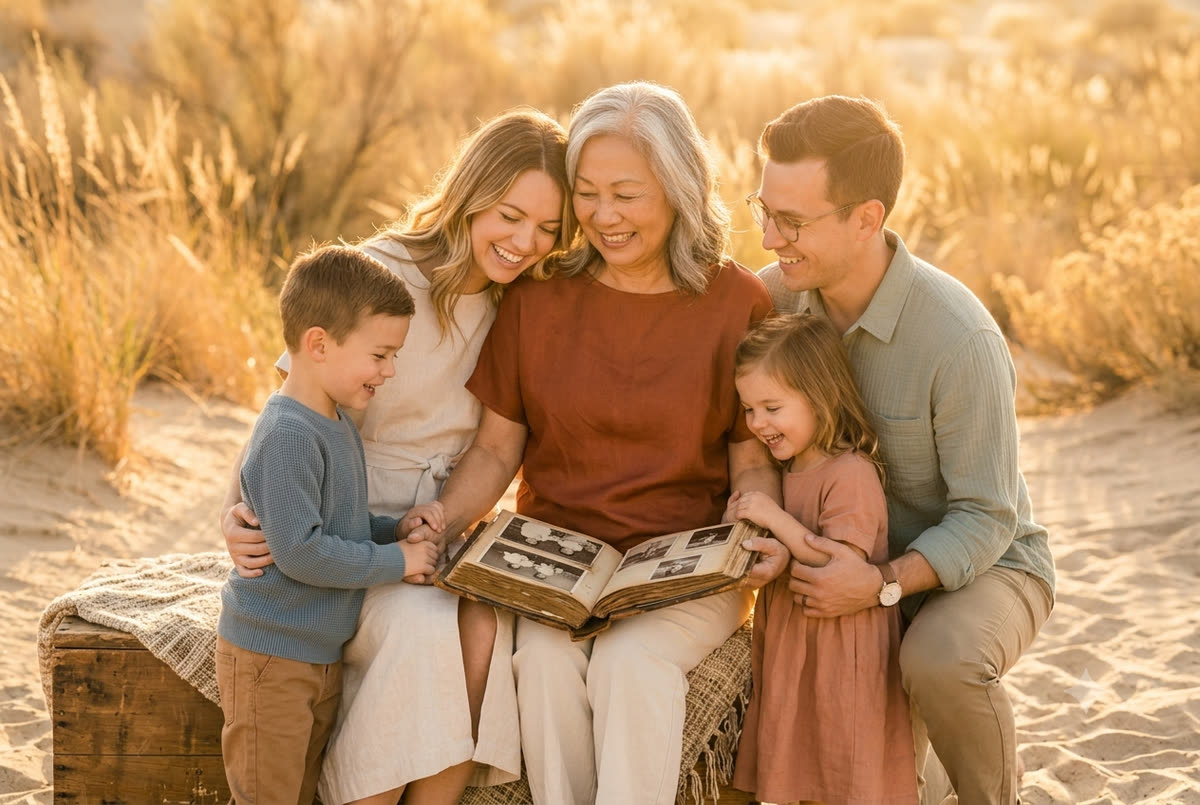
- The connections. Two people together, three generations on one bed, the holding of hands, a forehead kiss. If family has gathered, this is where the multigenerational images happen — and they are often the heart of the whole collection.
- The details. Close frames of the hands, the ring, the worn chair by the window, the things that say a real person lived a full life here.
Throughout, I follow your person's energy rather than my plan. If we need to stop for rest, water, medication, or simply a quieter moment, we stop without apology. A session that lasts fifteen good minutes is every bit as valid as one that runs two hours. Most land somewhere between forty-five minutes and a couple of hours, but I promise you we are never racing.
If your loved one is shy about being photographed — and many are — please don't worry. I work softly enough that the camera fades into the background, and connection photos rarely ask anyone to pose or "smile for me." The love in the room reads far louder than any awkwardness.
Legacy sessions in care settings and memory care
A good number of these sessions happen not at home but in assisted living, skilled nursing, hospice houses, or memory care communities across the valley — in Rancho Mirage, Indian Wells, La Quinta, and throughout Palm Desert and Indio. I'm comfortable and calm in these spaces. I know how to work quietly around medical equipment, to be respectful of staff and other residents, and to coordinate with nurses and caregivers about timing.
If your person lives with dementia, the session simply slows down further. We don't ask them to remember names or pose; we let them be exactly who they are that day, and we photograph the tenderness that doesn't depend on memory — a held hand, a familiar song, a daughter's face close to theirs. Families are often surprised by how much warmth comes through. For more on this, families have found our work with hospices and care communities reassuring.
I can frame to quietly include or exclude tubes, a hospital gown, or a wheelchair, whatever you prefer. Many families fear those details will dominate the picture. With careful light and angles, they almost never do.
A note about our desert light and seasons
Because we're in the Coachella Valley, two practical things shape Legacy sessions here, and it's worth knowing them.
First, where most of my Legacy work actually happens: indoors. The great majority of these sessions are made right in someone's home, in soft natural light near a north-facing window — a favorite armchair, the side of the bed, the kitchen table where the real conversations happen. That window light is gentle and forgiving, honestly some of the most flattering there is, and it means a beautiful session never depends on the weather or the hour. I bring my own soft lighting as well, so a gray afternoon or a dim room is never a problem.
Second, the outdoors, when your person is well enough and would enjoy it. A short, easy stretch on a shaded patio, in a back garden, or at a quiet neighborhood park can be lovely — and out there we let the light do the work, photographing in the golden hour late in the day when the desert turns warm and kind. In the hottest months I'll never ask a fragile person to sit out in the heat; we keep any outdoor frames to the cool edges of the morning or evening and we keep them brief. But the heart of this work is almost always inside, close to home and close to comfort.
Common questions about what to expect
How far in advance should we book? If you can plan ahead, two to four weeks is comfortable. If health is changing, please don't wait for a tidy moment — reach out and we'll move at whatever speed your situation needs, sometimes same-week or same-day.
What if my person isn't feeling well that day? We adapt or reschedule, and there's never a fee or a fuss for it. With Legacy work, flexibility is built in. I'd far rather catch a good morning than push through a hard one.
Will it be sad or awkward? Most families tell me the opposite — that the session became a warm, even joyful pause, a reason to gather and tell stories. There's often more laughter than people expect.
How long until we see the photographs? Because of the nature of this work, I prioritize delivery. When time is short I can turn around a first set of edited images very quickly — often within a day or two, sometimes a few key frames the same day — so you can see them while it matters most.
What do we actually receive? A collection of carefully edited, high-resolution digital images that are yours to keep, print, and share within your family forever. I'm a strong believer in printed photographs, so I'm always glad to help you turn them into something physical later — prints, a small album, an enlargement — but there's no obligation to order anything. The images themselves are the heart of it.
Is this private? Entirely. Nothing is ever shared publicly without your explicit permission, and many Legacy sessions stay completely within the family. You control who ever sees these pictures.
How to prepare your own heart for the day
Most of this article is about logistics, but I want to say something about the emotional side too, because families ask. You do not need to be composed. You do not need to hold it together for me. If there are tears, they belong in the room as much as the laughter does, and they often make the most honest pictures of all. My job is to hold a calm, steady space so that your only task is to be present with the person you love. Let me carry the rest.
And if you're the one organizing it all — the adult child making the calls, gathering the siblings, choosing the day — thank you. That is an act of love, and it's harder than it looks. Tell me where you're stretched and I'll take as much off your plate as I can.
When you're ready
A Legacy session is, at bottom, a small and steady way of saying you are here, you matter, and we will not forget your face. Families almost never regret making these portraits; what they regret is the year they meant to and let slip by. So if someone you love has been on your mind as you read this, send me a note through my contact page. Tell me a little about your person — their name, how they're doing, who you'd want beside them in the frame — and I'll write back with how I'd approach it for your family. We can go from there slowly or quickly, whatever the week is asking of you.
If it would help to read more first, families have found end-of-life photography services and generational legacy sessions to be good companions to this page.