Preserving the Story Behind Each Photo
Open almost any family's inherited shoebox of photographs and you'll find the same quiet problem. There might be two hundred prints in there, and they're often beautiful — a young man in uniform, a wedding on a windy hillside, children gathered on a porch nobody living can place. And almost none of them say anything. No names on the backs. No dates. No locations. Half can be guessed at and almost none are certain. The pictures clearly mattered to whoever kept them; the reasons left with them. That gap is the exact thing I spend my working life trying to prevent.
A photograph captures what something looked like. It does not, on its own, capture what it meant, who these people were to each other, or why this particular ten-thousandth of a second was worth keeping. Those things have to be preserved deliberately, and they almost never are — until it's too late to ask. So this is a guide to the part most people skip: not how to take a sharper picture, but how to keep the story attached to it, so that fifty years from now the image still speaks instead of going quiet in a box.
Why the picture isn't the story
We tend to treat the image as the whole record. It isn't. A photograph is the visible tip of a much larger thing — a relationship, an afternoon, a reason — and the rest of that thing lives in memory, which is the least durable storage medium ever invented.
Think about your own phone right now. You probably have a photo from three years ago that you can no longer fully place. You know it was someone's backyard, some celebration, but the specifics have already softened. Now stretch that forward two generations, to people who were never in the room and never knew the names. Without context, even a technically gorgeous portrait becomes a stranger's face.
The good news is that the story doesn't require much to survive. It needs only to be recorded and attached — written down, spoken aloud, or saved alongside the image while the knowledge still exists. The families who do this well aren't doing anything elaborate. They're just doing it on purpose, and they're doing it now rather than someday.
Capture the story while you're making the picture
The richest moment to gather a photo's story is the moment you take it, when everything is fresh and everyone who knows the answers is standing right there. A little intention at this stage saves enormous guesswork later.
Shoot wider than you think you need
When I'm photographing a family, I always make a few frames that include more than the perfect tight composition — the setting around them, the house, the car in the driveway, the dog half out of frame. The "imperfect" wide shot is often the one that tells you where you were and what the world looked like that day. A face fills the heart; a wide frame anchors the memory.
Get the in-between moments, not just the posed ones
A formal portrait tells you these people existed and were dressed nicely. The candid beside it — a grandfather leaning down to hear a four-year-old's secret, two sisters cracking up between setups — tells you who they were to each other. That's the storytelling frame. If you're photographing your own family, keep shooting in the gaps. The real story usually happens right after someone says "okay, we're done."
For more on this balance, I've written separately about candid versus posed family moments and why a good session needs both.
Photograph the details that carry meaning
Hands. A wedding ring that belonged to a great-grandmother. The quilt on the bed, the recipe card on the counter, the patch on a worn jacket. These objects are story compressed into a single frame, and they're easy to overlook in the moment because they feel ordinary. Ordinary is exactly what disappears.
Record the facts before they fade
Here's the discipline almost nobody keeps, and it's the single most valuable thing in this whole article: write down who, when, where, and why — within a day or two of taking the photo.
You think you'll remember. You won't, not in detail, and your children certainly won't. So capture, for the images that matter:
- Who — full names, not just "Grandma" and "the kids." Maiden names. How each person relates to the others. The baby's full name and birth date.
- When — the actual date. "Fall 2024" is far better than nothing, but the specific day is better still.
- Where — the location, and ideally why you were there. "Mom's backyard in Palm Desert, the morning of her 80th" tells a future reader everything.
- Why — the occasion or the reason. This is the one people skip, and it's the one that turns a picture into a story. "We did this because Dad had just finished treatment and we wanted everyone together" is the whole heart of the image.
You don't need a fancy system. A note in your phone, a shared family document, a few sentences in the photo's caption field. What matters is that the words live with the picture, not in your head.
Use what your camera already records — but don't rely on it
Modern phones quietly tag every photo with a date and GPS location, which is a wonderful safety net. But that metadata is fragile. It gets stripped when images are texted, posted to social media, or exported the wrong way, and it will never know why you took the picture or what anyone's name was. Treat automatic metadata as a helpful start and the human details as your real job.
Let the people in the photo tell it themselves
The most precious storytelling I know of isn't written — it's recorded in a voice. While the people who lived the moment are still here, get them talking about the pictures, and capture it.
This is gentle, lovely work and it costs nothing. Sit with a parent or grandparent and an album, open your phone's voice memo app, and just ask them to talk you through it. The questions that consistently unlock the good stuff:
- "Who is everyone in this one, and what were they like?"
- "What was happening right before this was taken?"
- "What do you remember about that day that the photo doesn't show?"
- "Why did you keep this picture?"
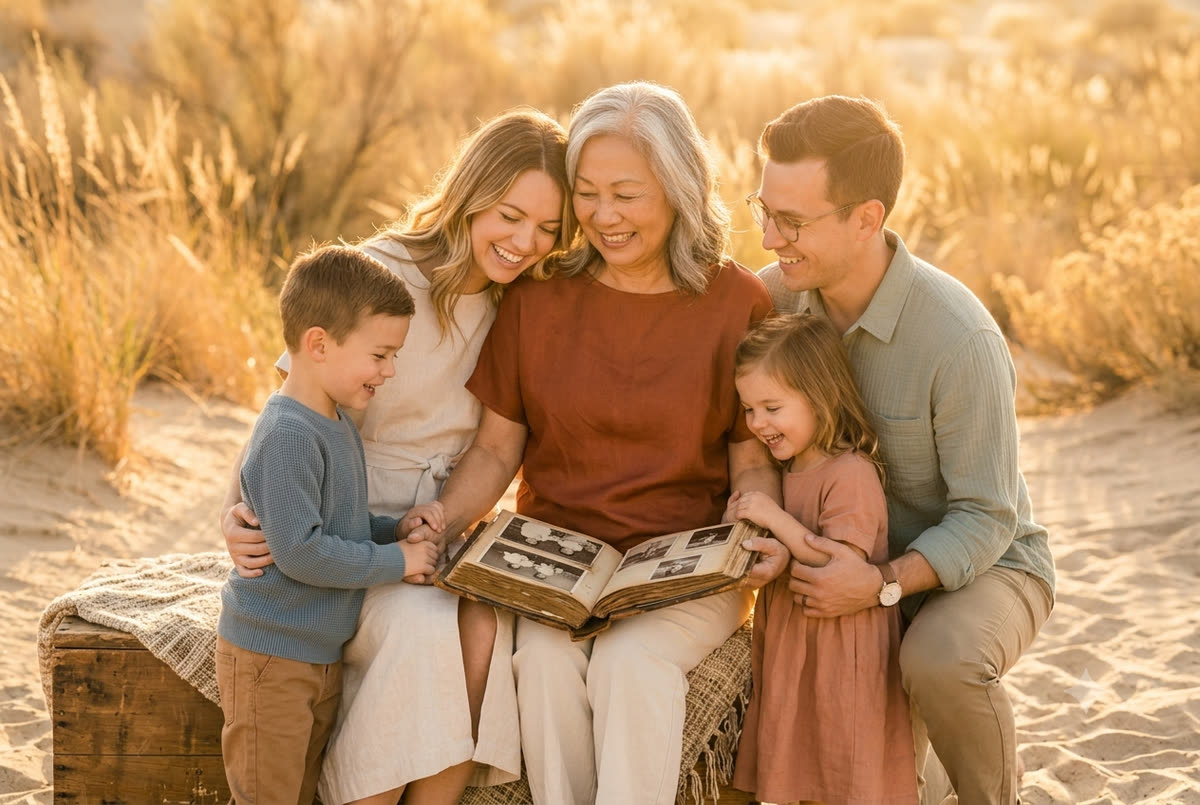
What you get back is rarely tidy, and that's the gift — the asides, the corrections, the laugh when a memory surfaces. I've sat in living rooms and watched a grandmother narrate forty years of pictures in a single afternoon, and those recordings become more valuable than the photos themselves. If you do nothing else from this article, do this, and do it soon. This is the spine of preserving your family's history, and the window for it is always shorter than it feels.
How I build storytelling into a session
When families work with me, I treat the story as part of the deliverable, not an afterthought. More often than not we work right where you live — in the soft window light of your own home, or at a nearby park or garden in the golden hour — because a place you already love puts everyone at ease and stitches its own meaning into the pictures. A few things I do on purpose:
I ask why before we start. Before I lift the camera, I want to know what this session is really about. Is it the last summer before a son leaves for college? A grandmother who's slowing down? A blended family marking their first year whole? Knowing the why changes what I look for. If I know the heart of the day, I can catch the frame that holds it.
I shoot the connections, not just the faces. A telling portrait is usually about the space between people — a hand on a shoulder, the way a child folds into a parent, two people who can't stop glancing at each other. I'm watching for the gesture that's unmistakably this family and no other.
I keep a record of the day. Names, the location, the occasion, the small things that came up — they go into the file with your images, so the context travels with the photographs into whatever comes next.
I think about where they'll live. A photo on a hard drive is a photo waiting to be forgotten. A print on the wall gets seen, asked about, and explained to the next person daily — which is its own kind of preservation. I talk through prints and albums with every family for exactly this reason.
Where you photograph becomes part of the story
Most of my sessions happen where families actually live their lives — in the home, out on the back patio, or in one of the Valley's parks and gardens. I lean toward those settings on purpose, because a place a family already loves carries its own meaning, and that meaning folds another layer of story into the frame before anyone has said a word. The living room where everyone gathers, the garden you tend, the park down the street where the kids have always run — decades from now those backdrops will say this was their corner of the world as plainly as any face.
Our region gives the idea extra weight, because the landscape here is so distinct it timestamps a picture all on its own. If you'd like to step outside for part of a session, a local park or garden at golden hour — that long, forgiving light in the hour before sunset that the Coachella Valley does better than almost anywhere — anchors a photo in both a place and a time. The San Jacinto mountains on the horizon, the date palms of Indio, a mid-century courtyard in Palm Springs: the setting is legible at a glance, and no one will have to wonder where you were. If you're weighing options, I've put together thoughts on the best places for family photos around Palm Springs with this kind of meaning in mind.
Common mistakes that let the story slip away
- Trusting your memory. The most confident "I'll never forget this" is exactly the memory that fades first. Write it down.
- Labeling nothing. A box of unidentified beautiful prints is a box of strangers in two generations. Names and dates are non-negotiable.
- Keeping everything only in one place. Phones drown, laptops die, single hard drives fail. Back up to a second location, and tell another family member where the archive lives.
- Saving only the perfect shots. The slightly blurry candid, the outtake where everyone's laughing — those often carry more story than the keeper you'd print. Don't delete in a hurry.
- Photographing only the people, never the world around them. The house, the street, the car, the era's clothes and clutter — that context is what makes a photo readable later. Give the picture some air.
- Waiting for "someday" to do the interview. The people who hold the stories won't always be here to tell them. This is the one with a real deadline, even when it doesn't feel like it.
A small practice that changes everything
If all of this feels like a lot, start with one habit: every time you take a photo that matters to you, take thirty seconds to write a sentence about why. Just one. "Took this the day we brought her home." "Last family dinner in the old house." "He insisted on wearing the cape." That single sentence, attached to the image, is the difference between a picture your great-grandchildren cherish and one they can only admire from the outside.
That inherited shoebox didn't have to turn into a box of strangers. Photographs like those were taken with love by people who knew every name and every story in them — they just never thought to set the words down beside the pictures, because at the time the knowing felt permanent. The images survived. The stories didn't have to be the part that got lost.
If you'd like to make pictures that come with their stories intact — a session built around what your family actually means to each other, and a real record to go with it — I'd be glad to help you think it through. You can get in touch with me here, and we'll find the right way to keep what matters most from going quiet.