Displaying Photos of a Loved One Who Passed
A few weeks after the funeral, once the steady stream of visitors has slowed and the days stretch a little emptier, the photographs tend to surface — a drawer opened, an old album lifted down from the closet shelf. Inside are the pictures: some glossy, some curling at the corners, a few you have never seen before — and you find yourself sitting on the floor holding them, not entirely sure what you are supposed to do next. Put them away and they vanish. Tape one to the fridge and it feels too small for what it means. The question underneath all of it is gentle and enormous at the same time: how do I keep this person present in my home, in a way that feels like love and not like a museum?
I have helped many Coachella Valley families think through exactly this, and I want to walk you through it the way I would if we were sitting at your kitchen table. There is no single correct way to do it. But there are choices that tend to feel warm and choices that tend to feel cold, and after years of being trusted with people's most precious pictures, I have a pretty good sense of which is which.
Start with the feeling you want, not the wall
Before you measure a single frame, ask yourself what you want the room to feel like when you walk past it.
Some people want to be greeted — a face they love, right at eye level by the front door, so the first thing that happens every morning is a small hello. Others want something quieter and more private: a photo tucked on a nightstand or a reading-chair side table, meant only for them. And some want a true gathering wall, a whole life laid out so that grandchildren who never met the person can still point and ask, who is that?
All three are right. The mistake I see is skipping this step and just hanging the one nice 8x10 in the obvious empty spot, then feeling, months later, that it isn't quite working. When the placement matches the feeling you were after, you stop noticing the frame and start simply feeling the person. That is the whole goal.
Choosing which photo (or photos) to display
This is the part people agonize over, so let me take some pressure off.
The best photo is rarely the most formal one. The studio portrait where everyone is posed and a little stiff has its place, but it is usually not the image that makes you smile. Look instead for the picture where the person is unmistakably themselves — your dad squinting into the sun on the patio, your mother mid-laugh at a table in Old Town La Quinta, your husband's hands on the steering wheel of the truck he loved. The telling gesture beats the perfect lighting almost every time.
A few things that help when you are sorting:
- Pull more than you think you need, then cut. Lay twenty on the table and let yourself react. The ones you keep picking back up are the ones to display.
- Mix the eras. A single photo freezes a person at one age. Two or three across a life — young and laughing, middle-aged and steady, old and beloved — tells the truer story.
- Watch for the candid that catches their spirit. Out-of-focus and crooked can still be the right one if the feeling is there. Display is about presence, not technical perfection.
- Don't forget the photos they took. If the person was the family photographer and is never in the frame, a landscape or a pet they shot can be just as much "them" as a portrait.
If you are torn between several, you do not have to choose. A small grouping almost always feels warmer than one lonely frame.
Protect the originals before you display anything
Here is the single most important practical thing I can tell you, and it is the thing most people skip: do not hang, tape, or prop an irreplaceable original where it will live in the light.
Our desert sun is merciless on photographs. A print in a sunny Rancho Mirage living room — especially anything from the 1960s through the 1990s, when color processing was less stable — can visibly fade in just a season or two of our light. I have watched faces go pink, then orange, then ghostly. Once that color is gone, it is gone.
So before anything goes on a wall:
- Scan or photograph every original at high resolution. A flatbed scan at 600 dpi is ideal; if you don't have a scanner, a careful phone photo in soft, even light (near a north-facing window, never direct sun) is far better than nothing.
- Back the files up in two places — your computer and a cloud account, or two drives. Fire, flood, and a dropped hard drive don't care how much a photo means to you.
- Display a print, not the original. Once you have a good scan, you can make as many prints as you like and keep the precious original safe in an album or archival box, away from heat and light.
If the originals are damaged — torn, water-stained, faded, or stuck to old "magnetic" album pages — they can very often be scanned and restored digitally before you reprint them. I write more about that in restoring and preserving old family photographs, because it deserves its own conversation.
Framing that feels like home, not a shrine
The difference between a display that comforts you and one that quietly unsettles you usually comes down to restraint.
On frames: matching frames read as intentional and calm; a jumble of ornate gold and black plastic reads as accidental. You do not need expensive frames — you need consistent ones. Pick one finish (warm wood, simple black, soft white) and let the photos be the variety. A generous white mat around each print does an enormous amount of work; it gives the image room to breathe and makes even a snapshot look considered.
On size: people tend to go too small. One modestly large print — say 11x14 or 16x20 — at eye level often does more than a scatter of wallet-sized ones. If you want a grouping, vary the sizes deliberately, with one clear anchor image and smaller pictures orbiting it.
On the "shrine" worry: this comes up a lot, and it is a real and tender fear — that a display will feel morbid, or that it will keep the household stuck in grief. The thing that tips a display toward shrine territory isn't the photos; it is the staging around them. Candles permanently lit, fresh flowers replaced like an offering, the image isolated on its own special shelf with nothing else nearby — that arrangement asks the room to mourn. A photo of your mother hung among the other family pictures, part of the ordinary flow of the home, simply asks the room to remember her. Integrate, don't isolate. That one instinct keeps almost everyone on the warm side of the line.
Ideas for displaying photos of someone who passed
Beyond the single framed print, there are many ways to bring a loved one into a desert home. A few that families here have loved:
- A gallery wall down a hallway. Hallways are forgiving — soft, indirect light, and you pass through slowly. A mixed grouping of generations along the hall to the bedrooms becomes a little walk through the family's history.
- A dedicated grouping on a bookshelf or console. Frames of varied heights clustered together, books and a small object or two woven in, so it feels lived-in rather than staged.
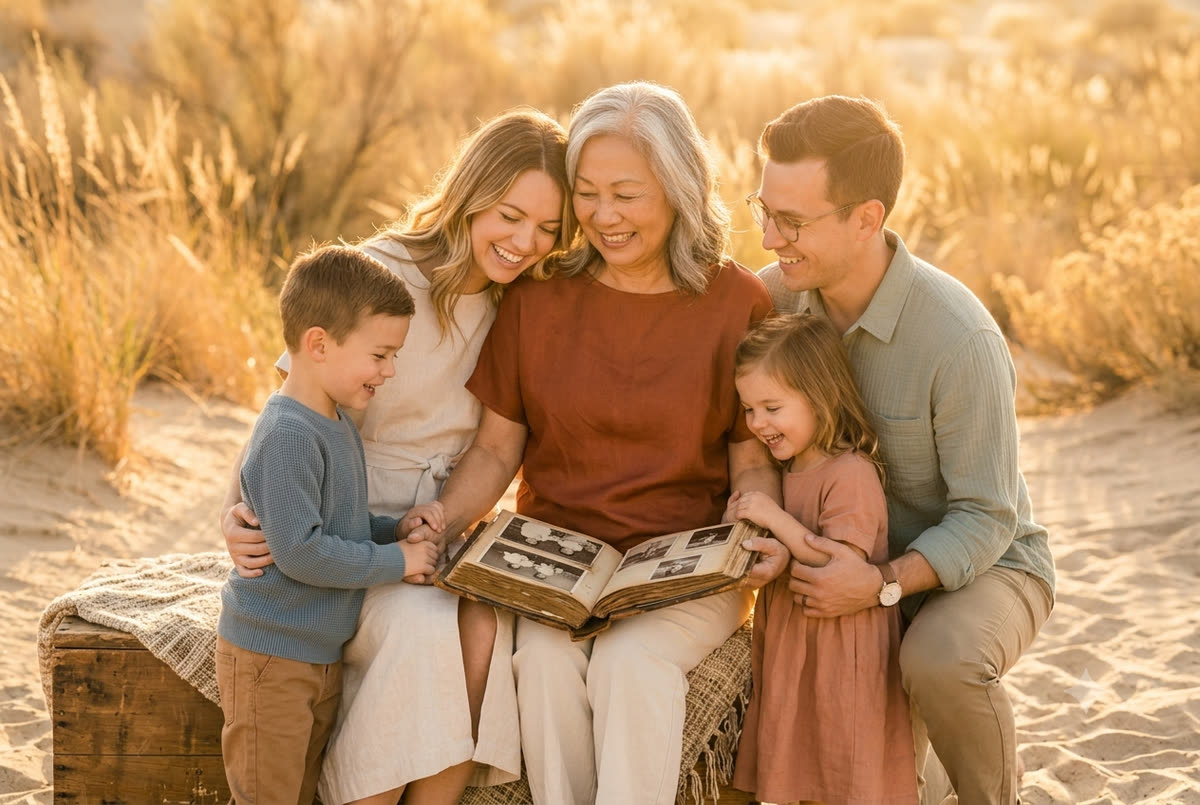
- A photo book on the coffee table. Not everything has to be on the wall. A well-made album invites people to sit down and turn pages, and it travels — you can take it to a sibling's home in Indio or hand it to a grandchild on the couch.
- A small framed photo in a place that was theirs. Your dad's photo in the garage near his tools. Your grandmother's by the kitchen window where she always stood. These quiet, specific placements often land harder than the prominent ones.
- Holiday and seasonal touches. Some families bring out a particular portrait at Thanksgiving or on the person's birthday, then return it to the album. The photo becomes part of a ritual, which is its own kind of remembering.
- A photo in the wallet, phone lock screen, or car. Display doesn't have to be furniture. Carrying a face with you counts.
If you are thinking about a larger tribute — a whole legacy wall, or gathering scattered family pictures into one curated collection — I go deeper on that in creating a family legacy wall.
Mind the light and the desert climate
Because we live where we live, two practical notes matter more here than they would on the coast.
Light fades prints, and our light is intense. Even a reprint will eventually fade in a south- or west-facing window that catches the full afternoon. For anything you want to last, choose an interior wall, a hallway, or a spot that gets only soft indirect light. If you love a sunny location, ask your printer or framer about UV-protective glazing (museum or conservation glass) — it noticeably slows fading and cuts glare. It costs more per frame, but for the photo you most want your grandchildren to see, it is worth it.
Heat and humidity swing hard here. A frame on a wall that backs up to afternoon sun, or one stored in a hot garage over a Palm Springs summer, can buckle a print or grow condensation behind the glass. Keep displayed photos in the conditioned, lived-in parts of the house. Keep archival originals somewhere cool, dark, and stable — a closet interior, not the garage.
When the photos you have aren't quite enough
Sometimes a family comes to me with only blurry phone snapshots, or a single faded portrait, and a deep wish for something better to display. There is real comfort in what restoration and good printing can do — a soft scan brought back to clarity, a crease smoothed away, a faded color portrait gently brought back toward life. Seeing a parent's face clear and warm again, large and well-printed on the wall, can be unexpectedly healing.
And if this loss has you thinking about the living — about getting the grandparents, the parents, the whole gathered family properly photographed while everyone is here — that is one of the most loving things you can do. I think about this often, and I wrote about it in why photographing your parents and grandparents now matters. The pictures we wish we had are almost always the ones no one got around to taking.
A few gentle answers to common questions
Is it morbid to keep a deceased loved one's photo up for years? No. Integrated into the normal life of your home, it is simply part of who your family is. Grief changes shape over time, and your display can too — what felt right the first year may shift, and that is healthy, not a betrayal.
Should I take down photos of an ex-spouse or estranged family member who passed? That is entirely yours to decide, and there is no wrong answer. Some keep them for the children's sake; some don't. Do what lets you live easily in your own rooms.
What if different family members want it done differently? Make copies. One of the quiet gifts of having photos scanned and reprinted is that everyone can have their own — your version on your hallway, your sister's version on hers — without anyone having to give anything up.
How soon is too soon? There is no clock. Some people need a face on the wall the first week; others can't bear it for a year. Both are normal. Let your own readiness lead.
When you're ready
Displaying photos of someone you've lost is really an act of keeping them in the conversation — at breakfast, in the hallway, on the birthday that still comes around every year. A display is never really finished, either — you can rearrange it, add to it, or let it change shape as the years do.
If you'd like help scanning and protecting precious originals, restoring a damaged or faded picture, or printing and arranging photos into a display that feels like home, I would be honored to help you do it carefully. You can reach me here whenever the time feels right. Bring the shoebox. We'll figure it out together.