How Photography Helps With Grief
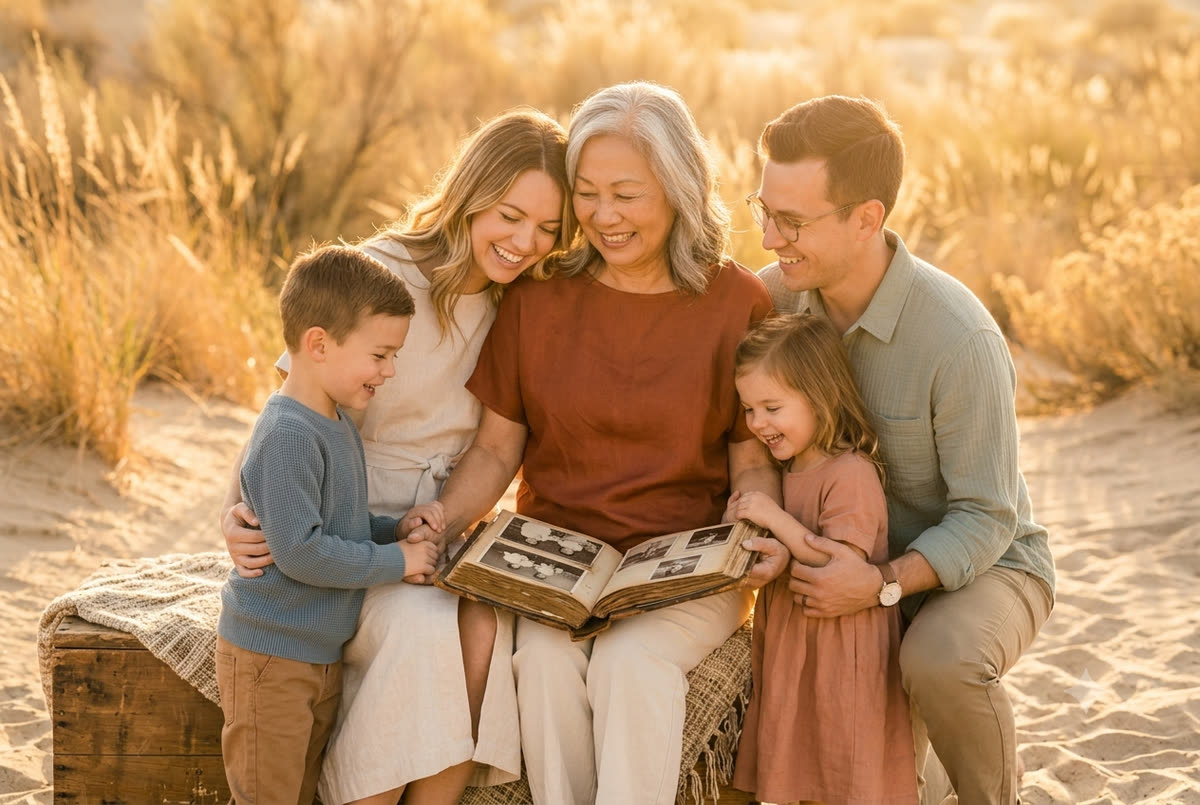
Of all the portraits a family asks me to make, the ones that end up mattering most are rarely the ones they came in for. A daughter might book a session because her mother has been given a diagnosis with a number attached to it, hoping for one careful, formal frame and not much more. And then, somewhere in the middle of it — once the camera is up and her mother starts teasing her about her posture — the morning turns into something nobody planned: an hour of being a family, on purpose, on the record. Afterward, the picture people reach for again and again is almost never the formal one. It's the frame where she's laughing with her eyes closed, mid-sentence, completely herself. A photograph like that gives a person back to you for a few seconds at a time.
That is, in the plainest terms I know, how photography helps with grief. It doesn't undo the loss. It gives you somewhere to put your love when the person is no longer in the room.
Grief and photographs are bound together
Grief is, at its core, a problem of memory. The people we lose don't vanish all at once. They fade at the edges — the exact sound of a voice, the particular way a father held his coffee cup, the gap between your mother's front teeth when she really laughed. We are terrified of forgetting, and that fear is its own kind of grief layered on top of the first one.
A photograph is one of the only things that pushes back against that fading. It is a fixed point. Years from now, when your own memory has softened and rearranged itself the way memory does, the picture will still be exactly what it was. That permanence is a comfort and, honestly, sometimes a sting — but it is real, and grief is hungry for things that are real.
There is a reason that, in a house fire or a flood, people run back in for the photo albums. We understand instinctively that these images are not decoration. They are evidence that a life was lived and loved and witnessed.
The two kinds of grief photography serves
In my work I've come to think about this in two phases, and they ask very different things of a camera.
Before the loss: anticipatory grief
When you know that someone you love is approaching the end — a terminal diagnosis, advancing age, a decline that has a direction — you are already grieving. This is what's called anticipatory grief, and it's a strange, exhausting country to live in. You're mourning someone who is still here, still asking what's for dinner, still here to hug. It can feel disloyal to even think about photographs, as though planning to remember someone is the same as giving up on them.
It isn't. I'd say the opposite is true. Choosing to be photographed together while you still can is one of the most hopeful, present-tense things a family can do. You are saying: this person matters, this love is worth marking, and I am not going to let the busyness and dread of these months rob me of the chance to simply look at them.
I write more about this in The Gift of a Portrait Session During a Terminal Diagnosis, because the practical and emotional considerations are different enough to deserve their own conversation.
After the loss: photographs as companions in mourning
After someone is gone, photographs do a quieter and longer work. They become the objects you live alongside — the frame on the nightstand, the album you open on the anniversary, the picture you set out at the memorial so that everyone who walks in is greeted by the person, not just the absence. This is the work that lasts decades, and it's why I care so much about making images that still feel honest and warm twenty years from now, not just flattering today.
What a photograph actually does for a grieving person
It's worth being specific about the mechanisms, because "it helps" is easy to say and hard to feel until you know how.
- It preserves the true person, not the idea of them. Grief has a way of flattening someone into a saint or a symbol. A good photograph keeps the eyebrow raised in skepticism, the half-smile, the mischief. It keeps them complicated and alive.
- It gives mourning a place to land. Grief needs ritual and objects. Lighting a candle next to a portrait, or holding an album on a hard anniversary, gives your sorrow somewhere to go instead of just circling.
- It carries the person to people who never met them. A grandchild born after a grandfather dies will know him largely through pictures. Photographs are how love crosses the gap between generations.
- It restores the small things. The things we miss most are rarely grand — they're a posture, a pair of reading glasses pushed up on a forehead, two people leaning into each other on a couch. Pictures hold the small things memory drops first.
- It lets you choose how you remember. Many families' last images of someone are from a hospital bed or a phone snapshot at a difficult time. A real portrait gives you a different last chapter to return to — them at ease, them as themselves.
How to photograph someone you're going to lose
If you're reading this because someone you love is fading, here is what I'd gently tell you, the way I'd tell a friend.
Go for honesty over formality. The pictures that comfort people most are almost never the stiff, everyone-line-up-and-smile ones. They're the in-between moments — a hand on a shoulder, a shared joke, a parent watching a child do something ordinary. Don't over-direct. The goal is to come away with a frame that makes you say, "Yes. That's exactly who they were."
Photograph the hands, the details, the context. Beyond faces, photograph the things that make this person this person: their hands, the wedding ring worn thin, the garden they tended in La Quinta, the chair they always sat in, them with the dog. These details become unexpectedly precious later.
Get in the picture yourself. This is the mistake I see most. The well people — the spouse, the adult kids, the caregivers — hang back because they're tired, or they don't feel camera-ready, or it feels like the day is about someone else. But you are part of this story, and one day a photo of you and them together will matter more to you than any solo portrait. Be in the frame.
Keep it short and gentle. When someone is ill or frail, energy is the real budget, not time. A session can be twenty unhurried minutes in a living room. I'd rather make six true frames in a sitting room in Palm Desert than exhaust someone chasing a hundred.
Don't wait for a better day. This is the hardest and most important thing I can say. Families tell me all the time that they wanted to wait until Mom felt stronger, until after the next treatment, until the weather cooled. Decline rarely waits with you. The "ordinary" day in front of you — pajamas, no makeup, soft light through the blinds — is very often the day you'll be most grateful you didn't postpone.
Doing this in the Coachella Valley
The desert offers something genuinely useful for tender, low-energy sessions: it's gentle and it's close.
- In-home and bedside sessions. For someone who can't travel easily, I come to you — a home in Indian Wells, a room at a care community in Rancho Mirage, a hospice room. Familiar surroundings relax people, and the details of a home tell their own story.
- Gentle outdoor light, close to home. If a short outing feels right, our golden hour is forgiving and kind to faces — a slow half hour in a backyard, on a shaded patio, or at a quiet local garden can feel like an afternoon out rather than a medical appointment. In the hottest months we simply move to early morning, or stay indoors and work with soft window light.
- Easy, level places. Spots like the paths at the Living Desert, a calm corner of a Palm Desert backyard, or a shaded patio let someone with limited mobility be photographed somewhere lovely without a strenuous trek.
The point is to remove friction. When someone is unwell, the logistics are part of the kindness.
After the funeral: photographs in mourning and memorial
If you're past the loss, photographs still have work to do, and you have more agency here than you might think.
- Build the memorial table thoughtfully. Choose images that show range — the young version, the laughing version, the dignified version. Let people meet the whole person.
- Print, don't just store. A picture living on a phone or a hard drive is a picture you rarely see. Make prints. Hang them. A framed image you pass every morning does steady, gentle work on a grieving heart that a digital file in a folder never will.
- Make an album, even a small one. The act of choosing and ordering pictures is itself a form of mourning that many people find healing. You sit with the person again, on purpose.
- Mark the anniversaries with the images. Grief comes in waves and the calendar knows where the rocks are. Having photographs ready for birthdays and anniversaries gives those hard days a focus that's loving rather than only painful.
If you're caring for an older parent right now and the future feels close, you may also find Why I Photograph Grandparents With Their Grandchildren and Making a Family Legacy Portrait worth reading — both are about capturing the connection while everyone is here to feel it.
Common worries, answered honestly
"Isn't it morbid to plan pictures of someone who's dying?"I understand why it feels that way, and I'd answer that it's the reverse. Choosing to photograph someone is choosing to celebrate that they're still here. In my experience, regret runs the other direction — families rarely wish they hadn't made the pictures. What they wish, almost always, is that they'd made them sooner.
"They don't like having their photo taken."Most people don't — until they're with someone who isn't rushing them and isn't making it a performance. My whole job is to make the camera disappear so that what's left is just a family being together. The reluctant ones are often the ones who, looking back, are most grateful.
"We don't look our best right now."Grief and illness don't wait for our best lighting or our best hair. And the truth is, the things you're self-conscious about now will be invisible to you later. You will only see the face you loved. I promise you that.
"Is it too late — they've already declined a lot?"It is almost never too late while someone is still here. Even quiet, simple frames made in a hospice bed become treasures. If there's any window at all, take it.
What I hope you take from this
Photography doesn't make grief smaller. Nothing does, and anyone who promises otherwise is selling something. What photographs do is give your love a body — something you can hold, hang, open, and return to. They let you keep introducing the person to new people and new years. They turn "I'm forgetting them" into "here they are."
That, to me, is sacred work, and it's the part of my job I hold most carefully.
If someone you love is approaching the end of their life, or if you're sitting in the early rawness of a loss and wondering whether it's too late to gather what images you have into something lasting, I would be honored to help — gently, on your timeline, in whatever form gives you the most comfort. You can reach me anytime through my contact page, and we can simply talk it through first. There's no right way to do this except the way that helps you keep the person close.