Memory Care Photography in Rancho Mirage
There is a particular kind of grief that arrives long before anyone says goodbye. When a parent or spouse is living with dementia, you begin missing them while they are still right in front of you — and at the same time, you are sometimes startled by a flash of the person you have always known: a joke they land perfectly, the way they reach for your hand, a song that brings their whole face back to life for a moment. Memory care photography is, more than anything, about being patient enough to catch that moment when it comes.
I photograph families across Rancho Mirage and the wider Coachella Valley, and some of the most meaningful work I do happens inside memory care communities here. If you are caring for someone who no longer remembers the way they used to — or who some days does not remember you — I want you to know that beautiful, true photographs are still very much possible. Not staged ones. Real ones. Let me walk you through how this works, and how I approach it with the gentleness it deserves.
What memory care photography is — and what it isn't
Memory care photography is portrait and documentary work made for a person living with Alzheimer's, vascular dementia, Lewy body dementia, or another form of cognitive decline. It is usually done where they live — a memory care neighborhood in Rancho Mirage, a private home with caregivers, or the secured wing of an assisted living community.
It is not about getting your loved one to "perform" for the camera, and it is not about pretending the illness isn't there. It is about preserving who they still are: the expressions, the gestures, the relationships, and the dignity that dementia does not erase. Sometimes that means a clear, gentle portrait. Other times it means a frame of you holding their hand while they look out the window, perfectly at ease, not even aware the photograph is being made.
Families come to me for this for a few reasons:
- To remember the person, not just the diagnosis. Years from now, you want grandchildren to see a warm, whole human being — not only the harder final chapter.
- To photograph relationships while they still register. A spouse of sixty years. The daughter who visits every afternoon. The great-grandchild meeting them for the first time.
- To mark a season honestly. Some families want a record of this stage of life, made with love rather than avoidance.
Why the camera still finds something true
People sometimes ask whether it is even worth it — whether someone in mid or late-stage dementia can really be photographed meaningfully. In my experience, yes, almost always.
Dementia takes memory and language, but it tends to leave emotion and connection intact far longer than we expect. Your mother may not recall your name, but she may light up at your voice. Your husband may not follow a conversation, but he may still hum along to Sinatra or relax visibly when you take his hand. Those are the photographs. The camera doesn't need a posed smile; it needs a real moment, and those moments are still there. My whole job is to slow down enough to be present when one surfaces, and to make a frame quietly when it does.
Time and again, families tell me that a single frame held their person exactly as they still know them underneath everything — the kind eyes, a particular tilt of the head, an expression that has always been theirs. That flash of recognition is the gift.
Photographing in Rancho Mirage memory care communities
Rancho Mirage is home to some of the valley's most established senior living and memory care, much of it clustered near Eisenhower Health and along the Highway 111 and Bob Hope Drive corridors. I work regularly in these settings and I am comfortable moving softly through them.
Here is what I keep in mind specifically for a memory care environment:
- Secured neighborhoods and access. Memory care wings are locked for residents' safety. I coordinate access ahead of time with the community and check in properly at the front desk so the visit is calm and expected, not disruptive.
- Shared spaces and other residents. I am careful and discreet. I never photograph other residents, and I am mindful of common areas where other families and staff are present.
- Light that flatters. Memory care interiors often have flat overhead lighting that isn't kind to anyone. I bring soft, portable light and I look for the best window in the room — frequently a north-facing one, or a shaded courtyard. In Rancho Mirage we are blessed with bright, clean light, and a community's garden patio in the cooler months can be a lovely, gentle option if your person enjoys being outside.
- Working around routines. Meals, medications, activities, and rest all have their rhythm in memory care. The best photographs happen when we fit into that rhythm rather than fighting it.
Timing matters more here than anywhere: working with sundowning
If you are caring for someone with dementia, you already know about sundowning — the agitation, confusion, or restlessness that often builds in the late afternoon and evening. It is one of the most important things we plan around.
For most people living with dementia, mid-morning is the sweet spot: after breakfast and morning care, when they are rested, fed, and at their most settled. That is usually when I like to schedule a memory care session. I avoid late afternoon when sundowning tends to peak, and I avoid the rush right around meals.
You know your person's rhythm better than anyone, and we build the visit entirely around it. If their good window is short, we keep the session short — fifteen or twenty unhurried minutes on a good morning can yield more than two forced hours ever would. And if the day simply isn't going well when I arrive, we adapt without any pressure: we wait, we shift to quiet connection photos, or we gently reschedule. There is no clock ticking against your loved one's comfort.
How I actually work in the room
My approach is to be small, slow, and warm. I arrive without a wall of equipment. I often spend the first while just sitting and talking — letting your person get used to a new face, letting the room relax. People living with dementia are often very attuned to the emotional temperature of a space, so my calm is part of the photograph.
A few things I lean on:
- I follow their lead. If they want to hold an object, look out the window, or tell me a story from 1962 that may or may not have happened, we go there. Those tangents are often where the best frames live.
- I use what soothes them. Music is remarkable here. A familiar song can settle someone and bring out an expression nothing else can. Family members, a beloved blanket, a cup of coffee, a pet if one is allowed to visit — all of it helps.
- I photograph connection, not compliance. Rather than asking your person to look at the camera and smile, I often photograph them with you — the two of you talking, your hand on theirs. Those images don't require anything of them, and they are frequently the most treasured.
- I keep dignity at the center. I frame thoughtfully so that the love in the room reads louder than any signs of illness. If you would rather keep certain things out of frame, we simply do.
Involving the family
Some of the most powerful memory care portraits include the people who love this person. If family is in town — and so many adult children fly into the desert to be near a parent in this season — this can be a beautiful reason to gather everyone.
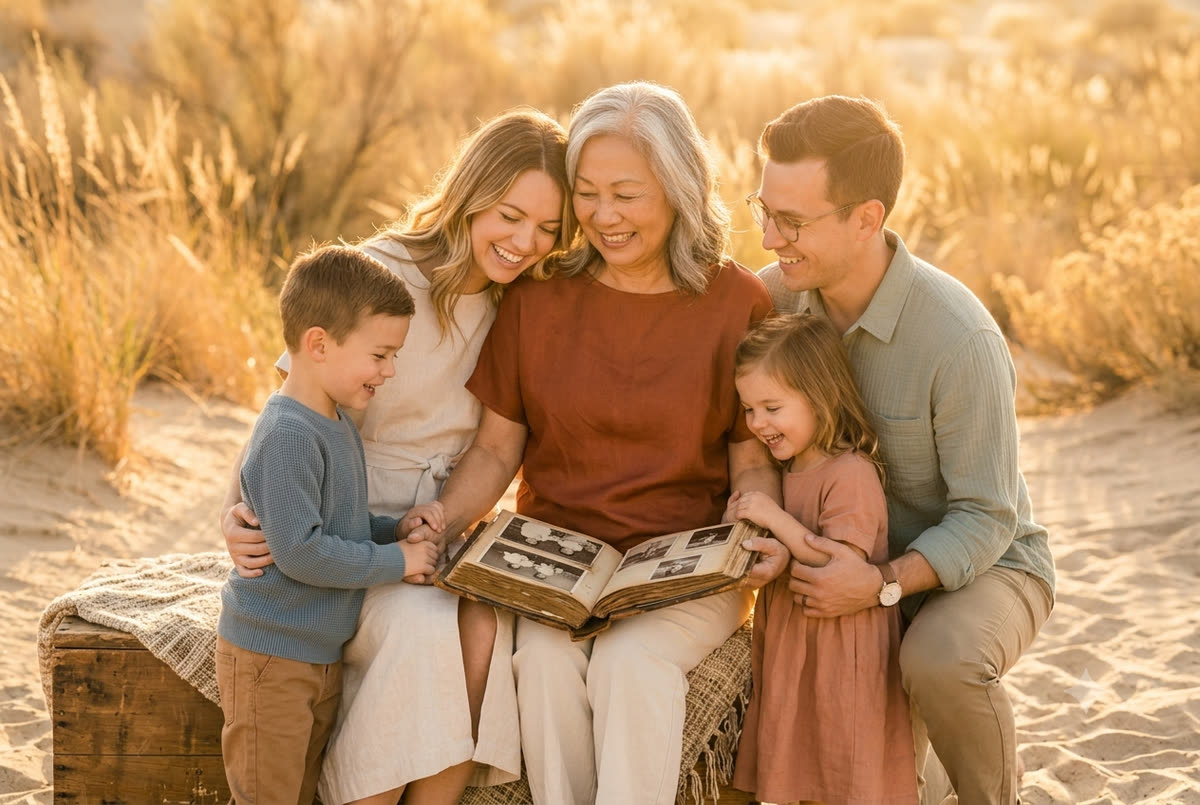
Multigenerational frames carry enormous weight: a great-grandchild on grandma's lap, three generations of one family on a single afternoon, the spouse who has quietly carried this whole journey. Even when your loved one can't fully participate in the way they once would have, their presence anchors the image, and your family will hold onto it.
If you are thinking about gathering everyone, you might find my notes on capturing personality in a memory care session and on memory care and assisted living photography helpful as you plan.
How to prepare your loved one — and yourself
You truly don't need to do much, and please don't wear yourself out preparing. A few small things help:
- Pick the right time of day, as we talked about — their most settled, alert window, usually mid-morning.
- Choose comfortable, familiar clothing. Soft, solid colors photograph kindly, but if they are most themselves in a particular cardigan or a favorite scarf, that is the right choice. Comfort over formality, always.
- Bring an anchor. A photo album, a favorite song queued up, a piece of jewelry, the worn watch, a treasured object. These often spark recognition and ease.
- Don't over-explain the session to them in advance. For many people with dementia, anticipation creates anxiety. A simple, warm framing in the moment — "we're going to spend a little time together and take some nice pictures" — is usually plenty.
- Let go of the idea that they need to remember. They don't have to know my name or understand what we are doing for the photographs to be honest and lovely.
And for you: it is okay if this is hard. It is okay to feel both grief and relief looking at the results. Many families tell me afterward that the session itself became a sweet, low-stakes visit — an hour where they weren't managing anything, just being together.
Common questions families ask
What if my person becomes agitated or confused during the session? That is completely normal and I am unhurried about it. We pause, we let them settle, we follow their cues. I never push. If it isn't a good day, we stop and try another time at no penalty.
Do I need permission from the community? Yes, and I handle that coordination with you. Memory care communities in Rancho Mirage are generally welcoming of family photography when it is arranged in advance; I work easily with their staff. (If you'd like to understand that side better, I've written about working with care community staff on a photo session.)
Can you work with someone who is non-verbal or in late-stage dementia? Absolutely, and with great tenderness. When someone can no longer respond, families still find deep meaning in images of held hands, a kiss on the forehead, the quiet of simply being beside them. We do this only ever with your blessing.
Will the photos look sad? Most families tell me the opposite. I make warm, honest portraits — you will see the person you love, lit gently, treated with respect.
What about privacy? Your trust is everything to me. Nothing is ever shared publicly without your explicit permission. Many of these sessions remain entirely private to the family, and that is completely your call.
How soon should we do this? Gently but honestly: sooner is kinder. Dementia is unpredictable, and the version of your person you can photograph today may shift in the months ahead. If you've been thinking about it, this is a good time to reach out.
What you receive
You'll receive a collection of carefully edited, high-resolution digital images that are yours to keep, print, and share within your family. I am a great believer in printed photographs for this work especially — a framed portrait where everyone can see it, a small album the grandchildren can hold. I'm always glad to help you turn the images into something physical, but there is never any pressure to order anything; the photographs themselves are the heart of it.
When you're ready
If you are caring for someone with dementia in Rancho Mirage, I know how much you are carrying. Choosing to make photographs in this season is a quiet, brave act of love — a way of holding onto the person beneath the illness, and of giving your family a face to remember with warmth rather than only with grief.
Whenever you'd like — to book, or simply to ask a question and talk it through — reach out through my contact page. Tell me a little about your person and where they are, and we'll find a gentle morning that works. Whatever pace this season asks of you, I'll meet you there.