Memory Care Photography in Palm Springs
Some of the most meaningful calls I receive begin in something tender and urgent at once. Picture it: a mother who no longer remembers her grandchildren's names, sometimes not her own — and then, one morning, she hums an old song and reaches up to touch her daughter's face. It is the gesture that has meant I love you in that family for as long as anyone can remember, and the daughter realizes she has no photograph of her mother's hands doing it. What she wants is not a posed portrait. She wants that.
That is the heart of memory care photography, and it is some of the most meaningful work I do. When a parent or spouse is living with Alzheimer's, dementia, or another condition that is slowly taking them away, a thoughtful photograph is not vanity. It is anchoring. It says: you were here, you were loved, and this is who you were even now.
If you are searching for memory care photography in Palm Springs, you are almost certainly carrying something heavy right now. Let me walk you through how this works, plainly and gently, so you can decide what is right for your family.
What memory care photography actually is
Memory care photography is portrait work made with a person who is living with cognitive decline — and usually with the people who love them — created in a way that protects their dignity, works with their abilities on that particular day, and produces honest, warm images the family can keep forever.
It is not a glossy studio shoot. It is not about pretending nothing has changed. It is about meeting your loved one exactly where they are and finding the true, telling moments that are still unmistakably them: the way your father still straightens his collar, the way your mother's eyes find the window light, the way a husband's hand still reaches for his wife's across the arm of a chair.
These sessions usually happen in one of three settings here in the valley:
- Inside a memory care or assisted living community — places like the communities in Palm Springs, Rancho Mirage, Palm Desert, and Indian Wells, where I come to your loved one's familiar room or a quiet common area.
- At a private home, when a family member is the caregiver and your loved one is most settled in their own surroundings.
- A short, gentle outing, when mobility and the day allow — a shaded courtyard, a garden, a favorite patio.
I bring the session to your loved one. Asking someone with dementia to travel to an unfamiliar studio rarely goes well, and it isn't necessary.
Why families do this — and why now matters
I want to be honest with you, because honesty is the kindest thing I can offer here: the right time to make these photographs is sooner than feels comfortable. Dementia is unpredictable. A person can be conversational and present this season and far more withdrawn by spring. The expression you remember, the eye contact, the spark of recognition — these are not guaranteed to wait.
Families come to me for memory care portraits for a few reasons that I hear again and again:
- To capture who their person still is, not only who they were in old photographs. There is profound comfort, later, in having an image from this chapter — proof that there was still light here.
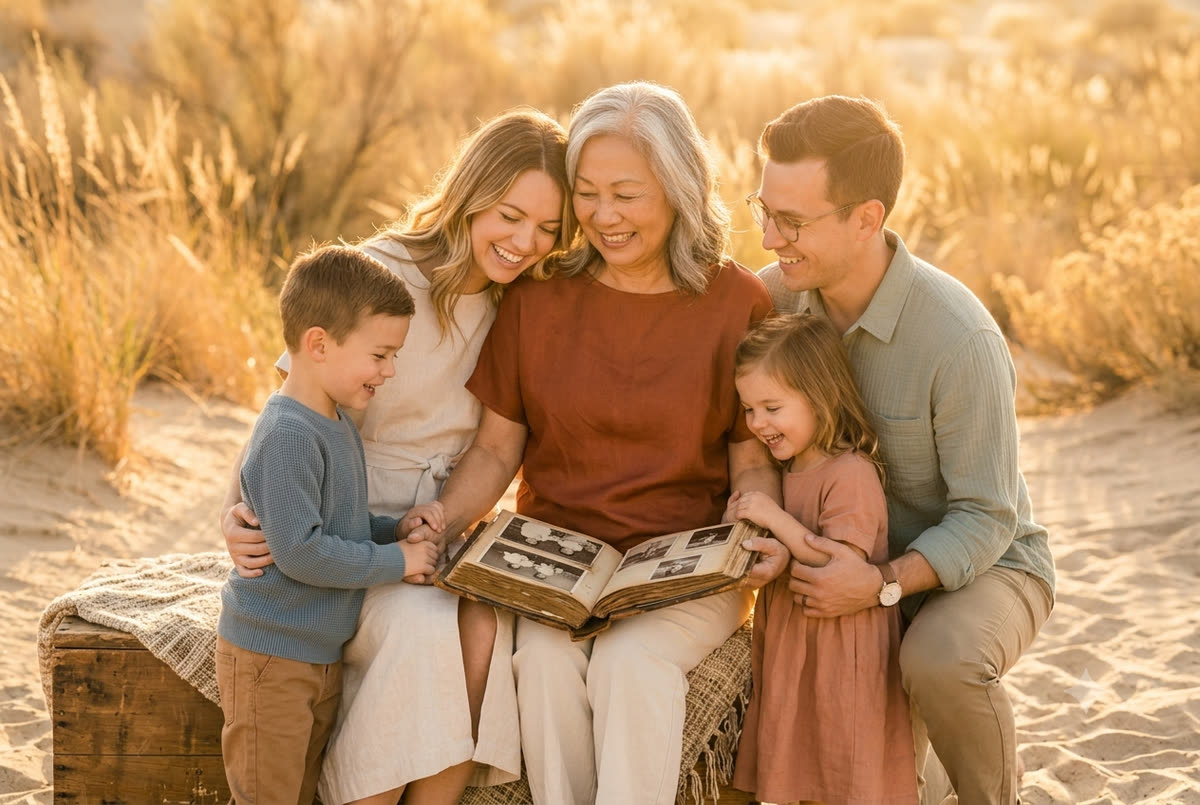
- To photograph relationships. Often the most precious frames are the grandchild leaning into a grandparent, three generations of hands together, a spouse's quiet devotion. These are the images that get framed.
- To have something true for the family to hold during the season of caregiving and, eventually, for the memorial and beyond. I'll say more about that below, because it deserves care.
If your loved one is in hospice or nearing the end of life, the timing is even more tender, and I approach that differently still. I've written separately about bedside and end-of-life photography for families in that situation.
How I prepare so the session goes gently
Most of the success of a memory care session is decided before I ever lift the camera. Here is how I prepare, and what I'll ask of you.
We talk first, away from your loved one
Before the session I have a phone or video conversation with the family. I want to learn who your person is: their history, their temperament, what soothes them and what agitates them, the music they love, the stories that still land, whether they respond to touch, and how the dementia tends to show up. I also want to know the practical things — are there good hours and hard hours, sundowning in the late afternoon, a nap schedule, hearing or vision changes.
None of this is clinical to me. It's how I learn to be a calming presence in the room rather than a stranger with equipment.
We pick the right time of day
This is one of the most important decisions, and it is specific to your loved one, not to the light. Many people living with dementia are clearest and most settled in mid-to-late morning, after breakfast and before the fatigue and confusion that can come in late afternoon — what families and caregivers call sundowning. I will almost always suggest a morning session for that reason.
That said, when we do step outside, our desert mornings are a gift. In the cooler months the Palm Springs light in the hour or two after sunrise is soft and forgiving, the temperatures are kind, and a shaded courtyard, garden, or patio is comfortable. In summer I keep everything indoors or to the earliest, coolest part of the day — heat is hard on older bodies, and I won't put your loved one through it.
We keep the footprint small
I work quietly and bring minimal gear — typically natural light and one camera, no banks of strobes, no barking of instructions. A loud, busy production is the enemy of a good memory care session. The goal is for your loved one to barely notice they're being photographed.
What the session itself looks like
On the day, I arrive early and let myself become part of the background. I'll often spend the first several minutes not photographing at all — just being in the room, letting your loved one get used to my voice, maybe asking the caregiver to carry on as normal.
A few principles guide everything:
- We follow your loved one's lead, not a shot list. If they're having a quiet day, we make quiet, beautiful images. If they're animated, we follow that energy. I never force engagement or correct behavior for the camera.
- Comfort first, always. If your person needs to stop, we stop. If they're tired, we're done — even if that's twenty minutes in. I'd rather have ten honest frames than an hour of distress.
- Familiar objects help. A worn cardigan, a wedding ring, a beloved dog, a photo album, a hymn playing softly — these often draw out the most genuine expressions and give the hands something natural to do.
- Family belongs in the frame. Some of the truest moments come when a daughter sits close and talks, or a grandchild climbs up beside grandpa. I'll quietly photograph around those interactions rather than posing them.
Sessions are usually short by design — often 30 to 60 minutes, sometimes less. With dementia, presence comes in windows, and my job is to be ready when the window opens.
A note on dignity and consent
I take this seriously. Your loved one may not be able to give full consent in the way they once could, and that places a real responsibility on both of us. I photograph people living with dementia the way I would want my own mother photographed: with respect for the person they are right now, never as a spectacle, never in a moment of indignity.
Before anything is taken outside the family — and I never assume it should be — we talk about how the images will and won't be used. Your family's privacy is yours to control completely. Many memory care sessions I do are kept entirely private, never shown publicly, and that is exactly as it should be.
Working with the community's staff
Memory care communities across the valley — in Palm Springs, Rancho Mirage, Palm Desert, La Quinta — are generally welcoming to a calm, respectful photographer who coordinates ahead of time. I'll work with the family to clear the visit with the community's leadership, choose a time that doesn't collide with meals or activities, and be mindful of other residents' privacy in shared spaces.
If a caregiver or favorite staff member has a special bond with your loved one, sometimes the family chooses to include them too. Those relationships are real, and the images can mean a great deal to everyone.
Common questions families ask me
My mother won't understand what's happening. Is that a problem?Not at all. She doesn't need to understand the session for it to work. My approach is built around people who can't follow instructions or hold a pose. I simply create the conditions for true moments and wait for them.
What if he becomes agitated or has a bad day?We adapt or we reschedule, with no penalty and no awkwardness. I build flexibility into how I book these sessions precisely because dementia is unpredictable. A bad morning is not a failure; it's just information, and we try again.
Should the whole family be there?Often a small group — one or two close people — is ideal. Too many faces and too much energy can overwhelm. But we can absolutely plan a session that brings in grandchildren or several generations if your loved one tends to light up with the people they love. We'll decide together based on what you know about them.
Is it strange to want photos like this?No. It is one of the most loving instincts I encounter. You are not being morbid or premature. You are protecting memory against a disease whose entire cruelty is the erasing of it.
How soon can you come?For memory care and hospice situations, I keep room in my schedule to respond quickly, because timing genuinely matters. If your loved one's situation is urgent, please say so when you reach out.
What you'll receive
After the session I carefully select and hand-edit the strongest images — the honest, telling ones — and deliver them in a way that's easy for the whole family to access and share among themselves. Many families also want beautifully made prints or a small album, something physical to hold and to pass down. I'll guide you to whatever suits your family, whether that's a single framed portrait for the mantel or a keepsake set for siblings and grandchildren.
If these images may one day be needed for a memorial, I can prepare a print-ready selection so that, when the time comes, you are not scrambling. I've also written about planning a legacy portrait while there's still time, which many families find helpful to read alongside this.
A gentle next step
If you've read this far, you are likely weighing whether to make the call. Here is the one thing I most want you to know: in this work, regret only ever seems to run in one direction — toward wishing the photographs had been made a little sooner, never toward having made them at all.
Whenever the moment feels right for your family, I would be honored to help you hold onto the person you love. You can reach me through my contact page, and we'll begin with a quiet conversation about who your loved one is and what would bring you some peace.
With warmth,Margot