Memory Care Photography in Palm Desert
Most of the families who come to me for this have realized the same quiet thing: there isn't a single real photograph of their mother or father from recent years. Plenty of phone snapshots, maybe, but nothing they'd frame — nothing that looks the way the person looks to them. And almost always there's a worry tucked underneath the request. That a session will be too much. That a parent who lives in a memory care community gets confused or anxious with new faces in the room.
That worry is the reason I'm writing this. Photographing someone living with Alzheimer's or another form of dementia is its own kind of work — slower, softer, more watchful than any other session I do. It asks the photographer to follow the person rather than the schedule. And done with care, it gives a family something that becomes almost unbearably precious later: a true likeness of a parent or grandparent, made while they were still here to be seen.
If you're caring for someone in a Coachella Valley memory care community and you've been thinking about portraits, this is what I'd want you to know.
Why these photographs matter more than people expect
We tend to put off pictures of the people we love most. There's always a better day coming — after the next doctor's visit, once Mom's settled into the new place, when she's having a good week. With memory care, the better day doesn't always arrive, and the version of a person we remember keeps quietly shifting.
What families tell me, again and again, is that they wish they had a photograph from before the last hard stretch. Not a clinical record of decline — the opposite. An image where their mother looks like herself: the particular tilt of her head, the hands she folds the same way she always has, the smile that surfaces when a grandchild leans in close.
I've come to think of these sessions as a kind of keeping. We're not staging anything. We're catching what's still unmistakably her, so that the family has it to hold onto when memory — theirs and hers — starts to thin.
This work sits inside a small series I write about for families navigating the end of a chapter — see also my notes on hospice and bedside photography and on making a portrait when time is short. Memory care has its own rhythm, though, and that's what I want to walk through here.
How a memory care session is different
A typical portrait session has a plan. This one has a posture: be ready, be unhurried, and let the person set the pace.
A few things I do differently:
- I work in the place they already know. Their room, their armchair, the courtyard they walk every afternoon. Familiar surroundings keep anxiety low and bring out the most natural expressions. A new studio with bright lights would only unsettle someone whose comfort depends on routine.
- I keep my gear small and quiet. No towering light stands, no clattering equipment, no big crew. Usually it's just me and one camera, working in the available window light. Less to react to means a calmer room.
- I follow good moments instead of summoning them. I don't ask someone with dementia to "look here and smile." I wait. I talk. And when a real expression arrives — recognition, amusement, a moment of peace — that's when I make the picture.
- I let family do what they do best. Often the truest photographs happen when a daughter holds her mother's hand, or a son tells the old joke that still lands. My job is to be invisible enough that those moments keep happening.
- I plan around their best time of day. This matters enormously, and I'll come back to it.
Sundowning and timing — the most practical thing I can tell you
If you've spent time with a loved one in memory care, you already know about late-afternoon restlessness. Sundowning — the agitation, confusion, and fatigue that often build as the day wanes — is one of the biggest factors in whether a session goes gently or not at all.
So we schedule around the person, never around my calendar. For most people that means mid-to-late morning, after breakfast and any morning care routine, when they tend to be most rested, most present, and most themselves. We avoid the post-lunch dip and the harder hours of the afternoon entirely.
There's a happy local accident here, too. Late morning in the desert gives us beautiful, soft, sideways light through a window or out in a shaded courtyard — gentle on the face, never the flat overhead glare of true midday. If a community has a pretty outdoor area, places like the gardens at communities in Rancho Mirage, Palm Desert, and Indian Wells can be lovely in that mid-morning hour, before the heat builds. In our long warm season, even a few minutes outside is best taken early.
I block out far more time than I'll need. If we get fifteen good minutes, we use them and stop. If the person is having a wonderful, lucid stretch and wants to keep going, we can. The session bends to them.
What to expect, start to finish
Families often ask me to walk them through it before they commit, so here's the shape of it.
Before the day. We talk — by phone or email — about the person. What calms them, what they love, what they're like at their best. Whether they respond to music, to a particular grandchild, to a favorite blanket or sweater. The more I understand going in, the less I have to figure out in the room.
Coordinating with the community. Memory care communities across the valley — in Palm Desert, Palm Springs, La Quinta, Indio — have their own visitor policies, and I'm glad to work within them. I'll check on guest sign-in, any health protocols, and the best entrance and timing with the staff. Many communities are wonderfully supportive of this; their caregivers often know exactly which hour of the morning is best.
Arriving gently. I come early and stay quiet at first. I'll often just sit and talk for a while before I lift a camera, so I'm not a stranger pointing a lens. With dementia, trust is built minute by minute, and there's no shortcut for it.
Making the pictures. Slowly. I'll catch quiet portraits — the face, the hands, a profile by the window — and the connection between your loved one and the people who came. If there's a good moment of laughter, I'm there for it. If your mother drifts and needs a rest, we pause without any fuss.
Afterward. I edit honestly and warmly. No harsh "fixing," no erasing of a life lived — just clean, timeless, lovingly finished images. I'll guide you toward prints and an album, because screens get lost and these are photographs meant to be held and passed down.
Including the family — and the generations
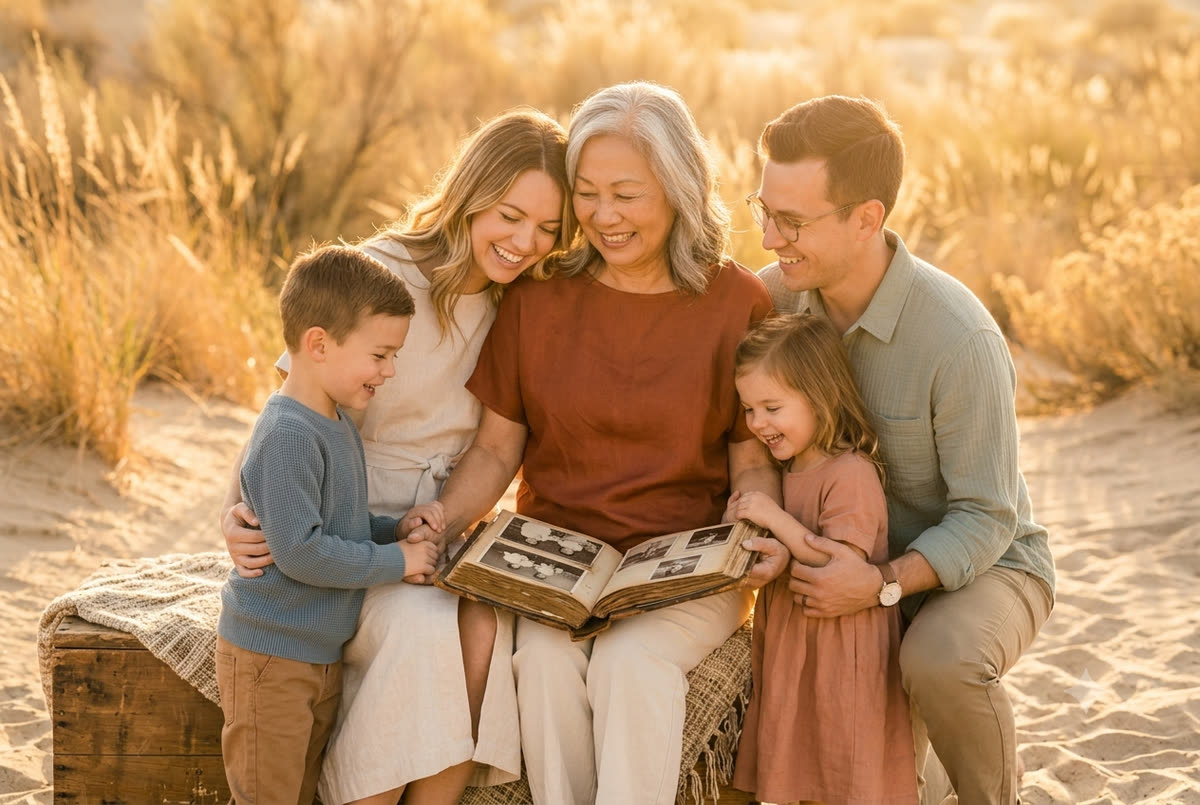
Some of the most moving frames from these sessions aren't solo portraits at all. They're a granddaughter resting her head on her grandfather's shoulder. Three generations of hands. A spouse of sixty years sitting close, the way they've always sat.
If you have family traveling in for a visit — and many valley families do — a memory care session can be a quiet, meaningful reason to gather. It gives everyone something to do together that isn't a medical appointment, and it sends them home with more than a memory.
I'd gently encourage including children when it feels right. Little ones often reach people with dementia in ways the rest of us can't — no agenda, no grief, just presence. Those frames tend to be the ones families weep over later, in the best way.
Common worries, answered honestly
"What if she won't cooperate?"There's nothing to cooperate with. I'm not directing a shoot; I'm keeping company and watching for truth. A photograph of someone gazing quietly out a window is every bit as honest and beautiful as a broad smile — sometimes more so.
"What if it's a bad day?"Then it's a bad day, and we don't force it. I build flexibility into how I schedule these so we can shift if needed. Your loved one's comfort outranks any photograph, always.
"Isn't this morbid?"I understand the instinct to ask, but no — I've never once found it so. These sessions are tender and often surprisingly light. There's laughter. There's an old song. There's a person being looked at with love. What's morbid is the photograph we never made.
"They don't look like they used to."None of us do. My work isn't to recover a younger face; it's to honor this one, as it is, with dignity and warmth. Families are almost always startled by how much of the person they recognize when the picture is made with patience instead of pressure.
A few mistakes I'd help you avoid
- Waiting for the "right time." With memory care, sooner is nearly always kinder than later.
- Scheduling in the afternoon because it's convenient for visiting relatives. Protect the morning hours; ask the family to come to them.
- Bringing a crowd into the room at once. Two or three loved ones at a time keeps the space calm. We can rotate people through.
- Over-explaining the camera. I keep it low and unremarkable so it never becomes the thing in the room to react to.
- Skipping prints. Order the album, frame the portrait. Down the road, a printed picture you can hold means far more than a file on a phone.
Working together in the Coachella Valley
I've photographed families across this valley for many years — in Palm Desert, Palm Springs, Rancho Mirage, Indian Wells, La Quinta, and Indio — through every season of life, including its closing ones. Memory care photography is some of the most meaningful work I do, and I approach each session as a guest in someone's life, not a vendor with a shot list.
If you're caring for a parent or grandparent in a memory care community here and you've felt the pull to make a real portrait while you still can, I would be honored to help. We can start with a quiet conversation about who they are and how to make the experience gentle for everyone — for them first, and for you.
When you're ready, reach out to me here. Tell me a little about your person. We'll find the right morning, and we'll do this with all the care it deserves.