Memory Care / Assisted Living Photography
Some of the most meaningful portraits I make never happen in a studio. They happen in a quiet room in a memory care community, or on a shaded patio at an assisted living residence, with a daughter holding her mother's hand. Families reach this crossroads more often than they expect: every photo they have of a parent is either a decade old or a hurried phone snapshot that doesn't quite look like them, and they want a real portrait — warm and true — while there's still time to make one.
If that's where you are, you may also be a little nervous. Will my parent understand what we're doing? Will it be sad? Will it even be possible? I want to answer all of that here, because so many families in the desert reach this same point and don't realize this kind of portrait session exists, or that it can be done with real gentleness and joy. So let me walk you through how I photograph parents and grandparents who live in memory care and assisted living, what these sessions actually feel like, and why families tell me afterward that they're so glad they didn't wait.
This is a celebration, not a goodbye
Let me say the most important thing first, because it changes everything about how the day feels.
I do not approach these as somber, "last chance" sessions. They are not about decline. They are about who this person is — their warmth, their humor, the particular way they tilt their head when they're listening, the hands that raised a family or built a career. We are celebrating a life that is still being lived. The goal is a portrait that, years from now, makes the family smile and say, "That's exactly how I want to remember her."
That framing matters for a practical reason too. When the mood in the room is light and easygoing, the person in front of my camera relaxes. Some of my favorite frames have come right after someone laughed at their own joke, or when a granddaughter leaned in and whispered something. Dignity and joy aren't a nice bonus here — they're the whole point, and they also happen to produce the best pictures.
Who these sessions are for
Families come to me for memory care photography and assisted living portraits in a few common situations:
- A parent or grandparent has moved into a community in Palm Desert, Rancho Mirage, Indian Wells, or La Quinta, and the family wants an up-to-date portrait that reflects who they are now.
- A diagnosis — dementia, Alzheimer's, Parkinson's, recovery from a stroke — has made everyone aware that time and energy are precious, and the family wants to capture this chapter while their loved one can still enjoy the experience.
- An out-of-town family is in town and wants a multi-generation portrait while everyone is in the same place at the same time, which is rarer than it should be.
- An adult child simply realizes they have hundreds of photos of their parent from old vacations, but almost none that were made for them — a deliberate, beautiful portrait.
If any of that sounds like your situation, you're exactly the person I'm writing this for.
What I've learned photographing in these settings
I've spent many years photographing people across the Coachella Valley, and a good portion of that work over time has moved into homes and communities rather than studios. Memory care and assisted living settings have taught me to slow down and read the room — to follow the person's pace instead of my shot list.
A few things I've learned that I now treat as rules:
Energy is highest in the morning. For most residents, especially those living with memory loss, late morning is the sweet spot — after breakfast and any morning care routine, before the afternoon tiredness (what many families and caregivers call "sundowning") sets in. I almost always schedule these sessions between about 9:30 and 11:30. It's a small choice that makes an enormous difference in how present and bright someone feels.
Short is better than long. A session in this setting is usually 20 to 45 minutes of actual photographing, sometimes less, and that is plenty. I'd rather get fifteen genuine minutes than push someone to the point of fatigue. We can always pause, sit, have a sip of water, and come back to it. The portrait does not require endurance.
The familiar face does the heavy lifting. People living with dementia often respond far more to a beloved daughter, son, or grandchild than to me, a stranger with a camera. So I frequently work through the family — I'll have them sit close, hold a hand, tell a story — and I photograph what naturally happens between them. Those in-between moments are where the real picture lives.
Hands, light, and small gestures matter. A portrait doesn't have to be a posed, look-at-the-camera headshot to be precious. The way someone holds a grandchild's hand, the light catching the side of a face near a window, a quiet smile of recognition — these tell the story honestly. I always make sure we capture some classic looking-at-camera frames too, but I never stop there.
On-site logistics: how a session actually works
The beautiful thing about photographing in a memory care or assisted living community is that we bring the session to your loved one. No transporting someone who tires easily, no unfamiliar studio, no logistics nightmare. Their own space, where they're comfortable, is where we work.
Here's how I typically approach the day at a desert community:
Working with the staff
I coordinate with the community's staff ahead of time, and I cannot overstate how much this helps. The caregivers and activity directors know each resident's rhythms — when they're sharpest, what soothes them, whether there's a favorite chair or a sunny corner of the courtyard. Many communities in the valley are genuinely lovely backdrops: shaded patios, desert gardens, a bright common room. The staff can also help with timing around meals, medications, and care routines so we land in that good window.
If you're a family member reading this: you don't always have to be the one to arrange every detail. Many local facilities are happy to help coordinate a photographer for residents' families — it's the kind of meaningful experience activity teams love to support. It's worth simply asking the front desk or activity director.
Working with the family
I ask families a few gentle questions before we begin: What does your mom love to talk about? Is there a song that lights her up? A piece of jewelry she always wears, a sweater she feels like herself in, a photo of her late husband she'd want nearby? These small touches make the portrait hers, and they often spark exactly the expression we're hoping to catch.
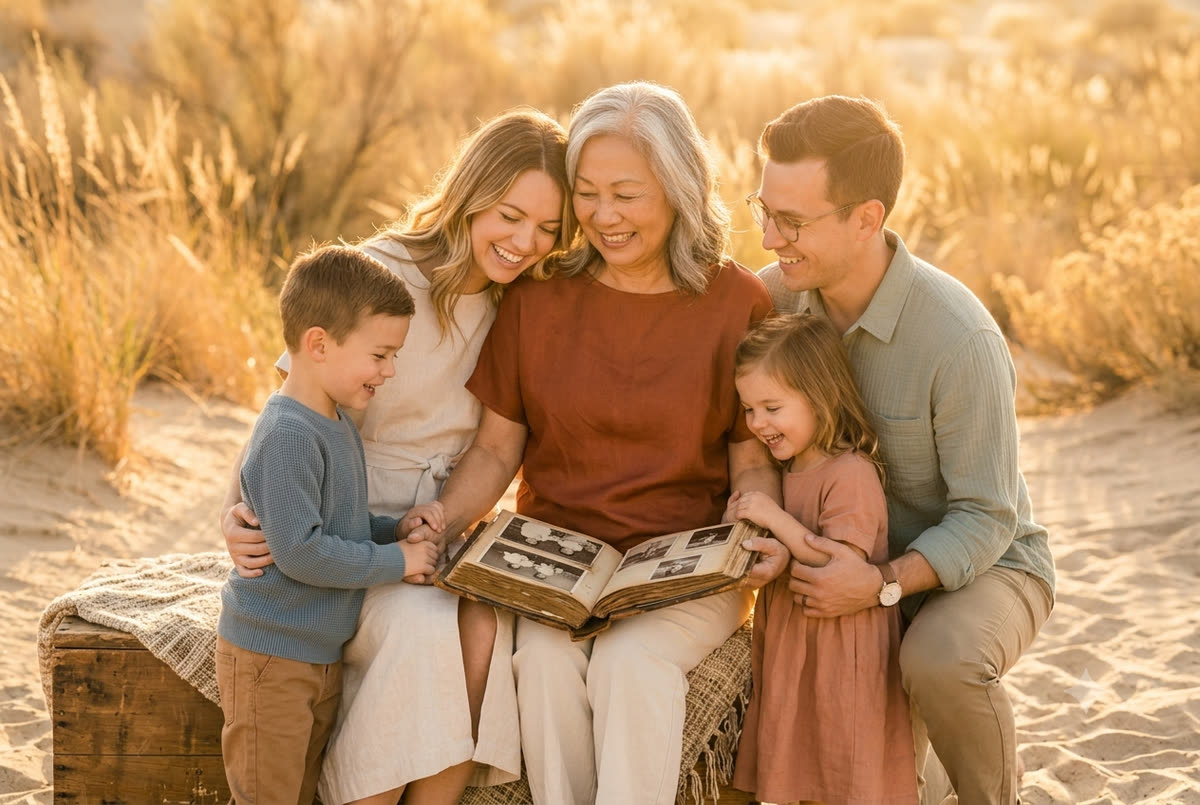
I also encourage families to be in the pictures. Multi-generation portraits — three or even four generations together — are some of the most treasured images I make. If grandchildren are visiting from out of state, that's a wonderful reason to gather everyone in one place while you can.
Keeping it calm
I keep my gear minimal and quiet. No blinding lights, no elaborate setup, no production. I usually work with available light — the desert gives us so much beautiful soft light through a window or on a shaded patio that I rarely need more. The less equipment and fuss, the more at ease everyone is. If your loved one needs to stop, we stop. There's no script we have to finish.
What to expect, start to finish
For families who like to know the shape of things in advance, here's the usual arc:
- A conversation first. We talk by phone or email about your loved one, the community, timing, and what you're hoping for. This is where I learn the things that make the session personal.
- Coordinating with the community. I connect with staff to choose the best day and time and to understand any guidelines the community has for visitors and photography.
- The session itself. Short, gentle, and led by your loved one's comfort. Often we'll do a few portraits one-on-one and then bring family in for the group and candid frames.
- Editing with care. I edit honestly and warmly — true to life, never plasticky or over-retouched. The goal is that the person looks like themselves on a good day.
- Delivering keepsakes. I deliver a gallery of finished images, and I always encourage families to make actual prints or an album. A file on a phone gets lost; a framed portrait on the mantel becomes part of the home.
Common questions families ask
Will the session upset my mother?In my experience, it very rarely does — and far more often it's the opposite. Familiar faces, gentle attention, and a relaxed pace tend to make people feel valued and engaged. We follow her lead the entire time. If she's having a harder day, we adapt or reschedule. There's no pressure to perform.
What if she won't look at the camera or won't sit still?That's completely fine, and honestly some of the most moving portraits come from exactly those sessions. I don't need cooperation in the traditional sense — I need presence. A glance toward a daughter, a hand resting on an armrest, a laugh — these are real, and they're what I'm watching for.
Can we do this if she's in a wheelchair or mostly in bed?Yes. I compose and light so that a wheelchair or bed never becomes the subject — your loved one is. I've made beautiful, dignified portraits in every kind of physical circumstance.
How quickly should we do this?Sooner than you think, gently said. The families who reach out and book promptly are almost always relieved they did. None of us can predict how someone will feel month to month, so if you're considering it, I'd encourage you not to wait too long.
Can the whole family be photographed together?Absolutely, and I hope you will. These sessions double beautifully as family portraits, and gathering the generations around the person you love is part of what makes them so meaningful.
A note for the families carrying this
If you're the daughter or son arranging this, you may be carrying a lot right now — the logistics of care, the grief that sometimes comes early, the wish that you'd done this sooner. I want you to know that choosing to make a portrait is a generous, loving thing to do, both for your parent and for the children and grandchildren who will hold these images long after. You are not being morbid. You are making something that will matter for generations.
If you'd like to explore the wider story of preserving your family's history, you might also find these helpful: legacy and heritage portrait sessions, multi-generational family portraits in the desert, and why printing and preserving your photographs matters.
Let's make this portrait together
If your mother, father, or grandparent lives in a memory care or assisted living community here in the Coachella Valley, I would be honored to come to them and create a portrait the whole family will treasure. We'll keep it gentle and led entirely by what feels good for your loved one. And if you're not sure where to start — including whether their community can help arrange it — just reach out and we'll figure it out together.
You can send me a message here, tell me a little about the person you love, and we'll find the right day to bring a camera to them.