Photographing in Assisted Living Facilities
The request usually comes quietly, sometimes a little apologetically. A daughter calls and says her mother has moved into a community in Rancho Mirage, that things are changing faster than the family expected, and she wonders — would I be willing to come photograph her there? Not a studio sitting. Not a posed family portrait at a park. Just her mom, in the room that is now home, while she is still herself.
The answer is always yes. Some of the most meaningful work I do happens inside assisted living and memory care communities across the desert, and I want to talk plainly about how it works, because families often don't know it's even an option until someone tells them. It is. And done with care, it gives you something you cannot get any other way.
Why these portraits matter more than people expect
We tend to schedule portraits around milestones — weddings, new babies, a senior heading off to college. But the season when a parent or grandparent enters assisted living is its own kind of milestone, even though no one frames it that way. It is often the last chapter where you can still capture the person, not just a likeness.
Families come to me for a few reasons:
- A parent has moved into a community and the family wants a current, true portrait while they are settled and comfortable.
- Someone is in memory care and the family wants images of the person they love — the smile, the hands, the way she still reaches for her husband — before the disease takes more.
- Several generations want to be photographed together, in the place where the eldest now lives, because traveling out is no longer realistic.
- Hospice has been mentioned, and the family wants something gentle and unhurried while there is still time.
None of these are sad photo sessions, though they can hold emotion. They are honest ones. My job is to walk in calmly, read the room, and find the real moments — the way your dad lights up when grandchildren pile onto his bed, the quiet of two hands folded together. That's the work.
Where this fits in the Coachella Valley
The desert has an unusually large community of older adults, and a correspondingly deep network of senior living. I photograph in independent living, assisted living, memory care, and skilled nursing settings throughout the valley — communities in Palm Desert, Rancho Mirage, Palm Springs, Indian Wells, La Quinta, and Indio. Some are sprawling resort-style campuses; others are small residential care homes on a quiet cul-de-sac with six residents and a shared kitchen.
This matters for two reasons. First, families are often scattered — adult children back east, grandchildren across the country — and in town together only for a narrow window, frequently around the holidays. When everyone is here at once, that's usually the moment to book; gathering three generations in one room may not happen again soon. Second, the season shapes the logistics. In the deep summer months, portraits out on the grounds are off the table in the afternoon heat, so we simply stay inside, near a window, working in the cool of the morning. I'll come back to light shortly.
What to expect before we ever pick up a camera
Photographing in a care community is different from a studio booking, and most of the work is in the preparation. Here's how I approach it.
We talk first, honestly
Before anything, I want to understand who I'm photographing and where they are. Is your mother verbal and mobile, or is she mostly in bed? Does she have good hours and hard hours in the day? Is there a behavior — sundowning in the late afternoon, say — that we should plan around? Is the goal a polished portrait, or candid togetherness, or simply her face, clearly, while she's still here? There are no wrong answers. The more you tell me, the gentler I can make the visit.
I also ask the question families sometimes avoid: how much does the person understand about why I'm there? With memory care residents I usually do not announce "we're taking pictures now." I become a quiet guest who happens to have a camera. That keeps the mood easy.
Permissions and the facility
Care communities are people's homes, and they're also regulated environments. A few practical truths:
- Most communities are welcoming to a photographer visiting a specific resident at the family's request. They do this all the time — for holidays, birthdays, and yes, for legacy portraits.
- Call ahead. I always coordinate with the family to clear the visit with the community's front desk, life-enrichment director, or executive director. It's courteous and it prevents an awkward moment at the door.
- Other residents' privacy is protected. In shared spaces — dining rooms, activity rooms, hallways — I'm careful to keep other residents out of frame unless their own family has consented. We usually work in the resident's private room or a quiet sitting area, which solves this entirely.
- Skilled nursing and hospice settings may have additional rules, and during certain seasons communities tighten visitor policies for illness. I stay flexible and follow their lead. If we need masks or a health screening at the door, that's fine.
The family typically handles the introduction; I handle being easy to host. I travel light, I don't need to rearrange the room, and I'm gone before anyone is tired.
Timing the visit to the person, not the clock
This is the single most important thing I've learned. In a studio I control the schedule. Here, the person controls it, and I plan around their best hours.
For many older adults — and especially in memory care — mid-morning is the sweet spot. They've had breakfast, they're freshly groomed, they're alert, and the difficult late-day hours haven't arrived. I avoid scheduling right at mealtimes, during medication rounds, or in the after-lunch lull when a lot of residents nap. If your mom is sharpest at 10 a.m., that's when we come.
I also keep sessions short and elastic. I would rather plan a relaxed hour and use forty minutes than rush. If she's having a hard morning, we can pause, let her rest, and pick back up — or quietly reschedule. Nothing about this should feel like an appointment she has to perform for.
Light in a small room
People worry their loved one's room is too small or too dim for good pictures. Almost always, it's enough — and the light tells me where to put everyone.
My first move in any room is to find the window. Soft daylight coming in from the side is the most flattering, forgiving light there is for aging skin; it wraps gently and doesn't dig into every line. I'll often seat the person in a comfortable chair turned toward that window, or photograph them sitting up in bed with the light falling across them.
A few specifics for desert rooms:
- North- and east-facing windows give that even, kind light through much of the day. South- and west-facing rooms can get blasting afternoon sun, especially in summer — so for those I lean toward morning, or I diffuse it with the sheer curtain most communities already have.
- I keep flash to a minimum. A sudden burst is startling and can agitate someone with dementia. I'd rather raise my camera's sensitivity and shoot in available light. If I need a touch of fill, I bounce it softly off the ceiling so nothing ever flashes in their eyes.
- Overhead fluorescent light is the enemy. It's the unflattering green-tinted glow in a lot of facility rooms. I usually switch it off and let the window do the work.
You don't need a beautiful room. You need one window and a little patience.
Finding the true moment
The portraits families treasure later are rarely the stiff, look-at-the-camera frames. They're the in-between ones.
So I come in and mostly wait. I'll sit, talk a little, let the camera become part of the furniture. With a parent and adult children in the room, I encourage the family to simply be together — hold hands, look at old photos, sing the hymn she still knows every word to. That's when the real expressions surface. A husband of sixty years leaning his forehead against his wife's. The exact tilt of your father's grin. Hands — I photograph a lot of hands, because they carry a whole life and they stay recognizable long after a face has changed.
For someone deep in dementia who may not engage with the lens, I focus on connection rather than cooperation. A grandchild reading aloud. A familiar song. A favorite blanket. The person responds to the people they love, and the camera catches it. We're not asking them to pose; we're documenting that they are still loved and still here.
If the family wants a few clean, formal portraits too — for an order of service someday, or simply to frame on the wall — we get those gently, in the first calm minutes, and then we relax into the candid work.
Bringing the generations together
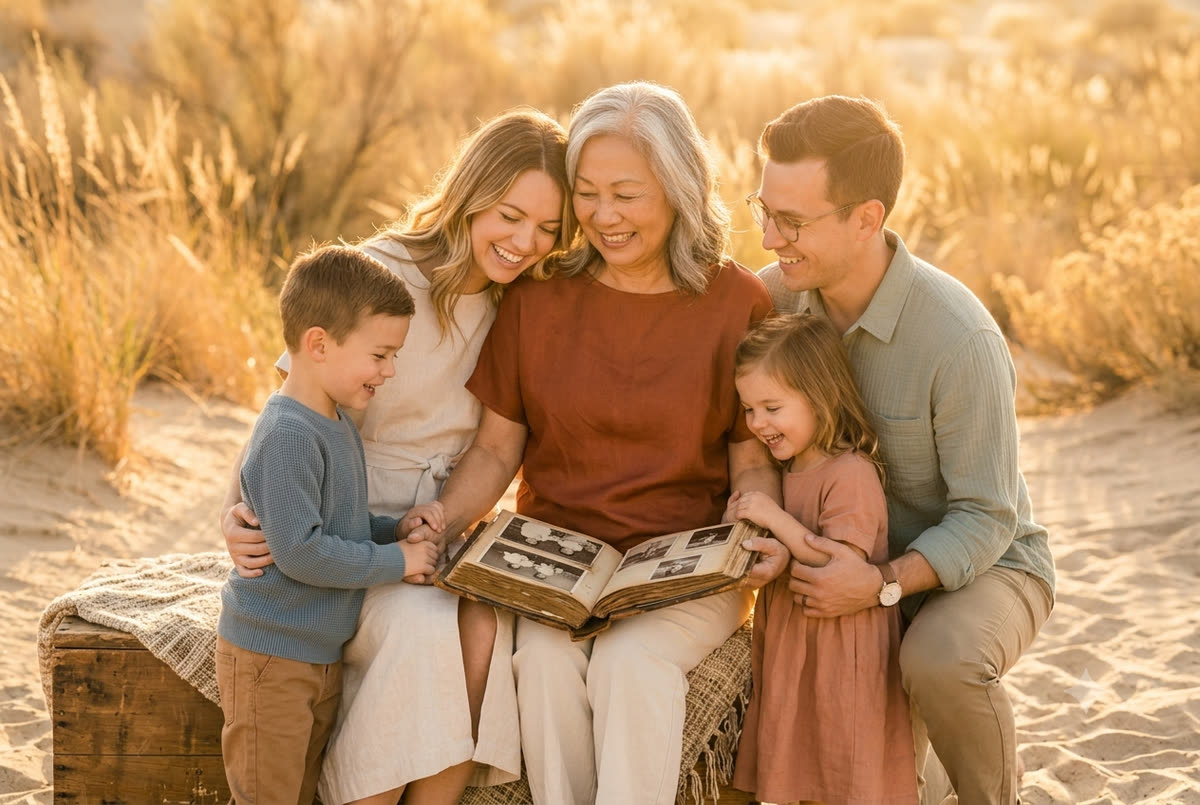
Some of my favorite legacy sessions are the full-family ones, where children, grandchildren, and great-grandchildren gather in great-grandma's room or out on a shaded patio of the community. These take a little choreography in a small space, but they're worth it.
A few tips if you're planning one:
- Keep the group manageable in the room itself. I'll photograph the eldest with two or three people at a time, then build up to the whole group for a frame or two, rather than crowding twelve people in at once.
- Use the grounds if the weather and season allow. Many desert communities have lovely courtyards, fountains, and shaded walkways. In the cooler months a few minutes outside in the late-afternoon desert light can be beautiful — but only if your loved one is up for the move, and only when the heat isn't a factor.
- Let the kids be kids. Little ones climbing onto a bed or holding great-grandpa's hand make the warmest images in the set. Don't over-manage them.
Gentle answers to the questions families ask me
Is it strange or morbid to do this? No. It feels loving, not grim. Families almost always tell me afterward they're relieved they did it — that the photos became something they hold onto. The regret I hear is from people who waited too long.
What if Mom doesn't want her picture taken? I respect that completely, and there are quiet ways around it — photographing her hands, her in profile while she's absorbed in something, or the candid togetherness rather than direct portraits. We never force a frame.
What should she wear? Whatever is comfortable and hers. A favorite sweater, real clothes rather than a hospital gown if she's able, a touch of her usual lipstick if that's who she is. But if a soft robe and her own bed is the truth of this season, that's a real, beautiful portrait too. I'd rather have her at ease than dressed up and miserable.
How soon should we book? Sooner than feels comfortable. Health can change quickly, and I'd much rather photograph someone while they're settled and well than be called in an emergency. If you're even thinking about it, that's usually the sign.
Can you come to memory care or hospice specifically? Yes. This is at the heart of my Legacy work in hospice and memory care, and I approach those visits with extra gentleness and zero hurry.
How I deliver the images
After our visit, I edit quietly and honestly. I don't airbrush a person into someone they aren't — I want your mother to look like your mother, lines and all, because those are the faces you love. I'll soften the harsh stuff, warm up the cool facility light, and let the gentleness of the day come through.
Families receive their gallery with full-resolution images so you can print freely. Many people order a small album, or a few prints for siblings spread across the country, or a single framed portrait for the eldest's room. If there's ever a memorial down the road, you'll be grateful to already have these in hand rather than scrambling for a phone snapshot. If that thought is part of why you're reaching out, you may also find my notes on choosing a portrait for a celebration of life helpful when the time comes.
A word to the family member reading this at midnight
If you're the one doing the worrying — managing the move, the medications, the long-distance phone calls — I see you. Adding "arrange a photographer" to that list can feel like one more thing. Let me make it the easy thing. I'll handle the logistics gently, work around your loved one's good hours, and ask very little of anyone in the room except to be together.
You will not regret having these. I have never once had a family tell me they wished they hadn't.
When you're ready — or when you're close to ready and just want to talk it through — reach out here and tell me a little about the person you'd like me to photograph and where they are in the valley. We'll find a time that's kind to everyone, and I'll bring you home something to keep.