Capturing Personality in Memory Care
Many families quietly stop taking photos once a parent's dementia sets in. Not for any lack of love — because every recent picture starts to feel like proof of what the disease is taking. The blank stare, the slumped posture, the cardigan buttoned wrong. They want to remember the person as they were, so the camera roll just... closes.
I understand that, and I also want to gently argue with it. Because the person in that memory care room is still there. There is still the song hummed under the breath when they're content, the hand reached for without being asked, the laugh that arrives from nowhere. The personality hasn't left — it has only gotten harder to photograph. And "harder to photograph" is exactly the kind of problem a patient photographer is for.
If you are thinking about portraits of someone you love who is living with Alzheimer's, vascular dementia, or another cognitive condition, this is the article I wish I could hand to every family before we begin. Some of it is for you if you plan to bring me in. A lot of it works just as well with the phone in your pocket on a Tuesday afternoon visit.
Why these portraits are worth the discomfort
There is a real grief in seeing the change. I won't pretend otherwise. But over many years of this work I've watched what happens after — when the session is done and the prints arrive — and it is almost never regret.
What families tell me is that a good portrait gives them back the person, not the diagnosis. A photograph made with care doesn't document decline; it isolates the moment the eyes lit up, the half-smile that was unmistakably him, the hands that built a life. Years later, those are the images that get framed. The phone snapshots from the lobby get forgotten; the picture where Dad looked like Dad gets passed down.
There's also something the person in the chair receives, even when they can't tell you so. Being looked at with warmth, being the focus of gentle attention for half an hour, being touched and spoken to softly — that lands, regardless of what the memory can hold. Some of my most cooperative, luminous sessions have been with people who couldn't have told you my name five minutes later.
Start with timing — it's the whole game
If you take one thing from this piece, take this: the day and the hour matter more than the camera.
People living with dementia very often have a rhythm to their lucidity. Mornings tend to be steadier. By late afternoon many experience what caregivers call "sundowning" — rising agitation, confusion, and fatigue as the light fades. That's not a small detail for a photographer; it can be the difference between a relaxed twenty minutes and tears.
Here's how I plan around it:
- Ask the care staff, not just the family, when this person is "best." The aides who do morning routines know exactly which window is calm. In most memory care communities across the valley — places like the dedicated memory neighborhoods in Palm Desert, Rancho Mirage, and La Quinta — that window is roughly mid-morning, after breakfast and grooming but before lunch winds them down.
- Avoid right after a meal, a bath, or a transfer. Those are depleting. Give a buffer.
- Keep the whole thing short. I plan for a 30-minute visit and I'm genuinely happy if the real photographic window inside that is ten good minutes. I would rather get three honest frames and leave on a high note than push for forty minutes and end with someone exhausted and upset.
- Build in a no-fault exit. Everyone — family, staff, me — agrees in advance that if it isn't working today, we simply stop and try another morning. Naming that out loud beforehand takes the pressure off, and the pressure is usually what sinks these sessions.
Because we're in the desert, I also factor the season. During snowbird months (November through April) families are often in town and the communities are busier; mornings can have more coming-and-going in the common areas, so a private room or a quiet courtyard before 10 a.m. is ideal. In summer, the heat means outdoor anything happens early or not at all, and many residents simply don't go outside — which is fine, because some of my favorite memory care portraits never leave the room.
Where to photograph: the room is usually right
Instinct says "find a pretty background." Resist it. For someone with cognitive decline, familiarity is worth more than scenery. Their own room, their own chair, the quilt they know, the window they sit by every day — that environment keeps them oriented and calm, and it tells the truth about their life right now.
A few placement notes I rely on:
- Window light is your best friend. Position the chair so soft daylight comes from the side, not behind. North- or east-facing windows in the morning give a gentle, even light that flatters older skin without harshness. I almost never use flash in memory care — a sudden pop can be startling and disorienting, and it flattens exactly the soft modeling I want.
- Watch the overheads. Fluorescent ceiling lights in care facilities are unflattering and can clash color-wise with window light. When I can, I'll switch them off and work with the window alone, or wait for staff's okay to do so.
- Bring the world down to their level. I shoot from seated height, at their eye line. Looming over someone in a wheelchair makes a portrait feel clinical and small. Sitting knee-to-knee makes it a conversation.
- A courtyard can be lovely — if it's known to them. Several communities here have shaded, secured garden courtyards that residents use daily. If your person already loves sitting out there, that's a wonderful, true setting in the cooler morning hours. If they've never seen it, the room is safer.
Building trust in the first five minutes
I never walk in and lift a camera. The introduction is the work.
When I arrive, I sit down first. I let them see my face and my hands. I keep my voice low and even — short sentences, warm tone, lots of space. I'll often keep the camera in my lap or beside me for the first while so it isn't the thing in the room. People who are confused read energy far more than words, so the most useful thing I bring is a settled nervous system.
What helps enormously is a familiar person doing the connecting. If a daughter or a longtime aide is the one chatting, holding a hand, sharing a laugh, I become the quiet observer at the edge — which is exactly where the real expressions happen. I'm not trying to make the subject look at me. I'm trying to catch them being themselves with someone they trust.
A few things I've learned not to do:
- Don't quiz them. "Do you remember me? Do you know what day it is?" creates anxiety and shame instantly. It's the fastest way to lose a face.
- Don't correct. If they say something that isn't accurate, I go with it. Their reality is the one we're working in for the next twenty minutes.
- Don't over-direct. "Chin up, look here, big smile" doesn't translate and it produces a tense, posed mask. I ask the family to talk to them, and I follow.
Coaxing out personality (without saying "smile")
A genuine expression in memory care almost always comes through a doorway, not a command. The doorway is usually one of these:
- Music. This is the single most powerful tool I know. A song from their twenties — Sinatra, a hymn, a big-band number, whatever was theirs — can reach a part of the brain the disease leaves remarkably intact. I've watched a silent woman start mouthing every word of a song and come fully, radiantly alive for ninety seconds. Have it queued on a phone, low volume, and be ready.
- Touch and texture. A soft blanket, a beloved sweater, holding hands, a hand resting on a familiar object. The body remembers comfort.
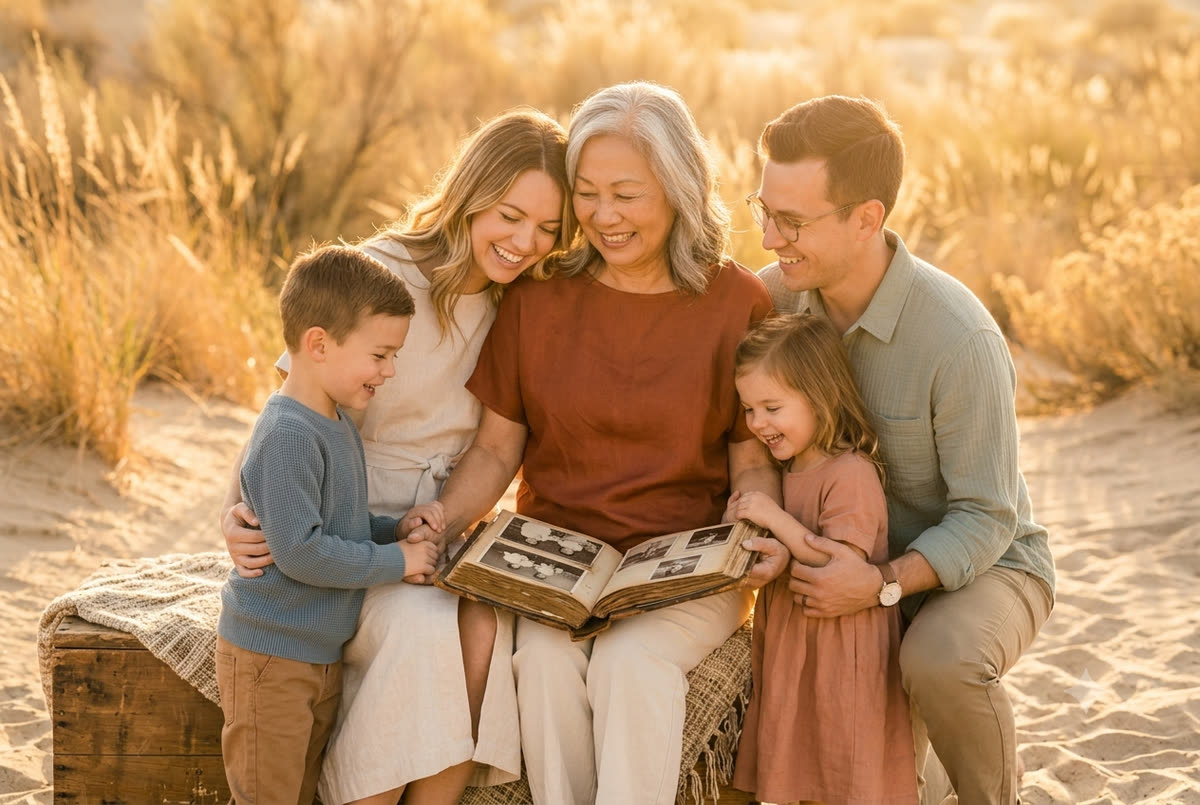
- Old objects, not new ones. A wedding ring, a worn Bible, a tool, a photograph of grandchildren, a pet if one's allowed to visit. Give the hands something meaningful and the face often follows.
- Their language. If English isn't their first language, switching to it can flip a switch. I've had families lean in and speak Spanish to a parent and watch decades melt off the face.
- Pets and children, in tiny doses. A great-grandbaby placed gently in the lap, a calm visiting dog — these produce some of the most unguarded joy I ever capture. Keep it brief and supervised.
And one reframe for families who worry the photos won't be "happy" enough: not every true portrait is a smile. Some of the most moving images I've made are quiet — a contemplative gaze out the window, hands folded, a peaceful stillness. If your father was a serious, dignified man, a serious, dignified portrait is the honest one. Don't chase a grin he wouldn't have given even in good health.
Hands, details, and the in-between frames
When the face is having a hard day — and some days it will — I turn to the parts of a person that age tells the truest story about. Hands, especially. Wedding bands worn thin. Knuckles that worked. The way two hands clasp. I'll photograph a daughter's hand over her mother's, the generations stacked in one frame. These detail images become some of the most cherished pieces in the final collection, and they ask nothing of the subject.
I also keep shooting in the spaces between the "trying." The moment after a joke lands. The glance as a grandchild walks in. The settling sigh when the music starts. Those unposed in-betweens are where the personality lives, so I stay loose and keep my finger ready long after a posed shot would be "done."
Practical and emotional preparation for families
A little planning makes the day immeasurably gentler:
- Pick clothing the day before, in their style. Comfortable, true to who they are, and ideally something they like the feel of. Soft solids photograph beautifully; avoid scratchy or unfamiliar new clothes that might irritate or confuse them.
- Do hair and grooming earlier, not in a rush. Let them recover from it before the camera.
- Decide who's in the room. A crowd overwhelms. One or two trusted people is the sweet spot. I'll happily photograph multi-generational groupings, but I bring them in for a few focused minutes rather than parking everyone there the whole time.
- Brief me honestly. Tell me what calms them and what sets them off. Tell me the songs, the nicknames, the off-limits topics, the side they hear best on. There is no detail too small.
- Prepare your own heart a little. This can stir things up for the family more than the resident. That's okay. Sometimes the most beautiful frames I get are of the adult child in the room — the love on their face is its own portrait, and I'm watching for it too.
If you're navigating end-of-life timelines alongside memory loss, you may also want to read what to know about hospice photography sessions and how to plan a multi-generation legacy portrait. And if you're earlier in the journey and simply want unhurried portraits of an aging parent while they're well, a relaxed at-home session for seniors is a wonderful place to start before memory care is ever part of the picture.
A few questions families ask me
Is it disrespectful or exploitative to photograph someone who can't fully consent?It's a fair and important question. My answer is that we proceed with consent from the family/guardian, with the resident's comfort as the absolute priority, and with the willingness to stop the instant they're distressed. Done that way, a session is an act of dignity and love, not exploitation. If at any point it feels like we're taking something from them rather than honoring them, we stop.
What if they refuse, or get agitated the day of?Then we don't push, and we don't count it a failure. We reschedule for another morning. Rescheduling is simply part of how this work goes — an expected feature, not an exception. Dementia is unpredictable, and the day belongs to your person, not to my calendar.
Can you come to the facility?Yes — nearly all of this work happens on-site at memory care and assisted living communities throughout the Coachella Valley, from Palm Springs to Indio. Photographing in their own space is almost always better than moving them anyway. I coordinate with the staff and work around their daily rhythm.
What about photographing through later stages?Some families do a session a year, or mark a specific occasion, or call when they sense the window narrowing. There's no wrong cadence. If your instinct is telling you it's time, I'd trust that instinct.
A gentle invitation
The portraits I make in memory care are, quietly, some of the most meaningful work of my life — because they insist that the person is still here, still themselves, still worth looking at closely. The disease takes a great deal. It does not get to take the photograph too.
If you've been carrying the thought that you should do this for your mother, your father, your grandparent, that thought is worth listening to. The window for these portraits rarely announces itself, and a single good morning is its own kind of invitation. We can keep it small, slow, and entirely on their terms. When you'd like to talk it through, reach out here and we'll plan around their best hours.