Legacy Photography Guide for Palm Springs Families
Most families come to me with the same sentence, said a little quietly: "We keep meaning to get a real photograph of all of us, and we never have." Sometimes there is a reason behind the urgency — a parent's health, a milestone, grown children scattered across the country who are finally in the same zip code for a week. Sometimes it is just the dawning sense that the people you love are not standing still in time. That impulse, to make one honest picture before the moment passes, is what legacy photography is for. This is my full guide to it for families here in Palm Springs and the wider Coachella Valley — what it actually is, how to plan it, and how to make sure the images outlive the day.
What "legacy photography" actually means
The term gets used loosely, so let me be plain about what I mean by it. A legacy session is a deliberate, well-made portrait of a person or a family created specifically to be kept and passed down. It is not the same as a birthday party documentary, a school portrait, or the cheerful chaos of phone snapshots that fill everyone's camera roll. The point is permanence. We are making the photograph that ends up framed in a hallway, reprinted for grandchildren who are not born yet, and — yes, I will say it gently — sometimes shown at a service many years from now.
Legacy work tends to cluster around a few situations:
- An elder or a matriarch/patriarch whose presence anchors the whole family, photographed properly while everyone is together.
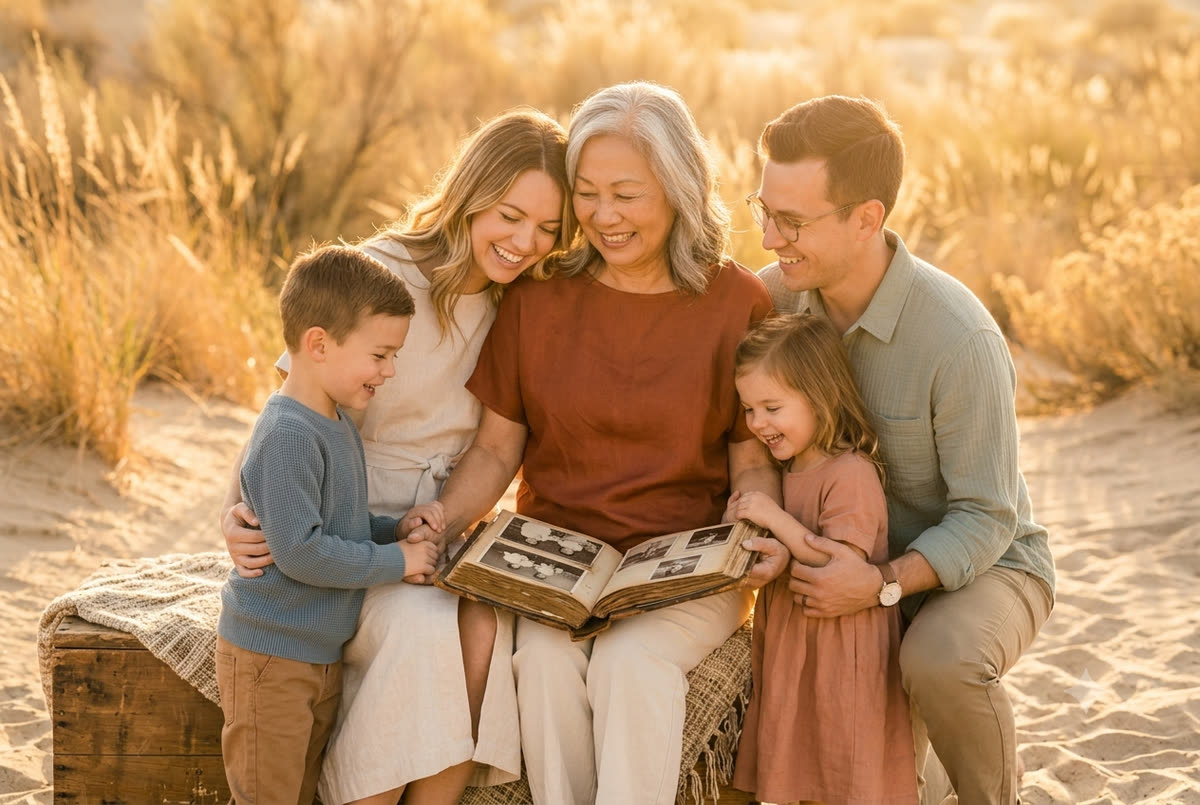
- Multiple generations in one frame — three or four generations standing in the same place at the same hour, which is rarer than people realize.
- A health turn or end-of-life season, when a family wants a calm, dignified record of someone they love. I handle these with particular care, and I write about that kind of session separately in what to expect from a legacy session.
- A milestone — a long marriage, a ninetieth birthday, a retirement, a reunion that pulled people in from out of state.
What ties all of these together is intention. Everything else in this guide follows from that one idea: we are not catching a moment by accident. We are making one on purpose, and making it well.
Why Palm Springs families, in particular
The Coachella Valley has a demographic shape that makes legacy photography unusually relevant here, and it is worth naming honestly rather than dancing around it.
A large share of our community is in the second half of life. Palm Springs, Rancho Mirage, Palm Desert, Indian Wells, and the country-club communities of La Quinta and Indio are full of retirees, snowbirds, and multigenerational families whose elders chose the desert for its ease and warmth. Adult children fly in to visit aging parents. Families gather here for the holidays and the cooler months precisely because this is where the grandparents are.
That creates a recurring window — and a recurring missed opportunity. Everyone is in town for a week in February. Then everyone flies home, and the photo nobody got around to taking waits another year, or doesn't happen at all. A legacy session is, in a very practical sense, the thing you do while the family is physically assembled, because in this valley that assembly is seasonal and not guaranteed to repeat.
When to book: timing this right
People ask me how far ahead to plan, and the honest answer depends on which kind of session this is.
For milestone and multigenerational sessions, book as soon as you know the travel dates. The valley's calm, comfortable months run roughly November through April, which is also when out-of-town family is most likely to be here — so those are my busiest weeks, and the good golden-hour slots fill first. If you are aiming for a holiday gathering or a spring visit, reach out a month or two ahead so we can hold a date that works around everyone's flights. I go deeper on lead times in how far in advance to book a legacy session.
For health-related or end-of-life sessions, throw the calendar out. I keep room for these and I will move quickly. When a family tells me there is a reason not to wait, we don't wait. A few days' notice is fine; same-week is fine. The right time for that photograph is while it is still possible to make it, and I would always rather you call too early than too late.
A word specifically about summer. From late June through September, the desert is genuinely hot — well over a hundred degrees by midday — and that changes the plan rather than canceling it. We simply move outdoor work to the first hour after sunrise or shoot indoors and on shaded patios. I would never ask an eighty- or ninety-year-old to stand in July sun for a portrait, and I will steer you away from it if you suggest it. The picture is not worth anyone's discomfort, and tired, overheated faces don't make good frames anyway.
Where to make legacy portraits in the valley
Location matters more for legacy work than for almost any other kind of session, because place carries meaning. Most of my sessions happen in one of two places — a family's own home, or a local park or garden close to it — and that is by design. Here are the options I work with, and how I think about each.
At home
Home is where I do most of this work, and for an elder it is very often the right answer — not just for comfort. The living room where the family always gathers, the back patio, the garden someone has tended for twenty years — these settings are part of the story. A portrait made there says something a rented backdrop never can. I work mostly with the natural light coming through the windows, drawing people toward it and letting it do the soft, flattering work; I bring my own lighting only when a room genuinely needs it, so a dim interior is never an obstacle. Practically, home also means the person never has to travel, never gets overtired, and is photographed in surroundings that are unmistakably theirs.
A nearby park or garden, in golden light
When a family would rather be outdoors, my next choice is almost always somewhere close and gentle — a neighborhood park, a botanical garden, a shaded courtyard or patio, the lawns and water features at a place like Sunnylands. Nothing remote, nothing rugged; just somewhere green and easy to reach where an elder can be seated and comfortable. I plan these for the last hour before sunset, when the light turns warm and forgiving, the mountains behind Palm Springs and Rancho Mirage catch a glow, and skin tones look their best — which matters enormously when you are photographing faces with a lot of years and a lot of character in them. I keep these sessions short and bring a chair when needed. Fifteen relaxed minutes in beautiful light beats an hour of wearing everyone out. For specifics on the prettiest local spots, my notes on the valley's golden-hour locations cover where I like to work.
Clubs, resorts, and gathering places
So many valley families have a clubhouse, a courtyard, or a favorite resort that is woven into their life here. Sun City Palm Desert, Trilogy in La Quinta, the clubs in Indian Wells — these have lovely covered patios and gardens that photograph beautifully in soft, indirect light. If a milestone is being celebrated at one of these, I will scout a quiet corner and pull the family aside for ten focused minutes before the meal, while everyone is still fresh.
Studio or a clean, simple setting
Sometimes the right choice is the simplest one: even, flattering light against an uncluttered background, with nothing to distract from the person. For a single classic portrait of a matriarch or patriarch — the kind that gets framed large — this stripped-down approach can be exactly right.
How a legacy session actually goes
If you have never done a formal portrait sitting, here is what to expect, so the day holds no surprises.
I start slow. Before any serious posing, we talk — about who is in the family, who belongs to whom, what this photograph is for. That is not small talk; it tells me how to arrange people so the relationships read clearly in the final image, and it gives everyone a few minutes to settle. Nervous, stiff faces relax once a session stops feeling like a procedure.
Then I work in a deliberate order, building from the most important frame outward:
- The big group first, while energy and patience are highest. If four generations are present, this is the photograph everything else is built around.
- The sub-groupings — the elder with just their children, then just the grandchildren, then the little ones. These take only a couple of extra minutes once everyone is already gathered, and they make wonderful prints.
- The individual portraits, especially of the eldest. A real, composed portrait of just them, looking like themselves, is frequently the image a family treasures most.
- The quiet, candid frames — a hand on a shoulder, a shared laugh, someone leaning in to tell a story. I am always half-watching for the gesture that is unmistakably this family.
The whole active portion rarely needs to run more than thirty to forty minutes for an elder, with plenty of seated rest built in. Nobody gets marched through a shot list. If someone needs to step away, we adapt.
The portraits worth making, beyond the group shot
The big group photo is the headline, but the richest sessions include a handful of quieter images that families often end up loving most:
- The eldest, alone. A dignified, well-lit portrait of just them. At eighty or ninety, a face is full of story, and it deserves to be photographed kindly and honestly. This is often the frame that ends up on the mantel.
- Hands. A close image of an elder's hands, perhaps holding a great-grandchild's. It can say a lifetime without showing a single face.
- The couple. If both partners in a long marriage are living, the two of them together. There is a particular tenderness in a portrait of people who have been side by side for fifty or sixty years.
- Each generation in turn. The descent made visible — child, grandchild, great-grandchild — so anyone looking at the picture decades from now can trace the line.
- A meaningful object or place. The piano, the recipe box, the workshop, the chair by the window. The things a person loved are part of who they were.
If your family's story runs especially through its women or across many generations, you might also look at how I approach three generations of women in one frame and photographing four generations together.
Practical questions families ask me
What should we wear? Think of one quiet palette for the whole group rather than a uniform — pick two or three tones that sit well together and let each person dress within that range in their own way. Avoid loud logos and busy patterns; they date a photograph instantly and pull the eye away from faces. Soft, slightly dressy tones tend to age best.
Color or black and white? Both, honestly — I deliver legacy portraits in a way that lets you choose, because the right answer depends on the image. Black and white can lend a timeless, archival weight to an elder's portrait; color keeps the warmth and the specifics of a place. I wrote about how I decide in color versus black and white for legacy portraits.
What if someone can't travel? We photograph who is present and make it complete and beautiful. If you know in advance that a family member is missing, tell me — there are graceful ways to acknowledge them, and we can plan a follow-up when they next visit.
Can you capture more than pictures? Yes, and I encourage it. Some families pair the portraits with a recording of an elder's voice and stories — the way they tell a particular memory is itself a heirloom. I describe that in recording the voices and stories alongside the photos.
Should we print, or are the digital files enough? Print. Please. A file on a phone is not a legacy — it is something that vanishes in the next software migration or a cracked screen. A framed portrait or a real album is what your family will physically hold in thirty years. I help every family choose what to print so the work does not simply disappear onto a hard drive.
Mistakes I'd gently steer you away from
- Waiting for "someday." Someday is the enemy of every legacy photograph. If the family is in town this season, this is the season.
- Relying on the guests' phones. Loving relatives take loving, crooked, half-lit snapshots. Wonderful for the group text; not for the wall.
- Over-scheduling an elder. A ninety-year-old needs a calm half hour and a comfortable chair, not a two-hour production.
- Skipping the solo portrait. In the rush of the big group, the simplest and most lasting image — just the eldest, alone — is the one most often forgotten. Don't let it be.
- Leaving the files on a drive. Unprinted photographs are promises you make to your future family and then quietly break. Make at least one real print.
Let's make the photograph your family will keep
If there is someone in your life you have been meaning to photograph properly — a parent, a grandparent, the whole family while everyone is finally in the valley at once — I would be honored to help you do it well. I will handle the light, the posing, and the pacing so the day stays easy on the person it is really about, and so you come away with one true, honest picture of everyone together.
When the time feels right, tell me about your family and what you're hoping for. Share who is coming, where, and roughly when, and we will plan a session that fits gently into your gathering — and gives you something that lasts far longer than the visit.