Legacy Photography Guide for Indian Wells Families
So many families arrive at this work the same way. Someone is helping a parent settle into a home here in the desert, and in the unpacking a shoebox of old black-and-white prints surfaces — a grandmother as a young woman, a wedding on a porch somewhere back east, a baby who turns out to be the very parent now sitting in the next room. And then the quiet realization lands: we have all of these, and almost nothing of Mom or Dad the way they are right now, before something changes. That realization is the whole reason this kind of work exists, and it's why I want to walk you through it carefully.
Legacy photography is, at its heart, portrait work made with the clock honestly in view. It's photographing your parents and grandparents as the people they are today — the laugh, the hands, the particular way your father still tucks a handkerchief in his pocket — so that the people who come after you don't have to make do with a blurry phone snapshot and their own fading memory. For families in Indian Wells, where so many of us arrived from somewhere else and our elders split the year between two homes, this work has a specific urgency and a specific rhythm. This guide is meant to help you do it well, and to do it in time.
What "legacy photography" actually means
The term gets used loosely, so let me say plainly what I mean by it, because it shapes every decision you'll make.
A legacy session is a portrait session organized around an elder — usually a parent or grandparent, sometimes a couple in their later years — with the goal of creating a lasting record of who they are while they can still take part fully and gladly. It is not a somber occasion. The best of these sessions are full of teasing and old stories. But the intention behind them is serious: we are making the photographs your family will reach for at the holidays, at memorials, at the births of children who will never meet this person directly.
It usually takes one of a few shapes:
- The elder alone or as a couple. Honest, unfussy portraits of one or two people — the kind of frame that becomes the photograph of Grandma, the one that ends up on the program someday and on a dozen mantels.
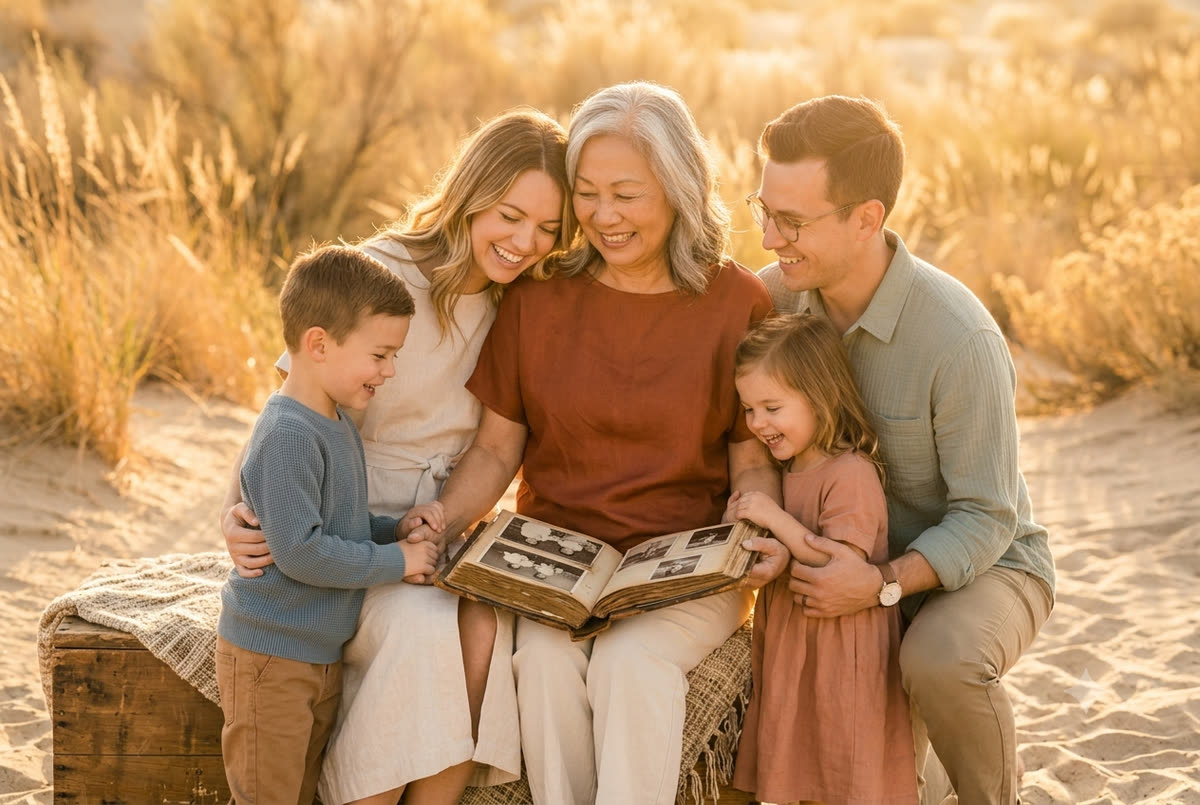
- The multi-generational gathering. Three or four generations together, which for many Indian Wells families only happens when the kids and grandkids fly in. These are logistical puzzles worth solving (more on that below).
- The story session. A portrait sitting paired with the things that tell the story — the hands that still garden, the heirloom ring, the medals, the worn cookbook, the dog who never leaves their side.
If you're weighing this against a standard family shoot, the difference is mostly intention and patience. I slow everything down. I'd rather get forty honest frames than four hundred posed ones.
Why Indian Wells families wait too long — and why not to
I'll be direct, because gentleness here doesn't serve you: the most common thing I hear is "we kept meaning to." Almost no one regrets booking too early. A great many people grieve having waited.
There are reasons particular to our valley that this slips:
- The seasonal split. A huge share of Indian Wells households are snowbirds — here November through April, back north for the hot months. That means there's a real, hard window for photographing a parent who winters here, and it's easy to assume "next season" without noticing how few next-seasons remain.
- The arrival of frailty. Many elders move to or near Indian Wells after a health event — a fall, a diagnosis, the loss of a spouse. Families are managing care and logistics, and the photograph feels like a luxury rather than the priority it actually is.
- The two-household problem. When Mom's primary home is still Ohio, nobody feels fully responsible for the desert chapter of her life. So it goes undocumented.
My honest counsel: if you've thought about it, that thought is the signal. Book while your elder is well enough to enjoy the morning, not when you're racing a decline. The session itself is a gift to them — an afternoon of being looked at with love and attention, which our oldest people don't get nearly enough of.
The best time of year and time of day
Two questions decide almost everything about how comfortable and how good the session is: when in the year, and when in the day.
Season. The kind months in the Coachella Valley run roughly November into early May. That overlaps neatly with snowbird season, which is convenient — your visiting family is already here, and the weather is forgiving. From late May through September, the heat is genuinely dangerous for older bodies. I won't put an eighty-five-year-old outdoors at the Indian Wells Tennis Garden in July, and you shouldn't want me to. If summer is your only window because that's when the grandchildren visit, we move indoors or shoot in the first soft hour after sunrise and keep it very short.
Time of day. For anyone who tires easily, mid-morning is usually best — they've had breakfast and their coffee, they're at their sharpest, and we're done before the afternoon slump. For outdoor light, the last ninety minutes before sunset is the most flattering window we have here; the desert light goes warm and low and kind to every face. I avoid the harsh overhead light of midday for legacy work specifically, because it deepens every line into something severe, and that's not how your mother looks to the people who love her. We either chase the gentle end-of-day light or work in open shade.
If your elder fades in the late afternoon, we don't force golden hour. A bright, beautiful morning indoors beats a tired face in pretty light every time.
Where to photograph in and around Indian Wells
Location matters less than you'd think and more than you'd guess — what matters is that the place means something and that it's physically easy for your elder. Here's how I think about it.
Their home
My first suggestion is almost always the home, and people are often surprised. But the house — the patio off the back, the chair where he reads, the kitchen where she's made the same recipe for sixty years — is where your elder is most themselves and most at ease. There are no stairs to negotiate, no strangers, no heat. The light through a west-facing Indian Wells living room in winter is genuinely lovely. And the home holds the objects that tell the story without us having to stage anything.
A nearby park or garden
When your elder is up for a change of scene, my next choice is somewhere green, gentle, and close — a local park, a botanical garden, a resort's manicured grounds, or a shaded courtyard. These give us a little of the desert's character without any of its hardship. A few thoughts:
- The mountains as a backdrop. From the right spot in a park or garden, the Santa Rosa range rises behind a portrait and reads as unmistakably here — no open scrub or long hike required.
- Accessibility first. I look for level paths, a short walk from the car, benches, and shade close at hand. A garden with a paved loop and a mountain view does everything a rugged trail would, and it does it far more kindly.
- Golden hour outdoors. Out here the last ninety minutes before sunset are the most flattering light we get; the warm, low sun is generous to every face. When we work in a park or out on a patio, that's the window I aim for.
Resorts and clubs
Many Indian Wells families have a long history with a particular club or resort — the Tennis Garden, a country club where Dad played for decades, a hotel where the family has gathered for years. These places carry real meaning and usually have golf carts, shade, and accessible grounds. If there's a venue woven through your family's desert life, tell me; we can almost always arrange to photograph there.
Multi-generational sessions: making the logistics work
When the goal is three or four generations in one frame, the photograph is easy. The gathering is the hard part. Here's how I help families pull it off.
- Anchor the date to the travel, not the calendar. Pick the one window when the out-of-town children and grandchildren are actually in the valley — usually a holiday or a planned visit during season — and build everything around it. I hold dates well in advance for exactly this reason.
- Keep the session short and front-loaded. Little kids and elderly grandparents have the same enemy: fatigue. I photograph the full group and the most important combinations first, in the first twenty minutes, while everyone's fresh. Then we let the elder rest while I pick up the smaller groupings and candids.
- Plan the seating, not the standing. I always arrange for your elder to be seated and comfortable, with family gathered around — it photographs more naturally than a stiff lineup and it spares them from standing.
- Mind the wardrobe lightly. Lean toward a shared palette of soft, muted tones rather than identical outfits — they photograph well against greenery or stone and don't date as fast as bold prints. I send a simple guide once we've booked.
If you're also thinking about the youngest generation while everyone's together, it's worth reading my thoughts on photographing grandparents with their grandchildren.
Bring the things that tell the story
This is the part families forget, and it's the part that turns a nice portrait into an heirloom. Before your session, gather a few objects that carry your elder's story, and we'll photograph them alongside the portraits:
- Hands and what they do — the hands themselves, holding the gardening trowel, the deck of cards, the rosary, the fishing fly they still tie.
- Heirloom jewelry — the wedding band worn smooth, the brooch from her mother, the watch.
- The work of a life — military medals, a chef's worn knife, a pilot's logbook, the quilt she's still making, the manuscript he never published.
- Old photographs — I love photographing an elder holding a portrait of themselves at twenty, or of the parent they lost. It collapses a lifetime into one frame.
- The companion — the dog or cat. They're family, and they relax everyone.
You don't need all of these. Two or three meaningful objects are plenty. Email me beforehand and tell me the stories; I'll know how to weave them in.
Capturing the voice, not just the face
A photograph holds a face, but it can't hold a voice — and the voice is often what families miss most acutely later. So I gently encourage clients to pair the session with something audible: a short recorded interview, a few voicemails saved, the recipe dictated in their own words. I'm happy to keep the camera rolling for a few minutes of video at the end, your elder simply talking, telling one story. It's not polished and it's not meant to be. Years from now it will be priceless.
If preserving the spoken history matters to you as much as the images, I've written separately about recording your parents' stories before it's too late, and I'm glad to coordinate the two.
What a session with me is actually like
I want you to know what you're walking into, because the unknown is what makes families hesitate.
We talk first — by phone or over coffee — about who your elder is, what they can comfortably manage, what you're hoping to hold onto. I plan the session around their stamina and their best time of day, not around a shot list. On the day, I move slowly. I don't bark poses. I mostly talk with your parent, let them settle, and watch for the moment they forget the camera is there and become entirely themselves — that's the frame I'm after, and it's almost never the one where everyone's saying cheese.
For a frailer elder, I keep it to forty-five minutes or an hour, with breaks, and I'm content to get a handful of true photographs rather than exhaust anyone for the sake of variety. For an active couple who wants to make a morning of it, we can range further. Either way, no one leaves wrung out.
Afterward, I edit honestly. I don't airbrush your grandmother into a stranger. I keep the lines that are hers and remove only the distractions — a stray shadow, a bit of glare on the glasses. The goal is for your family to look at the print and say that's exactly her, not that's a nice retouch.
Common questions
What if my parent doesn't want their picture taken?Most don't, at first — they'll say they look old, or they hate cameras. Nearly every one of them ends up grateful, because the session turns out to be about attention and stories rather than vanity. I'm patient, and I let them warm up. Tell them it's for the grandchildren; that usually does it.
My mother has dementia. Is this still worth doing?Yes — and the sooner the better. I've photographed clients with memory loss, and the trick is a short session, a familiar place (almost always home), and a family member close by. Even when much has slipped away, the person is still there in their expressions, and capturing that for your family matters enormously.
We're only in Indian Wells until April. Can we book quickly?Yes. Season is my busiest stretch, so the sooner you reach out the better, but I always try to make room for legacy work because it's the kind that can't simply wait until next year.
Can you come to a care facility or assisted living?Absolutely. I photograph in independent and assisted living communities throughout the valley regularly. We work around meal times and rest, and I keep my footprint small and calm.
What do we end up with?Beautiful prints, first and foremost — I believe legacy work belongs on paper and on walls, not trapped on a phone. We'll talk about albums and framed pieces, and you'll receive your favorite images in digital form as well.
A few mistakes to avoid
- Waiting for a "better time." There rarely is one. The healthier and happier your elder is today, the better the session — and that's an argument for now, not later.
- Over-scheduling the day. Don't stack the portrait session on top of a big family dinner and a long drive. Give your elder a calm, rested morning and nothing else demanding around it.
- Booking high summer outdoors. Our heat is not a backdrop you want to fight. Choose season, choose morning, or choose indoors.
- Forgetting the objects and the stories. The face is half of it. Come with the hands, the heirlooms, and the tales.
- Trying to make everyone perfect. Real beats flawless. The slightly imperfect frame where your father is genuinely laughing will outlast the stiff, tidy one every single time.
When you're ready
If you've read this far, you already know there's someone in your life whose portrait you don't yet have and ought to. That quiet pull is worth trusting. I would be honored to help you make these photographs while there's still ease and laughter in the doing — to give your family the frame they'll reach for in every season to come.
When you'd like to talk it through, reach out to me here and tell me a little about your parent or grandparent. We'll find a time that suits them, plan it gently, and make something your family will keep for generations.