Legacy Photography Guide for Rancho Mirage Families
There is a particular kind of phone call I get every spring, usually from an adult daughter, sometimes from a son, often a little hesitant. Mom and Dad still live in Rancho Mirage, the whole family is coming out before the heat sets in, and they want pictures — but not the kind everyone's phone already makes by the hundred. They want the real thing. They want to be able to hand their grandchildren a photograph one day and say, this is who we were.
That's legacy photography. And if you've found your way to this page, you're probably feeling some version of the same quiet urgency. Let me walk you through what it actually is, how I approach it here in the desert, and how to plan a session that your family will be grateful for long after the moment has passed.
What "legacy photography" really means
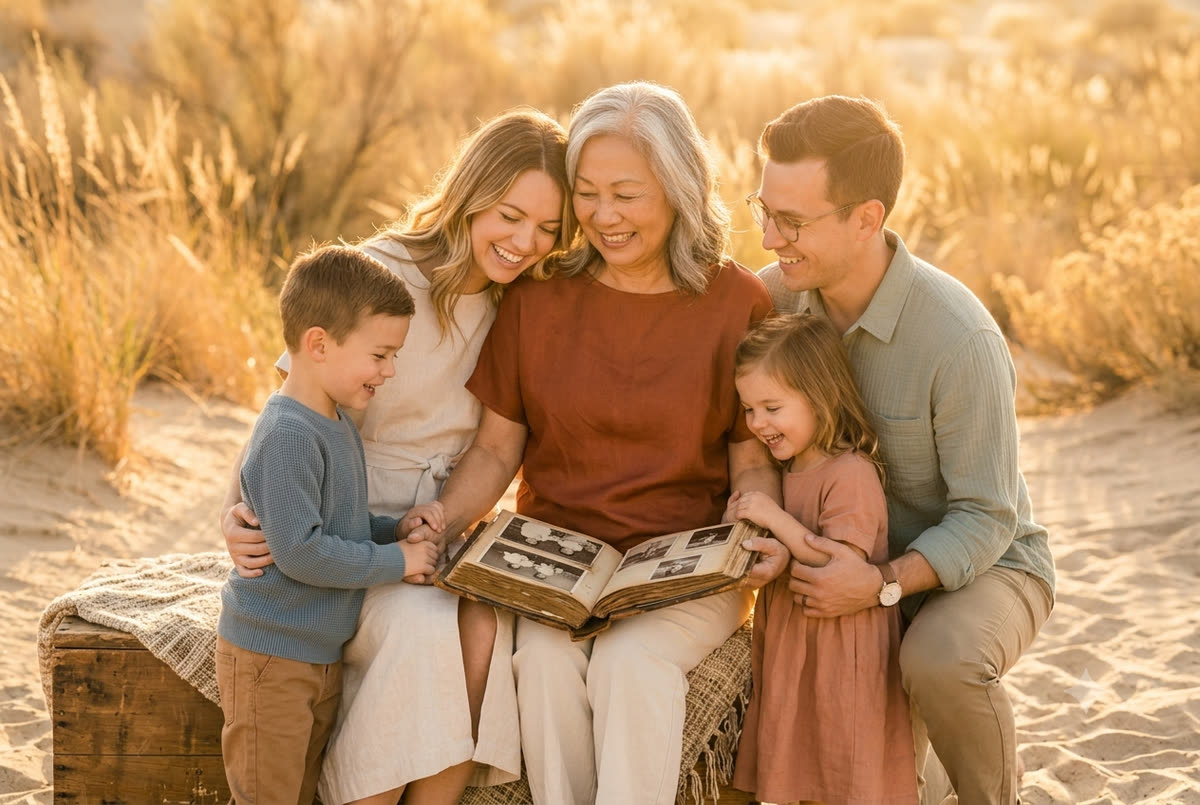
Legacy photography is portraiture made with the long view in mind. It isn't a single posed headshot, and it isn't a frantic holiday session squeezed between flights. It's a deliberate sitting — often spanning two, three, or four generations — created so that the people in the frame, and the people who will inherit the frame, can recognize something true about this family.
The word that matters most is honest. A legacy portrait isn't about looking ten years younger or pretending the family is something it isn't. It's about capturing the way your father rests his hand on your mother's shoulder without thinking, the way the youngest grandchild always ends up in someone's lap, the particular tilt of a grandmother's chin when she's pleased and trying not to show it. Those gestures are the inheritance. My job is to be paying close enough attention to catch them.
People sometimes confuse legacy work with end-of-life photography, and while there's overlap in spirit, they're not the same thing. Legacy portraits are best made while everyone is well, mobile, and able to enjoy the morning. You don't wait for a diagnosis. The whole point is to do this now, while the gathering is still easy to arrange and the laughter comes freely.
Why Rancho Mirage is such a natural home for this work
Rancho Mirage has a personality that suits legacy portraiture beautifully. It's quieter and more residential than Palm Springs, greener than you'd expect for the desert, and full of the kind of settings that feel timeless rather than trendy — which matters when you're making a photograph meant to look right in forty years.
A few things I love about working here specifically:
- The light has room to breathe. The valley floor opens up against the Santa Rosa Mountains, and in the soft hours that backdrop does half my work for me. You don't need a fancy location; you need good light and a little space.
- Most families already have a "home base" here, and that's where I do my best work. Grandparents who winter at Mission Hills, The Springs, or one of the country club communities along Bob Hope Drive almost always want the session at their own home — the place that is the family's desert chapter. The living room, the kitchen everyone gathers in, the patio off the back: those rooms hold more story than any backdrop I could find. In-home sessions are my signature, and they're where I'm happiest.
- The neighborhood settings are genuinely lovely, too. The Rancho Mirage Community Park with its lake and mountain views, the grounds around The River, the gardens at Sunnylands (with their reservation system and rules, which I'll come back to), and the shaded courtyards and walking paths tucked through the club neighborhoods all photograph wonderfully when a family wants a little more air around them.
If your parents have lived here for decades, there's real meaning in rooting the portraits in this place rather than a generic studio. The home, the patio, the favorite chair by the window — those details tell the story too.
When to schedule: the desert calendar matters
Timing is the single most practical thing I can help you get right, because in the Coachella Valley the season dictates everything.
The ideal window is roughly November through April, when the weather is gentle, extended family is most likely to already be in town, and we can comfortably photograph outdoors in the morning or late afternoon as well as inside. If your family's reunion or holiday gathering falls in this stretch, that's your moment. I book up well in advance for the Thanksgiving-through-Easter run, so reach out earlier than you think you need to.
Late spring (May into early June) can still work beautifully if we start at sunrise — and honestly, some of my favorite Rancho Mirage mornings have been in May, when the air is warm but not punishing and the light comes in long and gold.
Deep summer (July, August, into September) is the season I'll gently steer you around for outdoor work. Once we're in triple digits, standing on a sun-baked patio is no kindness to anyone, least of all an elder. If summer is the only time everyone can be together, we simply work inside — a bright room with good window light is wonderfully forgiving in any month — or meet at first light and keep it short. It's very doable; it just takes planning. I'd rather tell you the truth about the heat than promise a noon session that no one enjoys.
A related note for outdoor portraits: the flattering light here lives in the first ninety minutes after sunrise and the last ninety before sunset — what photographers call golden hour, and what your photos will quietly thank you for. Indoors, the rules change entirely; soft daylight from a window does the same gentle work at almost any time of day.
Planning a multi-generation session
This is where a little forethought makes an enormous difference. Here's how I help families prepare.
Start with the people, not the poses
Before we ever talk about outfits or locations, I want to know who's coming and what their day is like. Is there a great-grandparent who tires easily? A toddler who naps at ten? Someone using a walker or wheelchair? None of this is a problem — it's simply information that lets me build the morning around your family instead of forcing your family to perform for the camera.
For sessions with an elder at the center, I plan the must-have photographs first and shoot them early, while energy is highest. The big group, the four-generation shot, the portrait of the matriarch or patriarch alone — we get those in the bank within the first twenty minutes. Everything after that is gravy.
Let everyone dress like themselves, in colors that get along
You don't need everyone in white shirts and khakis. In fact, please don't. I steer families toward a shared palette — three or four colors that live well together — and then let each person dress like themselves within it. Soft, muted desert tones (sage, cream, dusty blue, warm tan, terracotta) read as timeless and sit beautifully against our landscape. Loud logos and trendy prints are the things that date a photograph fastest.
A few gentle rules I share:
- Dress the elders in what makes them feel most like themselves. If Grandpa has worn the same style of collared shirt for thirty years, that shirt belongs in the picture.
- Bring layers if we're shooting in cooler months — desert mornings can start crisp even when the afternoon is warm.
- Comfortable shoes for everyone, because we'll move around a little.
Build in time and grace
A legacy session is not a thing to rush. I block generous time so that a fussy baby, a bathroom break, or a long story about how Grandma and Grandpa met can all happen without anyone feeling the clock. Often the best frame of the whole morning comes after the formal posing is done, when everyone exhales and just talks to each other. I'm still photographing then. That's usually where the magic is.
Where we might photograph in and around Rancho Mirage
More often than not, my favorite place to photograph a family is their own home — but here are the settings I return to, depending on what your family wants:
- Your home (and patio). Hard to beat for meaning, and where most of my legacy work happens. We make warm, unhurried portraits in the living room using the daylight that comes through the windows, then step out to the patio or garden for the airier shots.
- Rancho Mirage Community Park. Lake, lawns, and that mountain backdrop. Easy parking and accessible paths, which matters with elders and strollers.
- The grounds near The River. Convenient, walkable, with water features and shade — a good option when mobility is a consideration.
- Sunnylands Center & Gardens. Stunning, but note the gardens have their own photography policies and reservation requirements, so we'd plan around those rules in advance rather than show up and hope.
- A garden or a green, shaded corner of the neighborhood, for families who want a little of that Coachella Valley landscape in the frame without anyone hiking into open desert.
If you're weighing locations more broadly, you may also find my thoughts useful in the best places for family photos in the Coachella Valley and my seasonal guide to desert golden hour.
Questions families ask me most
How long does a legacy session take?Plan on an hour and a half to two hours for a multi-generation group. Smaller sittings can be shorter, but I'd rather have the breathing room. If an elder fatigues quickly, we can compress the essential portraits into a focused half hour and let the rest be optional.
Can you photograph someone with limited mobility?Absolutely, and I do it often. Seated portraits can be every bit as dignified and warm as standing ones — sometimes more so. Tell me ahead of time about wheelchairs, walkers, oxygen, hearing, or stamina, and I'll choose locations with flat access and shade, and arrange the group so no one is straining.
What about someone who "hates having their picture taken"?Nearly everyone says this, and nearly everyone relaxes within ten minutes once they realize I'm not going to bark posing commands at them. I work conversationally. The reluctant ones often become my favorite subjects, because their guardedness drops all at once and you can see it.
Should we do this if a family member is seriously ill?Yes — and gently, and soon. When a family is facing a hard season, photographs become irreplaceable very quickly. I approach these sessions with great care and flexibility, including photographing at home or at a care facility if travel is difficult. If that's where you are, my guide to photographing aging parents with tenderness may help you think it through.
What do we actually end up with?That's a conversation I have with each family, because the answer should match how you'll live with the images. Many families want at least one large, beautifully printed portrait for the wall and an archival album, because a file on a hard drive isn't a legacy — a print your grandchildren can hold is. I'll guide you toward heirloom-quality printing that will outlast all of us.
A few mistakes worth avoiding
- Waiting for the "right time." The right time is while everyone is here and well. The most common regret I hear is from people who meant to schedule a session and ran out of runway.
- Over-styling outfits into something stiff and catalog-like. A photograph should look like your family, not a clothing ad.
- Booking midday in summer. Please let me protect you from this one.
- Forgetting the candid hour. The posed group photo matters, but don't skip the unstructured time afterward where the real connection shows.
- Leaving it all on a phone. Make a print. Make several. Future generations can't inherit a cloud account.
Let's make something that lasts
If your family is going to be together in Rancho Mirage — this season, this year, while the gathering is still easy — I'd be honored to help you turn that into something your children's children will hold one day and recognize as their own. These are quiet, joyful mornings, and the photographs that come from them have a way of becoming a family's most cherished possession.
When the dates start to firm up, reach out and tell me about your family. Tell me who'll be there, who the session is really for, and what you're hoping to hold onto — even a few sentences gives me what I need to start. We'll shape the morning around your family from there, beginning, most likely, right in your parents' living room.