Best Golden Hour Spots in the Coachella Valley
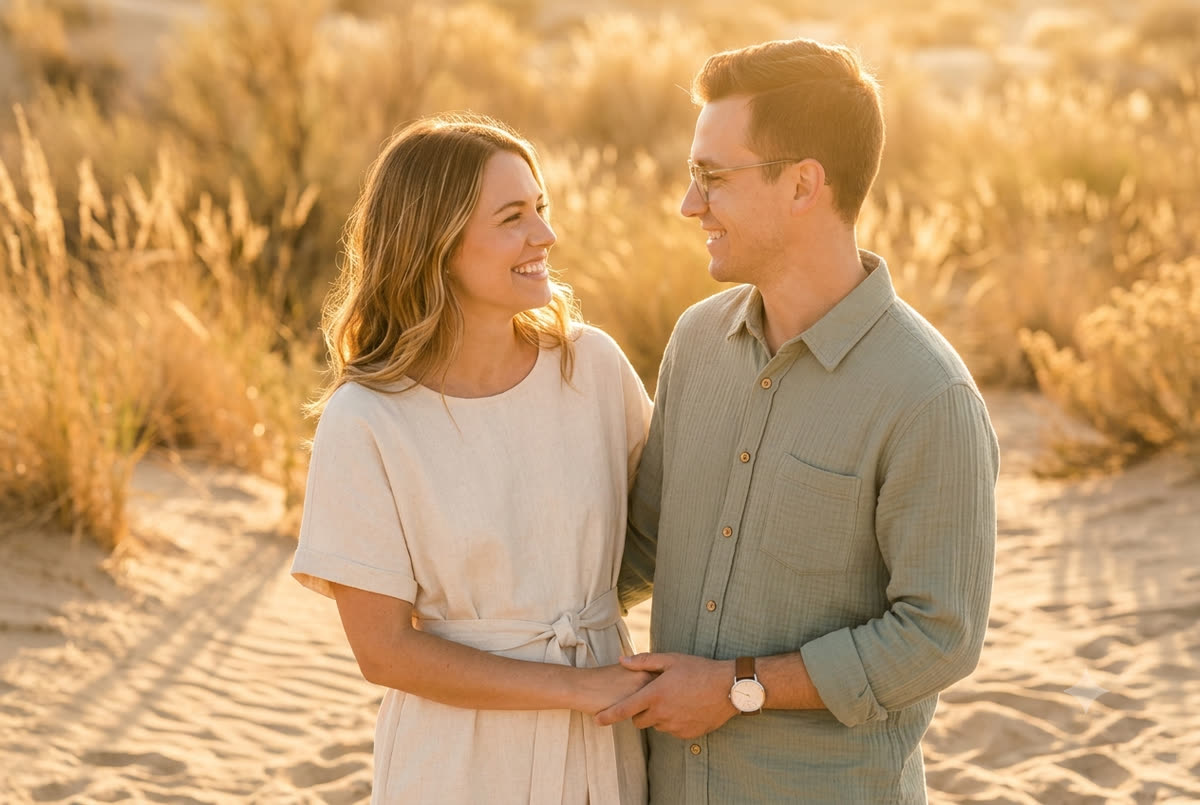
There is a moment, most evenings out here, when the desert simply lets go. The harsh white glare that pushes everyone indoors all afternoon softens into something honey-colored and forgiving, the San Jacinto and Santa Rosa mountains turn rose and lavender, and the whole valley seems to exhale. That hour — and it is closer to ninety good minutes if you know how to use it — is one of my favorite times to make pictures. Most of my sessions actually happen close to home: in a family's own living room with soft light pouring through the windows, or just down the street at a neighborhood park, a shaded garden, or a quiet patio. But when a family does want to step outside into that evening glow, the desert gives you something extraordinary, and after many years photographing families, couples, and children across the Coachella Valley, I have learned where that light falls best, when to be standing in it, and how to keep a session feeling unhurried and joyful. This is my honest, local guide to the best golden hour spots in Palm Springs and the rest of the valley.
What "golden hour" actually means in the desert
Golden hour is the stretch right after sunrise and right before sunset, when the sun sits low and its light travels through more atmosphere, scattering the blue away and leaving everything warm, soft, and dimensional. It is the most flattering light there is for portraits — it wraps around faces instead of carving shadows under eyes and noses the way midday sun does.
But the Coachella Valley has its own rules, and they matter more here than almost anywhere else I have worked:
- Our mountains steal the sun early. Because the San Jacinto and Santa Rosa ranges rise so steeply right at the valley's western edge, the sun disappears behind them well before the "official" sunset time on your weather app. In Palm Springs, tucked closest to San Jacinto, the sun can drop behind the ridge twenty to forty minutes before listed sunset. That is not a loss — it gives you a long, even, shadow-free afterglow — but it changes when you need to be ready.
- The light is cleaner than you would believe. Low humidity and little haze mean our golden hour is unusually crisp and saturated. Skin tones glow rather than turn muddy.
- Heat dictates the schedule. From roughly June through September, morning golden hour is not just prettier, it is the only comfortable option. More on that below.
- Cooler months bring the most dependable evenings. From November through April the weather is glorious and evening golden hour is warm and reliable — the easiest stretch of the year to plan an outdoor session around.
If you remember nothing else: check the actual sunset time, then subtract about thirty minutes for the mountain shadow, and plan to start a full hour before that. You want to be photographing in the good light, not still parking the car.
My favorite golden hour locations, valley by valley
I will start at the west end, where San Jacinto looms, and work east toward Indio. Every one of these I have actually shot, and I will tell you what each is good for.
Palm Springs
The mid-century neighborhoods (Twin Palms, Vista Las Palmas, Movie Colony). Palm Springs is famous for its architecture, and golden hour is when it earns the fame. Those clean white walls and breeze-block screens catch warm light beautifully, and the streets are lined with palms that throw long graphic shadows. I love these neighborhoods for couples and for stylish, modern family portraits. A word of respect: these are people's homes. We photograph from public sidewalks and rights-of-way, we keep our voices down, and we never block driveways or step onto private property.
Indian Canyons. Just south of downtown, the Indian Canyons (on Agua Caliente land) give you native palm oases, rock, and water — a completely different, lusher desert. The canyon walls mean the light goes soft early, which is wonderful for gentle, intimate sessions. There is an entrance fee and seasonal hours, so we plan around them.
Downtown and the Uptown Design District. For a more urban, lifestyle feel — walls of color, murals, the old neon — the light bouncing between buildings in the last hour is lovely and flattering. Great for engagement sessions with personality.
Tahquitz Canyon and the western foothills. Where the city meets the mountain, you get dramatic backdrops with San Jacinto glowing pink behind you. Beautiful, and worth the short walk.
Cathedral City and Rancho Mirage
Rancho Mirage's wide desert edges and resort landscaping. Rancho Mirage has some of the most manicured, photogenic open spaces in the valley, plus long mountain views to the south and west. Quiet residential edges and date-palm rows here make for clean, classic family portraits.
The Living Desert (Palm Desert/Rancho Mirage border). A botanic garden and zoo with gorgeous desert plantings. It is ticketed and has its own photography policies, so it is best for a planned, permitted session, but the variety of textures is a gift.
Palm Desert and Indian Wells
El Paseo. Palm Desert's elegant shopping street, lined with public art and jacaranda. In spring the jacarandas bloom violet, and against golden light it is unforgettable. Lovely for couples and for milestone or anniversary portraits.
The Santa Rosa foothills and trailheads (Bump and Grind, the Art Smith area, the Cahuilla Hills). Where Palm Desert and Indian Wells back up against the mountains, you get boulder fields, ocotillo, and big sky — a dramatic, rugged backdrop for families who want that quintessential "we live in the desert" feel, and pleasantly uncrowded if you arrive in the last hour of light.
Indian Wells' open desert and resort corridors. Refined, green, and framed by the Santa Rosas. Beautiful, calm backdrops for families who want something polished.
La Quinta
The Cove and the Bear Creek area. La Quinta Cove is nestled right against the Santa Rosa Mountains, and the rock walls catch a stunning warm light as the sun goes down. The mountains glow copper here. It is one of my favorite places in the whole valley for dramatic, earthy golden hour portraits.
Old Town La Quinta. Charming, walkable, with warm Spanish-style architecture that drinks up the late light. Wonderful for relaxed family sessions with a bit of small-town character.
Lake Cahuilla and the southern foothills. Water plus mountains plus open sky — rare in the desert, and gorgeous at sunset.
Indio and the east valley
The date gardens and palm groves. This is the agricultural heart of the valley, and the rows of date palms are pure magic in low light — endless warm corridors, dappled sun, a sense of place you cannot fake. For families who want something distinctive and rooted in the real Coachella Valley, I love bringing people here.
Open desert and the wide eastern sky. The east end has less mountain interference, so the sun sets a touch later and the sky often does more dramatic things. Great for big, airy, sky-filled portraits.
Worth the drive
A little outside the valley proper, two places reward the effort for an adventurous session:
- Joshua Tree National Park, about an hour northeast — surreal rock and twisted trees, otherworldly at golden hour. Sessions here require a little planning around park rules and the drive home in the dark.
- The Whitewater Preserve and the windmills near the I-10, on the way in from the west — those turbines catching the last light, with San Gorgonio behind, make for a striking, very-Coachella-Valley frame.
Timing it right, season by season
The single biggest mistake I see is treating "golden hour" as one fixed time of day all year. Out here it swings dramatically.
- Winter (Nov–Feb). Sunset comes early, around 4:30–5:00 p.m., and the light is soft and warm. Plan an evening session to start around 3:30–3:45 p.m. Mornings are chilly but stunning. Popular spots can be busier this time of year, so arriving early pays off.
- Spring (Mar–May). My favorite stretch. Wildflowers and blooming jacaranda, comfortable temperatures, sunset creeping later toward 7:00–7:30 p.m. Evening sessions are easy and lovely.
- Summer (Jun–Sep). Be honest with yourself: afternoons are brutal, often 105–115°F. I move almost everything to sunrise golden hour — we meet around 5:15–5:45 a.m., the air is bearable, the light is glorious, and we are done before it gets dangerous. If you insist on evening, we wait until the very last possible light and keep it short. Hydration is non-negotiable.
- Fall (Oct–Nov). The heat finally breaks, the valley refills, and evenings turn beautiful again. Sunset moves back toward 6:00 then 4:45 p.m. as the season turns. A wonderful, underrated time to photograph.
For the exact mountain-shadow timing on your specific date and location, I always scout and plan ahead — it is part of what I do for you, so you never have to think about it.
How I use golden hour in a real session
Knowing the spot is only half of it. The other half is working with the light:
- Backlight for glow. I often place the sun behind you so it rims your hair and shoulders with gold and bathes faces in soft, even light. It is the most flattering, dreamy look the desert offers.
- Open shade as a backup. Early in the window, before the light fully softens, I will tuck us beside a wall, a palm, or a canyon edge for even, gentle light on faces.
- We move with the sun. Because the light changes fast here, I plan a loose path through two or three nearby setups so we are always standing in the best of it without anyone feeling hurried.
- Close to home counts too. Not every family wants to drive out to a dramatic vista, and they do not have to — a neighborhood park, a garden, or your own backyard catches the very same golden light, and many people love the ease of staying near home.
- Playfulness over posing. With little ones especially, I keep things relaxed and unforced. The best frames almost always come when everyone has forgotten the camera is there.
If you want to go deeper on any of this, I have written companion pieces in my Golden Hour & Desert Light series: a practical guide to surviving and loving a summer sunrise session, and what to wear for desert portraits so your colors sing against all that warm light.
A few honest mistakes to avoid
- Trusting the app's sunset time. Subtract for the mountains, especially on the west end. I have watched families arrive at "golden hour" only to find the sun already behind San Jacinto.
- Underestimating the heat. From June to September, an evening session in full sun is miserable and unsafe for kids. Choose sunrise.
- Forgetting the locations are real places. Neighborhoods are homes; preserves, gardens, and tribal lands have fees, hours, and photography rules. Part of my job is handling permits and respecting access so the day is smooth and welcome everywhere we go.
- Booking too tight. Golden hour is generous but finite. Give us the full window so the session can breathe.
Let's make the most of the light together
The Coachella Valley gives us some of the most beautiful evening and morning light anywhere in the world, and there is real joy in putting it to work for a family. If you have people you want to remember exactly as they are right now, a relationship worth celebrating, or a child growing up far too fast, I would love to help you hold onto it — whether that is out in the warm desert glow or at home in the quiet light through your own windows.
Tell me a little about what you picture, and we will sort out the right setting and the right hour together. You can reach me right here: get in touch.