Photographing Four Generations Together
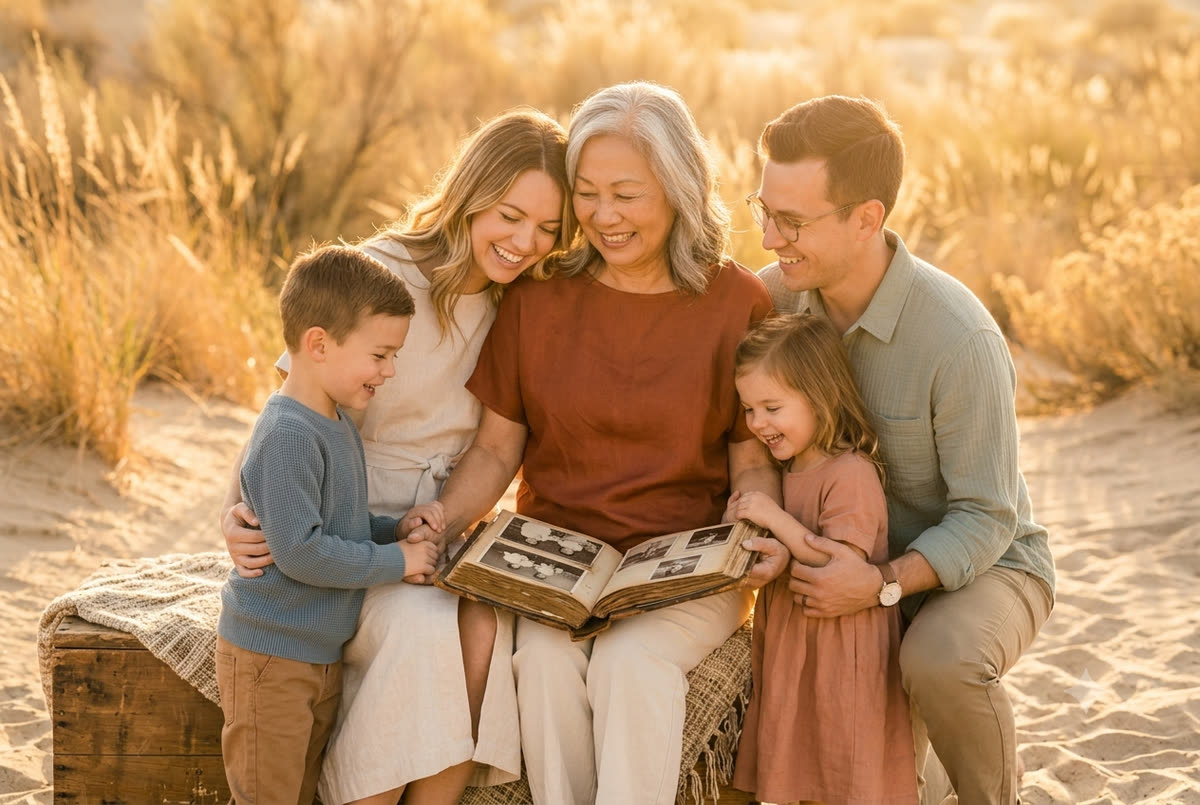
There is a particular hush that falls over a room right before a four-generation photograph comes together. The great-grandmother is settled in the good chair, the baby is being passed hand to hand, and everyone else is hovering, half-laughing, trying to figure out where to stand. That ten seconds of gentle chaos — before anyone has "posed" — is usually where the real picture lives. I have made a lot of these portraits over the years here in the desert, and the ones families end up framing are rarely the stiff, everyone-look-here frame. They are the ones where you can see how these four lifetimes actually fit together.
If you are reading this, you are probably trying to make one of these happen: a visiting grandparent during snowbird season, a new baby, a milestone birthday, or simply the dawning sense that you should not wait any longer. Good. Let me walk you through how I think about a four generation photo — the planning, the light, the posing, and the small logistics that decide whether the day feels joyful or frantic.
What "four generations" really means in one frame
A four generation photo is exactly what it sounds like: four direct, descending generations of one family, captured together. Most often that is great-grandparent, grandparent, parent, and child — frequently anchored by the youngest baby and the oldest matriarch or patriarch, with the bloodline running straight down the middle.
The detail that trips people up: it is usually a direct line of descent. So the classic version is one great-grandmother, her son or daughter (the grandparent), that person's son or daughter (the parent), and the new baby. Aunts, uncles, and cousins are wonderful and we can absolutely photograph them too — but the "four generation" image people treasure is the unbroken chain. When you are deciding who is in it, ask: does each person in the frame descend directly from the one before? That is your line.
It matters to name this clearly because these photographs are quietly about time. You are putting eighty or ninety years of one family into a single rectangle. That is why families ask for them when an elder's health is changing, when a baby finally arrives after a long wait, or when everyone is rarely in the same zip code at the same time. The picture is doing emotional work, not just decorative work.
Don't wait — the honest part
I will be candid, because I would rather say it gently now than have you wish I had. The single most common thing I hear at these sessions is "we kept meaning to do this." Four generation photos have a window, and the window is defined by the two ends of the line: the newest baby and the eldest elder. Babies change weekly. Elders' energy and health can shift in a season.
If four living generations are in the same place — even briefly, even if the house is messy and nobody feels camera-ready — that is the moment. We can work around tired, around a fussy infant, around a wheelchair, around oxygen, around someone who "hates having their picture taken." None of that is a reason to postpone. The only thing we cannot work around is having missed it.
When to shoot it in the Coachella Valley
Timing here is shaped by two things: who is in town, and the light.
Snowbird season (roughly November through April) is when many desert families are actually complete. The great-grandparents who winter in Palm Desert, Rancho Mirage, or Indian Wells are here; adult children fly in for the holidays or for a milestone. If your eldest generation only overlaps with the rest of the family during these months, plan around it deliberately — book before the calendar fills up around Thanksgiving, Christmas, and the spring events.
Summer is harder but not impossible. June through September we are dealing with real heat, so an outdoor session means we are either out for a short, focused window at the very start or very end of the day, or we are working indoors and in shade. For a portrait that includes someone in their nineties and someone in diapers, I almost always lean toward the cooler, gentler option in summer — comfort comes first, and a comfortable elder photographs far better than a wilting one.
Light, practically speaking: most of my four-generation sessions happen indoors, where a big north- or east-facing window does the work — soft, even, natural light that is also the gentlest setup for an older subject who cannot easily get up and move around. When we do step outside, I plan around the warm, low light of the hour after sunrise or before sunset; an east-facing patio in the morning, open shade, or a covered porch all give us that same flattering evenness. The thing I steer us away from is bright overhead light in the middle of the day, which flattens faces and drops shadows in the wrong places.
Where to actually do it
You have three good options, and the right one depends mostly on your eldest generation's mobility. For this kind of work I lean toward home first, almost every time.
- At home. This is where the great majority of my four-generation sessions happen, and it is what I would steer you toward. The matriarch is in her own chair, the baby has somewhere to nap, and the surroundings already mean something — that living room is part of the family story. We can do clean, simple portraits in the window light and then loosen into real life: the great-grandmother's hands, the family around the kitchen island, kids on the floor.
- A local park or garden. A gentle, familiar outdoor spot — a shaded garden, a resort lawn, a quiet corner of a place like the Living Desert or a neighborhood park in La Quinta or Indio — can be lovely in the soft light early or late in the day. The thing to plan for is the walk: how far from the car, is the ground even, is there shade and somewhere for an elder to sit between frames. I scout for this so nobody is stranded or worn out.
- A studio or indoor setting. The most controllable for heat, light, and footing. Less storytelling texture than a home, but very reliable, and easy for everyone to manage.
When you contact me about a four generation session, the first thing I will ask is about your oldest family member's comfort and mobility. Everything else flows from that answer.
Posing: how to actually fit the generations together
This is the part people are most anxious about, so let me demystify it. The goal is never a rigid lineup. The goal is connection you can see — hands on shoulders, a baby handed across, eyes that find each other.
A few principles I work from:
- Anchor on the eldest and the youngest. Seat your great-grandparent comfortably; that becomes the heart of the frame. The new baby usually goes into her arms or her lap if she is able and willing — that single image, oldest holding youngest, is the one families weep over. The two middle generations arrange around them.
- Build outward and connect by touch. Once the anchor is set, the grandparent stands or sits close behind or beside, the parent next, layered so the descending line is readable. I am constantly looking for a real point of contact between each generation — a hand on a shoulder, an arm around a waist — because that touch is what tells the eye these people belong to each other.
- Vary the heights. Four people standing in a flat row is the least interesting version. Seat some, stand some, put little ones on laps or on the floor in front. The zigzag of head heights is what makes a group feel alive rather than assembled.
- Mind the comfort clock. An elder can give you wonderful presence for a focused stretch, then fatigue sets in fast. I do the most important configurations first — the four generations together, then the oldest-and-youngest — while everyone is fresh, and save the looser, playful stuff for after.
A few four generation photo ideas that consistently work
- The straight line of descent, oldest holding youngest — great-grandmother (or grandfather) seated with the baby, the other two generations close behind. The classic for a reason.
- The "look at the baby" frame. Instead of everyone facing me, everyone looks at the youngest. It removes the pressure to perform for the camera and gives you genuine expressions every time.
- Matching detail, lightly done. Same hands, four sizes — a close-up of four generations of hands stacked or held. Or a shared heirloom: a christening gown, a quilt, a piece of jewelry that has come down the line.
- The walk-and-talk. A slow, supported stroll in soft light, the family clustered and chatting. Movement loosens shoulders and faces in a way standing still never does.
Stretching it: three and five generations too
Most families come to me for four, but the same thinking scales up and down.
Three generations is the most common version and often the easiest entry point — grandparent, parent, child. If you are not sure four living generations will line up before your next big gathering, do not skip the three you have. Some lovely 3 generation photo ideas: the three of them on the same sofa with the baby passed between laps; the grandmother and granddaughter doing one small shared activity (baking, gardening, looking at a book) while the middle generation watches; or three sets of the same feature — the same nose, the same smile — caught in a candid. Three generations also gives you a beautiful "mother-line" or "father-line" portrait: just the women, or just the men, down the bloodline.
Five generations is rare and precious, and when it is possible I treat it as a genuine occasion. The logistics get bigger — more chairs, more patience, a baby and a great-great-grandparent both with very short comfort windows — so we plan tightly and shoot the full-line frame first, immediately, before energy dips. If your family has five living generations in the valley at once, please do not assume there will be a better time. There may not be.
Practical logistics that make or break the day
- Think in a shared palette. Pick two or three soft, complementary colors and let everyone pull their own pieces from that range — no need for identical outfits. Skip big logos and loud patterns. In the desert palette, muted earth tones, soft neutrals, and gentle blues photograph beautifully and keep the focus on faces, not clothes.
- Plan the timing around the smallest and the oldest. Schedule around the baby's good window (often mid-morning after a nap and a feed) and your elder's best time of day. Mid-morning in cooler months tends to serve both.
- Bring the supports. A favorite chair, a cushion, water, any mobility aid, a pacifier, a snack. Comfortable people look like themselves.
- Allow margin. Getting eight or ten relatives photographed is partly logistics and partly herding. Build in unhurried time so the elder is never being rushed and the toddler's meltdown is just a pause, not a crisis.
- Decide on prints early. These are heirloom images — they are meant to live on walls and get passed down, not stay on a phone. I will talk through albums and framed pieces so the picture actually becomes the keepsake it is meant to be.
If you want to keep planning, you might find my thoughts on planning a multi-generation family session and on what to wear for desert family portraits useful as companion reading, along with why home sessions work so well for elders.
A few questions I get asked often
How long does a four generation session take?Plan for the better part of an hour, though we get the essential frames in the first fifteen or twenty minutes while everyone is fresh. The rest is for the relaxed, real images.
What if my great-grandmother uses a wheelchair or can't stand?Then we build the whole portrait around her, seated, beautifully. A wheelchair is never a problem — I compose so it is unobtrusive, and the resulting image is just as strong. Her comfort sets the design, not the other way around.
What if the baby cries the whole time?They often do, for a bit. It is fine. We pause, you soothe, and we keep gentle pressure off. Some of the most tender frames I have ever made happened in the minute right after the tears, when the whole family leaned in.
Can we add the cousins and aunts and uncles after?Absolutely. We do the direct four-generation line first, then open it up to the whole extended group. You get both.
When you're ready
A four generation photograph is one of the few things you can make that gets more valuable every single year — and one of the few you genuinely cannot remake later. If your family is going to be together in the valley, even for a weekend, that is reason enough to reach out.
Tell me who is coming, roughly when everyone overlaps, and how your eldest is doing, and I will help you find an easy, comfortable way to make it happen. You can start that conversation here, and we will shape the whole session — most likely right in your own living room — around your family. If there is any chance the window is short, sooner is kinder to everyone.