End-of-Life Photography FAQ
Most people who reach out about this work are holding two things at once: love and a clock. Someone they treasure is nearing the end of a long life, or facing a serious illness, and a quiet voice keeps saying we should have pictures while we still can. Then a hundred questions arrive — is it appropriate, is it too late, will it feel strange, what will it cost, how do I even ask.
I wrote this page for that exact moment. These are the questions families actually ask me before a Legacy session here in the desert, answered plainly. If yours isn't here, send it. There is no question too small or too tender for this.
What is end of life photography, really?
It is unhurried, honest portraiture made when time with someone is limited — whether that's measured in years, months, or days. Sometimes it's a vibrant 88-year-old who simply wants real pictures with her grandchildren before another season passes. Sometimes it's a husband in hospice and the family who loves him. The thread is the same: we make a record of this person, as they are, with the people who belong to them.
I am not there to document illness or decline. I'm there to find the look in his eye when his daughter laughs, the way her hands fold, the particular tilt of his head listening to a story he's told a thousand times. Those are the things people ache for later, and those are the things I protect.
If you want the fuller picture of how I approach this, I've written about it in end of life photography services and, more specifically, hospice and bedside sessions.
Isn't it morbid or in poor taste?
This is the question underneath most of the others, so let me answer it directly: no. The families I've done this for almost never use a word like morbid afterward. They use words like grateful, and I can't believe we almost didn't.
We don't make pictures of dying. We make pictures of a life that is still here. There is enormous tenderness in a room when everyone knows the time is precious — people hold hands they'd normally let go of, they sit closer, they tell the truth. That's not grim. It's some of the most loving energy I've ever stood inside.
When is the right time? Is it too early — or too late?
The honest answer is that earlier is almost always better, and "too early" is rarely a real problem.
- If a diagnosis just arrived, that is not too soon. Energy and comfort are usually highest right after, and waiting for "a better day" is the most common regret I hear.
- If someone is in good health but very old, treat the next stretch of good weather as the window. In the Coachella Valley that often means November through April, when the heat lifts and a snowbird parent or grandparent is in town and feeling well enough to enjoy an afternoon.
- If we're in the final weeks, it is not too late. I keep room in my schedule for sessions that need to happen quickly, and I can often come within a day or two.
The only timing I genuinely grieve is the call that comes after someone has passed. So if you're wondering whether to reach out, please lean toward sooner. You can always wait to share or print the images; you cannot make them later.
How quickly can you come if things are urgent?
Quickly. When a family tells me the situation is time-sensitive — a hospice nurse has said days, or a hospital is talking about transferring to comfort care — I move other things to make space. Across Palm Desert, Rancho Mirage, Palm Springs, La Quinta, Indian Wells, Indio, and Cathedral City I can usually be there same-day or next-day. The Eisenhower and Desert Regional areas are a short drive for me. When you write or call, please say plainly if time is short, and I'll respond accordingly.
Where do these sessions happen?
Wherever the person is most comfortable and most themselves. That's the only rule.
- At home. This is the most common, and often the best. Their chair, their light, their dog, the kitchen where everything important got decided. Home holds a person's story in a way no studio can. If you'd like to make the space feel its best, I've put together how to prep your home for an in-home session — though please don't deep-clean on my account; real is what we want.
- In hospice, a care facility, or the hospital. I'm experienced and calm in these rooms. I work around medical equipment, oxygen lines, and nursing schedules, and I'm glad to coordinate with staff so we choose a window when your person is rested and comfortable.
- Outdoors, gently. If mobility allows and the day is kind, a slow visit to a quiet garden can be lovely — Moorten Botanical Garden in Palm Springs, the shaded paths near Sunnylands, or simply a patio at golden hour. For anyone fragile, I keep these short and shaded and we never push past comfort.
Who should be in the pictures?
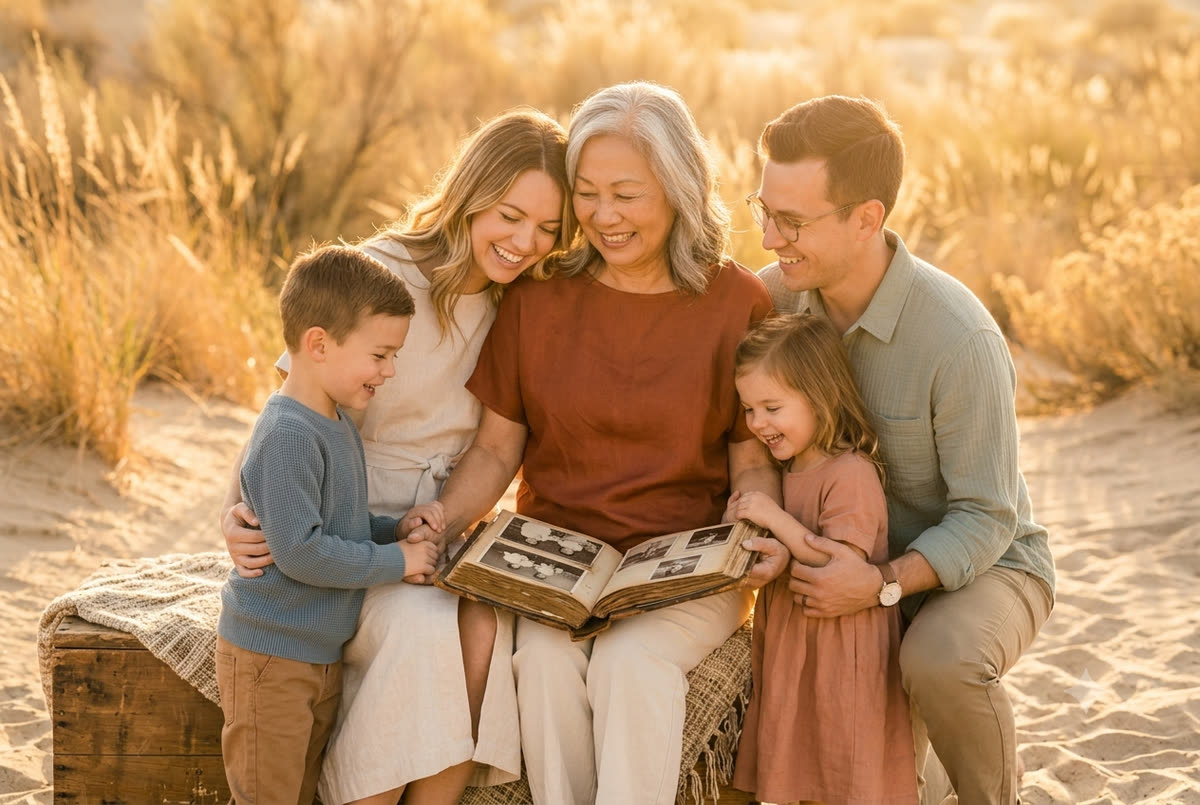
Whoever your person loves, and however many of them you can gather. Often the heart of a Legacy session is the generations together — a great-grandmother with the baby on her lap, three generations of one family on the same sofa. I think a great deal about how to make those work without it feeling like a stiff group shot; you might find how to plan a multigenerational photo session useful as you decide who to invite.
But solo portraits matter just as much. A clear, dignified, well-made photograph of one person — really seeing them — is something families return to for the rest of their lives. We can do both in one visit.
What actually happens during a session? Will it be exhausting?
I design these to be gentle, and I follow the person's energy, not a shot list.
A typical visit runs anywhere from twenty minutes to about an hour and a half, and I'd rather end early with everyone feeling good than press on. I usually start by just sitting and talking for a bit — no camera up — so the room settles and I stop being a stranger. Then I work quietly. I don't bark poses. I might suggest a few simple arrangements, but mostly I watch for the real moments and catch them: the hand-hold, the laugh, the quiet look between two people who've loved each other a long time.
If your person tires, we pause. If they need medication, food, or rest, we stop and that's completely fine. Nothing about this should feel like a performance.
What if they're self-conscious, frail, or not "looking their best"?
Nearly everyone feels this way, and it melts faster than you'd expect. Part of my job is to make the camera disappear so people forget to perform.
On the practical side: I photograph with kind, soft light and I'm thoughtful about angles, so the images feel like them at their warmest, not a clinical record. We can have hair done or not, favorite sweater or hospital gown — I'll make it look like dignity either way. If there's medical equipment someone would rather not see, I can frame around it or it can be edited out. The goal is a picture that, when the family looks back, says yes, that's exactly who they were.
Can the rest of us be in them, even if we're a mess emotionally?
Yes, and you don't have to hold it together for me. Some of the most honest frames I've made came from a moment that wasn't composed at all. If you cry, if you laugh too loud, if you climb onto the bed to be close — good. That's the relationship, and the relationship is what we're photographing.
How do I bring this up with my family — or with the person themselves?
This is one of the most common worries, so let me offer some words you can borrow.
To the person: "I love you, and I'd really like some beautiful pictures of us together while we can take our time with it. Would you let a photographer come spend a little while with us?" Most people, once they hear it framed as love rather than as an ending, say yes — and many are quietly relieved to be asked.
To reluctant family members: it helps to name the regret. Almost no one regrets having the photographs; a great many people regret not having them. You're not being morbid. You're making sure no one is left wishing.
If you're carrying a lot right now, you may also find comfort in my anticipatory grief resource hub, which gathers gentler reading for this season.
What about privacy? Will these images be shared anywhere?
Your privacy is absolute, and the default is that nothing is ever shown publicly. I will not post a Legacy session on my website or social media, full stop, unless a family later decides on their own that they'd like to and gives me written permission. These pictures belong to you. Many of the families I've photographed this way I've never named anywhere, and that's exactly how it should be.
What do I receive, and how soon?
You receive a collection of carefully edited, high-resolution digital images you can keep, print, and share with family forever. I also offer fine printing, albums, and framed pieces if you'd like something to hold — and for this kind of work, I gently encourage at least one beautiful print. Files are wonderful, but a photograph on the wall is what your grandchildren will grow up looking at.
For time-sensitive situations, I prioritize delivery. If a family needs an image quickly — for instance, to print and bring back to the bedside, or for a gathering — tell me, and I'll get a selection to you fast, often within a day, with the full gallery to follow.
How much does it cost? And what if money is tight right now?
Investment varies with what you're hoping for — the length of the session, how many people, whether you'd like prints or an album — and I'll always be transparent about it before we begin, with no surprises. I'd rather talk it through honestly than post a one-size price that fits no one.
I'll also say this plainly: I never want cost to be the reason a family goes without these pictures. If you're navigating real financial strain alongside everything else, tell me. I keep room for compassionate arrangements, and that conversation stays private and judgment-free.
Do you work with hospice teams, social workers, or care facilities?
Yes, and I'm comfortable doing so. I can coordinate timing with nursing staff, work within a facility's visitor guidelines, and keep a session quiet and steady in a shared space. If you're a hospice nurse, chaplain, social worker, or care coordinator in the Coachella Valley and you have a family who could use this, please feel welcome to connect us — I'm honored to be part of that circle of care.
What if our person passes before we can schedule?
First, I'm so sorry. If that's where you are, please be gentle with yourself — the wish to have photographed someone is itself a form of love, and not having gotten to is not a failure on your part.
There may still be ways I can help: thoughtfully copying and restoring older photographs, or making portraits of the family and the generations who remain so that this part of your story is held, too. Reach out and we'll talk about what would mean the most.
How do I begin?
You write one short note, or you call. That's the whole first step. You don't need to have the details figured out, you don't need to know who'll be there, and you don't need the right words — you can simply say my mother is ill and I think we'd like some pictures, and I'll take it from there with care.
When you feel the pull to do this, send me a note. Tell me a little about your person and whether time feels short, and I'll write back quickly and kindly. Of all the photography I do, this is the work I hold as the greatest privilege, and I'll meet whatever you send with care.