How to Plan a Multigenerational Photo Session
Most of my favorite multigenerational portraits are made somewhere ordinary and beloved — a grandparent's living room, a shaded back patio, a neighborhood garden a family has walked past for years. Three or four generations gather close, a grandmother rests her hand on her grandchild's shoulder, someone cracks a joke that only the family understands, and for a moment everyone forgets I am there at all. Those are the frames I treasure most — honest, warm, and impossible to recreate once the moment has passed.
If you are reading this, there is a good chance your family is gathering here in the desert, maybe for the holidays, maybe for a milestone birthday or anniversary, maybe simply because everyone finally landed in the same place at the same time. A multigenerational photo session is one of the most meaningful things you can do with that window of time together. It is also, I will be honest with you, the kind of session that rewards a little planning. The good news is that planning it well is not complicated, and I am going to walk you through all of it.
What a multigenerational session really is
A multigenerational session simply means more than two generations photographed together — grandparents, their adult children, and the grandchildren, sometimes a great-grandparent too. Around here I most often photograph these when the whole family converges on the Coachella Valley: snowbird grandparents who winter in Palm Desert or Indian Wells, with kids and grandkids flying in to visit them between November and April.
These sessions are different from a standard family session in a few important ways. There are more people, which means more logistics. There is a wider age range, from a six-month-old to someone in their eighties, which means we plan around the youngest and the oldest at the same time. And the emotional stakes are often higher, because these are frequently the photographs a family will hold onto for decades. I never lose sight of that — it is the reason I take the planning of a session like this so seriously.
Start with the "why" and the "who"
Before we talk about light and locations, I always ask families two questions.
Why now? Is this a reunion, a big birthday, a final winter season in the desert house, a new baby joining the family? Knowing the reason helps me photograph the heart of it, not just the faces. A session marking a grandfather's 80th will feel different from one celebrating a new grandchild, and it should.
Who is coming, and who matters most? Make a quick list — every person, their age, and any mobility or health considerations. If great-grandma tires easily, we photograph her groupings first and let her rest. If there is a toddler, we work around naps. I would rather know all of this in advance than discover it on the day.
This is also the moment to decide on the must-have groupings, which I will come back to below. A short, honest conversation up front is the single biggest thing that makes the day relaxed instead of rushed.
When to schedule: season and time of day
Living and working in the Coachella Valley means I plan every session around two things — the season and the sun.
Season. Our prime window for outdoor portraits runs roughly November through April. This is snowbird season, when the weather is glorious and, conveniently, when most extended families are actually in town. Daytime temperatures are comfortable, the light is soft, and you can stand outside in a nice outfit without melting. If your family is gathering for Thanksgiving, the December holidays, or a spring break visit, you are right in the sweet spot.
Summer is a different animal. From late May through September our afternoons regularly climb past 110 degrees, and that is genuinely too much for an 85-year-old or a baby to stand around in. I do not stop shooting in summer — I just move us to the very first light of morning, right around sunrise, or we shoot indoors and in shade. If your only chance to gather is July, do not despair; we simply adjust. But if you have a choice, the cooler months are kinder to everyone.
Time of day. My favorite light, hands down, is the golden hour — the hour or so before sunset (and the one after sunrise). The desert sun sits low, the harsh edges soften, and the mountains around us glow. It is flattering on every age and skin, which matters enormously when you are photographing a range from infant to elder. In winter that golden window falls in the late afternoon, around 3:30 to 5:00 depending on the month; in summer we chase it at dawn instead. The midday sun here is bright and unforgiving, so I steer families away from it unless we are working in open shade.
Where to photograph in the Coachella Valley
The two settings I reach for first with a large, multigenerational group are the family's own home and a nearby park or garden. They are the most comfortable for the very young and the very old, and they tend to produce the warmest, most personal images. From there, the valley offers plenty of variety within a short drive. Here are the settings I return to, and what each one offers.
- Your family home or vacation rental. This is where I most love to work. If the grandparents have a place in Palm Desert, Rancho Mirage, or Indian Wells with a pretty backyard, a sunlit living room, a pool, or mountain views, it is often the best possible choice. Everyone is comfortable, there is shade and a bathroom, little ones can nap, and the setting actually means something to your family. Indoors I work with soft natural light from the windows; out in the yard we use the warm, low light of the late afternoon. Some of my most treasured images are made right where a family lives.
- Gardens and parks. My other go-to. A landscaped park or community garden gives us greenery, gentle shade, easy paths, and benches — and benches are a quiet gift when you are seating an older relative between groupings. The Coachella Valley has lovely public gardens and shaded parks that suit a big group beautifully.
- Golf and resort grounds. Many families here belong to clubs in Indian Wells, La Quinta, or Rancho Mirage with manicured lawns, palms, and water features. With permission, these make for elegant, easy-access backdrops close to home.
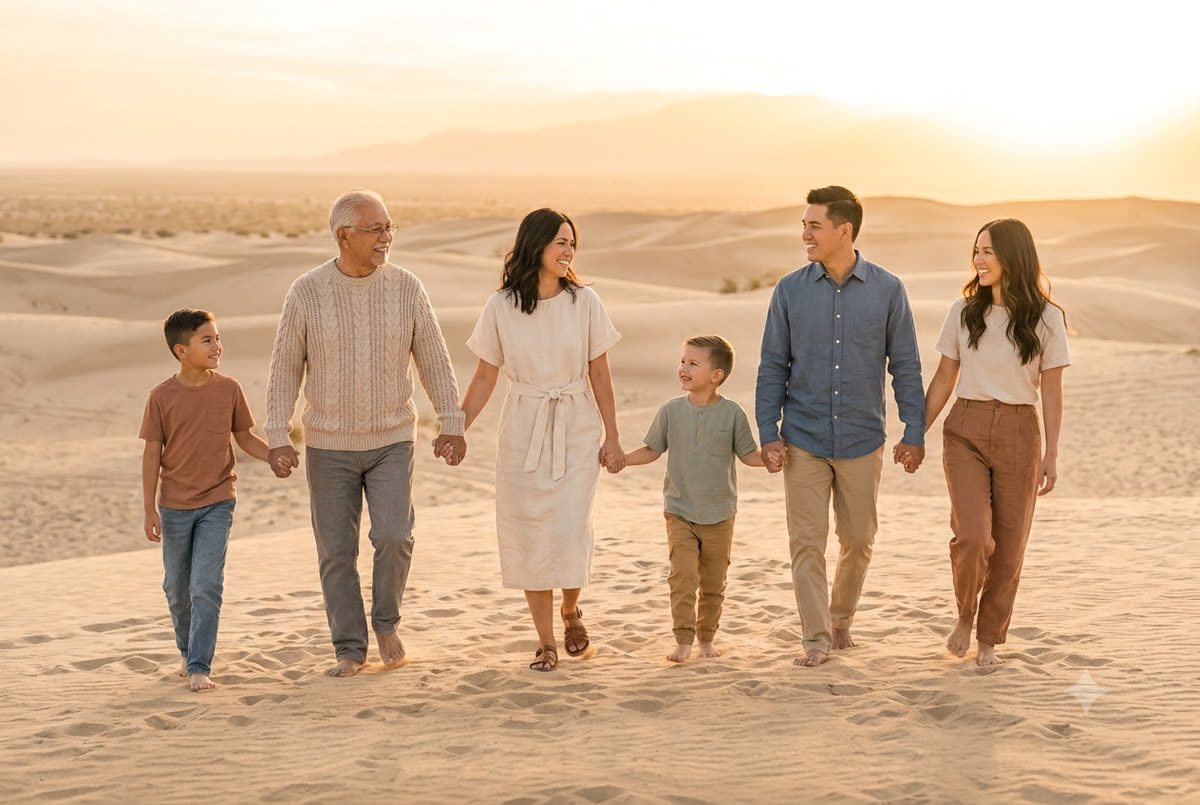
- A scenic desert backdrop, when you want it. For families set on that unmistakable Coachella Valley feel, we can include a sculptural desert view that glows in the late-day light. When we do, I choose spots with level footing and a short, easy walk so grandparents and toddlers alike can get to them — never a remote trek into open wilderness.
- La Quinta and the south valley. The dramatic Santa Rosa Mountains rising right behind the homes and resorts give portraits down here a real sense of place.
When I choose a location with you, I am quietly weighing four things at once: beautiful light, easy walking and parking, available shade and seating, and a backdrop that suits your family. A location that nails the first and fails the rest will make for a hard day with a large group, so we balance all four.
Coordinating outfits without the stress
The goal with a dozen people is harmony, not a uniform — you want a family that clearly belongs together while everyone still looks like themselves. The matching white-shirts-and-khakis approach has had its day, and identical outfits across three generations tend to flatten the very thing we are trying to capture.
Here is the simple approach I give every family:
- Pick a palette of two or three colors plus a neutral, and let everyone choose pieces within it. Soft, earthy desert tones — sand, warm white, sage, terracotta, dusty blue, olive — photograph beautifully against our landscape and light.
- Vary the textures and tones, not just the exact shade. A linen shirt, a knit, a flowing dress, a denim — variety within the palette keeps it from looking like a costume.
- Dress the anchors first. Often I suggest starting with grandma's outfit or the toddler's, then building everyone else around it.
- Mind the desert sun and dust. Lightweight, breathable fabrics keep older relatives and little ones comfortable. Layers are smart in winter, when mornings and late afternoons can be cooler than visitors expect.
- Skip large logos and busy patterns, which pull the eye away from faces.
If coordinating a dozen people feels daunting, send me a few photos of what people are planning and I will happily help you pull it together. I have done this many times and I genuinely enjoy it.
Planning the shot list
For a multigenerational group, a little structure on the day saves a lot of standing around. Before the session I work out a running order with you so we move efficiently from grouping to grouping. A typical list looks something like this:
- The full extended family, everyone together — we do this first, while energy and outfits are fresh.
- Grandparents with all the grandchildren.
- Grandparents alone (a portrait of the couple that started it all — these often become the most cherished).
- Each individual family unit (each adult child with their spouse and kids).
- The grandparents with each of their adult children.
- All the grandchildren together.
- Just the siblings (the adult children, as the kids they once were).
- Candid, unposed time — walking, talking, playing — where the real personality comes through.
We will tailor this to your family, but having an order means no one stands forgotten in the background and the people who tire most are photographed early. If you have a particular pairing that matters to you — the youngest grandchild with the eldest great-grandparent, say — tell me, and I will make sure we capture it before the day runs long.
The little ones and the elders: planning for both ends
The whole art of these sessions is keeping the youngest and the oldest comfortable at the same time.
For babies and toddlers: we schedule around naps and meals, not against them. A fed, rested two-year-old is a delight; an exhausted one is not, and that is on the schedule, not the child. I keep my approach calm and playful and I never force a smile — the best frames of small children come from real giggles, so I let them be themselves. Bring a favorite snack and a comfort toy, and trust me to work quickly through the groupings that include them.
For grandparents and great-grandparents: comfort and pacing are everything. We photograph their groupings early, keep a chair nearby, build in shade and water, and never make anyone stand longer than they need to. The pace I keep matters most here — gentle direction, plenty of breaks, no barking of orders. Plenty of older relatives arrive bracing themselves for a tedious afternoon and are surprised to find they enjoyed it, and that is exactly the experience I am after.
What to expect on the day
A full multigenerational session with me usually runs about 60 to 90 minutes — enough time to move through the groupings without anyone wilting, but not so long that the children fall apart. I will arrive ahead of you to scout the light, and when you get there my whole job is to make it feel easy. I will guide you into natural arrangements rather than stiff poses, I will catch the in-between moments, and I will keep the mood light. You are not performing for me. You are spending an hour together, and I am simply there to honor it.
If you are anxious about wrangling everyone, let that go. Herding a big, loving, slightly chaotic family is genuinely one of my favorite parts of the job, and I have a calm hand for it.
Common mistakes to avoid
After years of these sessions, here are the few pitfalls I gently steer families away from:
- Booking for high noon in summer. Heat and harsh light at once. Choose morning golden hour or the cooler months.
- Leaving it to the last day of the trip. Build in a backup. If a baby is sick or the wind kicks up, you want a second option, not a missed once-a-decade chance.
- Over-coordinating outfits into a matching uniform — relax the palette and let personalities show.
- Forgetting the grandparents-alone portrait. In all the group choreography it is the easiest one to skip, and so often the one families treasure most.
- Not telling me about mobility or health needs. I plan far better when I know. Nothing you share is a burden; it only helps me take care of your people.
A few related reads
If you are deeper into planning, you may find these helpful: my guide to the best time of year for family photos in the desert, my thoughts on what to wear for desert family portraits, and a piece on planning a multigenerational session during snowbird season when the whole family is in town.
Let's plan yours
Families rarely regret making time for these portraits. What I do hear, far too often, is the wish that they had done it a year or two sooner — while everyone was still here to stand in the frame. If your family is gathering in the Coachella Valley, that window is open right now. I would be honored to help you make the most of it, in a way that feels true to who you all are.
So here is my invitation: tell me about your family. Send me a note with who is coming and roughly when, and we will sort out the home or the park, the light, and the timing together. That first message is all it takes to set it in motion.