Hospice Photography
There is a particular kind of phone call I have learned to answer slowly and softly. It usually comes from a daughter, sometimes a son or a spouse, and the voice on the other end is trying to be practical about something that is anything but. "My mother is in hospice," they say. "I think we waited too long for pictures. Is it too late?"
It is almost never too late. And that single, tender question is the reason I do this work.
I have spent many years photographing weddings, engagements, newborns, and three-generation family portraits across Palm Desert and the Coachella Valley. Over time, more and more families have asked me to come to them at the hardest moment — when a parent or partner is nearing the end of life — to make photographs they will treasure long after. This is what people mean when they search for a hospice photographer, and it is some of the most meaningful work I am ever invited into.
I want to talk about it plainly here, because most families have never thought about hospice photography until they suddenly need it, and they deserve a calm, honest guide rather than a sales pitch.
What hospice photography actually is
Hospice photography is a session made during end-of-life care — in a private home, an assisted living community, a memory care unit, or a hospital room — to capture a person while they are still here, and the people who love them gathered close.
It is not morbid. It is the opposite. It is a celebration of a life that is still being lived, photographed with enormous gentleness and respect. Sometimes the photographs are of the person alone — their hands, their face in the afternoon light, the wedding ring they have worn for sixty years. Often they are of relationships: a husband holding his wife's hand, grandchildren leaning in for one more story, adult children sitting on the edge of the bed the way they did when they were small.
Some families want a portrait that looks formal and timeless. Others want something documentary and quiet — me staying in the background, photographing the visit as it naturally unfolds. Many want both. There is no single right way to do this, and part of my job is helping you find the shape that fits your family.
People use a lot of different words for this when they first reach out to me — hospice photography, end-of-life photography, legacy portraits, a "before it's too late" session. They are all reaching for the same thing: a face they love, held safely in an image, before that chance is gone.
Why families wait — and why I hope you won't
Almost every family tells me the same thing afterward: I wish we had called sooner.
It is completely understandable that people wait. In the middle of medications, appointments, and the emotional weight of it all, photography can feel like the least urgent thing on the list. There is also a fear that asking for pictures means giving up hope, or that it will upset the person who is ill.
In my experience, the truth is gentler than the fear. When a session is handled with patience and care, it is far more often a comfort than a strain — for everyone in the room. The person who is dying frequently understands, better than anyone, how much these images will mean to the people they are leaving. I have watched a frail parent rally with real joy at being photographed with their grandchildren, because for an hour they got to be the center of their family's love rather than the center of its worry.
So my honest, gentle advice is this: if the thought has crossed your mind, that is the signal to reach out. Conditions can change quickly, and I would always rather have a relaxed, unhurried session next week than a rushed one we almost missed. If today is the only good window, I will do everything I can to come today.
What to expect from a session with me
My approach to hospice and legacy work is the same gentle, patient one I bring to every shoot — just slowed down and softened to fit the moment.
Before I arrive, we talk. Usually with a family member rather than the patient. I want to understand who they are: their name, what they love, who will be there, what their energy and comfort are like, and what time of day they tend to feel strongest. In the desert, that is often mid-morning before the heat and fatigue set in, though every person is different. We will also talk about anything sensitive — medical equipment you would like included or kept out of frame, mobility, hearing, whether they tire quickly.
I keep the footprint small. No big lights, no elaborate gear, nothing clinical or intimidating. I work primarily with the natural light already in the room — the soft glow through a west-facing window in Rancho Mirage, the warm desert light that pours into so many of our valley homes in the late afternoon. A quiet camera, a gentle presence, and plenty of time.
We go at their pace, not mine. If your loved one needs to rest, we rest. If a good moment lasts ten minutes, we make beautiful work in ten minutes. I never force smiles or stiff posing. I am watching for the real thing — the way a hand reaches for another hand, the expression that crosses a face when an old song comes on, the laugh that still sounds exactly like it always did. That flicker of someone being unmistakably themselves is what I am always watching for, and it matters more here than anywhere.
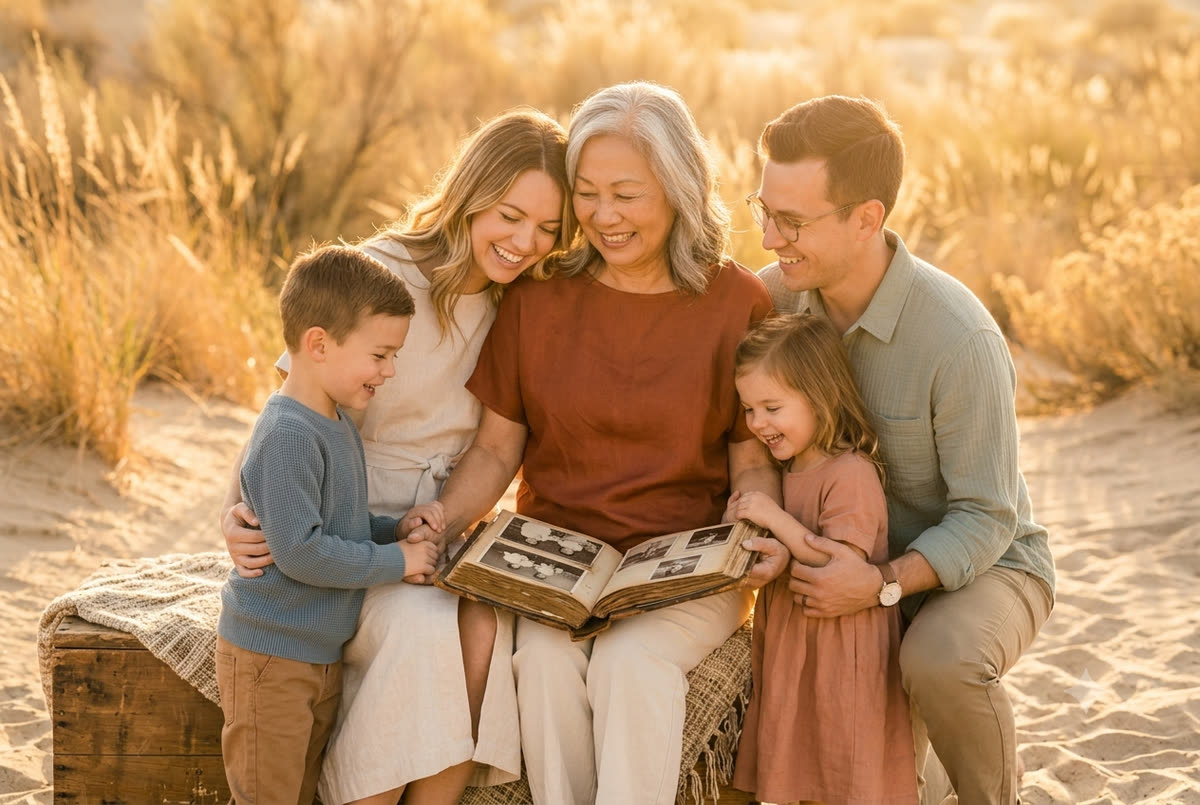
Family is welcome and encouraged. Some of the most treasured frames are the ordinary ones — everyone crowded onto the bed, four generations in a single picture, a great-grandchild meeting their namesake. If relatives are flying in from out of town, we will try to time the session for when the most people can be present.
Where these sessions happen in the Coachella Valley
I photograph hospice and legacy sessions wherever you and your loved one are most comfortable, throughout Palm Desert, Palm Springs, Rancho Mirage, Indian Wells, La Quinta, Indio, and Cathedral City. That includes:
- Private homes, which are my favorite setting — surrounded by familiar things, family photos on the walls, the light they know.
- Assisted living and memory care communities across the valley. Many have lovely common rooms, shaded courtyards, and gardens that photograph beautifully, and most are very accommodating when I coordinate with staff ahead of time.
- Hospital and inpatient hospice rooms, where I work quietly within the staff's guidance and keep everything calm and unobtrusive.
- A favorite outdoor spot, when health and mobility allow. If your loved one is well enough to sit outside for a short while, the soft light of a desert morning or the golden hour before sunset can be extraordinarily tender — a shaded patio, a garden, a view of our mountains.
Because we have such a large snowbird community here, I often work with families whose loved ones spent their winters in the desert for decades. If relatives are scattered between here and back home, I am happy to help plan around travel so the right people can be in the room.
Tender details worth thinking about
A few small things make a meaningful difference in how these photographs feel and last:
- Meaningful objects. A wedding ring, a favorite sweater or hat, a beloved book, a quilt, an instrument, a pet. These tell the story of a whole life in a single frame.
- Hands. I almost always photograph hands — held, folded, resting on a grandchild's. Years from now, you will know those hands anywhere.
- The things they say and do. If your loved one is up for it, I love to quietly photograph them doing something they have always done: sipping coffee a certain way, telling a particular story, holding someone close.
- What to wear. Comfort comes first, always. Soft, solid colors photograph beautifully and there is no need for anything formal. If family is joining, gently coordinated tones look lovely together, but please do not let wardrobe become one more thing to worry about.
- Privacy and dignity. You decide what is photographed and what is not. Medical equipment can be included as part of the honest story or kept entirely out of frame — whatever feels right to you. Nothing is ever shared publicly without your clear permission.
Common questions families ask
Is it disrespectful or strange to want photos right now?Not at all. Wanting to hold on to someone you love is one of the most natural human instincts there is. Families thank me for these images for years.
What if my loved one isn't conscious or able to participate?We can still create something beautiful and respectful — gentle portraits, the family gathered close, the quiet details of hands and rings. I will follow your lead entirely on what feels right.
How quickly can you come?As quickly as I can. I treat these requests as time-sensitive and will always try to accommodate a short timeline. Please reach out the moment you are thinking about it.
How long does a session take?However long is comfortable — often somewhere between thirty minutes and an hour, and easily shorter if your loved one tires. We never rush.
How and when will we receive the images?I handle these with care and priority. I deliver a gallery of beautifully edited images, and I am glad to advise on prints and albums so these moments live somewhere more permanent than a phone.
Beyond the session: holding the story
Hospice photography is one part of something larger I think of as legacy work — preserving not just a face but a whole life's story for the people who come after. If you find these images comforting, you may also want to think about a legacy portrait session for elder family members while they are well, or about preserving old family photographs and the stories behind them so they are not lost.
And when the time comes, gentle end-of-life and memorial photography can help a family hold onto one another, too. These are hard subjects, I know. But I have found that the families who face them with a little tenderness and intention are the ones who later feel most grateful they did.
A quiet invitation
If you are reading this in the middle of a hard season, I am so sorry for what your family is walking through, and I am honored that you would even consider letting me into it. You do not need to have anything figured out before you reach out — a short conversation costs you nothing and often makes the next step clearer.
Whenever it feels right, send me a note here. Tell me a little about your loved one, or just ask me a question. I will answer gently, and we will take it one step at a time — together.