End-of-Life Photography Services
Of all the work I do, this is the work I hold most carefully. End-of-life photography is the quiet art of being present with a person and the people who love them, in a season that asks for tenderness rather than performance. There is no posing toward a future milestone, no "say cheese." There is only now — a hand held, a story told one more time, the particular way someone's eyes still light up. My job is to notice that, and to keep it.
If you have found your way to this page, you may be facing something hard: a parent in hospice in La Quinta, a spouse whose health is fading at home in Rancho Mirage, a grandparent you want the grandchildren to remember not as a memory but as a face. I want you to know that you are not asking for too much. Wanting beautiful, honest images of someone while they are still here is one of the most loving things a family can do. Let me walk you through what this work is, how it unfolds in the Coachella Valley, and how to think about it without pressure.
What end-of-life photography actually is
End-of-life photography — sometimes called legacy photography, hospice photography, or simply final portraits — is documentary and portrait work made during the last chapter of someone's life. It is not morbid, and it is not the same as the funeral photography or memorial slideshows that come after. This happens while your person is living: alert or resting, talking or quiet, at home or in a care setting.
The images can take many shapes depending on what the family wants and what the person is able to do:
- Quiet portraits of the individual — a real, dignified likeness made with soft light and patience.
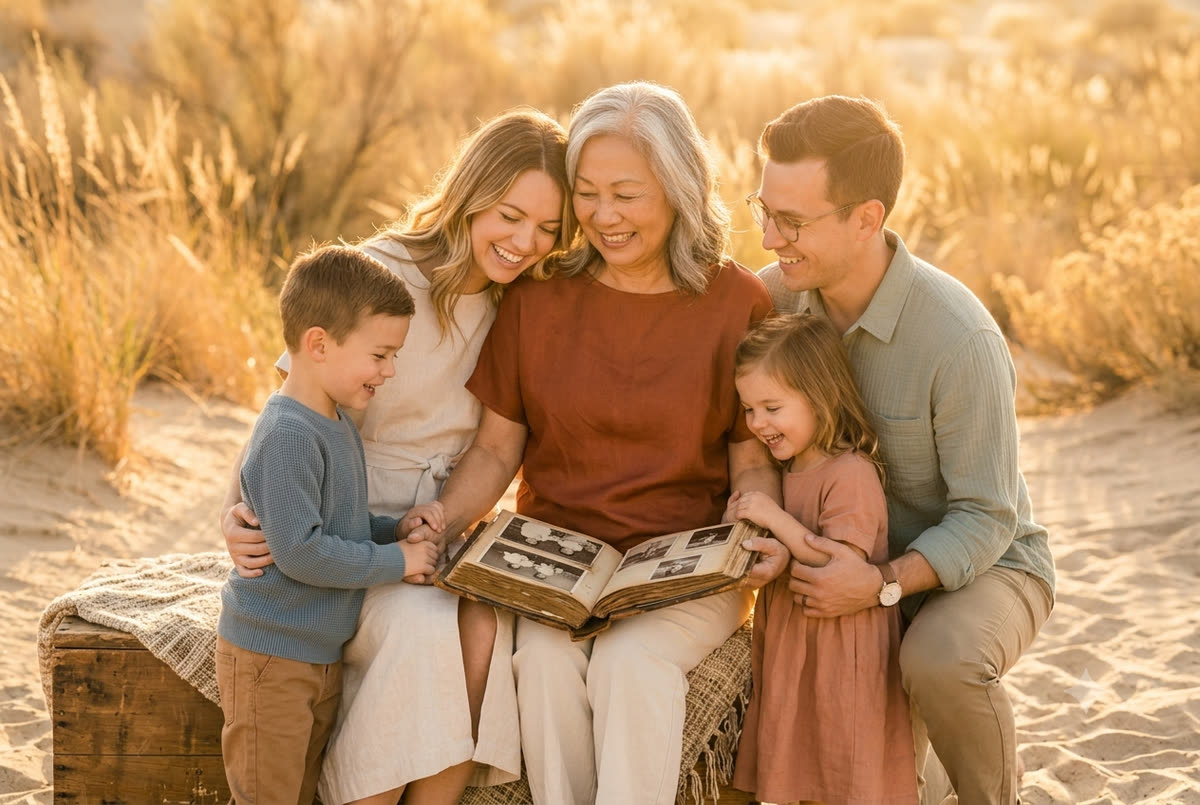
- Connection photographs — the holding of hands, a forehead kiss, three generations on one bed, a granddaughter reading aloud.
- The details that carry a whole life — the wedding ring worn thin, the worn recliner by the window, the garden in Indian Wells they tended for forty years, the rosary, the reading glasses, the hands.
- Story and voice — sometimes families pair the session with a short recording of their loved one talking, so the photographs come with a sound.
There is no single correct version. Some families want only a few tender frames of two people together. Others want a full afternoon documented. We decide together, gently, and we can change course at any moment.
Why these portraits matter more than we expect
I have been photographing families for many years, and the same thing happens nearly every time: it is the unplanned, in-between frames that people treasure most. A laugh. A glance. The hand resting on a shoulder. In ordinary life we assume there will always be another chance to take that picture. In this season, there may not be — and that is exactly why the photographs become irreplaceable.
Again and again, it is one of these quiet frames that a family ends up keeping by the door — a portrait of a mother's hands, perhaps, or a grandfather smiling at a great-grandchild he has only just met — the kind of image people find themselves looking at every morning. These pictures do not erase grief. But they give it somewhere to rest. They let children and grandchildren remember a real, warm, whole person rather than only the harder final days.
When to call — and why sooner is gentler
If there is one regret I hear echoed in this work, it is the wish to have reached out a little sooner. I never want anyone to feel rushed, and at the same time I want to be honest with you: health can change quickly, and the earlier we connect, the more options we have.
If your person is comfortable, conversational, and able to be photographed sitting up or moving a little, that is a beautiful time — we can take things gently and at our own pace. If things are further along, we simply adjust: shorter sessions, softer expectations, more rest. There is no stage that is "too late" to make something meaningful, but earlier almost always means gentler.
Practically, here in the desert this often means a same-week or even same-day call. I keep room in my schedule for these requests and treat them as the priority they are. If you reach out and your person is having a good morning, I will do everything I can to come while that window is open.
What a session looks like in the Coachella Valley
Most end-of-life sessions happen wherever your person is most at ease. In our community that is usually one of three places:
- At home — a living room in Palm Desert, a bedroom in Cathedral City, a shaded patio in Indio. Home is where someone is surrounded by their own things and their own light, and it almost always makes the most honest pictures.
- In a care or hospice setting — Coachella Valley hospice houses, skilled nursing, assisted living, or hospital rooms throughout the valley. I am comfortable working quietly in these spaces and around medical equipment, and I am respectful of staff and other residents.
- Outdoors, when health allows — a wheelchair-accessible spot of desert garden, a courtyard, the soft early light off a fountain in Rancho Mirage or Indian Wells.
A word about our desert specifically: light and temperature matter more here than almost anywhere. From late spring through summer the heat is real, and I will never ask a fragile person to sit in it. Most of the time we simply work indoors, near a window where the daylight falls soft and even across the room — to my eye, the loveliest light there is for this kind of portrait. When the weather is kind and your person is up for it, a short, gentle time outside — on a shaded patio or in a nearby garden during the slanting golden light of late afternoon — can be a gift. Either way, I bring my own soft, flattering light with me, so the photographs are never at the mercy of the hour or the sky.
A typical visit unfolds slowly and quietly. I arrive quietly, often without much equipment visible, and I spend the first while simply being in the room — letting your person and your family relax, letting me understand the dynamic. I photograph softly around the edges of normal life: the conversation, the holding, the small rituals. If portraits are wanted, we make them when the moment feels right, never on a clock. Most visits run somewhere between forty-five minutes and two hours, but I follow your person's energy, and a fifteen-minute session is just as valid if that is all the day allows.
How to prepare — for the family
You do not need to do much, and please do not exhaust yourself cleaning or arranging. Still, a few small things help:
- Think about a few objects or settings that matter — a favorite chair, a quilt, a piece of jewelry, a window with good light. Tell me, and we will weave them in.
- Consider who you want in the frame. Spouse, children, grandchildren, the dog. Multigenerational images are some of the most cherished, so if family is in town, this is a beautiful reason to gather them.
- Choose comfortable clothing, not formal. Soft, solid colors photograph kindly. But if your person is most themselves in a worn cardigan, that is the right choice.
- Let go of "looking sick." Families often worry about tubes, thinness, or a hospital gown. I photograph with great care and the right light and angles, and the love in the room always reads louder than the illness. We can also keep certain things out of frame if you prefer.
- Pick a good time of day. You know your person's rhythm — when they are most alert and comfortable. Morning is often best. We build the visit around that.
How to prepare — and what to say to your person
If your loved one is aware and able, a simple, warm framing usually lands best: "We'd love to have some beautiful pictures of you, and of all of us together." Most people are touched to be asked. Some are shy about being photographed; that is completely all right — I work softly enough that the camera fades into the background, and connection photos rarely require anyone to "perform."
If your person is no longer responsive, families still find deep meaning in images of held hands, a kiss on the forehead, the gathering at the bedside. We do this with the utmost gentleness and only ever with your blessing.
Common questions families ask
Is this strange or inappropriate to want? Not at all. It is loving and brave. For generations, families made portraits in exactly these moments; we have simply grown unused to it. Wanting to remember is human.
Will the photos be sad to look at? Most families tell me the opposite — that the images become a comfort. I make warm, honest pictures, not clinical ones. You will see the person, not the illness.
What about privacy and dignity? Your trust is everything to me. Nothing is ever shared publicly without your explicit permission, and many of these sessions remain entirely private to the family. You are always in control of who sees these images.
Can you work with hospice staff and medical equipment? Yes. I work quietly and unobtrusively in care settings and I coordinate easily with nurses and caregivers. I can frame to include or quietly exclude medical details as you wish.
How quickly can we get the photographs back? Because of the nature of this work, I prioritize delivery. When time is short, I can turn around a first set of edited images very quickly — often within a day or two, sometimes the same day for a few key frames — so the family can see them while it still matters most.
Do you photograph the very young this way too? Yes. I also do gentle remembrance work for families facing loss at the very beginning of life, with the same care and discretion.
What you receive
You will receive a collection of carefully edited, high-resolution digital images that are yours to keep, print, and share within your family forever. I am a believer in printed photographs, especially here — a framed portrait on the wall, an album the grandchildren can hold. For legacy work I am always glad to help you turn the images into something physical: prints, a small album, an enlargement for a service if that becomes part of your story later. There is no pressure to order anything; the photographs themselves are the heart of it.
A note on cost and care
I keep the conversation about money simple and humane in these circumstances, and I never want it to be a barrier to a family who needs this. When you reach out, tell me what you are facing and we will find a way that works. This is, more than anything, a calling for me rather than a transaction.
You are not alone in this
If you are reading this for someone you love, I am so sorry for what you are walking through, and I am honored that you would even consider letting me into this moment. End-of-life photography is a small, steady act of love — a way of saying you mattered, you were here, and we will not forget your face.
You may also find these companion pieces helpful as you think about legacy and remembrance: legacy and heritage portrait photography for celebrating a life that is still being fully lived, multigenerational family portraits in the desert for gathering everyone while you can, and how to plan a meaningful family session when you want the whole story told.
Whenever you feel ready — and it is perfectly all right if that is the very hour you finish reading this — send me a note through my contact page. Tell me a little about your person: their name, where they are, how things stand for you right now. From there, we will move at whatever pace the days will allow.