Legacy & End-of-Life Photographer in Palm Desert
Most people who find this page were not casually browsing. They typed something specific into a search bar — legacy photographer Palm Desert, or some braver, plainer version of photographer for my dying father — and they did it with a particular face in mind. A mother whose memory is slipping. A husband on hospice. A grandfather who is suddenly, undeniably old. If that is why you are here, I want to say first that you are doing a loving and clear-eyed thing, and I am glad you found me. I am Margot, and for many years I have photographed families across Palm Desert and the Coachella Valley through every chapter, including the last one.
This is the page where I tell you exactly how that work goes — what a legacy or end-of-life session looks like in practice, where we do it here in Palm Desert, how I handle the hard logistics of frailty and timing, and what you will be left holding when it is done. I will be honest with you throughout, because honesty is the only thing that helps in this particular situation.
A note on the words "end of life"
Let me address the phrase head-on, since it is probably the one you searched. I do not love the term end-of-life photography. It is clinical, and it points at the wrong thing — at an ending, when the whole purpose of these portraits is to hold onto a person while they are still here. I tend to call this work legacy photography: making a deliberate, dignified record of someone who matters, so the people who love them have something true to keep.
But I use the longer phrase on this page on purpose, because I know it is the language families reach for in a hospital hallway at two in the morning, and I would rather you find me than not. So whether you call it legacy photography, heritage portraits, a while-we-still-can session, or end-of-life photography, we are talking about the same gentle thing. You do not need to have the right word. You just need to reach out.
Who calls me, and when
Over the years, the calls about a parent or grandparent's final season tend to come at a handful of recognizable moments. You may see your own situation in one of these.
- Right after a hard diagnosis. The word terminal has been said, and there is a window — sometimes months, sometimes weeks — when your person still feels like themselves. This is the best time to call, not the last.
- When a parent moves into care. A move into assisted living or memory care in Palm Desert often makes families realize how much has already changed, and how little is documented from the years that mattered.
- When the snowbird season is ending. The kids have flown into the valley for the winter, everyone is finally in one place, and you can feel that this particular gathering may not happen again. (More on that timing below — it matters here more than almost anywhere.)
- On hospice. I do photograph people who are actively dying, in their homes and in hospice care, and I consider it some of the most important work I am ever trusted with. These sessions are short, quiet, and built entirely around comfort.
- Too late, almost. Sometimes someone calls and says I should have done this a year ago. We can still make something beautiful from where we are. We start with what today gives us.
If you are anywhere in those moments, you are not being morbid or premature. You are being the person in the family who pays attention.
What an end-of-life or legacy session actually looks like
I think the fear that stops most families is a picture in their head of something heavy and formal — a sick person propped up under hot lights, made to perform wellness they do not feel. That is not what I do. Here is what actually happens.
We talk first, by phone or text, before anything is scheduled. You tell me who this is — not their diagnosis, but them. The way your father tells the same three stories. The fact that your mother will only smile for real if her great-grandbaby is on her lap. What they are still able to do, and what tires them. I build the entire session around the answers.
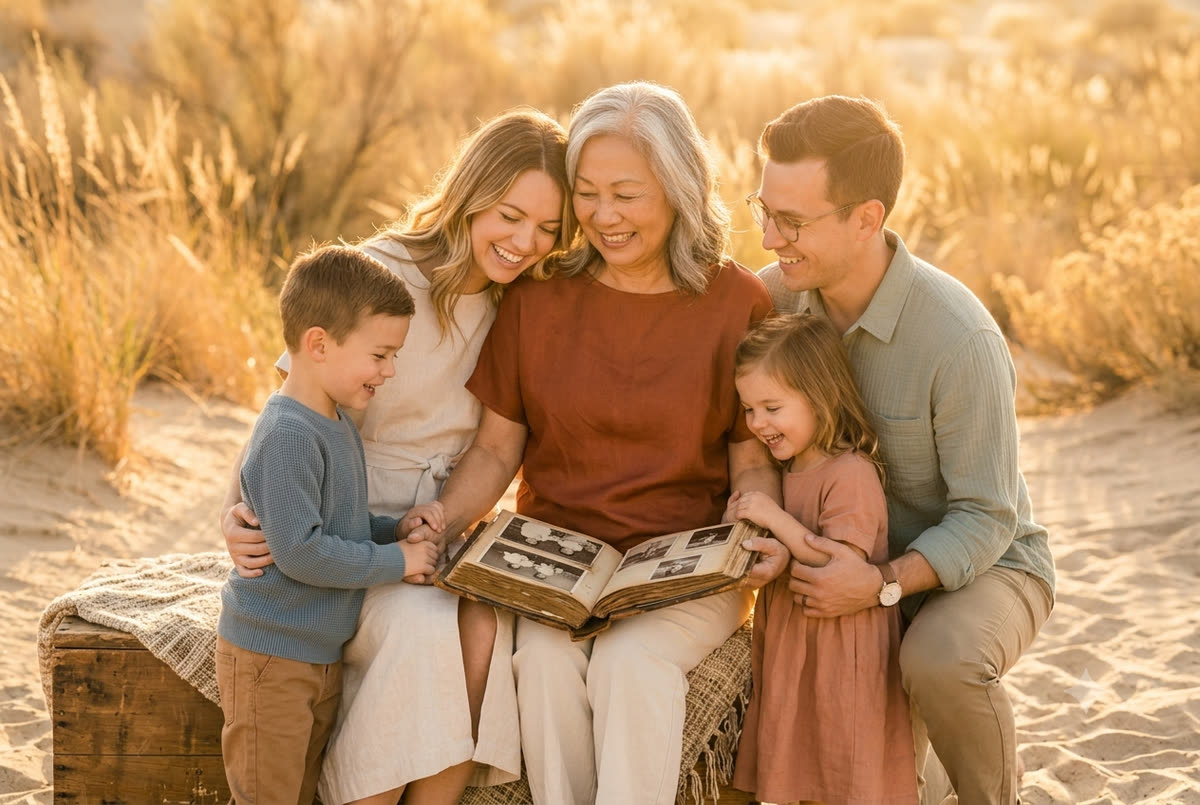
On the day, I come to wherever your person is most comfortable, and I work slowly and quietly. Often I will photograph the family around them first — the hands, the leaning-in, the small affections — so that by the time I turn the camera toward the person themselves, the room has softened and nobody is bracing. I look for the real thing: the one expression that anyone in the family would recognize across a crowded room. If we get twenty good minutes, that is plenty. If your person fades, we stop, and what we have is enough. I would rather end early with three honest frames than push for an hour and get a tired stranger.
I have written more about the gentle particulars of this in my piece on photographing aging parents with dignity, and about the broader celebratory side in my guide to legacy and heirloom portraits. This page is the Palm Desert–specific, plainer-spoken companion to both.
Where we photograph in Palm Desert
One advantage of having worked this valley for so long is that I know which settings are kind to an older or frail body, and which only look good in a brochure. Almost all of this work happens where life already does — in a parent's own home, or somewhere small and familiar close by. For legacy and end-of-life work in Palm Desert specifically, here is where I actually shoot, starting with the setting I return to most.
In the home
This is where most of these sessions belong. A parent's own living room — the chair they always sit in, the window with the good afternoon light, the wall of grandchildren's school photos behind them — already holds the story. There is nothing to travel to, no stairs to manage, no audience. For anyone with limited mobility or low energy, the home is almost always the right answer, and frankly it produces the most honest pictures anyway.
At assisted living and memory care communities
Palm Desert and the surrounding cities are full of senior living communities, and I am comfortable working inside them. I come to the community, check in with the staff, and photograph your loved one in their room, in a quiet lounge, or in a shaded courtyard, with family gathered close. I keep these sessions short and gentle, and I follow your person's pace, not a schedule. If your mother is sharpest in the late morning, we shoot in the late morning. If a nurse needs to be nearby, that is no trouble at all.
Outdoors, when it is genuinely possible
Some people in their last chapter are still mobile and still love to be outside, and the desert can be glorious for them. When that is the case, I choose easy, level, shaded ground close to parking — the gardens around Palm Desert's Civic Center Park, a quiet stretch near El Paseo, a courtyard or poolside at a resort where the family is staying. The honey-colored light an hour before sunset is forgiving on every face, young and old, and it gives the portrait an unmistakable sense of this is a desert family, this is home. But I will never march a frail person across hot open sand for the sake of a dramatic backdrop. Comfort wins, always.
At the hospital or in hospice
When someone cannot leave a bed, I come to the bed. I have photographed people at Eisenhower Health and in home hospice settings throughout the valley, and I know how to be small and quiet in those rooms. We can include the things that matter — a wedding ring, held hands, a grandchild climbing up gently — and we can make a tender, dignified image even there. If this is your situation, please just tell me when you call. I will plan everything around it.
The timing nobody wants to talk about
I am going to be direct, because gentleness without honesty is not actually kind in this work.
The single most common thing families say to me afterward is a quiet version of I am so glad we did not wait. And the single most common regret I hear from people who call too late is the mirror image of it. Time is the whole subject here. We tell ourselves there will be another visit, another winter, another good week — and most of the time there is, until the once there is not.
There is also a seasonal reality specific to the desert. So many Palm Desert families are split across the country, with adult children and grandchildren who only land here during snowbird season, roughly November through April. That winter window may be the only stretch when three or four generations are physically in the same place. If a parent or grandparent is declining and the family is gathered for the holidays or spring break, that is the moment — not next year, not the last day before everyone flies home with a cold going around. I always encourage families to book early in the visit, so we have a little slack if someone needs a quiet day first.
If you take one thing from this page, let it be this: the right time to make a legacy portrait is while it still feels slightly too early. By the time it feels obviously urgent, the window has usually narrowed more than you can see.
What you will be left holding
Here is the part I feel strongly about, and it is the same advice I give every family: order the print. Please do not let these images live only as files on a phone.
A digital file feels like the safe, modern choice, but it is the most fragile thing we make. Phones are lost, cloud accounts lapse, file formats quietly stop opening a decade from now. None of that can hold the place a real print holds. The framed portrait on the hallway wall, the album in the drawer that gets pulled out at every holiday, the archival print tucked in with the family papers — that is the heirloom. That is what a grandchild not yet born will one day hold and say this is who we came from. I help my families choose those prints and albums precisely because, in this work, a portrait that never leaves a hard drive has not finished its job.
For the families I photograph in someone's final season, there is one more quiet truth: these prints often become the image at the memorial, and then the image on the mantel for the next forty years. It is worth getting it right and getting it printed.
A few honest questions families ask
Is it strange or wrong to photograph someone who is dying? No. It is an act of love, and almost every family tells me afterward it was one of the best decisions they made. The discomfort beforehand is normal; the gratitude afterward is nearly universal.
My parent is very frail, or confused, or self-conscious about how they look now. All of that is workable, and none of it disqualifies us. I photograph people as they are, with dignity, and I am unhurried and patient with confusion. We can keep it to their room, to a few minutes, to whatever they can give.
Can you come the same week? It feels urgent. Yes — please say so when you reach out, and I will do everything I can to move quickly. For active hospice situations I treat the timeline as the priority it is.
Should the whole family be in it, or just the one person? Both have their place. A single, definitive portrait of one beloved face is a powerful thing to own. So is the four-generations-of-hands image, or the full family gathered close around the chair. We can do several in one short visit.
We are only in Palm Desert for the winter. Is that enough time? It is, and it is often exactly the right time. The whole point is to photograph everyone while you are together. Reach out early in the stay so I can hold a date.
When you are ready
If you have read this far, there is almost certainly a specific person on your heart — and a quiet voice telling you not to put this off. I would be honored to make these portraits for your family, here in Palm Desert or wherever in the valley your person is. We can begin simply, with a phone call about who they are and what you most want to remember.
The desert light is patient, and so am I. When you feel ready — and a little before you feel fully ready is better still — send me a note here, and we will make something your family will hold onto long after this season has passed.