Creating a Memory Wall at Home
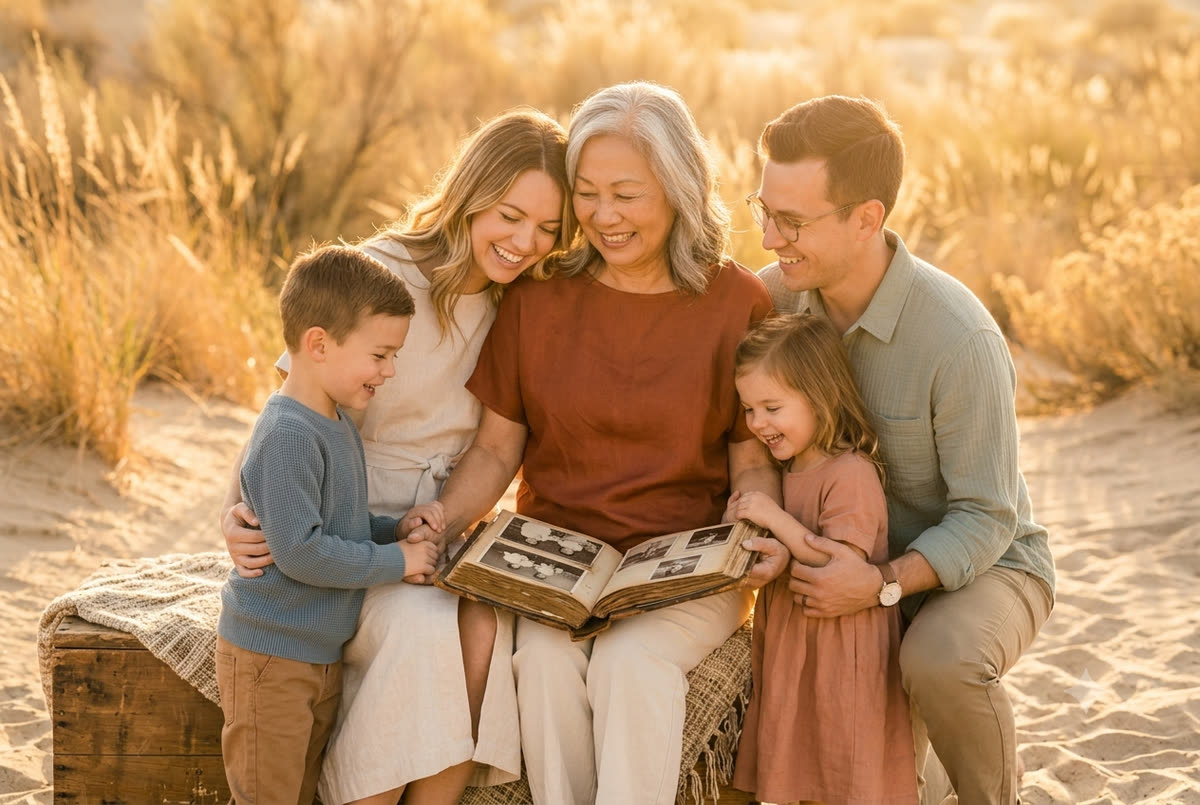
There is a particular hour, usually a few weeks after a loss, when the casseroles have stopped arriving and the house has gone quiet again, and you find yourself standing in front of a blank stretch of hallway. You have a shoebox of prints, a phone full of pictures, and the ache of wanting to see the person — not just remember them, but look up from folding laundry and find their face there. That blank wall is not an emptiness. It is an invitation. And turning it into a memory wall is one of the gentlest, most quietly powerful things you can do for yourself and the people you live with.
I have photographed Coachella Valley families through every chapter, including the hardest ones, and I have spent a lot of time helping people figure out what to do with the images afterward. So let me walk you through how to build a memory wall that feels like them — warm, honest, and present — rather than a stiff shrine you tiptoe past.
What a memory wall really is
A memory wall is simply a deliberate grouping of photographs (and often a few objects) gathered in one place to honor a person, a relationship, or a whole family's story. People build them for all sorts of reasons:
- To remember someone who has died, and give grief a place to land.
- To celebrate a long marriage or a parent's life on a milestone birthday or anniversary.
- To keep a far-flung family visible — the grandchildren in Seattle, the cousins in Indio — all in one view.
- To anchor a sense of belonging for children, so they grow up literally surrounded by the people who love them.
The remembrance kind is what I want to focus on here, because it carries the most weight and the most worry. People are afraid of getting it wrong — of making it too sad, too cluttered, too permanent, too soon. I promise you there is no wrong. There is only the version that helps, and we can build toward that together.
If you are earlier in the process and still gathering and protecting the images themselves, you may want to start with organizing and preserving family photos after a loss before you hang a single frame.
Start with the feeling, not the frames
Before you measure anything or buy a single nail, sit with one question: what do you want to feel when you walk past this wall?
Some families want comfort and warmth — golden, casual, full of laughter. Others want something more formal and reverent. Some want the wall to be a conversation that children are invited into; others want a private corner only the household sees. There is no correct answer, but knowing yours will quietly decide everything else: the location, the color palette, whether you mix in handwriting and objects, how dense the arrangement gets.
I always tell people: a memory wall should feel like the person walking back into the room, not like a memorial plaque. The goal is presence, not solemnity. When you choose images, lean toward the ones where they are being themselves — mid-laugh, squinting into the desert sun at a tailgate, hands in the dirt in the garden — over the stiff posed studio portrait where they look like a stranger in their good shirt.
Choosing the wall and the spot
Location matters more than people expect. A few things I have learned watching these go up in homes across the valley:
Pick a wall you pass often, but don't have to perform in front of. Hallways are wonderful — you encounter the wall many times a day, in passing, in your own rhythm, without an audience. A stairwell wall, a spot beside the kitchen, the wall along the way to the bedrooms. Living room walls work too, but be honest about whether you want guests asking about it every time they visit.
Mind the desert light. This is the one piece of genuinely local advice that matters here. Our valley light is gorgeous but it is strong. A wall that gets direct afternoon sun — especially west and south-facing windows from roughly Palm Springs to La Quinta — will fade unprotected prints faster than you would believe, and our summers are long and brutal. If your chosen wall catches hard direct light, do two things: ask your print lab for UV-protective glass or acrylic (museum glass is worth it), and consider that a true archival pigment print will outlast a cheap drugstore print by decades. North-facing and interior hallway walls are the safest homes for irreplaceable images.
Watch the temperature and humidity swings. Avoid hanging your most precious original prints on a wall directly above a fireplace, or in a casita or garage that isn't climate-controlled through summer. Heat and humidity cycles are hard on paper and adhesives.
How many photos, and which ones
The most common mistake I see is treating a memory wall like a data dump — forty photos of decreasing importance, crammed edge to edge until no single image can breathe. Restraint is what makes it feel curated and loving rather than overwhelming.
A good working approach:
- Choose one anchor image. The single photograph that most says this is who they were. Print it largest. Everything else orbits it.
- Add a supporting cast of 5 to 12. Different eras, different moods — one from their youth, one with the grandkids, one of just their hands or their handwriting, one that makes you laugh.
- Leave breathing room. Empty wall space between frames is not wasted space; it is what lets each face matter.
Mix the scales of life, too. A wedding portrait next to a candid of them asleep in a lawn chair at a family barbecue. The formal and the ordinary side by side is what makes a wall feel true, because that is how we actually loved them.
Black-and-white, color, or both
A cohesive memory wall usually picks a lane. All black-and-white reads timeless and unified, and it has a way of pulling decades of mismatched photos — different cameras, different film, different lighting — into one calm visual family. All color feels alive and immediate. A mix can absolutely work, but it needs a unifying thread: matching frames, consistent matting, or grouping the black-and-whites together rather than scattering them.
If your source photos are a chaotic jumble of warm and cool tones (and most family archives are), converting everything to black-and-white is the single easiest trick to make a wall look intentional and gallery-like. Any good print lab can do this, and so can I when I prepare images for clients.
Layouts that actually work
Here are the arrangements I reach for most, depending on the feeling you are after.
The salon wall (organic and full)
Frames of varying sizes clustered together with consistent spacing — usually two to three inches between them. It feels collected over a lifetime, warm and a little wild. Best for families who want abundance and storytelling. The trick to keeping it from looking messy: keep your spacing consistent even while your frame sizes vary, and let one or two larger pieces act as anchors.
The grid
Same-size frames in clean rows and columns. Calm, modern, reverent. Wonderful for a series — twelve square black-and-white portraits, or one image of the person from each decade of their life. The discipline of the grid carries a quiet dignity that suits remembrance beautifully.
The single statement
One large, gorgeous print, framed generously, alone on the wall. Sometimes the most powerful memory wall is not a wall of many but one image given room to be monumental. This is my favorite choice for a person whose presence was larger than any collection could hold.
The ledge
Picture ledges (a simple shelf with a lip) let you lean and overlap frames, and — crucially — rearrange and add over time without putting new holes in the wall. For grief especially, this matters. You may not be ready to commit today to something permanent, and a ledge lets the wall evolve as you do.
A planning tip for any layout: cut paper or kraft-paper rectangles the size of each frame, tape them to the wall with painter's tape, and live with the arrangement for a day or two before you hammer anything. Move them around. Stand in the doorway. It costs nothing and it saves your wall and your nerves.
Beyond photographs
A memory wall becomes unmistakably theirs when you let in more than pictures. Consider weaving in:
- Their handwriting — a recipe card, a note, a signature — framed simply. Few things bring a person back like their own hand.
- A small object on a nearby shelf or ledge: reading glasses, a fishing lure, a worn deck of cards, a sprig of something from their garden.
- A short quote or a line they always said, hand-lettered or simply printed.
- A pressed flower from the service, or from their own desert garden — bougainvillea, a bit of palo verde bloom.
- A map or a ticket from a place that meant everything to them.
These are the touches that make visitors stop and say tell me about this — which is exactly the kind of remembering that keeps a person alive in a family.
Framing and printing: the part that lasts
This is where I get a little protective, because I have watched too many irreplaceable images fade or curl from corner-store framing.
- Use a real print, not just the screen. A photograph you can touch and hang behaves completely differently in a home than one trapped in a phone. If you only have digital files, get them professionally printed.
- Insist on archival materials for anything you cannot replace: acid-free, lignin-free matting and backing, and UV-protective glazing — especially given our light.
- Keep your originals safe. Never frame your only copy of a treasured old photo without first having it scanned at high resolution. Hang the print; protect the original. Scanning also means you can reprint at any size later, or share copies with family across the country.
- Choose frames that recede. The frame should hold the image, not compete with it. Simple is almost always better, and a consistent frame family unifies a wall instantly.
If you would like the images themselves to be stronger before they go on the wall — old photos restored, an in-home portrait session to fill a gap, or a thoughtful reprint plan — that is exactly the kind of legacy portrait work I do with families here in the valley. Most of my sessions happen right where life already feels easy: in the family's own home, on a shaded patio, or in a favorite local park or garden, so the people in the new pictures look like themselves.
Building it as a family
If there are children in the house, bring them into it. Hand a grandchild a stack of prints and ask which ones make them smile. Let kids help arrange the paper templates. A memory wall the children helped build is one they will stand in front of for years, telling each other the stories — and that is how a grandparent they barely remember, or never met, becomes real to them.
For grieving adults, the building itself is part of the healing. Choosing images, holding the prints, deciding where the anchor goes — it is slow, hands-on, and it gives sorrow something gentle to do. Don't rush it. There is no deadline on a wall like this.
A few common worries, answered
"Is it too soon?" It is never too soon and never too late. Some people put up a wall the first month; others wait a year until they can look without dissolving. Both are right. A ledge arrangement is forgiving if you are unsure.
"Will it make the house feel sad?" Done with warmth — laughter, color, ordinary moments — it does the opposite. Grief is already in the house whether or not the wall exists. The wall gives it dignity and a place, which tends to make the rest of the home lighter, not heavier.
"What if family members disagree?" Build your wall for your household, and offer to make copies and a simple layout guide so siblings and cousins can build their own. Shared images, separate walls, is far kinder than fighting over one.
"My photos are low quality / blurry / faded." A skilled lab or photographer can restore, sharpen, and rescue far more than you would expect. Bring me the worst one — I have brought back images people had written off.
Living with it
A memory wall is not finished the day you hang it. Seasons turn, new grandchildren arrive, you find a photo you had forgotten in a drawer. Let the wall keep breathing. Swap an image. Add a frame. The best ones I have seen change a little, year over year, the way a family does.
And give yourself permission to simply stand there sometimes. That is the whole point. Not to grieve on schedule, not to perform remembrance for anyone — just to look up on an ordinary Tuesday, meet their eyes, and feel them near.
If you are working toward a memory wall and want help — restoring old prints, making proper archival reprints, or photographing the family that remains so the wall keeps growing — this is work I genuinely love. Tell me about the person you want on that wall: send me a note here and we will figure out the kindest way forward, one print at a time. I serve families throughout Palm Desert, Palm Springs, Rancho Mirage, Indian Wells, La Quinta, and across the Coachella Valley.