Why You Should Photograph Your Aging Parents Now
There is a particular kind of message that anyone doing this work comes to recognize. It arrives from someone whose parent has just died, asking a quiet, almost apologetic question: is there any good photograph of them anywhere — a real one, recent, that actually looks like the person and not a blurry crop from somebody's birthday? More often than it should be, the honest answer is no. There was always going to be a proper portrait, someday. Someday kept moving, and then it ran out.
I think about that often, because the photographs we most wish we had are almost never the ones we planned. They are the ones we kept meaning to get to. This article is my honest case for not keeping meaning to, and a practical guide to actually doing it — written for families here in the Coachella Valley, where so many of our parents and grandparents have landed for the warm winters and the long, easy light.
The quiet math nobody wants to do
Here is the part we avoid, so let me just say it plainly. The window for photographing your aging parents is finite, and it is usually shorter and less predictable than we assume. A stroke, a fall, a diagnosis, a move into memory care — these don't send a calendar invite. One season your father is telling the same fishing story at Thanksgiving, and the next he is quieter, or somewhere else.
I am not trying to frighten you. I am trying to be useful. Most people don't delay out of indifference; they delay because there is always a better time coming. After Mom recovers from the knee surgery. After Dad loses the weight he keeps mentioning. After the holidays, when things calm down. The calm never quite arrives, and the better time is a story we tell ourselves to make the waiting feel responsible.
The truth is that the best time to photograph your parents is whatever version of them is in front of you right now. Not the recovered version, not the twenty-pounds-lighter version — this one. Their hands the way they are this year. The way your mother still does that thing with her eyebrow when she thinks you're being ridiculous.
What you are really preserving
When people picture a portrait of an older parent, they often imagine something stiff and formal — Dad in a collared shirt he doesn't like, hands folded, looking mildly trapped. That is not the goal, and honestly those are the images families look at once and put in a drawer.
What lasts is specificity. The single gesture or expression that is unmistakably this person and no one else. I spend most of a session simply watching for it: the way your mother's whole face reorganizes when she laughs at something true, the particular way your father's hands rest when he finally stops performing for the camera. That is the frame your family will fight over in twenty years. Not the posed one — the honest one.
There is also a layer that is easy to overlook: voices, stories, the texture of who someone is beyond their face. I'll come back to that, because some of the most precious things about a parent are not visual at all, and a good session can quietly capture more than a likeness.
The kinds of sessions that work for this
There is no single right format. The best choice depends on your parent's mobility, energy, and temperament, and on what you're hoping to hold onto. A few that I find work beautifully:
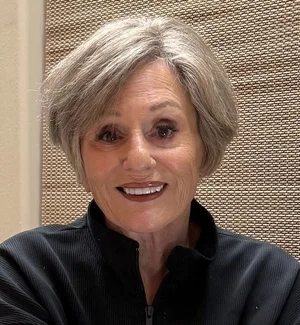
- A one-on-one portrait of the parent alone. Underrated and deeply worth doing. We so rarely have a good, recent photograph of just our mother or just our father, as themselves, not flanked by grandchildren. This becomes the image on the memorial table, yes, but long before that it becomes the image on your mantel that makes you smile every time you pass it.
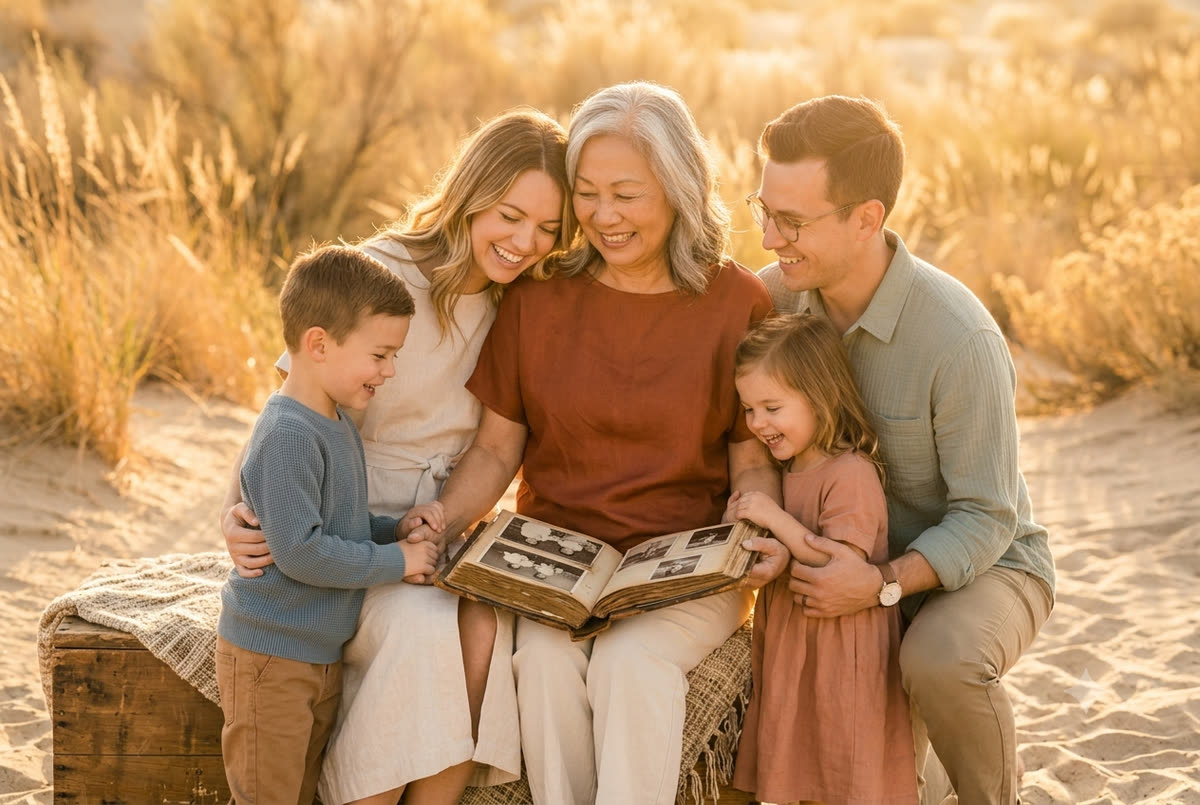
- The multigenerational family session. Grandparents, adult children, grandchildren — everyone in one frame, and then in smaller breakout groupings. These are wonderful when family is already gathered, which in the desert often means the winter holidays or a spring visit.
- The couple, if both parents are living. A portrait of your parents as a couple — the marriage, not just the individuals. Forty, fifty, sixty years of a partnership in one quiet image.
- An at-home or "their world" session. Photographed where they actually live, with the chair Dad always sits in, the garden Mom tends, the kitchen where everything important got discussed. Context tells the story that a studio backdrop cannot.
If your parent is frail or has limited stamina, we simply scale the ambition to fit the person. A meaningful portrait can take fifteen genuine minutes. I would rather have your father relaxed and himself for a short while than wrung out chasing a longer shot list.
Photographing a parent with dementia or serious illness
I want to speak to this directly, because families navigating it often assume a session is off the table, and it usually is not — it just asks for a gentler approach.
If your parent has dementia, mornings are frequently better; the late-day disorientation that caregivers call sundowning makes afternoons harder. Keep the setting familiar. A new, bright, busy place can be overwhelming, so photographing at home or at their care community, in a room they know, often brings out more of the person than a studio ever would. Bring a caregiver or the family member they're most at ease with, and let me take cues from you about pacing.
And here is something I've learned from doing this work: a person who can no longer hold a conversation can still hold a gaze, still light up at a familiar song, still reach for a spouse's hand out of fifty years of habit. Those moments are real, and they are photographable. The image you walk away with may not look like the portrait you would have made ten years ago. It will be true to who they are now, which is its own kind of gift.
For a parent in treatment or recovery, we work around energy and appearance on their terms. Some people want every honest line of an illness in the frame; others want to be remembered as robust. Both are valid. This is their portrait, and dignity leads.
Where and when to do it in the Coachella Valley
Living out here gives us real advantages for this kind of work, and a few things worth planning around.
Season. Our golden stretch runs roughly November through April. The weather is forgiving, the light is gentle, and — crucially — it's when extended family is most likely to be in town visiting. If you are coordinating an out-of-state sibling or grandchildren on school break, the winter and early-spring window is your friend. Summer is not impossible, but with triple-digit heat we keep outdoor sessions very short and very early, or move indoors entirely. For an older parent, heat is not a minor inconvenience; it's a genuine consideration, and I plan accordingly.
Time of day. For outdoor portraits I almost always work in the soft hour around sunrise or sunset rather than the flat, hard light of midday — gentler on aging eyes, and far kinder to skin and expression. Indoors, the rules change: a room with good north-facing windows gives lovely, even daylight at almost any hour, so for a parent who tires or fades as the day goes on, a relaxed late-morning session at home can be the wiser call than chasing a sunset they're too worn out to enjoy.
Settings that suit this work. Most of my sessions for this happen where a parent feels most like themselves — at home, with the chair Dad always sits in and the garden Mom tends, or out on a La Quinta patio in the shade, in the clubhouse or on the grounds of a community like Sun City or Trilogy. That familiarity does half the work, and soft window light through a living room is some of the most flattering there is. When a family would like a little more scenery, the Coachella Valley offers gentle, walkable settings that don't ask much of an older parent: the gardens at the Living Desert, the lawns and shade at Civic Center Park in Palm Desert, or a quiet green stretch close to home. There's no wrong answer. I'll come to wherever your parent is most comfortable, including their home, a hospital, or a care facility when travel isn't realistic.
How to bring it up with a parent who resists
This is often the real obstacle — not scheduling, but a parent who waves the whole idea away. "Oh, don't waste your money on me." "I look terrible." "Nobody wants pictures of an old woman."
A few things that tend to help:
- Make it about you, not about them. "I want a really good photo of you for myself" is much harder to refuse than "we should document you." It's also true.
- Fold them into a group reason. Many parents who would never sit for a solo portrait will happily be part of a family photo with the grandkids. Once they're relaxed in front of the camera, the individual frames often come naturally.
- Lower the stakes out loud. Reassure them it's casual, it's at home, it's short, and they don't have to perform. Most resistance is really anxiety about being scrutinized.
- Let them choose something. The shirt, the room, the chair. A small amount of control turns "being photographed" into "doing this together."
I'm also happy to be the gentle outsider in this. Parents will sometimes relax for a calm photographer in a way they won't for an adult child who's clearly anxious about getting it right.
What to expect from working with me
I keep these sessions unhurried by design. We are not racing a shot list. I spend the first stretch just talking — letting your parent settle, getting them used to me, finding the rhythm of how they actually are. The real frames tend to arrive once people forget the camera is there, and that can't be rushed.
I'll guide gently. You won't hear me bark "say cheese." I might ask your father about the boat he used to keep, or your mother how she and your dad met, and somewhere in the answer the face I'm looking for appears. If you'd like, family can be part of it — sometimes the best portrait of a grandmother is the one taken while she's watching a grandchild, not the one where she's looking at me.
Afterward, I help you do something with the images rather than letting them die on a hard drive. A printed portrait on the wall, an album, an enlargement for the people who couldn't be here. Prints matter more than we admit; a file gets lost in a phone upgrade, but a framed photograph stays in a family for generations.
If you want to think more about the larger picture of preserving a family's story, I've written about creating a family legacy portrait that lasts generations and about recording your parents' stories alongside their portraits. And if a milestone is on the horizon, a 50th anniversary or milestone-birthday session is a natural, joyful reason to finally get everyone in front of the camera.
A few common questions
Is it morbid to do this "before it's too late"?I understand the flinch, but no. Done well, these sessions are warm — full of stories and laughter far more than solemnity. You are celebrating someone while they're here to be celebrated and to enjoy the attention. The morbid version is the one where we wait too long and end up scanning a blurry phone snapshot for a memorial slideshow.
What if my parent isn't "photogenic"?Nearly everyone says this, about themselves or their parents, and nearly everyone is wrong. Photogenic mostly means relaxed and well-lit, and both of those are my job, not yours.
Should we get it done while one parent is healthy, or wait until things are calmer?Sooner. Calm is not coming on a schedule, and the healthiest, easiest version of this is always today's version, not a hoped-for future one.
Can you photograph in a care facility or hospital?Yes, regularly. I'm comfortable working quietly and respectfully in those settings, around staff and medical realities, and I keep it low-key and brief.
One last thought
The photographs of our parents that we treasure most are rarely the ones taken when everything was perfect. They're the ones taken at all. Years from now, no one in your family is going to wish your father had lost the weight first or that your mother had worn a nicer blouse. They are going to be grateful, beyond words, that someone made the appointment.
If you've been carrying this as a someday, let this be the small push that turns it into a date on the calendar. Tell me a little about your parent — where they are, what they're like, what you most want to hold onto — and I'll help you shape a session around them, at home or wherever suits them best. You can reach me here; we'll start with the easy parts, and you'll be the one who made the appointment.