A Legacy Project for Grandchildren
Picture, for a moment, the oldest relative you can call to mind from the generations before yours. For many of us that person survives as exactly one thing: a single sepia photograph — no smile, no voice, no story attached, a face we recognize but a life we never really knew. That gap is the whole reason a legacy project exists. It is the deliberate decision to leave behind more than a stranger's face — to leave a record of who you really are, made on purpose, while you can still shape it yourself.
Most of us assume this happens automatically. It does not. Phones fill with thousands of pictures that no one ever prints, hard drives get lost, and the stories that would explain those faces go quiet. A legacy project is the antidote: a small, intentional body of work — photographs, words, places, and objects — gathered and preserved specifically so your grandchildren and the generations after them will know you. After many years photographing families across the desert, helping people build these has become some of the most meaningful work I do.
This is a long, practical guide to planning one. Whether you are a grandparent who wants to create this for the little ones, or an adult child who wants to capture your parents before more time slips by, I will walk you through what a legacy project actually includes, how to plan it here in the Coachella Valley, and how to make sure it lasts.
What a "legacy project" really is
A legacy project is bigger than a photo session and smaller than you fear. Think of it as a curated collection, built over one season or a few, that answers a simple question for a grandchild who may not be born yet: Who were you, and what did you want me to know?
In practice it usually weaves together several threads:
- Intentional portraits — of you, and of you with the people you love, made with care rather than caught by accident.
- Your voice and your stories — the memories, the advice, the family history that lives only in your head right now.
- The places that shaped you — your home, your garden, the spots in the valley that are part of your daily life.
- The objects that hold meaning — a wedding ring, a recipe card, a worn tool, a favorite chair.
- Words in your own hand — letters, notes, a signature, a blessing.
You do not need all of it. A legacy project can be one beautifully made album of portraits with a few stories written alongside, or it can be an ongoing archive you add to every winter. The point is that it is chosen — assembled with the grandchildren in mind, not left to chance.
Why grandparents are at the heart of it
Grandparents occupy a particular place in a family. You carry the history — the names, the moves, the hard years, the jokes — and you tend to have something the middle generation rarely has: time and patience. Grandchildren feel that. The relationship between a grandparent and a grandchild is often the most unguarded one in the whole family, and it photographs beautifully because there is so little performance in it.
There is also a plain truth worth naming gently: this is the generation we have the least time left with. I never say that to pressure anyone. I say it because the families who wish they had done a legacy project always wish they had started sooner, and the families who did it are, without exception, grateful. The best moment to begin is usually the next time everyone is together.
Start with the story, not the camera
The instinct is to book a photographer and figure out the rest later. I would flip that. Before we ever discuss light and locations, spend an evening thinking about what you actually want the grandchildren to carry forward. The photographs become far richer when they are attached to something.
A few prompts I give people to get started:
- What do you want your grandchildren to know about where they come from?
- What is a piece of advice you would want them to have at eighteen? At forty?
- What was your childhood like, and how is theirs different?
- What are the small daily rituals you hope they remember about you — the morning coffee on the patio, Sunday phone calls, the way you garden?
- Is there a story in this family that is at risk of being lost if you do not tell it?
You can record these as voice memos on a phone, write them by hand, or simply talk through them with someone who writes them down. Even a single page in your own handwriting becomes a treasure once it is paired with your portrait. If recording feels daunting, I wrote a gentler walkthrough in how to record a loved one's life story that pairs naturally with the photography side.
The photographs: what to actually capture
Here is how I think about building the visual core of a legacy project. You want range — not fifty versions of the same smile, but a set of images that together feel like a portrait of a whole person.
The honest individual portrait
Every legacy project should anchor on at least one strong portrait of you alone. Not stiff, not corporate — just you, looking like yourself, made in good light. This is the image a great-grandchild will one day point to. It deserves to be made with intention rather than cropped out of a group shot at a party.
You with your grandchildren
These are the frames families treasure most: a grandfather teaching a grandchild to bait a hook, a grandmother and a little one shelling peas, a piggyback across the lawn, a shared book on the couch. I keep these loose and let the real connection surface rather than directing it. If this is your main interest, my guide to photographing grandparents with grandchildren goes deeper on timing and approach.
The full generations together
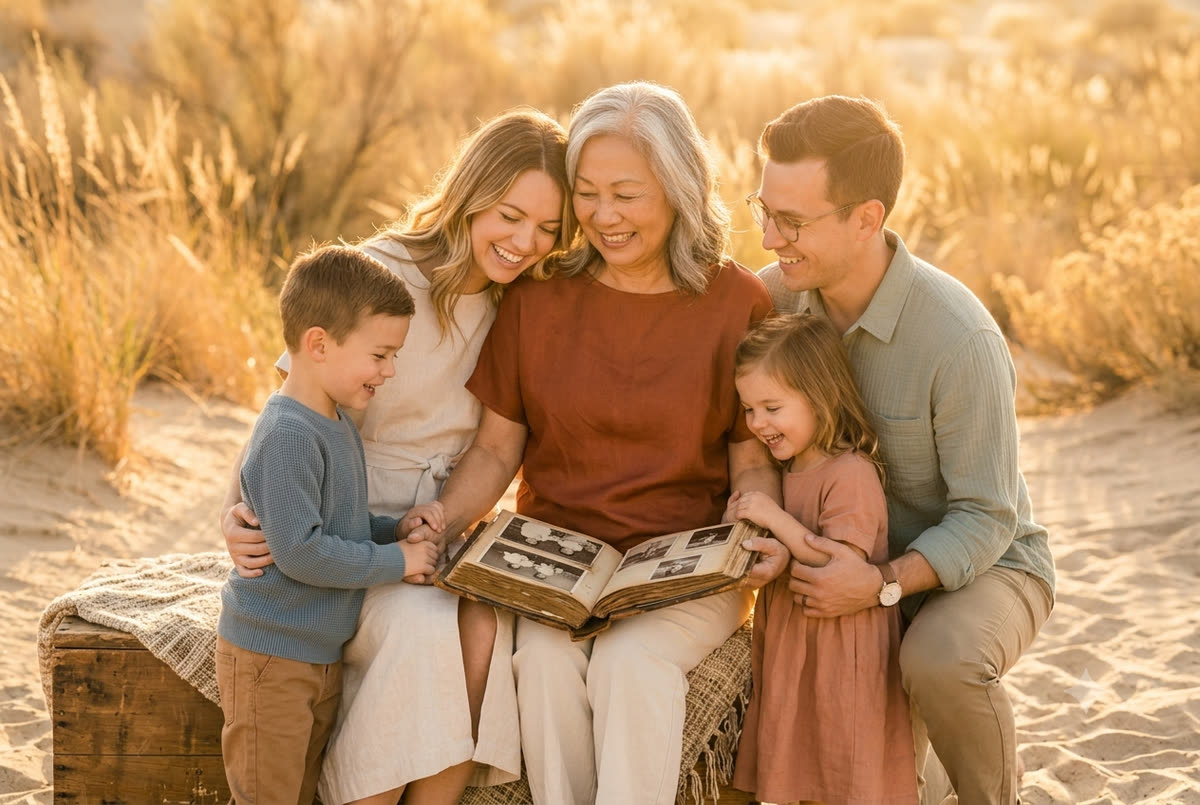
If the family can gather, a multigenerational frame — grandparents, parents, and children in one image — is the spine of the whole archive. These take a little coordinating, and I walk through the logistics in planning a multigenerational photo session.
The hands, the details, the surroundings
A legacy project is made richer by the in-between images: weathered hands holding a coffee cup, the garden you tend, the recipe card in your handwriting, the view from your favorite chair. These quiet frames carry as much meaning as the faces. If your family stories live partly in the kitchen, you may also enjoy capturing family recipes and traditions as a thread to weave in.
Planning it in the Coachella Valley
Living here shapes how we do this, and mostly for the better.
Begin where life actually happens — at home. Almost every legacy project I make starts in the grandparents' own home, and most of it stays there: the living room, the courtyard, the patio with the citrus tree, the kitchen where the recipes get made. This is my signature way of working, and there is a reason for it. A legacy archive is about you, and nowhere shows who you are like your own four walls and the garden you keep. Children relax in a familiar place, the everyday objects that hold your story are already within reach, and I can work in soft natural window light that flatters every age in the room. The images carry meaning precisely because they were made where your life is lived.
Add the local places that belong to your routine. When it suits the story, we step just outside the front door to the nearby spots that are genuinely part of your week — the neighborhood park where you take the grandchildren, a favorite local garden, the green at the quiet end of the day, a bench under the trees at Sunnylands or Moorten. Outdoors, I time these for the gentle, low light of golden hour — late afternoon in winter, or early morning in the warmer months. We are not hunting for a dramatic wilderness backdrop; we are documenting the small, real geography of your daily life, close to home.
Time it to when the family is actually together. The practical reality of the valley is that families often overlap here only for a stretch each year — children and grandchildren visiting Palm Desert, Indian Wells, or La Quinta over the holidays and school breaks. If that visit is your one window, plan the legacy session around it rather than the other way around.
Build the day around comfort. I pace everything around the youngest and the oldest people present — we take breaks, keep water close, and keep an older relative or a small child out of heat and glare. Indoors that is easy; outdoors we simply work in the kinder light at the edges of the day.
Turning it into something that lasts
This is the step families skip, and it is the one that matters most. A legacy project that lives only on a phone or a memory card is not a legacy — it is a liability waiting for a dropped device. The whole point is permanence, so plan for it from the start.
- Make a book or an album. A printed, archival album is the single best form for a legacy project. It can hold portraits alongside the stories, the handwriting, the recipes — a true keepsake a grandchild can hold in their lap. I help clients design these so the images and the words live together.
- Print the anchor portraits as wall art. The pieces that hang in a hallway become part of the family's daily landscape and outlive any file format. I write more about choosing between albums and framed pieces in the heirloom album and wall art.
- Keep the digital files, properly. Yes, keep high-resolution digital copies — in more than one place, and backed up. But understand that files are the backup, and prints are the heirloom. My honest take on that balance is in digital files versus heirloom prints.
- Label everything. A photograph without names and dates becomes that sepia stranger within two generations. Write down who is in each image and when it was made. It is the least glamorous step and the most important.
- Tell someone where it lives. A legacy project does its job only if the next generation can find it. Make sure your children know the album exists and where it is kept.
Common questions families ask
How long does a legacy project take?It can be a single thoughtful session of an hour or two, or it can unfold across a few visits as we add stories, places, and the wider family. There is no single right scale. We start with what is meaningful and build from there.
Should it be in color or black and white?Both have their place. Black and white can lend a timeless, archival weight that suits legacy work beautifully, while color keeps the desert's warmth and the details of clothing and place. I usually deliver a mix; I get into the trade-offs in color versus black and white for legacy portraits.
What if a grandparent is frail or has limited mobility?This is common and never a problem. I choose accessible settings with seating and shade, and I build the session around being comfortable — some of the most moving legacy portraits I have made are of a seated grandparent with grandchildren gathered close.
What if we are doing this because time feels short?Then we move with care and without delay, and we keep the day gentle. Legacy work sometimes happens in tender circumstances, and I am at ease in them. The aim is simply to make sure the people you love are not left wishing they had a record of you.
How far ahead should we book?Sooner than you would guess, especially in the busy winter months. If you have a family gathering on the calendar, that is the time to plan around — more on that in how far in advance to book a legacy session.
Mistakes I gently steer families away from
- Waiting for a milestone. People put this off until a big birthday or anniversary. A legacy project does not need an occasion — ordinary life, captured well, is the point.
- Capturing the faces but losing the voices. Portraits without stories are only half a legacy. Spend the evening recording the words, even roughly. You will never regret it.
- Leaving it all digital. Print it. Bind it. A legacy that cannot be held tends not to be passed down.
- Overproducing it. This is not about perfect outfits and staged perfection. It is about truth. The worn hands and the favorite hat matter more than a flawless pose.
- Going it alone with the planning. You do not have to figure out the structure by yourself. Walking through it together is part of what I am here for.
Let's build yours
A legacy project is, in the end, an act of love pointed at the future — a way of reaching across years you will not see to a grandchild who will know you because you decided, now, to leave them something real. I find few things more worth my time than helping a family do that well, here in the valley we share.
If you are thinking about creating this — for your grandchildren, or for the parent or grandparent you do not want to become a stranger to anyone — tell me what you have in mind. Reach me through my contact page, and we can start by mapping out the stories worth keeping and the home where they live, then shape a project that sounds like your family and lasts well beyond all of us.