Genealogy Meets Photography
Most of the dedicated genealogists I meet arrive at the same wall. They've assembled the binder — census printouts, a hand-drawn family tree folded in quarters, photocopied documents, ship manifests, burial plots — and they can recite names and dates four and five generations back. What they don't have is faces. You can spend years tracing your people to a village in Sicily or a homestead in Iowa and still end up with two hundred years of paper and almost no one you can actually look at.
That is the gap a genealogy photo project is built to close. Genealogy answers who and when. Photography answers what they looked like, who they sat next to, and how they held a baby. Put the two together and you stop having a database — you start having a family you can see.
If you've been doing the research and you're ready to give it faces, this is how I'd approach it.
What a genealogy photo project actually is
A "genealogy photo project" is the deliberate work of attaching images to the people on your family tree — and, just as importantly, photographing the living generations now so that future researchers don't hit the same blank wall you did.
It has two directions, and the best projects run both:
- Backward — finding, restoring, identifying, and organizing the historical photographs that already exist (or that cousins are sitting on without realizing it).
- Forward — making intentional, well-documented portraits of the people who are alive today, so that fifty and a hundred years from now, your descendants have faces to match the names.
Most people start thinking only about the backward half — the shoebox, the restoration, the mystery tintype. But the forward half is the part only you can do, and it has a deadline you can't see. The grandmother who could name everyone in the 1948 reunion photo is the single most valuable resource in your entire project, and she is not getting younger. I'll come back to that, because it's the thing I most want you to take away from this.
Start with the tree you already have
Before you scan a single photo, get your written genealogy into shape, because it becomes the spine everything else hangs on.
You don't need anything fancy. Whatever you've built in Ancestry, FamilySearch, MyHeritage, or even a spreadsheet is fine. What you want is a clear, current list of the people you're trying to illustrate, organized so you can see the holes. I usually suggest a simple working document with a row per person and these columns:
- Full name (and maiden name)
- Birth and death years
- A "photo status" flag — have it / need it / lost / never existed
- Where any known image lives (which cousin, which box, which website)
- Who can identify them
That last column is gold. The point of the document isn't tidiness for its own sake; it's to turn a vague feeling of "I should really deal with the family photos" into a finite, finishable to-do list. When you can see that you have good images for eleven of your fourteen direct ancestors back four generations and you're missing exactly three, the project stops feeling infinite.
If you want a deeper walk-through of capturing the stories that go with those names — the audio and the written accounts — I wrote a companion piece on recording a loved one's life story that pairs naturally with this kind of project.
Hunt down the photos that already exist
Here's the encouraging part: more old family photos survive than most people assume. They're just scattered. Your job is to find them before they're thrown out by someone clearing a house who doesn't know what they're looking at.
Where to actually look:
- The obvious shoebox — your own, and your parents'. Then go one ring out.
- Cousins, especially older and more distant ones. The photos that vanished from your branch often survived intact on a cousin's branch. A polite group message — "I'm putting together a family photo archive, would you be willing to let me scan anything you have?" — turns up astonishing things. People love being asked.
- The relative who became "the keeper." Most families have one. Find out who inherited Grandma's stuff.
- Online collections. FamilySearch's Memories section, the photo features on Ancestry and MyHeritage, Find A Grave (which often has portrait photos attached to memorials), and Fold3 for anyone with military service. DeadFred and AncientFaces are surprisingly useful for orphaned, identified photos.
- Local and regional archives. If a branch of your family settled here in the valley, the Palm Springs Historical Society, the Coachella Valley History Museum in Indio, and the local genealogical society holdings can surface images from old newspapers, church directories, and community events. County historical societies wherever your people lived are worth an email.
- Newspaper archives. Old wedding announcements, obituaries, and society pages frequently ran a photo. Newspapers.com and GenealogyBank are full of them.
When you find a physical photo you can't keep, don't ask to borrow the original and risk it in the mail. Ask to scan or carefully copy it on the spot. Which brings me to the next part.
Get everything digitized — the right way
Once photos start coming in, capture them well, because a bad scan locks in the damage forever and you may not get a second pass at a cousin's fragile original.
A few rules I give every family I help with this:
- Scan at 600 dpi minimum for normal prints; go to 1200 dpi for anything small, like a wallet photo or a tintype, where you'll want to zoom in on faces.
- Save uncompressed. TIFF if your software allows it; high-quality JPEG if not. The JPEGs your phone makes are fine for sharing but not ideal as your master archive copies.
- A flatbed scanner beats a phone, but a phone in good, even light (a cloudy-bright window, not direct sun, and not your kitchen's yellow bulbs) is far better than nothing — and far better than letting the photo go un-copied. Apps like Google PhotoScan handle glare reasonably well.
- Never trim, glue, or "clean" an original. Whatever restoration is needed, we do it to the scan, not the artifact.
- Capture the back. The handwriting on the reverse — a name, a date, "Easter, on the porch" — is often the only thing that makes the photo identifiable. Scan it too.
For older, deteriorating prints — the cracked, faded, water-stained ones — modern photo restoration can do remarkable things, but it works from the best scan you can give it. Garbage in, garbage out. I sometimes help families coordinate restoration as part of pulling everything together into an heirloom album from old photos, which is a satisfying way to give the finished research a physical home.
Identify the mystery faces before it's too late
You will end up with photos of people nobody can name. This is the most urgent and most rewarding detective work in the whole project, and it has a clock on it.
What helps:
- Sit down with your oldest relatives and a stack of prints — sooner than you think you need to. This is the single highest-value afternoon in the entire project. Bring the unknowns. Record the conversation (your phone's voice memo app is plenty) so you capture not just "that's Aunt Vera" but the story that comes with it. Memory is a resource that expires, and it expires quietly.
- Date the photo by its clues. Clothing and hairstyles, the type of photograph (tintype, cabinet card, Polaroid), car models in the background, the photographer's studio stamp on the mount — all of these narrow the window. A cabinet card with a studio name can often be dated to within a few years.
- Compare faces across known photos. Family resemblance is a real tool. The nose that runs through four generations will tell you something.
- Crowdsource carefully. Posting unknowns to a family Facebook group or a genealogy forum often produces an identification within days.
Label as you go. A correctly identified photo with no caption attached is a photo that becomes a mystery again the day you're gone.
Now do the part only you can do: photograph the living
This is where I, as a portrait photographer, get to make my real argument. Everything above is recovery — saving what already exists. But a genealogy photo project is not only about the dead. The most important images in your archive a century from now are the ones that don't exist yet, because nobody has made them.
Think about what you'd give to have a real, considered portrait of your great-great-grandmother — not a stiff, anonymous studio card, but a warm photograph where you can see who she was. That's exactly what you have the power to create right now, for the descendants who will research you.
Most of this work I do right where the family already feels at ease — in their own home, on the back patio, in a familiar garden, or at one of the valley's gentle local parks. There's a reason I lean that way. A multi-generation portrait lives or dies on whether the elders are comfortable, and a great-grandmother is herself in her own living room or a shaded park bench in a way she will never be standing out in the open. The setting where someone is relaxed is the setting where you get the real face, the one a stranger a century from now will actually recognize.
A few ways I see Coachella Valley families build the forward half of their project:
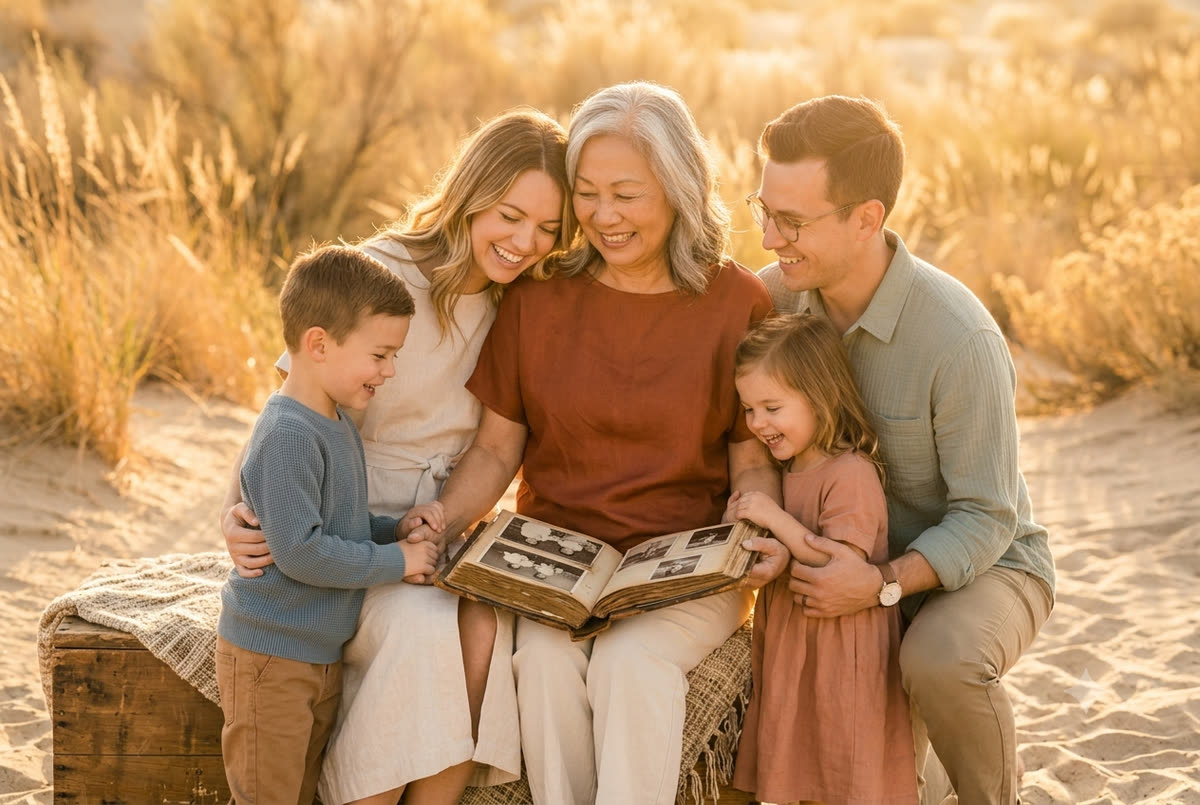
- Generational portraits. Four generations in one frame is the photograph everyone wishes they had of their own ancestors and almost nobody does. If you have a great-grandparent still with you, this is not a someday project. I've written more about how these generational legacy sessions come together.
- Individual character portraits of your elders. Not a snapshot — a real portrait that captures the particular way your grandfather's mouth goes when he's about to tell a joke. The goal is a single honest, telling frame that a stranger a hundred years from now would look at and understand.
- The whole family, dated and documented. A reunion portrait, made on purpose and properly labeled, becomes the 1948-reunion photo for the people who come after you.
Out here in the Coachella Valley, the practical window for this work tends to be the cooler months, when family is in town for the holidays and the generations are all in Palm Desert, Rancho Mirage, and La Quinta at the same time — which is exactly the rare alignment a multi-generation portrait needs. Don't wait for it, though: a living room works in any season. Indoors I shoot by soft, natural window light, which is forgiving and flattering and asks nothing of anyone but to sit near the glass. If we step outside to a patio, garden, or park, I aim for the last hour or two before sunset, when the light goes warm and low and easy on everyone's eyes. The thing that matters most is simply getting the family together while you still can; the light will cooperate either way.
Pull it all together into something that lasts
A genealogy photo project that lives only on a hard drive is one dead laptop away from being gone. The whole point is permanence, so finish the job.
- Organize and back up digitally. A clear folder structure (by surname, then by person), consistent file naming, and the 3-2-1 rule: three copies, on two kinds of media, with one stored away from your house. Cloud plus an external drive plus the originals counts.
- Attach images to your tree. Upload the identified photos to FamilySearch, Ancestry, or wherever you keep your genealogy, so cousins and future researchers find them — and so the work isn't trapped in your account alone.
- Make something physical. A printed family-history book, an album, or a set of archival prints. Paper has outlasted every digital format ever invented; the photos in your shoebox prove it. For the bigger picture on keeping all of this safe across formats and decades, see how to preserve family memories.
- Caption everything, generously. Names, dates, places, relationships. The unlabeled photo is the problem you started out trying to solve. Don't recreate it.
Common mistakes I see
- Waiting on the living to chase the dead. People pour months into a brick-wall ancestor while a grandparent who could identify forty photos sits un-interviewed. Reverse it. The living half has a deadline; the archives will still be there next year.
- Borrowing originals. Scan on the spot. The post office is where heirlooms go to disappear.
- Hoarding scans with no labels. A folder of 3,000 unnamed images is just a faster shoebox.
- Treating it as all-or-nothing. You don't have to solve the whole tree. One generation, well documented, is a real gift. Start there.
- Forgetting yourself. You are someone's ancestor. Get in the picture.
A few questions I get often
How far back can photography even go? Practically, family photographs begin in the 1840s–1860s with daguerreotypes, tintypes, and cabinet cards. Before that, it's painted portraits or nothing. So your photographic record realistically reaches back four to six generations — which is further than most people expect.
Do I need to finish my genealogy research first? No. Run both in parallel. Often a found photo breaks open a research wall — a studio stamp reveals a town you didn't know the family lived in.
Is this only for big, organized families? Not at all. Some of the most moving projects I've been part of were one person quietly making sure a small family wasn't forgotten.
When you're ready to make the faces of the future
If your research has given you names and dates but you're looking at the living generations of your family and realizing those are the photographs that don't exist yet — that's where I'd love to help. Making honest, lasting portraits of the people who are here now, so the next genealogist in your family has faces instead of a blank wall, is some of the most meaningful work I do.
Tell me who's still here and where they're most at ease — the den, the garden, a park you all love — and we'll plan a generational session or a documented family portrait around that. Start the conversation here, and let's make the photograph your descendants will be grateful you didn't put off.