Digital Files vs. Heirloom Prints
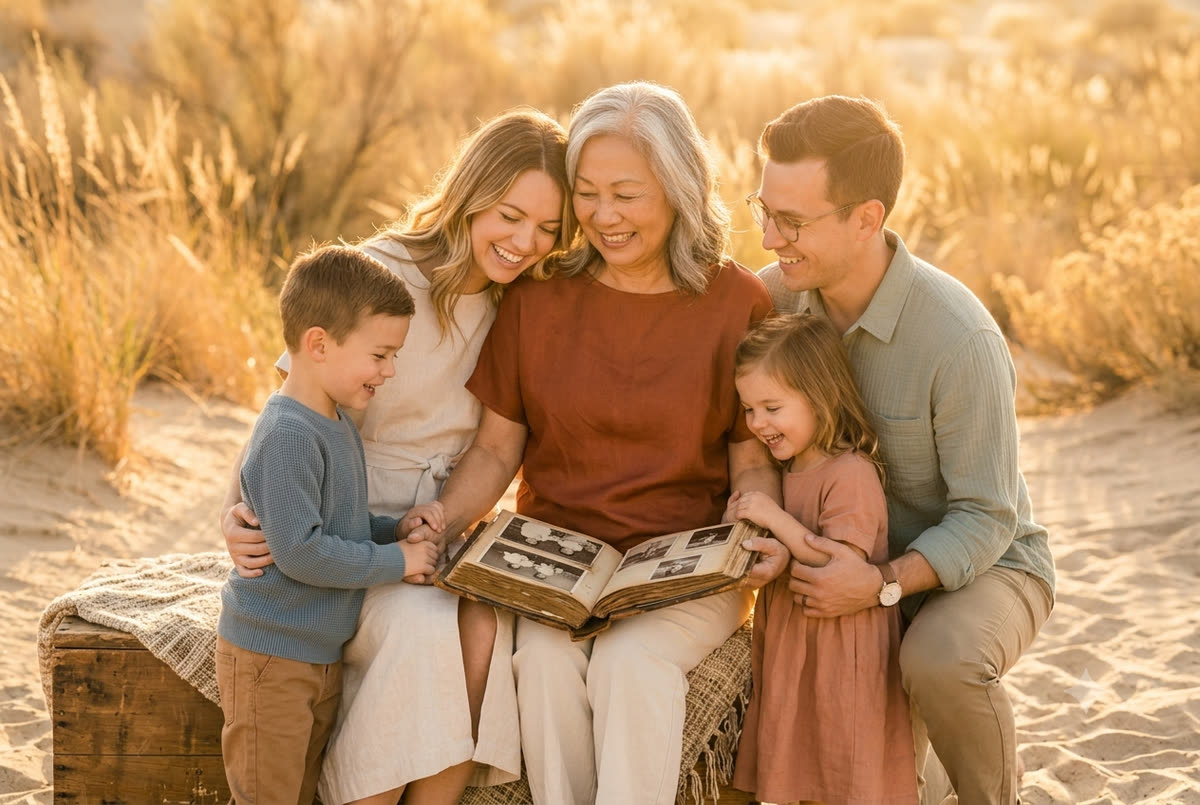
Sooner or later, most of us end up at a kitchen table after a parent has passed, sorting through what's left. It's a scene I've heard described many times: boxes of slides nobody can play, a laptop behind a forgotten password, and then one shoebox of prints from the 1970s — sun-faded, corners gone soft, but right there in your hands. It's almost always the shoebox that survives the move, the years, the technology that came and went. That contrast is the whole heart of this question: when you photograph the people you love, which form actually lasts?
If you have ever booked a session and then stared at the package options wondering whether to just take the digital gallery and skip the prints — or whether the prints are the real point and the files are a backup — you are asking exactly the right question. Let me walk you through it the way I would if you were sitting in my studio, because the honest answer is "both, but for very different reasons," and the reasoning matters more than the rule.
What you're actually comparing
It helps to be precise about what each thing is, because "digital files" and "prints" are doing completely different jobs.
A digital file is the raw, flexible, infinitely-copyable version of your photograph. It lives as data — a JPEG or a high-resolution TIFF — and its great gift is reach. You can text it to your sister in Minnesota, post it, set it as a phone background, order more prints from it in ten years, and make a hundred copies without degrading the original. It is the negative of our era.
A printed heirloom is a physical object made to last: a fine-art print on archival paper, a pressed album, a framed portrait, a folio box. Its gift is permanence and presence. It does not need a password, a charged battery, a working app, or a compatible file format. It hangs on a wall in La Quinta and gets looked at every single day, which is something a file buried in a phone almost never gets.
So the real comparison is not "which is better." It is distribution and flexibility versus permanence and presence. You want both, and you want to understand which risks each one protects you from.
The case for digital files
I deliver high-resolution digital files with nearly every portrait session, and I believe in them. Here is what they genuinely do well.
- They travel. Coachella Valley families are spread out — half the year people are here, half the year they're in Seattle or Calgary or back East. A gallery link means Grandma sees the grandkids the same afternoon, not next Christmas.
- They're the master copy for future prints. As long as you keep the files safe, you can reprint, reframe, or make a new album years from now. The file is the source.
- They're flexible. Phone screens, holiday cards, a slideshow at a 90th birthday at the Indian Wells clubhouse — the file adapts to whatever you need.
- They cost nothing to duplicate. Backup is free and easy, which matters enormously for survival (more on that below).
If a photographer ever tells you that you can't have your high-resolution files at all, ask why. There are legitimate album-first business models, but for most family and senior portraits you should be able to own usable, full-resolution copies of your images.
The quiet problem with files
Here is what I have watched happen, over and over, for two decades. Digital files survive beautifully — right up until they don't, and when they fail, they fail completely and silently.
- The phone is lost in a pool in Palm Springs, and the photos "in the cloud" turn out to have been only on the device.
- The old laptop dies and nobody knows the iCloud login.
- A subscription lapses, the storage account is purged after a few months of non-payment, and there is no warning that mattered.
- The files are technically fine but scattered across three phones, two dead hard drives, an email account, and a memory card in a drawer — so functionally, no one can find the picture of Dad laughing.
A faded print is still a print. A corrupted file or a forgotten password is nothing. That asymmetry is the whole reason I keep pushing clients toward physical pieces for the images that truly matter.
The case for heirloom prints
A real print does something a screen cannot. I don't mean that sentimentally — I mean it mechanically.
It gets seen. This is the single most underrated fact in photography. The portrait on the wall in your Palm Desert hallway is part of your daily life. Your kids absorb their own faces, your parents' faces, the family they belong to, simply by walking past it for years. The 400 images in a phone gallery get viewed once, on delivery day, and then they sleep. Presence is not a luxury feature; it is the entire point of taking the picture.
It lasts without maintenance. A properly made archival print on cotton-rag or quality fine-art paper, kept out of direct desert sun, can hold its color for generations — we're talking estimates of 100-plus years for good pigment prints. It needs nothing from you. No format migration, no charged battery, no remembering an account exists.
It survives handoff. This is the part people don't think about until they're the daughter at the kitchen table. When you're gone, your heirs inherit your things. They walk through the house and the boxes. A framed portrait, a labeled album, a folio of prints — these get found, understood, and kept without anyone needing a single technical skill. A drive full of files, by contrast, usually needs someone technical, motivated, and lucky to even open it, let alone know what's worth keeping.
It carries more weight as an object. There's a reason a wedding album feels different from scrolling the same images. The sequencing, the paper, the act of turning a page and sitting with it — that's an experience, and it's one your family will return to deliberately.
Where prints fall short
I'll be just as honest here. Prints are not flexible. You can't text a frame to your brother. Making many copies costs real money. They can be damaged by water, fire, or — very much a desert issue — being hung where afternoon light hits them directly and bleaches them over years. And a single print is a single point of failure unless you've kept the file to reprint from. Which brings us neatly to the actual answer.
The honest answer: it's not a competition
The families who never lose their photographs are the ones who use each format for what it's good at:
- Keep the digital files as your master and your distribution copy — for sharing, for convenience, and as the source you'll reprint from for decades.
- Print the images that matter most as physical heirlooms — the wall portrait, the album, the handful of pieces that should outlive all of us and survive being inherited.
Files protect you against the print being lost or damaged. Prints protect you against the files being lost, forgotten, or locked. Together, they cover each other's weaknesses almost perfectly. Apart, each has a failure mode that ends with someone holding nothing.
If budget forces a choice in any given year, my guidance is simple: get the files now so you own the source forever, and print the one or two images you'd grieve losing — even if it's just those. You can always add to the wall later. You cannot reprint a file you no longer have.
A practical plan for keeping photos that actually survive
This is the part I wish more families had in hand long before anyone is sorting through a shoebox. None of it is hard.
For your digital files
- Follow 3-2-1. Three copies of anything important, on two different kinds of media, with one copy off-site. In practice: the originals on your computer, a copy on an external drive in a drawer, and a copy in a reputable cloud service.
- Don't trust your phone as the only home. Confirm your photos are genuinely backing up somewhere off the device, and check it once in a while rather than assuming.
- Write the login down on paper and put it where your family can find it. A perfect backup nobody can access is the same as no backup. This matters more than any technical step.
- Re-save and migrate every few years. Drives die, formats drift. Moving your archive to a new drive every 3-5 years keeps it alive and verified.
- Name and date a "best of" folder. Your heirs will not wade through 8,000 frames. A small, labeled folder of the real keepers is a genuine gift.
For your prints
- Choose archival materials. Pigment (archival) inks and acid-free, cotton-rag papers are what give you the century-long lifespans. Ask your photographer or lab specifically.
- Mind the desert sun. Hang framed work on walls that don't take direct afternoon light, and use UV-protective glass for anything near a window. Our light is glorious and it is also hard on pigment over years.
- Watch the heat and dry air. Avoid storing albums in a hot garage or attic. A closet inside the air-conditioned house is far kinder than anywhere that bakes in July.
- Label the backs. Names, year, place. The most beautiful print in the world loses half its value to a grandchild who doesn't know who's in it.
How I handle this with my own clients
When we plan a session — whether it's a family gathered in their own living room in soft morning window light, a senior portrait at a local Palm Desert park as the afternoon turns golden, or quiet documentary frames of a parent in their final season — I think past delivery day. I want to know which images are headed for a wall, which belong in an album, and which are simply for sharing. Then you leave with files you fully own and a small number of physical pieces built to be inherited. That combination is what keeps a photograph from quietly disappearing.
This is especially close to my heart in the Legacy work I do — sessions made when a family knows their time together is finite. In those cases the print isn't a product; it's the thing someone will hold when they can no longer hold the person. If you're navigating that season, you might also find it helpful to read why a Legacy session is worth doing sooner rather than later and how to choose which photographs to print and display. And if albums are new to you, what makes a printed album worth it walks through that decision in more detail.
A few questions I get often
"Aren't digital files good enough on their own now?"They're wonderful and necessary — but "good enough" assumes they'll be found and openable in thirty years by someone who isn't you. In my experience, the files that get printed are the ones that survive, because the print becomes the obvious, findable backup of the file.
"If I have the files, can I just print them later?"Yes, and you should keep that option open — it's a great reason to own your files. But "later" has a way of becoming "never." The print that exists is worth more than the ten you mean to order.
"What about a digital photo frame or a slideshow?"Lovely for daily enjoyment, and I'm all for them. Just don't count them as preservation — they depend on power, software, and a working file, all of which can quietly fail. Enjoy the screen; preserve with the print.
The thing I'd leave you with
Photographs are how a family remembers itself once memory alone isn't enough. Files give you reach and flexibility; prints give you permanence and a presence in the room. The families who lose nothing are simply the ones who use both on purpose — and who write down the password.
If you'd like help thinking through which of your images belong on a wall, in an album, or simply backed up and shared — for your family here in the Coachella Valley, or for a Legacy session you've been quietly meaning to plan — I'd be glad to talk it through with you. You can reach me here, and we'll start with what matters most to you.