Recording a Loved One's Life Story
The calls that stay with me longest tend to start the same way. Someone has an aging parent — a father in his nineties, say, still sharp, still telling the same three stories at every Sunday dinner — and they've begun to feel time moving differently. They want his face. They want his voice. They want the stories written down before they become "the stories Dad used to tell."
So we make the portraits. But these conversations almost always drift toward everything around the photographs — the shoebox of prints nobody has labeled, the recipe cards in a late grandmother's handwriting, the question of how you actually capture a whole life before it slips out of reach.
I've had some version of that conversation more times than I can count. So this is the guide I wish I could hand to everyone who reaches out with that particular ache in their voice. If you want to record family history — really record it, in a way your grandchildren will thank you for — here is how I'd start.
Why now is the right time (and why we keep waiting)
The honest truth is that almost nobody does this until something forces the issue. A diagnosis. A move into assisted living. A milestone birthday. We tell ourselves there's plenty of time, and then one day the person who held all the names and dates is gone, and the photographs in the box become a roomful of strangers.
You don't need a crisis to begin. You need an afternoon. The single biggest mistake I see is treating this as a someday project — a grand archival undertaking you'll get to when life calms down. It never calms down. What works is starting small and starting this month.
Here in the desert, the rhythm of the year actually helps. Families gather in force from November through April — snowbird season, the holidays, the run-up to the Coachella and Stagecoach crowds. The grandkids fly in. The light softens. That window, when everyone is in town and the heat isn't chasing you indoors, is the natural time to sit an older relative down and finally ask the questions.
What "recording a life story" actually includes
People hear "family history" and picture a genealogy chart — births, marriages, deaths, a tidy tree. That matters, but it's the skeleton, not the person. A life story is richer than dates. When I'm helping a family think this through, I break it into four kinds of record:
- The voice. Audio or video of them simply talking — the cadence, the laugh, the way they pronounce a hometown that no longer exists on a map.
- The face. Real portraits, made with care — not a hurried phone snapshot.
- The objects. The wedding ring, the union pin, the immigration papers, the cast-iron pan. Things carry stories that words skip over.
- The words. Names, dates, places, and the connective tissue — why they left, how they met, what it cost them.
You want all four if you can get them. They reinforce each other. A photograph of your mother's hands means more when you can also hear her explaining how those hands learned to make tortillas at her grandmother's stove in the Coachella Valley sixty years ago.
Start with the interview
If you do only one thing, record a conversation. Phones make this absurdly easy now — the Voice Memos app is enough, though a quiet room and a second person to listen and follow up will get you far more.
A few things I've learned from sitting in on these:
Pick a comfortable, quiet spot. Kitchen tables work beautifully. Avoid a buzzing television or a tile-floored room that echoes. Mid-morning, after coffee and before the afternoon tiredness sets in, tends to be the sweet spot for someone in their eighties or nineties.
Don't interrogate — converse. Open-ended invitations beat yes/no questions every time. "Tell me about the house you grew up in" will get you ten minutes; "Did you like your house?" gets you a shrug.
Follow the emotion, not your list. If their face changes when they mention a brother, set the questions aside and stay there. The list is a safety net, not a script.
Let silences sit. People remember more in the pauses. Resist the urge to fill them.
Some questions that reliably open doors:
- What's your earliest memory?
- Who were you named after, and why?
- What was your first job, and what did it pay?
- How did you meet [spouse]? Tell me the whole thing.
- What did your parents worry about? What did they hope for you?
- Was there a moment you knew your life had changed direction?
- What do you know now that you wish you'd known at twenty-five?
- What do you want the great-grandchildren to know about you?
That last one tends to land hard. It's worth saving for when you've both warmed up.
Plan for an hour, maybe ninety minutes. You can always come back. In fact, several shorter sessions almost always beat one marathon — memory works better when it isn't tired, and you'll think of new questions between visits.
Photographs are part of the record, not separate from it
This is where my own work comes in, so let me be plain about why it matters.
A life story without a real photograph of the person is incomplete. Not a candid from across the room — a portrait where they're looking at the camera, or laughing at something off to the side, made well enough that it will hold up framed on a wall for the next fifty years. When I photograph an older person, I'm not chasing a flattering pose. I'm watching for the gesture that's unmistakably them — the particular tilt of the chin before they say something wry, the hands that never quite stop moving while they talk. That's the frame the family keeps.
Practically, most of these sittings I do right in someone's home, and for good reason. Familiar surroundings put people at ease, the objects on their shelves become part of the picture, and there's no drive to tire out a parent or grandparent before we begin. I work with the natural light from a big window — soft, flattering, and kind to older skin — which is really all a good portrait of someone in their eighties or nineties needs. If your relative would rather be outdoors, a shaded garden or a quiet neighborhood park works beautifully too; there I'll aim for the cooler months and the gentle light of late afternoon, when golden hour does the flattering for me. The gardens at Sunnylands in Rancho Mirage, a leafy corner of a La Quinta courtyard, or a familiar back patio all photograph far better than the bright glare of midday.
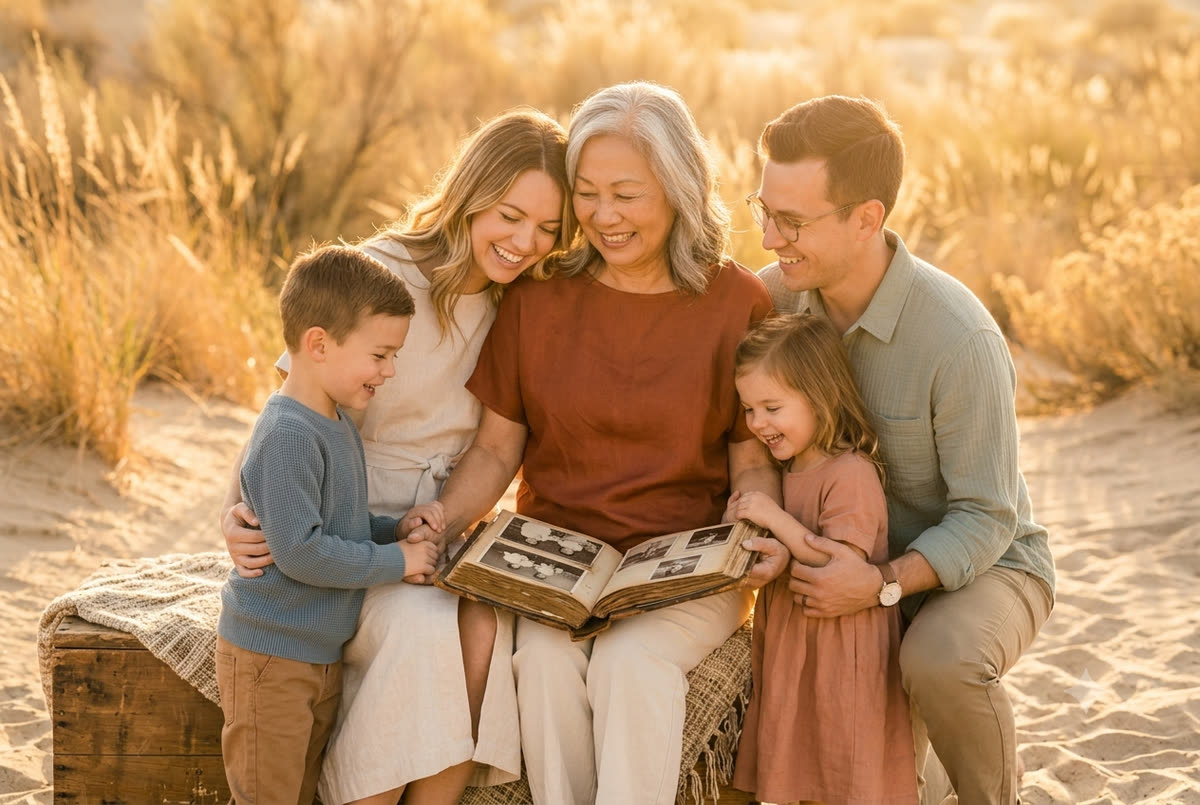
I also tell families: photograph more than one generation together while you can. A great-grandmother holding the newest baby is the kind of image that becomes a touchstone. Three or four generations gathered on one patio while everyone's in town — that's a photograph people will fight over (lovingly) for decades.
If you're weighing the value of a sitting like this, I've written more about that in why a professional portrait outlasts a phone photo. And if your relative is uneasy in front of a camera — most of the best people are — how I help nervous subjects relax may set your mind at ease.
Gather and label the photographs you already have
Almost every family I meet has a box, a drawer, or a closet shelf full of unlabeled prints. This is the most fragile part of your history and the easiest to lose, because once the person who knows the faces is gone, the knowledge goes with them.
Here's a weekend project that pays off enormously:
- Bring out the boxes while your elder is still here to narrate. Sit together and go through them. Record the audio while you do — "Who is this? Where was that? What year?" You'll capture stories you'd never have thought to ask about.
- Label as you go, lightly in pencil on the back, or with a soft-tip photo-safe pen, or by writing names on a slip and photographing it alongside the print.
- Scan the keepers. A decent flatbed scanner or even a good phone-scanning app preserves the image against fading, water, and the next move. Local print shops around Palm Desert and Palm Springs will batch-scan a box if you'd rather not.
- Get the slides and movie film digitized. Those Kodachrome carousels and 8mm reels are degrading right now. There are services that transfer them; do it before the colors shift further.
Old photographs in this climate have a particular enemy: heat. Garages and storage units in the Coachella Valley swing well past 100 degrees half the year, and that bakes prints, melts adhesives, and curls negatives. If your family's history is sitting in a non-climate-controlled space, moving it inside is the single most protective thing you can do today.
Don't forget the objects and documents
A life story lives in things, too. As you sit with your relative, ask about the objects that matter and write down what they say. The pocket watch isn't just a watch — it's the watch your great-grandfather carried off the train when he arrived. Photograph these heirlooms cleanly; I sometimes include them in a session, set in the person's hands, so the object and the owner live in the same frame.
Gather the documents while you're at it: birth and marriage certificates, military records, naturalization papers, the deed to the first house, the obituary clippings. Make digital copies. Note where the originals live so they're not lost in a move or an estate cleanout.
Put it together so it survives
Recording everything is only half the job. The other half is making sure it doesn't evaporate into a forgotten hard drive or a phone that gets traded in.
A few principles:
- Make more than one copy, in more than one place. A drive at home, a copy in the cloud, and ideally a set with another family member. Files you only have once are files you will eventually lose.
- Use plain, durable formats. Standard photo and audio files, clearly named with dates. Avoid niche apps that may not exist in ten years.
- Print the most important things. Prints survive technology changes that files don't. A well-made photo book of the portraits and best old images, with the names and stories captioned, is something an eight-year-old can pull off a shelf — no password, no charger, no obsolete cable.
- Write a one-page index. Where the audio lives, where the scans live, who's who. The map matters as much as the treasure.
If you want to go further, you can weave the interview audio, the scanned photos, and the new portraits into a single keepsake — a book, or a short edited video. That's the heart of the Legacy work I do for families folding heirloom history into something lasting. It's the same instinct that brought you here: the wish to hold onto a person fully, not in fragments.
A gentle word about timing
I'll say the thing nobody wants to hear, because I've watched too many families learn it the hard way. The window is always smaller than it feels. Memory fades before the body does. The relative who could narrate every face in the shoebox last winter may not be able to next winter.
That isn't meant to frighten you into a frenzy. It's meant to move the boxes off the someday shelf. Record one conversation this month. Make one set of real portraits this season, while everyone's in town and the desert light is kind. Scan one drawer of photos. You'll be astonished how much of a life you can hold once you simply begin.
If you'd like help with the portrait part of this — a proper sitting for a parent or grandparent, several generations together, or a Legacy project that brings the old photographs and the new ones into one keepsake — I'd be honored to talk it through with you. I work all across Palm Desert, Rancho Mirage, La Quinta, and the wider Coachella Valley, and I'm happy to come to you. You can reach me here, and we'll find the right way to keep your family's story safe.