Memory Care Communities in the Desert
There is a sentence I've now heard from more families than I can count, usually said softly, often through tears: "I want to photograph her before she forgets us." It stopped me cold the first few times I heard it, and I still don't take it lightly. Across years of work out here, photographing both grief and joy, I keep returning to one thing: a diagnosis takes a great deal, but it does not take everything, and the people who love someone with dementia are often desperate for a thoughtful guide and an honest hand.
So this is that guide — written partly for the family choosing a community, and partly for the family who has already chosen one and is now wondering how to keep their person present while the present is still here. I am a portrait photographer, not a placement agency or a physician, and I will tell you plainly where my expertise ends. But I have spent years inside these buildings across the valley, camera in hand, and I have watched what good care looks like up close. That counts for something.
What "memory care" actually means out here
People search for "memory care Palm Springs" the way they search for an emergency room — usually because something has already gone wrong, or is about to. So let me make the categories plain, because the words get used loosely.
Memory care is a specialized form of residential long-term care for people living with Alzheimer's, vascular dementia, Lewy body dementia, frontotemporal dementia, and related conditions. It differs from ordinary assisted living in a few concrete ways:
- Secured environments. Exterior doors are alarmed or coded so a resident who wanders can't walk out into 115-degree July heat. In the desert, this is not a small detail — heat is genuinely dangerous here, and "wandering" is a clinical reality, not a character flaw.
- Higher staffing ratios and caregivers specifically trained in dementia behaviors — sundowning, repetition, agitation, the way a familiar face can suddenly become a stranger.
- Structured days. Predictable rhythms, simplified choices, and cueing that reduces the anxiety of not knowing what comes next.
- Designed spaces. Shorter hallways, looping walking paths, high-contrast plates, memory boxes outside each door so residents can find their own room.
In California, these communities are licensed as Residential Care Facilities for the Elderly (RCFE) through the Department of Social Services, often with a dementia-care waiver on file. You can and should look a community up in the state's public licensing database before you tour. Inspection reports and any substantiated complaints are public record.
A note on geography that trips people up: when families say "Palm Springs," they usually mean the whole Coachella Valley. The actual city of Palm Springs has comparatively few large memory care buildings; many of the best-known communities sit a few miles east in Rancho Mirage, Palm Desert, La Quinta, and Indio. Widen your search radius to the valley as a whole and your options roughly triple.
How memory care fits alongside the other options
It helps to see the whole ladder, because families rarely start at the top.
- In-home care — caregivers come to the house. Works well early, gets expensive and unsafe as supervision needs grow, especially overnight.
- Assisted living — help with daily tasks, but not a secured setting and not dementia-specialized. Fine until wandering, exit-seeking, or safety incidents begin.
- Memory care — the secured, specialized step above.
- Skilled nursing — for significant medical and rehabilitation needs; a different license entirely.
- Hospice — comfort-focused care that can be layered on top of memory care in the final chapter, often without a move.
Many valley campuses offer several of these on one property, which lets someone "age in place" and move buildings rather than towns. If you are early in this and still weighing keeping Mom at home, I wrote separately about navigating assisted living in the desert — that decision and this one tend to arrive in the same season of life.
What good memory care looks like when you walk in
I tour these buildings often, and I have learned to read a room the way I read light. Brochures all say the same things. Your senses will tell you more.
Trust your nose and your ears first. A persistent smell of urine masked by air freshener tells you about staffing and attention. So does the soundscape — is it calm and conversational, or is someone calling out unanswered? A good memory care floor has a low, steady hum to it, not silence and not chaos.
Watch the caregivers with the residents, not with you. Are they crouching to eye level? Using the resident's name? Are residents dressed, groomed, and out of their rooms, or parked in front of a television? The way an aide speaks to a woman who has asked the same question four times is the single most honest thing you will observe on a tour.
Look at the activity board — and the clock. It should show something happening right now, not a laminated ideal. Music, chair exercises, a baking group, a visiting dog. Engagement is medicine for this disease.
Ask about the things nobody volunteers:
- What is your caregiver-to-resident ratio during the day, the evening, and overnight? Evening matters because sundowning is real.
- What is your staff turnover? Continuity of faces is everything to someone losing their grip on faces.
- How do you handle a medical emergency or a fall at 2 a.m.?
- What triggers a move to a higher level of care, and who decides?
- How do you handle summer? Outdoor time, hydration, and cooling are valley-specific concerns from June through September.
- What is the all-in monthly cost, and what pushes it up? Most memory care here is priced as a base rate plus a "level of care" add-on that climbs as needs grow.
On cost, plainly: memory care in the Coachella Valley generally runs higher than standard assisted living, often in the $7,000 to $12,000+ per month range depending on the community and care level, and it is overwhelmingly paid privately or through long-term care insurance. Standard Medicare does not pay for custodial residential care. A few communities accept the VA Aid and Attendance benefit for qualifying veterans and surviving spouses — always ask, because wartime-era veterans are well represented in this valley and many families don't know they qualify.
The seasonal reality the brochures skip
Two desert truths shape life inside these communities, and they're worth naming because they affect when and how you'll move someone.
Snowbird season (November through April) is when the valley fills and when adult children flying in from colder states tend to tour and decide. Good communities fill their best rooms in this window. If you are touring in season, ask specifically about availability and waitlists; if you are touring in the quiet of summer, you may have more choice and more of the staff's time.
Summer heat is a safety factor, not just discomfort. A secured outdoor courtyard is wonderful in February and effectively closed by midday in July. Ask how residents get fresh air and movement in summer — shaded early-morning courtyard time, indoor walking loops, evening patio hours after the sun drops. A community that has genuinely thought this through is a community that has thought everything through.
Keeping the person while the memory goes
This is the part I actually know something about, and the reason I do this work.
A move into memory care is grief that doesn't get a funeral. The person is still here, and you are mourning anyway. Families pour all their energy into the logistics — the tour, the deposit, the labeling of clothing — and almost none into the thing they'll wish they had more of: a record of who this person is, right now, in this chapter.
Here is what I have learned photographing people through the long middle of this disease:
- The expression you remember is rarely the posed one. It's the way your father's whole face changes when his old song comes on. The way your mother's hands still know how to smooth a tablecloth. I look for those, because dementia loosens its grip for a few seconds at a time and you can catch the real person passing through.
- Familiar settings unlock more than studios do. A session in the resident's own room, or in the community's garden where they take coffee every morning, draws out far more than a strange backdrop ever could. Routine is comfort; comfort is where the true expressions live.
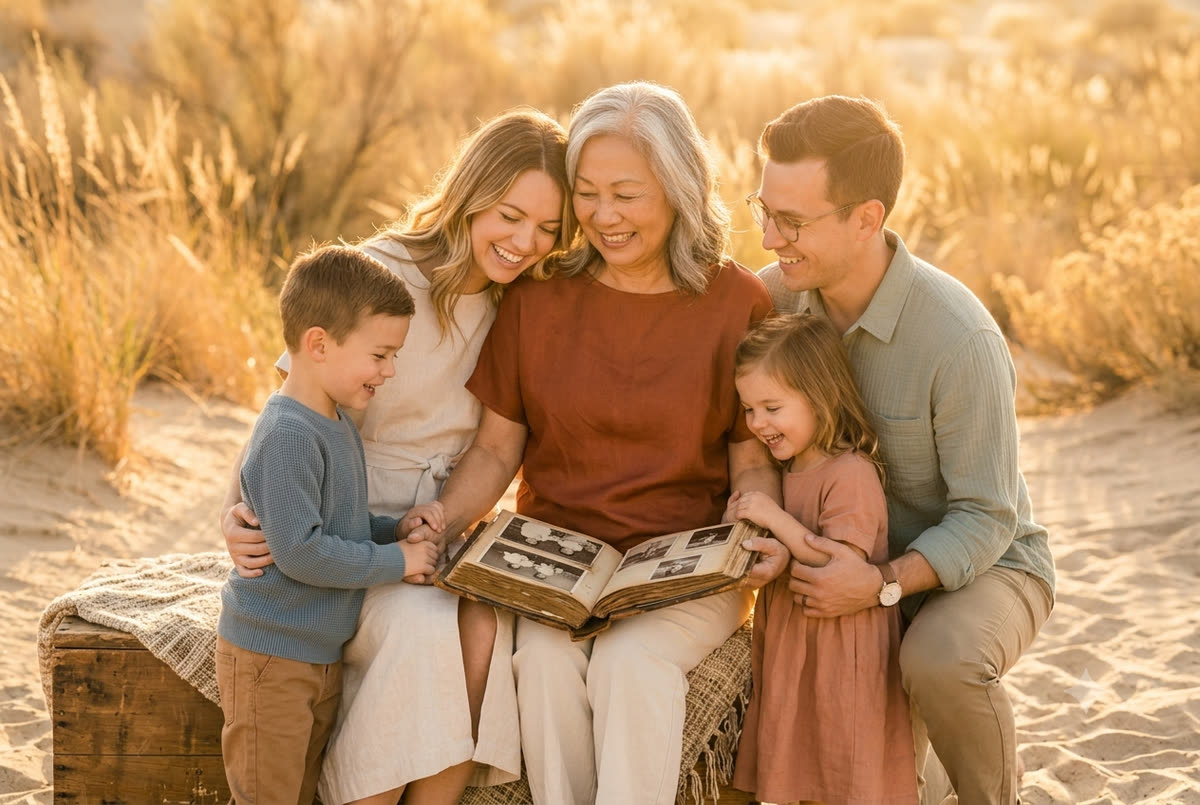
- Bring the generations. A grandchild on the bed beside a grandmother who may not remember the name but absolutely remembers the feeling — that's the frame that matters in ten years. Time and again, a resident who's been quiet all afternoon will light up the moment a great-grandbaby is set in her arms.
- Don't wait for a "good day." Families tell me they'll book a portrait when Mom is "more herself." There is no more-herself coming. There is only now, and now is enough. The honest photograph of who she is today will mean more than the one you keep postponing.
If you are thinking about how to gather everyone for this, my piece on photographing the elders in your family with care and patience walks through the practical side — timing, pacing, and how I keep a session gentle for someone who tires easily.
A short, honest word on the building search itself
You will be tempted to outsource this entirely to a free placement service. Those services can genuinely help — they know the inventory and the openings. Just understand that most are paid a commission by the communities they refer you to, so their list of "matches" is the list of places that pay them. Use them for legwork, then tour independently, read the public state inspection records yourself, and trust the visit over the pitch.
And visit more than once. Visit on a weekday morning and again on a Sunday evening. The community that's wonderful when fully staffed at 10 a.m. is the same building at 7 p.m. when the family members have gone home and the day shift has left. That second visit is the true one.
You will not get this season back — so don't let it pass unrecorded
If you take one thing from a photographer who has spent years in these courtyards: the practical decisions are urgent, but they are not the only urgent thing. The window to capture your parent or grandparent as they still are is open now and quietly closing. I have never once had a family tell me they regretted making the portrait. I have heard the other regret many times.
When you're ready — whether your person is still at home, newly settled into a community in Palm Desert or Rancho Mirage, or somewhere in the long middle — I would be honored to come to them — their own room, a favorite chair in the soft light of a window, the patio where they take their morning coffee — and find the real person while they're still reaching back for us. I follow your person's lead on the day rather than a shot list, and I let the session shape itself around whatever they have to give.
You can reach me anytime through my contact page. Tell me a little about your family and where you are in all of this, and we'll figure out the gentlest way to do this together.