Final Portraits of Elderly Loved Ones
There is a phone call I have learned to recognize within the first few sentences. The voice is a little careful, a little apologetic, as if the person is not quite sure they are allowed to ask. "My mother is ninety-one," they say. "She is still herself, mostly, but things are changing, and I realized we don't have a single good photograph of her — not a real one." Sometimes the person is calling about a father in hospice in Rancho Mirage. Sometimes it is a daughter who has just moved a parent into memory care in Palm Desert and feels the clock differently now. Whatever the circumstance, the question underneath is always the same, and it is a brave one: Is it too late to make a beautiful portrait of someone I love before they are gone?
Almost always, the answer is no. And I want to tell you, plainly and gently, that this is some of the most meaningful work I do.
If you have found your way to this page, you are likely carrying something heavy — a parent or grandparent who is aging, frail, ill, or simply very old, and a quiet urgency that you should capture them while you still can. I have written this for you. I want to walk you through everything: why these portraits matter, when to make them, what to expect, how I handle the tender realities of photographing someone who is unwell, and how to do this in a way that feels like love rather than a sad errand. Take your time with it. I have tried to be both honest and gentle, because this subject asks for both.
What a "final portrait" really is
The phrase sounds clinical, even a little frightening, so let me soften it. A final portrait — or what some families call a legacy portrait — is simply a photograph made of an elderly loved one in the late season of their life, with the conscious knowledge that our time with them is finite. It is not about death. It is about presence. It is about looking, really looking, at a face you have loved your whole life and saying: you mattered, you are here, and I want to remember exactly how you were.
These portraits take many forms, and none of them is more correct than another:
- A solo portrait of the person alone — their face, their hands, the particular way they hold themselves. The image that becomes the photograph the family gathers around for decades.
- A relationship portrait — your mother with you, with the grandchildren, with her sister, with the dog that never leaves her side.
- A storytelling session in their own surroundings — your father in his chair by the window, his books, his reading glasses, the light he sits in every afternoon.
- A quiet, documentary set of moments — hands being held, a story being told, a forehead being kissed. Less a posed picture than a record of a tenderness that words cannot hold.
Most families I work with want a little of each, and I plan accordingly. The goal is not a single perfect frame. It is a small, honest collection that, taken together, feels like the person.
Why families wait — and why I hope you won't
I understand the hesitation, because I hear it often. Let me name the things that hold people back, because naming them tends to loosen their grip.
"She wouldn't want a fuss." Many of our elders are from a generation that does not love being the center of attention, and the idea of a "photoshoot" feels vain or theatrical to them. But a final portrait is not a fuss. In my hands it is a quiet hour, mostly conversation, made in a comfortable room or a shaded garden. I have photographed many reluctant elders who, within twenty minutes, were telling me stories and forgetting the camera entirely.
"He doesn't look like himself anymore." Illness, weight loss, fatigue, the marks of age — families worry that a portrait now will not be flattering, that they have missed the window when their loved one "looked good." I want to gently push back on this. A face at the end of a long life is not a problem to be hidden. It is a record of everything that person lived through. With soft light and a patient eye, I photograph dignity, not decline. The lines are part of the love.
"It feels morbid to plan this." It can feel that way for an afternoon. And then the photographs arrive, and almost without exception families tell me the same thing: this was not sad, it was a gift. The morbidity is a story we tell ourselves beforehand. The reality is warmth.
"We keep meaning to, and then a season passes." This is the one I worry about most, because it is the one that takes people by surprise. Here in the Coachella Valley, so many families are split across distance — a parent wintering in Indian Wells or La Quinta while the children live in Los Angeles or farther. You see them at the holidays, you think next visit, and health does not always wait for the next visit. If there is one thing I have learned in many years of this work, it is that the right time is almost always sooner than it feels.
I will say it as kindly as I can: if you are wondering whether you should do this, that wondering is usually your answer.
The honest question of timing
People ask me, with real anguish sometimes, how to know when it is time. There is no perfect formula, but here is the guidance I give.
Do it while there is still energy for it. The most joyful sessions happen when a loved one can sit up, engage, and enjoy the hour — even if only for thirty minutes. If your parent has good days and harder days, we plan around a good day, in their best window (for many elderly people that is mid-to-late morning, after they have woken and eaten but before afternoon fatigue sets in).
Do not wait for a recovery that may not come. Families sometimes postpone because "she's not quite up to it this month, maybe when she's stronger." With a frail or declining elder, stronger does not always arrive. I would far rather photograph someone gently in bed or in their favorite chair today than wait for a better day that the illness has no intention of granting.
A new diagnosis is a signal, not a deadline. If a doctor has used words like hospice, palliative, or we should talk about comfort, that is the moment to call a photographer, not the moment it is too late. I can often arrange a session within days when timing is urgent, and I treat those requests with the priority they deserve.
Weather is rarely the obstacle. Because we work indoors so often, final portraits are not at the mercy of the forecast the way a sprawling outdoor family session would be. The cooler months do tend to be when far-flung relatives are in town, so if you hope to gather grandchildren or siblings who live elsewhere, planning around a visit can be worthwhile. But if your loved one is here through the summer heat, we simply stay inside, or step out only into soft early-morning shade, and the session is every bit as beautiful. A frail person never has to contend with high temperatures or glaring light. Their comfort sets the terms, always.
Where we make these portraits
The setting matters enormously, and for final portraits I almost always recommend meeting your loved one where they are most at ease rather than asking them to travel.
In their own home
This is my first suggestion for most families, and especially for anyone frail. There is no greater comfort than one's own chair, one's own light, one's own things. A parent surrounded by the photographs on their mantel, the afghan over the armrest, the window they have watched the desert from for twenty years — that context is not a limitation, it is the story. Some of the most moving portraits I have made are of someone simply at home, in the soft light of a familiar room. I bring everything I need and work entirely with natural light wherever possible, so there is no glare, no hot equipment, nothing intrusive. You can read more about how I approach this gentle, in-home style in my guide to in-home family sessions in the desert.
In a care facility, hospital, or hospice
I photograph in assisted living, memory care, skilled nursing, and hospice settings throughout the valley — in Palm Desert, Palm Springs, Rancho Mirage, Indian Wells, and beyond. These environments are entirely workable. I am quiet, respectful of staff and other residents, and practiced at finding the good light and the dignified angle in a room that was not designed for portraits. A bedside, a sunny common-room window, a small garden courtyard — I can make something tender almost anywhere. If you let the facility know in advance, most are warmly accommodating.
A garden, courtyard, or shaded outdoor spot
If your loved one is mobile and well enough to enjoy it, a gentle outdoor setting can be lovely — a shaded patio, a resort garden in Rancho Mirage, a quiet courtyard with seating and smooth paths. The key words are accessible and comfortable: short distances, a place to sit, shade, and our beautiful soft desert light in the cooler hours. I never plan anything that requires a frail person to walk far or stand long.
What to expect when you book a final portrait session with me
I know that not knowing what will happen is part of what makes this daunting. So here is exactly how I work.
We talk first, gently. Before anything, we have a conversation — by phone or email — about your loved one. How are they doing? What are their good hours? Are there mobility, hearing, or cognitive considerations I should plan around? What do you most hope to come away with? This conversation matters as much as the photography. It lets me arrive prepared and unhurried.
I keep the footprint tiny. No large lighting rigs, no crew, no spectacle. It is just me, working softly and slowly, mostly with the light already in the room. For someone who is unwell or easily tired, a small, calm presence makes all the difference.
We go at their pace, not the clock's. A typical session might be scheduled for an hour, but I never treat that as a quota. If your mother is bright and engaged, we make the most of it. If she tires after twenty minutes, twenty minutes is enough, and twenty minutes is plenty — I can make beautiful work in a short window. I watch the person, not my watch.
I let the real moments surface. I will set up a few simple, anchored portraits so we are sure to have the face-forward image families treasure. But the photographs that tend to move people most are the unposed ones — the moment you lean in to fix your father's collar, the way your grandmother's hand finds yours, the small smile that arrives when someone tells a familiar joke. I am always watching for that flicker of something true, the moment that is unmistakably them. That is the heart of my work, and it is where these sessions become heirlooms rather than snapshots.
I include you, if you want to be included. Many families come for a portrait of the elder alone and then realize, in the moment, how much they want to be in the frame too. Please do. A photograph of you holding your mother's hand, or three generations gathered close on the sofa, may become the most precious image of all. I gently encourage it.
A word about dignity, illness, and hard realities
I want to speak honestly about the difficult parts, because pretending they do not exist helps no one.
If your loved one has dementia or Alzheimer's, the session looks a little different, and that is completely all right. I do not need cooperation or understanding from them — I need only their presence. We work in their calmest part of the day, we keep things familiar, and we let a trusted family member or caregiver stay close. Sometimes the most beautiful frames come when the person is simply being themselves, engaged with someone they love, not "performing" a portrait at all. I have great patience for this and no expectations that pressure anyone.
If your loved one is very frail or bedbound, we adapt entirely. Portraits made in bed or in a recliner can be exquisitely tender — soft light across the face, hands at rest, a loved one's hand within the frame. I am careful, calm, and never intrusive. Comfort always comes before any photograph.
If there are medical devices — oxygen, monitors, a hospital bed — we make a gentle choice together. Some families want these softened or kept out of frame; others feel they are part of the truth of this chapter and want them included. There is no right answer. It is your story, and I follow your lead.
On their appearance: a little grooming can help a person feel like themselves — a favorite cardigan, their hair done the way they like it, the jewelry they always wear. But please do not exhaust someone with elaborate preparation. The goal is for them to feel comfortable and recognizable, not transformed. I photograph the person you love, exactly as they are.
Common questions families ask me
How quickly can you come?When timing is urgent — a hospice admission, a sudden decline — I do everything I can to come within a few days, often sooner. Please do not hesitate to tell me if this is time-sensitive. I will treat it that way.
Is it strange to want photos of someone who is dying?Not at all. It is one of the most loving impulses there is. You are choosing to hold on to a face, not to a diagnosis. In my experience, families who do this come away grateful they did.
What if they pass before we can do it?If you are reading this and that has already happened, I am so sorry. Please know that older existing photographs can still be beautifully restored and printed into something worthy of a memorial. And if your loved one is still with us, even barely, please call sooner rather than later.
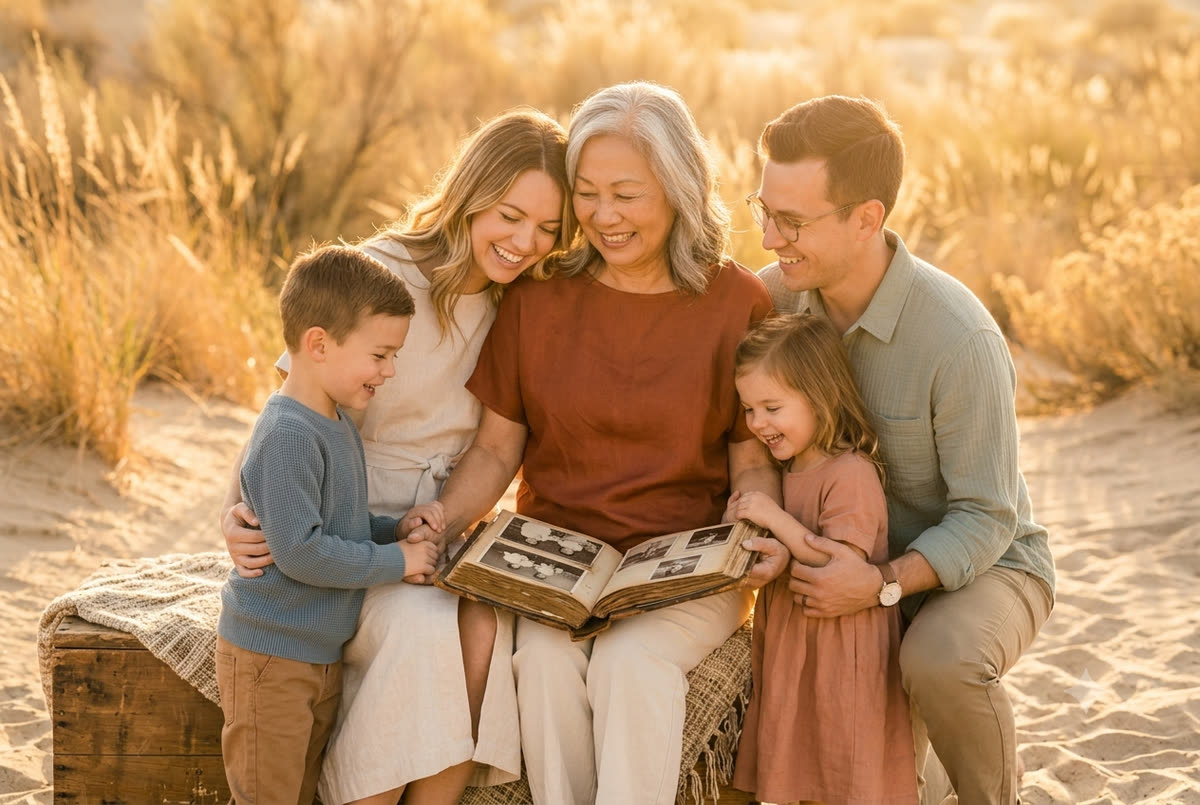
Should the grandchildren be involved?If it feels right, yes. A photograph of an elderly great-grandparent with a small child — the very oldest and the very youngest of a family — is among the most powerful images I make. It only need be brief. You might find my thoughts on photographing three generations of women helpful as you think about who to include.
Will the photos be sad to look at?In my experience, the opposite. In the first raw weeks of grief they may be tender to open. But over the months and years, families tell me these become the images they are most grateful to have — proof of a face, a presence, a love that was real.
What do we do with the photographs?Please, do not let them live only on a phone or a hard drive. Print them. These are the images meant to be framed on a wall, gathered into an album, shared among siblings, and one day passed to grandchildren who will study a face they were too young to remember. The printing is the point.
Mistakes I gently steer families away from
- Waiting for a better day that the illness will not grant. The good-enough day in front of you is almost always the right one.
- Over-preparing the person into exhaustion. A long morning of hair, makeup, and outfit changes can leave a frail elder with nothing left for the camera. Keep it simple and let them rest.
- Treating it as a grim duty. Bring a little warmth — a favorite story, a shared cup of tea, the grandchildren for a few minutes. The session should feel like time together, because it is.
- Forgetting the small details. The wedding ring worn thin, the hands that worked a lifetime, the particular way they fold a newspaper. Those details are the person, and I am always looking for them.
- Excluding yourself from the frame. You will want to be in at least a few. Trust me on this one.
A few words before we begin
I have photographed families across the Coachella Valley for many years, and I will tell you honestly that final portraits have taught me the most about why I do this work at all. There is nothing abstract about the value of a photograph when it is the last good image a family will ever have of someone they loved. I do not take that lightly, and I carry it with all the care and tenderness it deserves.
My promise to you is simple. I will move slowly and softly, and I will never let the camera come before the person. I will protect your loved one's comfort and dignity above any photograph. I will look for the warmth and the truth in their face, not the frailty. And I will give you images that, in time, you will be deeply grateful you found the courage to make.
If you are thinking about a final portrait of your mother, your father, your grandparent, or anyone whose time you feel quietly slipping — send me a note. We can begin with nothing more than a quiet conversation about who they are and what you most hope to keep. You can reach me any time through my contact page, and if your need is urgent, say so plainly and I will make room that week. I would be honored to help you hold on to them.