What Is Legacy Photography? A Guide for Coachella Valley Families
There's a kind of photograph people describe to me in roundabout ways — not just a nice picture, they'll say, but something that holds the whole of who a person is. Often they apologize for not knowing what to call it. It does have a name: legacy photography. And it turns out a great many families are quietly looking for it without ever knowing what to type into a search bar.
So if you've landed here wondering what legacy photography actually is — whether it's a real thing or just a pretty label, whether your family is the kind of family it's "for," and what it would mean to do one here in the desert — let me give you the clearest, most honest answer I can. I've been photographing people across the Coachella Valley through every chapter of life for a long time, and this particular work has become the part I hold closest.
The short answer
Legacy photography is the deliberate, unhurried making of portraits meant to preserve who a person is — their face, their hands, their bearing, the way they sit with the people they love — so that those images can be printed, framed, and handed down through a family for generations.
That's the whole of it. But every word in that sentence is doing work, so let me slow down and unpack it, because the difference between a legacy portrait and an ordinary nice photo lives entirely in the details.
- Deliberate. It's a decision, not an accident. You don't stumble into a legacy portrait the way you catch a good candid at Thanksgiving. You set out to make it.
- Unhurried. These sessions are built around patience. The subject is often an older parent or grandparent, and rushing is the fastest way to lose the very thing we're after.
- Who a person is. Not how they photograph for a magazine. The goal is recognition — a grandchild not yet born looking at the picture in forty years and feeling like they actually met this person.
- Printed and handed down. A legacy image is made to leave the phone and live in the physical world, where it can outlast all of us. More on why that matters below, because it matters a lot.
What legacy photography is not
It's easier to understand something when you can see its edges, so here is what legacy photography is not.
It is not a sad thing, even though it's sometimes booked for tender reasons. People hear the old industry term "end of life photography" and brace themselves. I've retired that phrase from my own work because it frames the whole experience around loss, when in practice these sessions are far more often a celebration — this person is here, this person matters, let's give them an hour of being truly seen. Many of mine are booked for a ninetieth birthday, a sixty-fifth anniversary, or simply the one winter all four generations are healthy and in town at the same time.
It is not a stiff studio headshot. No grey backdrop, no fake smile held until your cheeks ache, no "chin down, eyes up." Legacy work is the opposite of that formality. I'm looking for the real face, which only shows up when a person forgets the camera is there.
It is not the same as your annual family pictures, though it's a close relative. Your yearly session by the palms is wonderful and you should keep doing it. A legacy session tilts the focus deliberately toward the eldest people in the room and toward permanence — these are the frames meant to be hanging in the hallway long after.
And it is not only for the very old or the very ill. Anyone whose presence holds a family together is a worthy subject. Sometimes that's a great-grandmother; sometimes it's a couple in their seventies who built the whole clan; sometimes it's a father in his fifties who has come through a hard stretch of treatment and wants his kids to have him strong.
Where the idea comes from
Families have always done this. Before photography, people commissioned painted portraits of their elders and hung them in the front room so the children grew up under the gaze of the people they came from. The Victorians kept formal albums and framed cabinet cards of grandparents on the parlor wall. The instinct to fix a beloved face in something that lasts is very old; the camera just made it possible for ordinary families, not only wealthy ones.
What's changed in our lifetime is that we take more pictures than any humans in history and keep fewer of them where they can be found. Tens of thousands of photos scroll past on a phone and then vanish into a locked account or a dead device. Legacy photography is, in part, a deliberate correction to that — a return to making a small number of images that are meant to be real objects in the world. I wrote more about that lineage in my history of legacy and heirloom portraiture if you'd like the longer view.
Who legacy photography is for
In my experience here in the Valley, families come to this work from a handful of recognizable places:
- Adult children who suddenly realize a gap. The most common one. "We don't have a single good photograph of Dad — not one where he actually looks like himself." Often they have ten thousand phone snaps and nothing they'd be proud to frame.
- A milestone worth marking. A ninetieth birthday in Sun City Palm Desert, a fiftieth or sixtieth anniversary, a retirement, a move into assisted living. Round numbers have a way of making people finally pick up the phone.
- A diagnosis that turned "someday" into "soon." This is the tender corner of the work, and I take it seriously. When time has become precious, we move quickly and gently.
- Snowbird families catching the overlap. So many of our elders winter here November through April and head back to Minnesota, Alberta, or the Pacific Northwest for the summer. When the parents are in La Quinta and the grandkids fly in for the holidays, that overlap is the moment.
- Anyone who simply doesn't want to wait. The wisest clients I have don't need a reason. They understand that the right time to photograph someone you love is while they're well and here.
If your family includes several generations and you've been meaning to get everyone in one frame, you might also look at my piece on multigenerational and generational legacy sessions, which is a close companion to this one.
What actually happens in a legacy session
People who haven't done this are often nervous — usually on behalf of an older parent who "hates having their picture taken." So here's the shape of it, start to finish, with no surprises.
It starts with a conversation, not a camera. Before we shoot, I want to learn who this person is. What do their hands do all day? What sweater or hat or ring is them? What makes them laugh the real laugh, not the polite one? The more I understand before we begin, the faster I can find the one true moment once we're together.
The pace is slow and kind. I budget far more time than the photographs themselves need, because hurrying an older adult produces tired, tight faces. We pause. We let people sit. If your mother needs to rest, we rest — and I keep the camera close, because the unguarded moment when she thinks we've stopped is usually the best frame of the day.
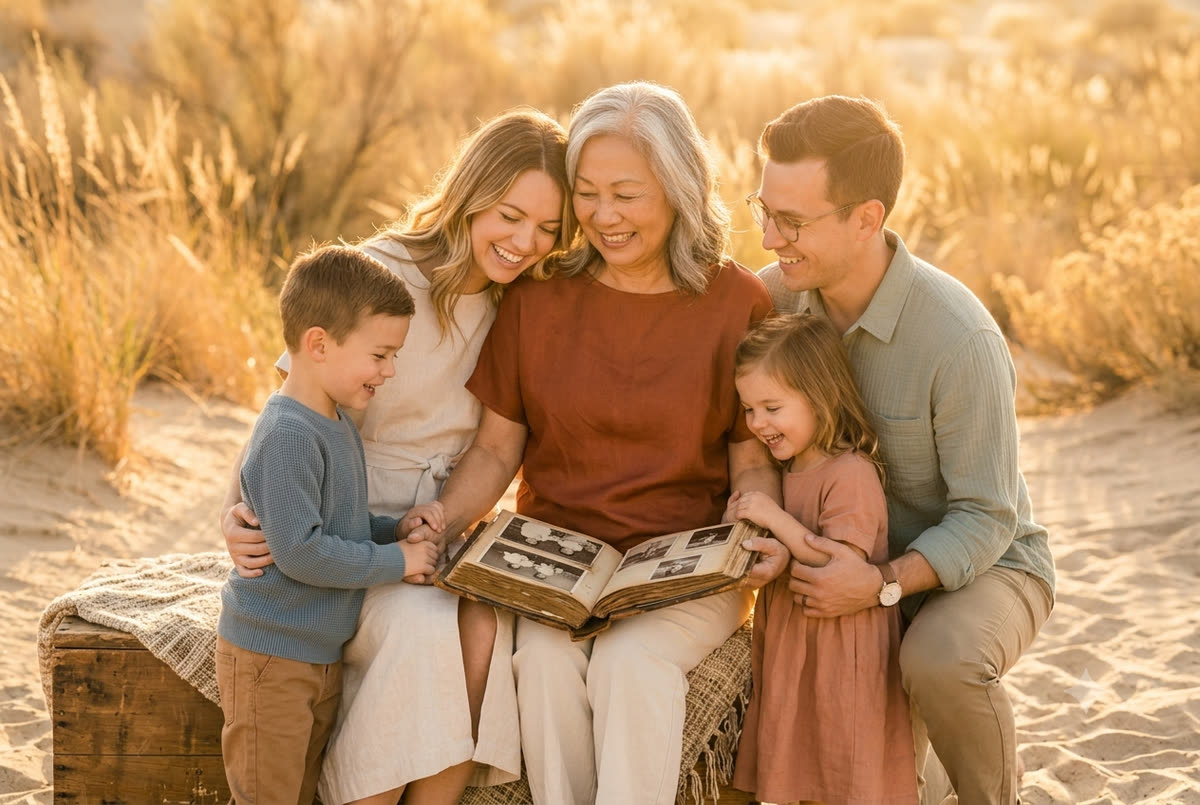
I direct, but I don't pose people stiffly. Rather than lining everyone up and counting to three, I set up a situation — Grandpa in his chair, the grandchildren invited to lean in and tell him something — and then I wait for the gesture that's unmistakably this family. A hand laid over a hand. A whispered joke. That's the picture worth keeping.
Mixed generations are welcome, mess and all. Toddlers will be toddlers and teenagers will be teenagers, and I genuinely don't mind. Some of my favorite legacy images have a great-grandbaby mid-howl in the middle of four laughing adults. That's the truth of a family, and the truth ages beautifully.
For a fuller walk-through, I've written a whole guide on what to expect from a legacy session.
The desert specifics: light, heat, and timing
Doing this work well in the Coachella Valley means respecting our particular climate, because the desert rewards good timing and punishes bad timing fairly hard.
Season. For outdoor sessions with older adults, the comfortable window runs roughly November through April — conveniently, exactly when our snowbird families are here. From late May into September I move most sessions indoors or shoot only in the cool sliver just after sunrise. No ninety-year-old should be standing on a sun-baked patio in 110-degree heat, full stop.
Time of day. When we're outside, I shoot the last ninety minutes before sunset almost without exception. That low, warm desert light wraps softly around a face and is forgiving of every line and shadow. Overhead light at noon does the opposite — it flattens features and drops hard shadows under the eyes — so I plan our outdoor time around the gentler end of the day.
Home is often where I'd rather be anyway. For most families, and especially for frail or limited-mobility elders, photographing at home is my first suggestion regardless of season — no transfers, no walkers across gravel, no fatigue from an outing. We work in the chair your father always sits in, in the soft natural light by the window your mother loves, and honestly the result is usually more them than any location could be.
Where these portraits get made
Place carries memory, and that matters more in legacy work than almost anywhere else. A few directions I love here:
- At home. My first choice for many families. The reading chair, the kitchen, the back patio with the mountain view — rooms already full of a life lived.
- A senior community. Sun City Palm Desert, The Springs in Rancho Mirage, the country clubs around Indian Wells — many have lovely grounds, easy parking, and shade, so we tire no one out.
- A local park or garden. For a mobile, game elder, a shaded city park, the gardens of the Living Desert in Palm Desert, or the palm groves of the Coachella Valley Preserve — green, walkable, easy places with the Santa Rosa Mountains rising behind, photographed in the soft light of the last hour before sunset.
- A place that tells their story. The diner they've gone to every Sunday for thirty years, the church in Palm Springs, the citrus tree grown from a seedling out back. A spot like that can say more about a person than any backdrop ever could.
Color or black and white?
Families ask me this constantly, and there's no single right answer — it depends on the person and the room. Black and white tends to lift a portrait out of any particular decade and lean into timelessness and emotion; color holds onto the warmth of someone's actual sweater and the gold of desert light. I usually deliver a thoughtful mix and help you choose what hangs large. I dig into the trade-offs in color versus black and white for legacy portraits.
The part I care about most: print it
I'll be plain, because this matters to me more than almost anything else I do. A legacy photograph that lives only on a phone is a photograph at risk. Phones are lost, accounts get locked, files corrupt, formats go obsolete. The portraits families still treasure fifty years from now are the ones that got printed — framed on a wall, gathered in an album, tucked into a drawer to be rediscovered by someone who never met the person and falls a little in love anyway.
So I deliver legacy sessions as finished, archival prints, not just digital files. When a family hangs their grandmother in the hallway, she becomes part of the daily life of the house — the grandchildren grow up greeting her face every morning. That, to me, is what the word "legacy" actually means.
A note on what else can be preserved
The face is the heart of it, but it isn't the only thing worth keeping. A voice — the particular way your father tells a story, the song your grandmother hums — is just as much a person as a photograph is. More families are now pairing portraits with short recorded conversations, and if that speaks to you, I've written about preserving voices and stories alongside the images. I mention it because legacy work, at its fullest, is about keeping the whole person within reach.
Questions families ask me most
My parent is self-conscious about how they've aged. Will this be uncomfortable?This is the worry I hear most. My entire approach is built to ease it — we go slowly, I photograph people being genuinely themselves rather than holding a pose, and the images come back warm and dignified, never clinical. Almost every elder who dreaded the session ends up surprised by how much they like the pictures. They were never seeing what their family sees; my job is to show them.
What if my loved one has dementia or limited mobility?I've done many of these, and they can be deeply tender. We keep it short, familiar, and low-stimulation, usually at home with one or two close family members nearby, and I follow their pace entirely. Even on a hard day, the connection between an elder and the person who loves them tends to show through — and that connection is exactly what we're after.
How is this different from regular family photos?Mostly in intent and in pace. Annual family pictures capture a season of your life; a legacy session is built to outlast everyone in it, with the focus tilted toward your eldest people and toward prints meant to be handed down.
How far in advance should we book?For snowbird families, as soon as you know the dates everyone overlaps in the Valley — the November-through-April calendar fills, especially around the holidays. For health-sensitive situations, call and we'll find a date quickly; I keep room for those. There's more in my note on how far ahead to book a legacy session.
Do you travel across the Valley?Yes — Palm Desert, Palm Springs, Rancho Mirage, Indian Wells, La Quinta, Indio, and the communities in between. If your family is here, I'll come to you.
If this is on your heart
If you've read all the way down here, there's probably a particular face in your mind already — someone whose laugh you'd want your great-grandchildren to know. That's what legacy photography is, finally: a way of keeping that face within reach, not as a memory that softens at the edges over the years, but as a photograph you can hold and frame and pass forward.
There's rarely a perfect moment that announces itself. The good moment is usually just an ordinary week when everyone's well and home. If you'd like to talk it through, reach out and tell me about the person you're thinking of. We'll find the right time, place, and shape for it together — and I'd be honored to make these for your family while there's all the time in the world to do it beautifully.