Anniversary & Remembrance Photo Traditions
The first anniversary of a loss is its own kind of weather. You feel it coming for weeks — a date circled on no calendar but the one inside you — and when it finally arrives you want to do something, though you are rarely sure what. Many of the families I work with come to me in exactly that state: wanting to mark the day, wanting to keep a person close, and not quite knowing how to hold grief and love in the same set of hands.
This is a guide to doing that with photographs. Some of these ideas are about pictures you'll make on a remembrance day going forward. Some are about caring for the images you already have — the ones in shoeboxes and on old phones and tucked into the corner of a mirror. And some are simply about building small, repeatable traditions so the people you love are remembered out loud, year after year, instead of only in the quiet.
I've spent a long time photographing this valley's families through their whole arc — weddings, new babies, the children who grow up between sessions, and yes, the goodbyes too. What I've learned is that remembrance doesn't require anything grand. It rewards being specific, gentle, and a little bit brave.
What "remembrance photo ideas" really means
When people search for remembrance photo ideas, they're usually standing at one of a few different doorways:
- An anniversary is coming — of a death, or of a wedding to a spouse who has since passed — and they want a meaningful way to observe it.
- They have old photos that are fading, damaged, or trapped in one fragile copy, and they're afraid of losing them entirely.
- They're planning a gathering — a birthday that goes on without the person, a holiday, a scattering of ashes — and want it documented with care.
- They want a portrait now, of the people who remain, that quietly includes the one who's gone.
I'll walk through all of these. Take what fits your family and leave the rest. There is no correct way to grieve, and there is certainly no correct way to photograph it.
Anniversary traditions worth building
The strongest remembrance traditions are the ones small enough to actually keep. A tradition you can only manage once, when you have the energy and the budget for something elaborate, tends to make the following years feel like failures. So I lean toward simple and repeatable.
The same-place portrait, year after year
Pick a spot that meant something — the front steps of the family home in La Quinta, the kitchen table where everyone always ended up, the backyard patio your dad tended, or a familiar bench at the Living Desert or a shaded path through a local garden. Most of the families I photograph choose a place close to home for exactly this reason: it's where the person actually lived their days. On the anniversary, photograph the people who remain in that same spot. Same framing, loosely. Same place.
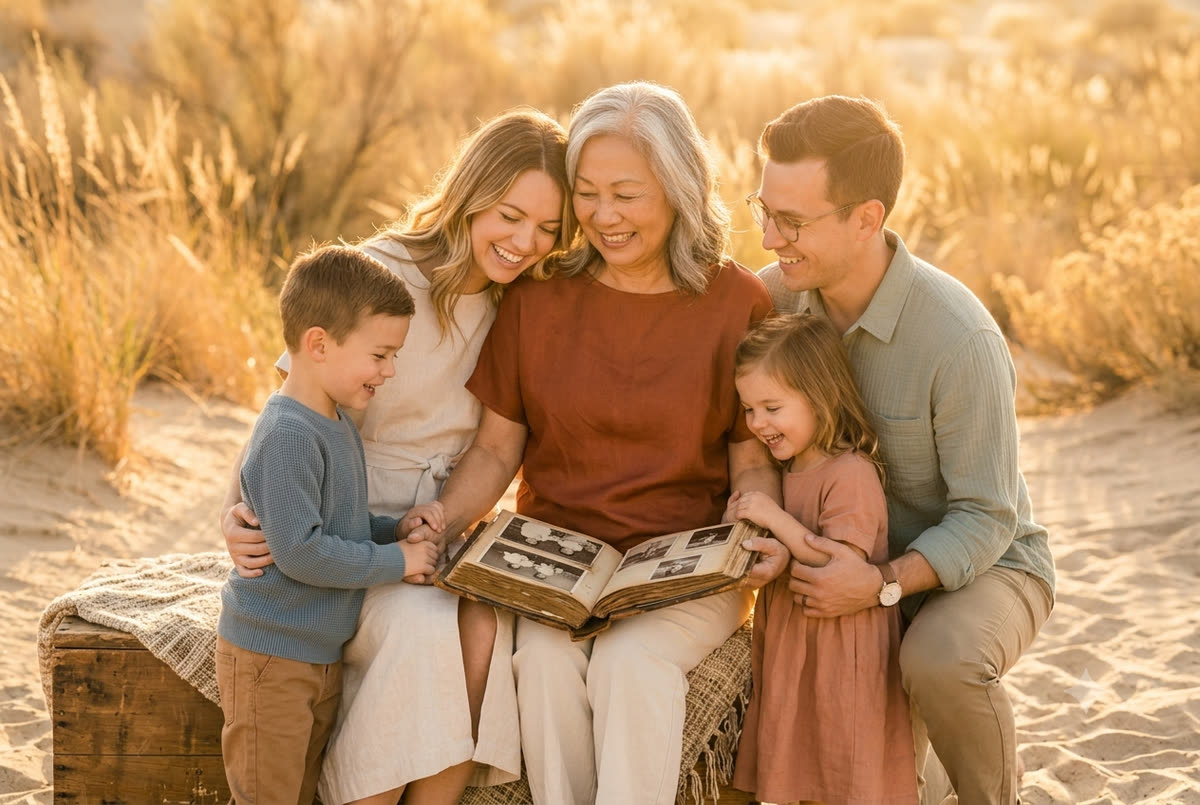
What this builds over years is quietly extraordinary. The children get taller. Someone new joins the frame; someone else is held only in memory. The place stays, and the photographs become a record of a family continuing to love someone forward. Families who keep this up often end up with five or six of these to lay side by side — and that small stack of years tends to undo people in the best way. That's the whole point.
The empty-chair frame
This one is tender and I offer it carefully, because it lands differently for everyone. At a remembrance gathering, leave a chair — the person's chair, if there is one — and photograph the family around it. Some families set the table place. Some lean a framed portrait on the seat. For others the empty chair is too much, and that's a perfectly good reason not to do it. You know your people.
The letter or the toast
Not every tradition has to be visual to be worth photographing. Some families read a letter aloud each year, or raise a glass with a specific line the person always said. My job in those moments is to disappear and catch the faces — the daughter's hand pressed to her mouth, the grandson grinning at a joke about a man he barely got to meet. Those candid frames usually become the most treasured ones, far more than any posed setup.
A walk in their honor
If sitting still feels wrong, move. A slow loop through the El Paseo gardens, a stroll around a neighborhood park, an evening turn through the family's own garden as the light goes gold. I'll come along quietly and document the family in motion — talking, remembering, being ordinary together. Grief and an easy afternoon are allowed to share the same day.
Keepsakes and objects that carry a person
A remembrance photograph doesn't have to be a portrait of people. Often the most powerful image is of a thing — and the way a living hand holds it.
- Their hands' work: a grandmother's recipe card in her own slanted writing, a woodworker's plane, a knitter's last unfinished row still on the needles.
- Worn objects: reading glasses, a wedding band, a watch stopped or still ticking, a pair of boots shaped by the feet that wore them.
- The handwriting: a signed card, a grocery list, a note left on the fridge. Photographed close and clean, handwriting hits people in a place almost nothing else reaches.
- The shared object across generations: your mother's ring on your daughter's finger, the same quilt held by three sets of hands.
These photographs are easy to make and they age beautifully. If you have objects like these, I'd gently suggest photographing them soon — before they're lost in a move, before the ink fades, before memory blurs which recipe was really hers. I get into the why of this more in why we don't wait to photograph the people we love.
Caring for the photographs you already have
For a lot of families, the most urgent remembrance project isn't making new images — it's rescuing old ones. After a loss, photographs often surface in difficult condition: water-stained Polaroids, slides nobody can view, a single irreplaceable print that exists in exactly one copy.
A few honest, practical steps:
- Digitize the one-of-a-kind images first. A faded copy that exists in fifty places is safer than a pristine one that exists once. Photograph or scan the irreplaceable prints before anything else — even a careful phone snapshot in good window light beats nothing.
- Don't try to "fix" originals yourself. Resist the urge to trim, tape, or glue a damaged print. Stabilize it flat, keep it out of heat and direct desert sun, and let a professional handle restoration from a digital copy.
- Gather, then sort. Pull everything into one place before you start culling. Family photos have a way of being scattered across siblings, attics, and old laptops. You can't see the whole story until it's together.
- Write down what you know. A name, a year, a place, a story — even a guess. Unlabeled photographs lose half their meaning within a generation. Voice memos count.
- Make a backup off-site. One copy in the cloud, one on a drive in another house. Heat and a single failed hard drive have ended more family archives than any fire.
If you've inherited a box like this and feel overwhelmed, you're not alone — it's one of the most common things people bring me. There's a gentler, step-by-step version of this in organizing inherited family photos after a loss.
Including someone who's gone in a portrait today
When a family books a session after a loss, we often talk about how — or whether — to include the person who died. There's no obligation to. But when families want to, here are approaches that feel honest rather than staged:
- The held portrait: someone holds a small framed photo of the person. Simple, classic, and it never reads as gimmicky when the emotion is real.
- The worn or carried object: a child wearing grandpa's hat, a widow in her late husband's flannel, his dog tags around a grandson's neck.
- The empty space, used on purpose: a deliberate gap in the lineup where the person would have stood. Quiet and strong.
- The location itself: photographing at the place that was theirs — the living room they filled with people, the porch in Rancho Mirage, a favorite bench in a familiar garden.
- The composite, done with restraint: occasionally a family asks me to digitally place an old portrait into a new family photograph. I do this thoughtfully and rarely, and only when it serves the family rather than tricking the eye. It's not for everyone, but for some it's exactly right.
Doing this in the desert: light, timing, and place
A few things specific to photographing remembrance here in the Coachella Valley.
Where I usually work. Most of my remembrance sessions happen right where the person lived — in the family's home and, when we do step outside, in nearby parks and gardens. A home holds a person better than any scenic backdrop can: the chair, the window, the light they read by. Indoors, I work with natural window light, drawing people toward the soft glow of a north- or east-facing window and turning off the harsh overheads. It's flattering, it's calm, and it keeps the day on familiar ground.
Timing for outdoor frames. If we head to a park or garden, aim for the first hour after sunrise or the last hour before sunset — golden hour, when the light is low and forgiving. Midday light out here is a different animal; it falls hard and flat, and standing in the heat is no way to spend a tender morning. A garden in the cool of evening gives us soft color and breathing room. Inside, of course, window light works at almost any hour.
Place. The valley is full of locations that already hold meaning: the Living Desert Zoo and Gardens, a shaded neighborhood park, the date gardens and citrus groves near Indio, the mountains catching last light over Indian Wells. But more often than not the right setting is closer in — a backyard, a patio, the rooms a person filled. If your person loved a specific spot, that beats any "pretty" location I could suggest. Meaning outperforms scenery every time.
Pace. Remembrance sessions move slower than a typical family shoot, and they should. I build in room for the moment someone needs to step away, or laugh, or cry, or simply stand quietly. We take the time the day asks for. The good frames come from the slow stretches, not the posed ones.
Gentle questions families ask me
Is it strange to want photos on such a hard day?Not at all. Wanting to remember is the most natural thing in the world. Photographs give grief something to hold onto besides the ache.
What if I cry the whole time?Then we'll have honest pictures. Some of the most beautiful frames I've made were through someone's tears. You don't have to perform being okay for the camera.
Should I include the children?Usually, yes — if they're willing. Children process loss through ritual and story, and being part of a remembrance tradition gives them a way to keep knowing a grandparent they may barely remember. I keep it light and never push.
We don't have any good recent photos of the person. What now?Then we focus on what remains — the people, the places, the objects, the handwriting. And we treat it as a reason to photograph the living generations now, so this gap doesn't repeat.
A few mistakes to sidestep
- Waiting for the "right" anniversary. The fifth feels more momentous than the second, so people postpone — and lose two years of pictures in between. Start with whichever one is next.
- Over-designing the day. Elaborate setups create pressure and rarely survive into a yearly habit. Simple endures.
- Letting one fragile copy stay one copy. If you take nothing else from this, back up your irreplaceable photographs this week.
- Assuming everyone grieves the same way. What comforts one family member may overwhelm another. Build flexibility into any tradition so people can opt in at their own pace.
When you're ready
Whether you're marking an anniversary, starting a yearly tradition, sorting through an old box of prints, or making a portrait that quietly carries someone forward, I'd count it a privilege to help you figure out the shape of it. Tell me a little about the person and the day you have in mind, and we'll take it from there — send me a note here.
However you choose to remember them, the act of remembering out loud — of pointing a camera at the love that's still here — is never the wrong thing to do.