A History of Memorial & Legacy Photography
The wish to hold onto a face after someone is gone is far older than the camera. Long before photography, families commissioned painters, pressed locks of hair behind glass, and kept a parent's eyeglasses on a windowsill. So when I tell people that memorial photography has a long and surprisingly tender history, I'm really pointing at something even older underneath it — the plain human refusal to let a beloved person simply vanish. The camera only gave that instinct a new, astonishingly accurate tool.
I do legacy and end-of-life work here in the Coachella Valley, and families often ask me, gently and a little nervously, whether wanting these photographs is normal — or even decent. The honest answer is that it is one of the most well-worn paths in the whole history of pictures. Understanding where the practice comes from tends to take the strangeness out of it. So let me walk you through that history, from its earliest forms to what legacy photography looks like in a Palm Desert living room today.
Before the camera: the long human habit of remembering
Memorial portraiture did not begin in the 1800s. The Romans kept wax ancestor masks and displayed them at funerals. Medieval and Renaissance families who could afford it commissioned painted portraits — and a striking number of those paintings were made specifically because someone was dying or had just died. A grieving parent would hire an artist to paint a child from memory, sometimes adding a wilted flower or a snuffed candle to signal the loss to anyone who looked.
Mourning had its own visual language for centuries: black-bordered stationery, memorial samplers stitched by daughters, and jewelry woven from a loved one's hair and worn against the skin. These weren't morbid by the standards of the time. They were ordinary, and they were comforting. People lived much closer to death than most of us do now, and they built warm, tangible ways to keep their dead near.
I mention all of this because it reframes what came next. When photography arrived, it didn't invent memorial keepsakes. It joined a tradition that was already thousands of years deep.
The daguerreotype and the birth of memorial photography
Photography became publicly available in 1839 with the daguerreotype, and almost immediately it collided with grief. Sitting for a portrait was expensive and uncomfortable — early exposures could take many seconds or even minutes, requiring the subject to hold perfectly still. Because of the cost, a great many people went their entire lives without ever being photographed at all.
That is the crucial detail that explains so much of what followed. For a family of modest means in the 1840s or 1850s, a death might be the only occasion that justified the expense of a photographer. If you had never managed to picture your mother while she lived, the hours after her death could be your single, final chance to have any image of her face at all.
So families did exactly that. They called for the photographer when someone died, and what we now call post-mortem photography became one of the most common uses of the early camera.
Victorian post-mortem photography: what it really was
This is the part of the history that unsettles modern people, so I want to talk about it plainly, because it is usually misunderstood.
Throughout the Victorian era, roughly the 1840s through the early 1900s, it was a normal and respectable practice to photograph a person after death — often a child, since child mortality was heartbreakingly high. These images were not hidden away in shame. They were displayed on mantelpieces, mailed to relatives, and kept in the family album beside everyone else.
A few things to understand about them:
- The intent was love, not spectacle. A post-mortem portrait was frequently a family's only photograph of that person. It was treasured precisely because nothing else existed.
- They were often composed to look peaceful. The deceased might be posed as if sleeping, surrounded by flowers, or held in a parent's arms. Photographers and families worked hard to make the image tender rather than frightening.
- Many myths have grown up around them. You may have heard that Victorians used hidden metal stands to pose the dead standing upright, or that you can spot a corpse in old photos by looking for posing stands behind the feet. Most of that is internet legend. Those stands existed to help living people hold still during long exposures, not to prop up the dead. Historians who study these images are quite firm on this point.
I find it worth sitting with how matter-of-fact our great-great-grandparents were about this. They did not consider it ghoulish to want a picture of someone they loved, even in death. They considered it natural. Somewhere in the last century, we lost that ease — and I think we lost something real along with it.
Mourning culture, cartes de visite, and the spread of the image
As photographic technology improved through the 1850s and 1860s, prices dropped and formats multiplied. The carte de visite — a small photographic card mounted on cardstock — made it cheap to print many copies of a single portrait. Suddenly a family could send a deceased loved one's image to relatives across the country, or keep multiples in different households.
This era also gave us the memorial card, a printed keepsake with the person's name, dates, and often a small portrait or a verse, handed out at funerals. If you have ever received a laminated prayer card at a Catholic funeral here in the valley, you've held a direct descendant of that Victorian tradition. The form has barely changed in a hundred and fifty years.
The American Civil War deepened the relationship between photography and grief. Soldiers carried small portraits of family into battle, and families clung to the last image they had of a son who marched off. The war also brought the work of photographers like Mathew Brady's teams into public view, and the nation saw, for the first time in pictures, the true scale of death. Photography and mourning were now permanently entwined in the culture.
There was a darker, stranger chapter too: spirit photography. In the 1860s and beyond, some photographers claimed they could capture the ghostly images of the dead hovering beside their grieving clients. It was fraud, achieved through double exposures, and it preyed on people in deep sorrow. But it tells you how powerfully the public wanted to believe a photograph could keep the dead present. The hunger was real even where the pictures were faked.
The twentieth century: how we grew uneasy
So what changed? Why does post-mortem photography feel so foreign to most of us now, when it was once perfectly ordinary?
Several things shifted at once across the early and mid-1900s:
- Cameras became cheap and personal. Once the Kodak Brownie put a camera in nearly every household, people no longer needed a death to justify a portrait. Lives were now photographed while being lived — birthdays, vacations, front porches. The single posthumous portrait became unnecessary, because albums were already full.
- Death moved out of the home. Care of the dying and the dead shifted from the family parlor to hospitals and funeral homes. As death became less visible in daily life, the customs around it grew quieter and more private, and eventually a little taboo.
- Medicine changed our expectations. As life expectancy climbed, death came to feel less like an expected season of life and more like a failure or an interruption — something we preferred not to picture at all.
By the second half of the twentieth century, the old practice had nearly disappeared from mainstream American life, surviving mostly in pockets and in cultural traditions that never abandoned their relationship with the dead.
The traditions that never let go
It's worth naming that not every culture followed that path of avoidance. Right here in our region, Día de los Muertos keeps photographs of the deceased at the very center of remembrance — portraits placed on home altars among marigolds, candles, and the favorite foods of those who have passed. Families across the Coachella Valley build these ofrendas every fall, and the photograph is the heart of the whole thing. The image is how the dead are invited back to the table.
That tradition has always understood something the broader culture forgot for a while: a picture is not a morbid thing. It is an act of welcome and love.
The quiet revival: legacy and end-of-life photography today
In recent decades, the instinct has come back, reshaped for our time. Hospice and palliative care reawakened the idea that the end of a life deserves attention, presence, and dignity — and photography followed naturally.
The most significant modern development is a shift in timing. Where the Victorians photographed people after death out of necessity, today's families almost always want the photographs made while their person is still living. Programs that photograph fragile newborns for grieving parents helped pioneer this compassionate, before-not-after approach, and the philosophy has expanded to honor people at the end of long lives as well.
This is the tradition I work within, and it has a few names that all circle the same idea:
- Legacy photography — celebrating the whole life, with the emphasis on the living person rather than the loss to come.
- End-of-life photography — portraits made during a final chapter, often during hospice care.
- Final portraits — the plain, honest term many families reach for first.
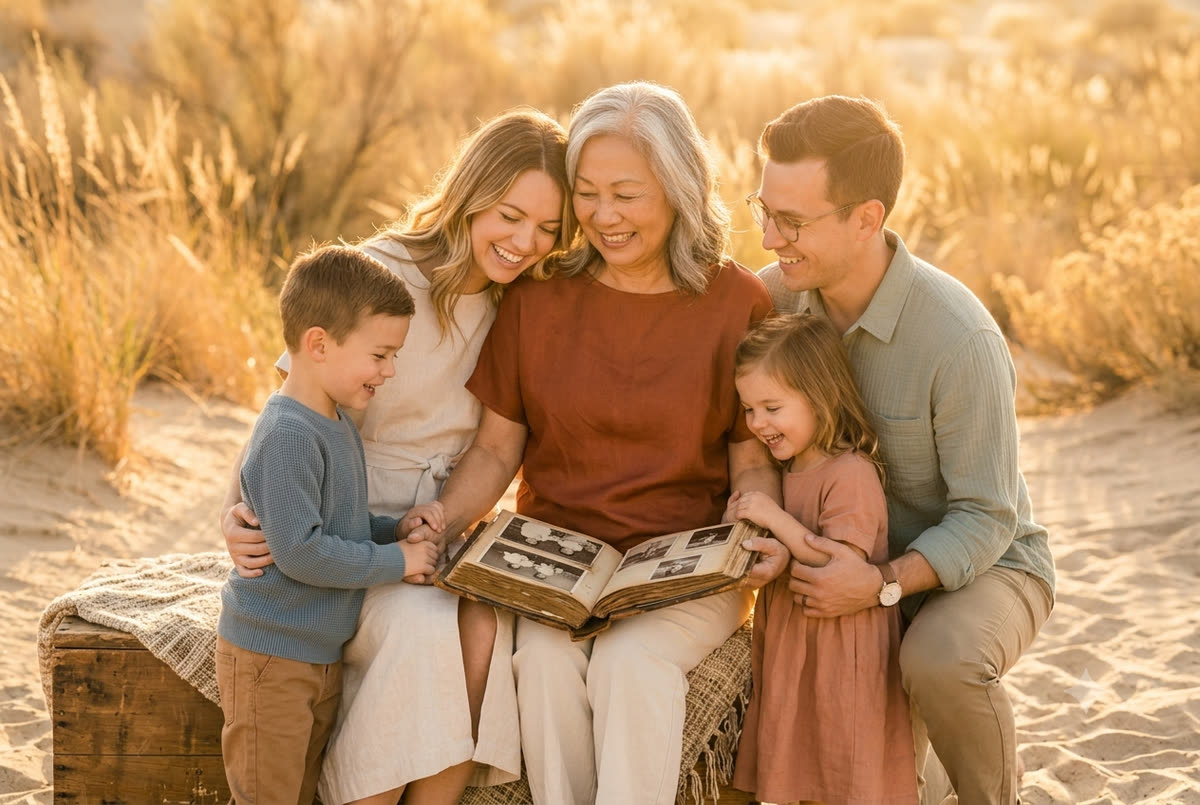
If you want the full explanation of what that work involves, I've written it out gently in what is end-of-life photography. And if your elder is still well and active, the celebratory cousin of this work is a generational legacy session, where we gather the whole family while there is time and ease to enjoy it.
The throughline across nearly two centuries is unbroken: people want to remember the faces they love. What's changed is that we now have the wisdom — and usually the time — to make the photographs before the goodbye, when the person can still look back at the camera, hold a grandchild's hand, and be present for their own portrait.
What this history means for a family in the desert right now
I think knowing the history matters because it lifts a quiet weight off the people I photograph. If you feel a pull to capture your father before his illness takes more of him, or to gather four generations around your mother while she can still join them, you are not doing something odd or unseemly. You are doing what families have done for as long as there have been ways to make an image. You're simply doing it earlier, and more warmly, than the Victorians could.
Here in the valley, that work tends to happen in a few familiar settings:
- In private homes across Palm Desert, Rancho Mirage, La Quinta, and Indian Wells, where someone is surrounded by their own light and their own things.
- In assisted living and memory care communities, where I coordinate quietly with staff and work at the resident's pace.
- In hospice and hospital rooms, when a person's strongest window is short and we make beautiful, gentle work inside it. I've written more about that in my piece on hospice photography.
Most of this work happens indoors, in the soft, even light of a window — a living room, a bedroom, a familiar chair where someone is at ease. When the weather and the person both allow it, a shaded garden, patio, or a quiet local park near the end of the day can offer its own kind of tenderness, with the late golden-hour light falling low and warm. But the heart of a legacy session is rarely a grand desert vista; it's the ordinary room where a life has been lived, surrounded by its own things. And because so many valley families are spread between here and somewhere back home, I'm glad to help time a session around relatives flying in.
If you're carrying the heavier weight of an approaching loss as you read this, you may find some gentler company in my anticipatory grief resource hub. There's no need to absorb all of it at once.
A few questions families ask about the history
Was post-mortem photography really that common?Yes. In the mid-1800s it was a mainstream, respectable practice, especially for children, and the resulting images were displayed openly rather than hidden.
Are the eerie standing-corpse photos real?Almost always no. The posing stands you see in old portraits were for living sitters holding still during long exposures. Most "hidden corpse" claims online are myths that historians have repeatedly debunked.
Is modern legacy photography the same as the old practice?It shares the same root impulse — remembering a beloved face — but the timing is reversed. Today we photograph people while they are still living, which is gentler for everyone and gives us far more to work with.
Why does this feel taboo when it used to be normal?Largely because cheap cameras filled our albums with everyday pictures, and because death moved out of the home and into institutions. The discomfort is recent and cultural, not permanent or universal.
A closing thought
When I make a portrait of someone near the end of their life, I feel myself standing in a very long line of people — Roman families with their wax masks, Victorian parents clutching a single small daguerreotype, a granddaughter placing a photo on an ofrenda in Indio every November. We are all doing the same ancient thing in our own way. I just get to do it with better light and, most importantly, while the person is still here to be loved out loud.
If someone you love came to mind while you read this, that pull is worth listening to — it's the oldest instinct in this whole long story. When you're ready, write to me through my contact page and tell me a little about them: who they are, where they are, and what you'd most like to remember. We can figure out the rest from there.