Tips for Photographing Elderly Loved Ones With Dignity
Some of the most tender conversations I have begin the same gentle way: a careful voice on the phone, usually an adult daughter, sometimes a son, occasionally a granddaughter. They want a real photograph of their mother, or their father, or the grandfather who raised them — and they want it soon, but they are worried. Worried that Dad will feel put on the spot. Worried that Mom is self-conscious about how she looks now. Worried, underneath all of it, that asking for the photograph means admitting out loud that time is short.
I understand that worry completely, because I have felt it about my own family. So before I give you a single technical tip, let me say the thing that matters most: photographing an elderly loved one well is far more about how you treat them than about any camera setting. Dignity is not a filter you apply afterward. It is built into how you ask, how you pace the time, where you point the light, and whether the person in front of the lens feels respected or merely processed. Everything below is in service of that.
Start with the conversation, not the camera
The most common mistake families make is surprising an older relative with a photo session. It comes from a kind place — you don't want them to fuss or refuse — but springing it on someone who is already feeling frail or uncertain almost guarantees a guarded, closed-off expression. People can feel ambushed, and the camera reads it instantly.
Instead, let them in on the plan, and frame it as something you want rather than something they have to perform.
- Tell them why. "I want a good picture of you for our wall" lands very differently than "we should get some photos done." The first is a request rooted in love. The second sounds like a chore or, worse, a deadline.
- Give them a say. Ask what they'd like to wear, where they feel most comfortable, what time of day they have the most energy. Handing back a little control matters enormously to someone who may feel they have lost control over a lot lately.
- Keep the scale honest. If your father would be overwhelmed by a "shoot," don't call it that. Call it a visit where we'll also take some pictures. The lower the stakes feel, the more themselves they will be.
When I work with families here in the desert, I often suggest we talk on the phone first — me and the older person directly, not just the adult child arranging it. Five minutes of conversation before I ever arrive does more for the final photographs than any equipment I could bring.
Choose the time of day around their body, not the light
Photographers love to talk about golden hour, and there is a reason — that soft, low desert sun in the hour before sunset is genuinely flattering. But with an elderly loved one, the schedule has to bend to their stamina first and the light second.
Many older adults are sharpest and most comfortable in the mid-to-late morning. By late afternoon, fatigue, "sundowning," or simple tiredness can set in, especially for someone living with dementia. A gorgeous 6 p.m. light does you no good if the person is exhausted, anxious, and ready to be done by 5:30.
So I plan backward from their best window:
- For a morning person, we shoot mid-morning and I use open shade — a covered patio, the north side of the house, the shaded edge of a courtyard — to get soft, even light without the harshness of full sun.
- For a true golden-hour session, I keep it short and bring everything to them, so the only thing they have to spend energy on is being present.
- Year-round in the Coachella Valley, I avoid asking anyone elderly to sit in direct midday sun. From roughly April through October that is not just unflattering, it's genuinely unsafe for older bodies — heat and glare both. Shade, early hours, or indoors with window light are kinder and look better.
In the cooler months the whole thing gets easier. The light stays soft for more of the day, the temperatures are gentle, and a shaded patio at a Rancho Mirage or Palm Desert home is comfortable enough for an unhurried, extended sitting.
Photograph them where they are most themselves
A studio backdrop can feel clinical, and getting an unsteady person into an unfamiliar building is a hurdle that uses up patience you'd rather save for the photographs. Almost always, the best place to photograph an aging parent is in their own world.
- At home is my first choice. Their chair, their light through the kitchen window, the wall of family photos behind them — these aren't just convenient, they tell the truth about who this person is.
- In a care setting, whether assisted living or memory care in places like Palm Desert, La Quinta, or Indian Wells, we can absolutely make beautiful, dignified portraits. I look for a window with soft light, tidy the immediate frame, and keep the medical details out of the picture unless the family wants them in. If you're navigating that world, I've written more about photographing in assisted living settings.
- A meaningful outdoor spot — a favorite garden, a quiet stretch of a country club lawn, the shade of a palm at a familiar park — works well if mobility allows, and a short, planned route to a seated spot keeps it manageable.
The goal is never an impressive location. It is a comfortable one where they don't have to brace themselves.
Let them sit, and build the session around comfort
Standing for a portrait is tiring, and a tired body shows up as tension in the face and shoulders. I plan almost every session with an elderly loved one around a chair — a real, supportive one, not a folding chair or a stool.
A few things I always have ready:
- Their own seat if possible, the recliner or armchair they actually use, which means their posture is natural and their back is supported.
- Water within reach, and a willingness to stop for it. Hydration matters here more than people think, especially in this climate.
- Their glasses, hearing aids, and anything else that helps them engage. I would much rather photograph someone in the glasses they always wear than chase a "cleaner" look that erases who they are.
- Permission to take breaks, stated out loud at the start. "We will go as slowly as you like, and we can stop any time" removes the pressure to push through.
When someone knows they are allowed to rest, they relax — and a relaxed face is a dignified face.
Pose gently, and protect how they feel about their appearance
This is delicate, so let me be honest about it. Many older people are quietly unhappy with how aging has changed their face, their weight, their posture, their hands. If you fuss visibly — adjusting and readjusting, frowning at the back of the camera, asking them to "sit up straighter" over and over — you confirm their fear that something is wrong with how they look. The session curdles.
I keep my direction warm, brief, and reassuring:
- A slight turn of the shoulders away from the camera is more flattering than facing fully forward, and it's a small ask.
- Bring the chin slightly forward and down, which softens the neck and jaw. I demonstrate it myself rather than narrating a critique of their face.
- Mind the hands. Aging hands carry a whole life in them and can be beautiful in a portrait — resting in a lap, holding a cup of coffee, folded around a grandchild's fingers. I rarely hide them; I just place them with care.
- I never say "lose the double chin" or anything like it. I guide with positive cues — "turn just a touch toward the window for me, that's lovely" — and let the result speak.
And I show them the back of the camera early, on a frame I know is good. The moment someone sees themselves looking like themselves — dignified, recognizable, well — the worry usually melts and the rest of the session is easy.
Find the one true gesture, not just a smile
A forced "say cheese" smile is the least interesting thing a face can do, and with older loved ones it often looks strained. What I'm really after is the gesture that is unmistakably this person: the particular way your grandmother raises an eyebrow, the dry half-smile your dad gives when he's pretending not to be amused, the way her hands move when she talks about her garden.
So I talk to them while I work, and I ask about the things they love.
- Ask about how they met their spouse, the house they raised their kids in, the job they were proud of. The face that appears when someone tells a story they treasure is the face you want to keep.
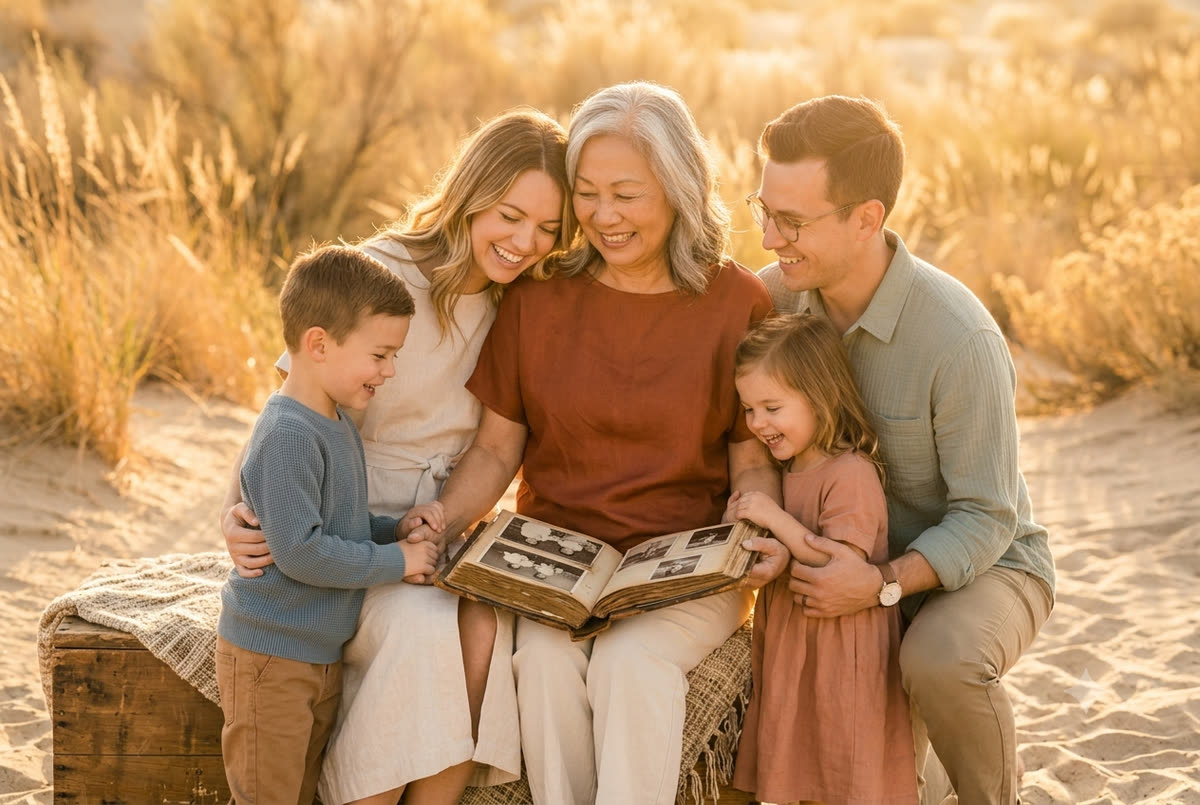
- Bring a grandchild or great-grandchild into a few frames. The way an elder looks at a small child they love is one of the most honest expressions there is.
- Don't be afraid of the quiet, thoughtful expressions. Not every great portrait is a beaming one. A calm, knowing look often says more about a long life than a grin does.
This is the same instinct I bring to a multi-generation family portrait — the picture isn't really finished until I've caught the one moment that could only be them.
When memory loss or frailty is part of the day
If your loved one is living with dementia, Alzheimer's, or significant frailty, the approach shifts, and that is completely okay. I have photographed many people in this season of life, and there is real beauty to be found in it.
- Keep the group small. A crowd is confusing and tiring. One or two familiar faces nearby helps far more than a big audience.
- Follow their rhythm, not a shot list. On a good day we get plenty. On a harder day we get a few, and a few real frames are worth everything. I never force it.
- Let a caregiver or close family member stay close, even just out of frame. Their calm presence steadies everything.
- Photograph connection, not just the solo portrait. A hand being held, a son leaning in to be heard, a daughter sharing a laugh — these tell the story of love and care, which is often what the family most wants to remember.
There is nothing undignified about photographing someone who is fragile. What's undignified is making them feel like a subject to be managed. I aim for the opposite: a relaxed afternoon among people who love them, where the camera is the quiet part.
A short, gentle checklist before the day
If you take nothing else from this, take these:
- Talk to them first; never spring it on them.
- Pick the hour when they have the most energy, then worry about the light.
- Photograph them where they're comfortable — usually home.
- Let them sit, in a real chair, with water and their glasses.
- Keep direction warm and brief; show them a good frame early.
- Chase the real gesture, not the posed smile.
- Go slow, allow breaks, and stop while it's still pleasant.
A word about not waiting
The families I see carry regret are almost never the ones who did a portrait. They are the ones who meant to and didn't — who kept thinking there'd be a better time, when Dad felt stronger or Mom had lost a little weight or the holidays settled down. That better time is a quiet trap. The honest, loving photograph you can make this month is worth infinitely more than the perfect one you keep postponing.
If you've been thinking about a portrait of your mother, your father, or a grandparent here in the Coachella Valley, I would be glad to help you plan it gently — at their pace, in a place they love, in a way that feels like care rather than a production. You can reach me here whenever you're ready, and we'll figure out the kindest way to do it together.