Wall Art & Albums
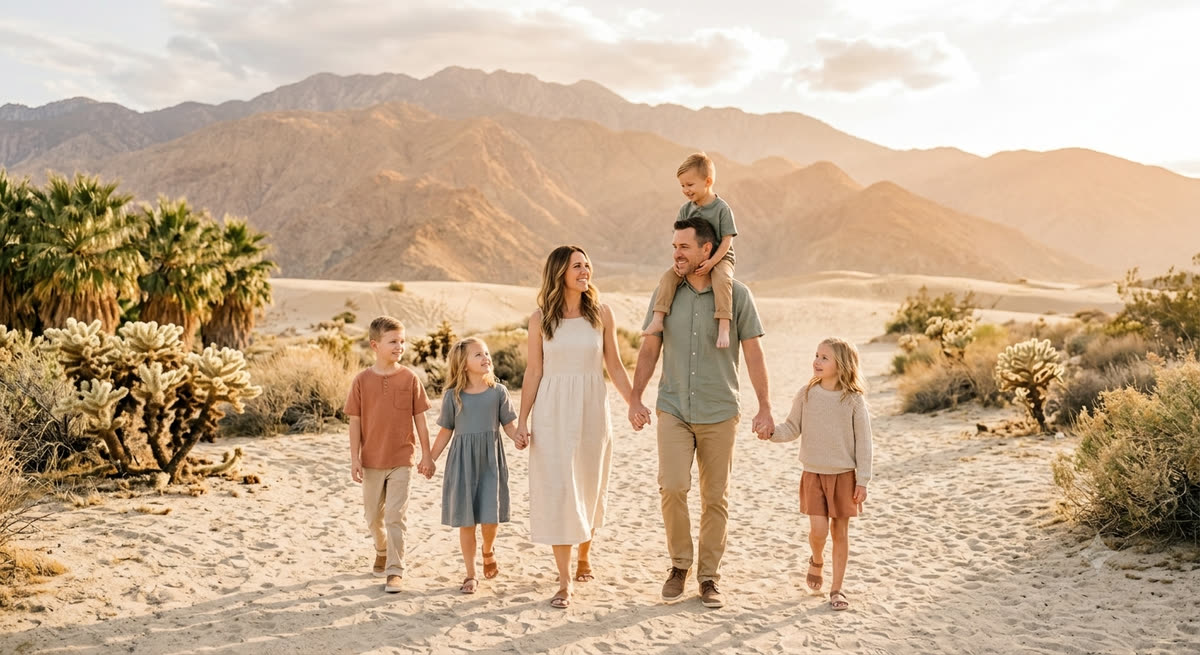
There is a moment I love that happens months after a session, long after the shoot itself is a memory. A client texts me a photo of their own wall — a large framed portrait now hanging over the fireplace, or a print of their kids mid-laugh that greets them every morning in the hallway. That is when the work is actually finished. Not when I press the shutter, and not when I deliver the files, but when the picture has a home and becomes part of the rhythm of your days.
I bring this up because the part of photography we talk about least is also the part that lasts longest. A gallery of digital files is wonderful, and you should absolutely have them backed up. But a hard drive is not a memory you live with. Wall art and albums are how a session stops being a folder you mean to get to and becomes something your family sees, touches, and grows up around. This guide is everything I have learned about doing that well — specifically here, in the dry light and big-walled homes of the Coachella Valley.
Why printed work matters more than people expect
I am old enough to have lost photographs to dead phones, retired laptops, and a cloud account I forgot the password to. Almost everyone has a version of this story. Digital files feel permanent because they are easy, but ease and permanence are not the same thing. The images most likely to survive the next thirty years are the ones that were printed and put somewhere a person looks at them.
There is a quieter reason too. A portrait on the wall changes how a family sees itself. Children who grow up seeing themselves displayed — not performing for a camera, but simply present, valued, part of the household art — carry something from that. It tells them, without anyone saying a word, that this family is worth framing. I have watched kids stop in front of their own portrait and study it like it is telling them who they are. In a way, it is.
So when I talk about wall art and albums, I am not upselling a product. I am talking about the actual point of hiring a photographer in the first place.
Wall art: what actually works in a desert home
Homes here have a particular character. A lot of you are in open-plan layouts with high ceilings, big stucco or plaster walls, and a strong indoor-outdoor feel — sliding glass to the patio, neutral palettes, plenty of light. That kind of space can swallow a small frame whole. The single most common mistake I see is art that is too small for the wall it lives on. A 16×20 that looked substantial in the proof ends up looking like a postage stamp above a long sectional.
Getting the size right
Here is the rule of thumb I give every client: your main piece should fill roughly two-thirds to three-quarters of the wall space above a piece of furniture. Above a sofa, a mantel, or a console, measure the width of the furniture and aim for art that spans about two-thirds of it. In practice, that means most living-room statement pieces in valley homes want to be 30×40 inches or larger, not the 11×14 people instinctively reach for.
A few size references that hold up in real rooms:
- Hallways and stairwells: a vertical 16×24 or 20×30, or a tidy series of matched prints.
- Above a bed or sofa: a single 30×40, 40×50, or 40×60 statement piece.
- Great rooms with tall walls: go big — 40×60 and up, or a grouping that reads as one large gesture.
- Powder rooms and nooks: this is where small, intimate prints (8×10, 11×14) actually belong.
When in doubt, tape newspaper or a paper template to the wall at the size you are considering and live with it for a day. You will almost always discover you want it bigger.
Materials — and what the dry air does to them
The desert is hard on some materials and kind to others. Our air is dry, our light is intense, and many valley homes get strong sun through big west-facing windows. That matters for what you choose.
- Framed prints under glass or acrylic. My usual recommendation. A quality archival print, matted and framed, with UV-protective glazing, is timeless and forgiving. The UV coating is not optional here — direct desert sun will fade an unprotected print faster than you would believe. Acrylic (sometimes called museum acrylic) is lighter than glass, shatter-resistant, and has a beautiful depth, which I love for larger pieces where glass would be heavy and fragile.
- Canvas (gallery wrap). Warm, casual, no glare, and no glass to worry about. Canvas suits family and lifestyle images especially well. Ask for a UV-protective coating and avoid hanging it in a spot that bakes in afternoon sun, since canvas has no glazing to shield it.
- Metal (dye-sublimation aluminum). Vivid, modern, and remarkably durable — it shrugs off humidity swings and is easy to wipe clean, which makes it a favorite for homes with pools and indoor-outdoor living. The look is sleek and contemporary; it pairs better with desert-modern interiors than with traditional ones.
- Mounted/face-mounted acrylic. The most luminous option, almost backlit-looking. Stunning for a single hero image in a well-considered spot. Pricier, and best away from harsh direct light.
Whatever the material, keep art off walls that take direct, sustained sun, and skip hanging anything irreplaceable on the wall directly above a working fireplace, where heat and soot do slow damage over years.
Where to hang it (and how high)
Hang the center of your art at about 57 to 60 inches from the floor — gallery eye level. The instinct is to hang things too high, especially over tall furniture. If a piece sits above a sofa, leave roughly 6 to 10 inches between the top of the furniture and the bottom of the frame so the two read as connected, not floating apart.
The best spots in most valley homes are the ones you pass through, not the formal ones you rarely enter: the hallway between bedrooms, the wall you see walking in from the garage, the kitchen sightline. Art you actually live with beats art in a room reserved for guests.
Galleries and groupings
Not everyone wants one giant piece, and a thoughtful grouping can be lovelier than a single image. A few ways I see them work:
- The matched set. Three to five prints, same size, same frame, evenly spaced. Calm and architectural. Great down a long hallway.
- The salon wall. A mix of sizes and orientations clustered around a central anchor image. More personal and collected-over-time in feeling. It takes planning — lay it all out on the floor first, and keep the gaps between frames consistent (2 to 3 inches is a good default).
- The story sequence. Images from a single session arranged in the order they happened, so the wall tells the arc of an afternoon.
If you are mixing wall art with albums, a common and satisfying setup is one statement piece on the wall plus an album on the coffee table for the rest of the gallery. The wall holds the one image that defines the year; the album holds the whole story.
Albums: the heirloom you can hold
I have a real soft spot for albums. A frame shows one moment; an album holds a narrative — the warm-up, the in-between glances, the quiet portrait, the chaos, the resolution. It is the closest thing photography has to a chapter of a book about your family.
What makes a good album
Not all albums are equal, and the difference is mostly in the binding and the pages.
- Flush-mount, lay-flat pages. This is what you want. The pages are thick and rigid, and a spread opens completely flat so an image can run across both pages without disappearing into the gutter. Cheaper "press books" with thin pages that bow in the middle are not in the same category.
- Cover materials. Linen and leather are the classics. Linen is soft, contemporary, and comes in lovely muted tones that suit desert interiors; leather is traditional and ages beautifully. Some studios offer a cover with an inset image or debossed names and dates.
- Size and length. A 10×10 or 12×12 makes a generous coffee-table album. Smaller 8×8 books are perfect as duplicates for grandparents. As for length, a well-edited family session usually makes a beautiful 20 to 30 page album — enough to tell the story, edited tightly enough that every spread earns its place.
The case for parent albums
If grandparents live far away and only see the kids a couple of times a year, a small duplicate album is one of the most appreciated gifts I know of. It sits on their table year-round, and it does not depend on anyone remembering to text photos. Many of my families order one main album and two smaller parent copies in the same design.
Design and editing
The hardest part of an album is leaving images out. A book that includes everything tells no story; a book that is edited tells one clearly. I help with this — choosing the hero images, pacing the spreads, deciding what gets a full page and what works in a cluster. Trust the edit. Twenty-five strong spreads will move you more than sixty crowded ones.
How to plan for prints before your session
The best wall art and albums are not afterthoughts — they are decisions that shape the shoot itself.
- Know your wall before you shoot. If you want a big horizontal piece over the sofa, I will compose horizontally with room to crop. If you want a tall vertical for the entry, we will shoot for that. Bring me a phone photo of the wall and its measurements.
- Think about orientation. A vertical image cannot become a wide horizontal canvas without cropping out half the family. Tell me what you are imagining and I will frame for it on the day.
- Dress from one palette, not a uniform. For wall art especially, soft, harmonious colors photograph and frame better than tightly matched outfits or loud prints. See my notes on this in what to wear for desert family photos.
- Mind where the light comes from. Most of my sessions happen right in your own home, where soft natural light through the windows is the most flattering thing in the room — and it works in any season. For outdoor sessions at a local park, garden, or backyard patio, golden hour late in the afternoon does the same gentle work, and the cooler stretch from roughly November through April gives the warmest light of the year. Either way, that soft, glowing quality is what produces the strongest wall art. If you are weighing timing, my guide to the best time of year for desert family photos walks through it.
Common questions
Should I just order the digital files and print them myself?You can, and I will never stop you. But consumer print labs and the files-as-you-see-them on a screen rarely match. Screens are backlit and run bright; a print is reflective and reads darker unless the file is prepared for it. Professional prints are color-managed and made on archival materials rated to last generations. For small snapshots, drugstore prints are fine. For anything going on a wall or into an heirloom album, print through the studio.
How long do prints actually last here?Archival prints with UV protection, kept out of direct sun, are rated well beyond a lifetime — think 75 to 100+ years before noticeable fading under normal conditions. The variable is light exposure. The same print in a blasting west window will not last nearly as long as one in a shaded hallway.
What does wall art and album work cost?It varies with size and material, and I would rather talk specifics once I understand your space than quote numbers into the void. As a frame of reference, statement framed pieces and heirloom albums are an investment on the order of furniture — meant to last as long.
When should I order?Soon after your gallery is ready, while the images are fresh and the excitement is high. The boxes of unprinted sessions I worry about are the ones where the family meant to decide later and later never came.
My honest advice
If you do only one thing with your session, print one large piece for the wall you walk past most. If you do two things, add an album. Files are insurance; printed work is the thing your family actually lives inside. I would rather you have one beautifully made portrait over the sofa than two hundred files you never look at.
When you are ready, I would love to help you figure out exactly what your home needs — what wall, what size, which images, and which material will hold up in your particular light. We can do it together, with your room and your measurements in hand, so the result fits your space instead of fighting it.
If you would like to talk through wall art, an album, or both, send me a note here and tell me a little about the wall you have in mind. I will take it from there.