Celebratory Portraits of Aging Parents & Elderly Loved Ones
More of these conversations than you would guess start with an apology. This is probably silly, someone will say — an adult daughter whose father has moved out to Rancho Mirage to be near her, who is in his late eighties now, whose memory comes and goes — and then the real question: is it even worth photographing him at this point, or has the moment already passed?
I want to answer that plainly before anything else, because I have heard some version of it so many times: it is never silly, and it is almost never too late. The portraits people treasure most are rarely the ones made when everyone was at their most photogenic. They are the ones made in time — while the person was still here to sit in the good chair by the window, still here to be teased, still here to say the thing they always say. This article is about how to do that well, and how to make it a celebration rather than something somber.
Why a portrait of an aging parent is its own kind of session
Photographing an eighty-year-old is not the same job as photographing a wedding party or a toddler, and pretending otherwise is how these sessions go wrong. The pace is different. The goal is different. And what counts as a "good" picture is different.
When I photograph someone in the later chapters of their life, I am not chasing a flattering angle or a magazine pose. I am after the things that make them them — the way your mother folds her hands, the particular tilt of your father's head when he is about to make a joke, the wedding ring worn so thin it is nearly a wire. Those details are the whole point. A celebratory portrait of an aging parent says: this person was loved, was specific, was here.
So the work is slower and gentler, and it is built entirely around the person's real comfort and dignity. That shapes every decision below.
Why "someday" is the wrong plan
I will be honest with you, because I think honesty is kinder than reassurance here. The most common message I get is not "I'm so glad we did this." It is "I wish we had done this a year ago."
Health changes. Memory changes. Mobility changes. A parent who can sit comfortably for forty-five minutes this winter may not be able to next winter, and a parent who lights up when the grandchildren pile onto the couch today may be more withdrawn later. None of this is meant to frighten you. It is meant to give you permission to stop waiting for a better time, because the better time is usually the one you are in.
If your parent is a snowbird who comes to the desert only from November through April, that seasonal window is its own deadline. I would much rather photograph your father in January, while he is here and rested and the light is forgiving, than have you mean to schedule it "next visit." The next visit is not guaranteed in the way we like to pretend it is.
This is the heart of what I think of as legacy work — and it pairs closely with the questions I wish more families would ask their elders before it's too late and with why a simple recorded voice can matter as much as a picture.
What a celebratory session actually looks like
People sometimes imagine something stiff — a parent propped in front of a gray backdrop, told to smile. That is not what I do, and it is not what you want.
A celebratory portrait of an aging loved one is warm and a little bit alive. Here is the range it can take:
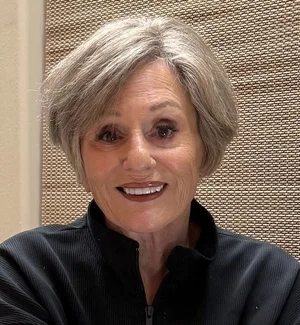
- A solo portrait that honors the person. Just your mother, in good light, looking like herself at this age — not a younger version, not a retouched stranger, but her, now. These become the images families use later, and they are far more comforting when they are real.
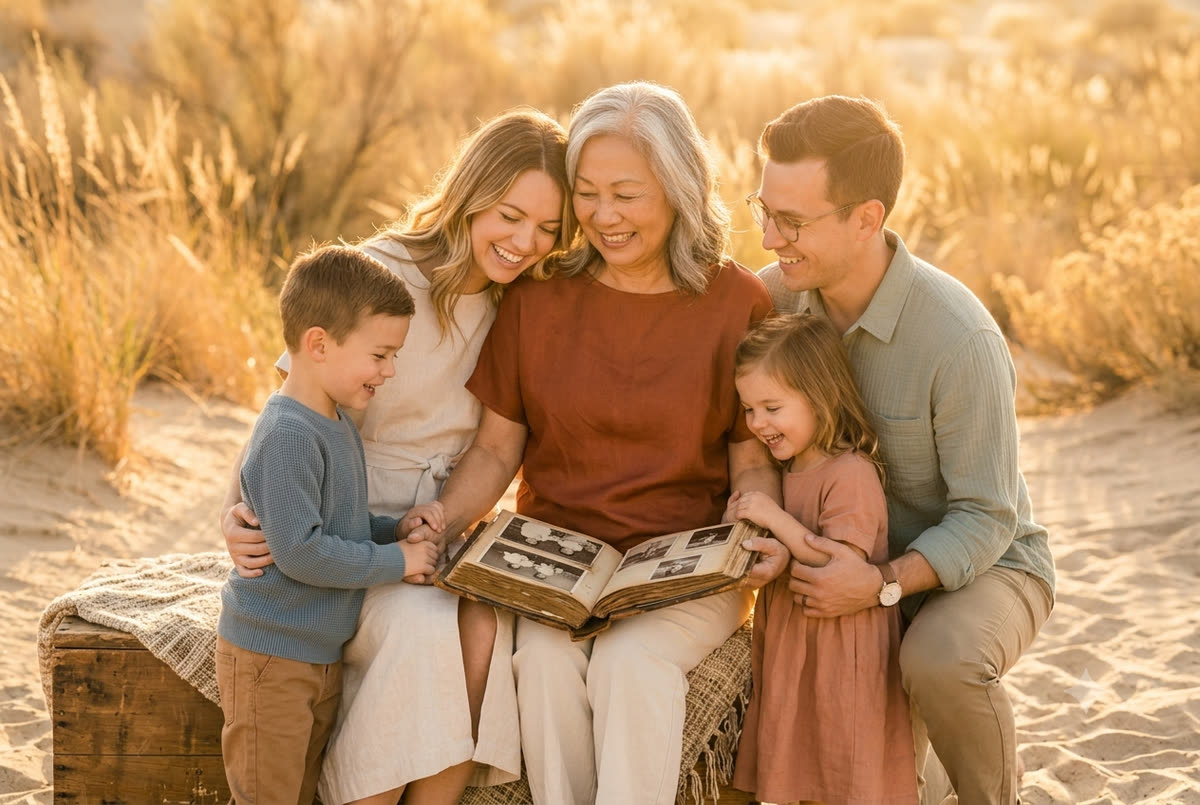
- Three generations together. Grandmother, daughter, granddaughter in one frame. There is something about hands of different ages resting near each other that says everything words cannot.
- The couple, still a couple. If both parents are living, a portrait of the two of them in their eighties or nineties — after fifty or sixty years of marriage — is one of the most moving things I make.
- The person in their element. Your father at his workbench, your mother at her piano or in her garden. Context tells the story. A man in his own kitchen making the coffee he has made every morning for forty years is a portrait of a whole life.
The mood I aim for is celebratory, not clinical and not mournful. We are marking a life that is still being lived.
Where to do it in the Coachella Valley
The best location is almost always the one where your parent is most at ease, and for elderly subjects that very often means home.
At home
I am a strong advocate for in-home sessions with aging parents. The familiar living room, the chair by the window they always sit in, the light they know — all of it relaxes a person in a way no studio can. There is no travel, no parking, no walking across uneven ground. If your mother uses a walker or tires quickly, home removes every obstacle at once. And homes in Palm Desert, Indian Wells, and La Quinta tend to have wonderful big windows; mid-morning light through a sheer curtain is honestly some of the most flattering light there is.
If your parent lives in a community like one of the senior or assisted-living residences around Rancho Mirage or Palm Desert, those often have beautiful common rooms, courtyards, and shaded patios that work beautifully and require almost no walking.
Outdoors, gently
Once a parent is settled and rested, a little time outdoors can be lovely too — but planned around comfort, never the other way round. Midday heat and glare are simply too much to ask of an older subject, so I shoot the golden hour instead: the soft, low light in the first hour after sunrise or the last before sunset. I stay in shaded, easy-to-reach spots close to where we start — a quiet corner of a neighborhood park or community garden, the lawns and fountains around El Paseo, the gentle paths at the Living Desert, or just the back patio with a tree over it. In summer, when the valley turns punishing, I keep these sessions indoors or hold them for the cooler months. Comfort first, always.
How to prepare your parent (without making it a production)
The way you set this up matters as much as anything I do with the camera.
- Tell them the truth, simply. "I'd love a nice picture of you" lands better than a long explanation about legacy and mortality. Keep it light. Most people are quietly pleased to be asked.
- Pick their best time of day. Many older adults are sharpest and most energetic in the mid-morning. If your father fades after lunch or "sundowns" in the late afternoon, we schedule around that. You know his rhythms; tell me.
- Choose clothes that feel like them. Solid, comfortable colors photograph beautifully. The cardigan he actually wears, the blouse she loves. Avoid brand-new outfits bought for the occasion — they tend to look like costumes. We want recognizable.
- Don't over-rehearse. You do not need to coach your mother on how to smile. The best moments come when she forgets the camera is there, which she will, because I work quietly and we mostly just talk.
- Bring the small things. A beloved dog, a cup of tea, the reading glasses, the hat. These props are not clutter; they are the person.
Handling the hard parts with care
I want to speak directly about the situations families worry about, because pretending they do not exist helps no one.
Memory loss and dementia. I have photographed many people living with dementia, and it can be deeply tender work. The session has to be shaped around the person's state on that particular day — kept short and quiet, never rushed, with a familiar family member close by. We follow their lead. Sometimes the most honest, beautiful frame is the one where a daughter is simply holding her mother's hand and the recognition flickers across both their faces. That is not a failure of the portrait. That is the portrait.
Frailty and mobility. Wheelchairs, walkers, oxygen — none of these need to be hidden, and none of them stop us. I can frame and pose so that medical equipment recedes if that is what the family prefers, or include it honestly if that is the truer picture. We take breaks. There is no clock ticking.
Self-consciousness. Many older people will tell you they "hate" having their picture taken or that they "look terrible now." This is so common. My job is to make the experience easy enough that they relax into it, and to make pictures that show them why everyone in the room loves looking at their face. Almost without exception, the person who protested most is the one most moved by the final images.
What to do with the photographs
A celebratory portrait deserves to live somewhere real, not just on a phone.
- Print and frame the best images. A printed portrait on the wall or the mantel is something your parent can see and enjoy now, while they are here. That matters enormously, and it is a gift to them, not only to you.
- Make a small album. Holding a printed book is a different experience than scrolling. For grandchildren especially, it becomes an heirloom.
- Give copies to the wider family. Siblings, far-flung grandchildren, old friends. These images have a way of circulating exactly when families need them most.
I deliver high-resolution files so you are free to print, but I will also help you turn the session into prints and albums if you would rather not handle it yourself. The goal is that the work does not sit on a drive.
If you are thinking about preserving family history more broadly, you might also like my thoughts on building a proper family archive from the boxes of old prints in the closet.
A few honest answers to common questions
"Is it morbid to do this?" Not at all — it is the opposite. You are celebrating a person while you can be in the room with them. Families consistently tell me the session itself became a happy afternoon they were glad to have shared.
"What if my parent says no?" Sometimes the gift is for them, not from them. Often a reluctant parent says yes when they understand a grandchild wants it, or when there is no pressure to be perfect. And occasionally the answer stays no, and that has to be respected too.
"How long does it take?" I plan for the person, not the clock — usually somewhere between forty-five minutes and ninety, with breaks. For someone who tires easily, shorter and sweeter is better, and I would rather get twenty real minutes than exhaust anyone.
"Should the grandchildren come?" If you want them, yes — children loosen everyone up, and the cross-generational frames are often the keepers. If your parent does better with calm, we can keep it small. Either is right.
A gentle word to close
If you have read this far, there is probably a particular face in your mind — a mother, a father, a grandmother who raised you. The fact that you are thinking about this at all is usually a sign that the time is now rather than later.
You will never regret having made these pictures. The only regret I ever hear runs the other direction. So if your parent is wintering here in the valley, or living nearby year-round, let's find a quiet morning and do this gently and well — for them, and for the people who will be grateful to have their face for a very long time.
When you are ready, send me a note and tell me a little about the person you want to remember. We will take it from there, at whatever pace feels right.