Multigenerational & Extended Family
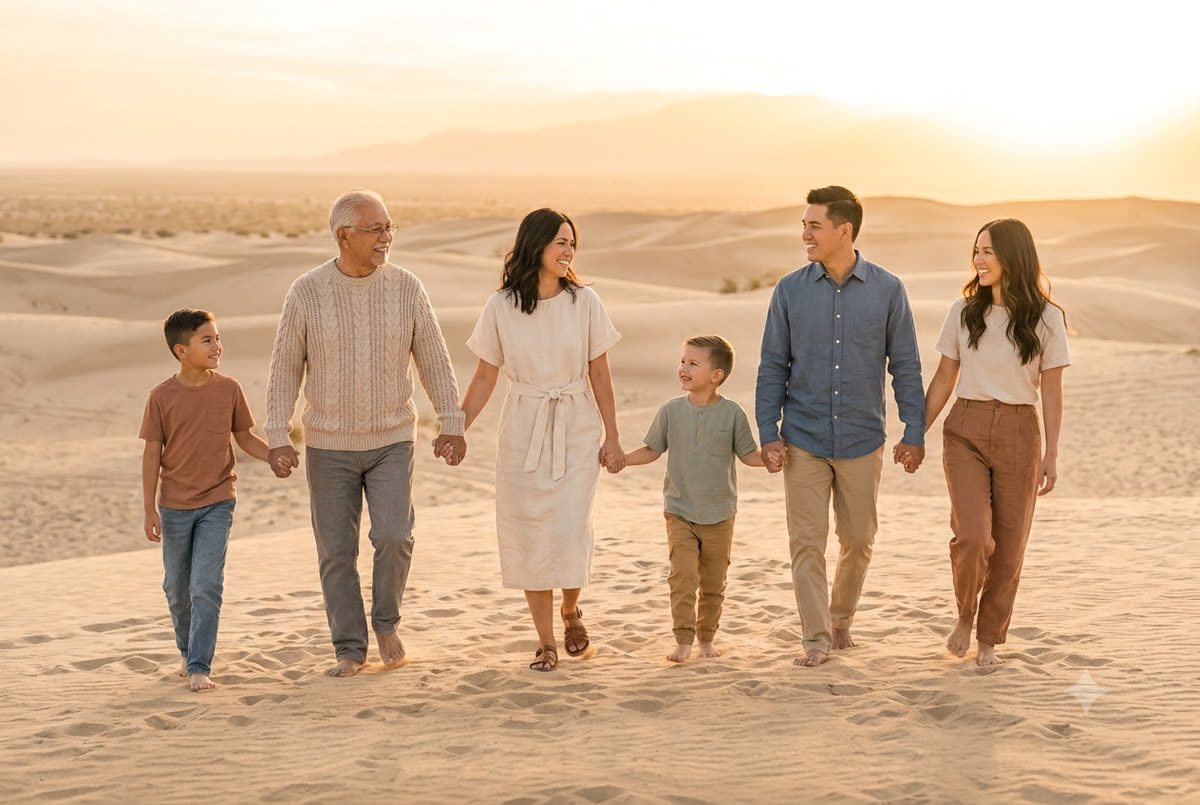
Some of the most meaningful afternoons of my career have started with a phone call that begins, "My mother is turning ninety, the whole family is finally in the same place, and we have never once had a picture with everyone in it." There is a particular weight in that sentence — relief, urgency, a little disbelief that it took this long. When grandparents, parents, grown children, and the littlest grandchildren are all in one frame, you are not just making a nice photograph. You are drawing a map of where a family came from and where it is headed.
This is the page I point people to when they want to gather three, four, or five generations together in the desert. It is the most logistically involved kind of session I do, and also, year after year, the one I am most grateful to be trusted with.
Why gather everyone now
I want to be gentle but plain about this, because it is the heart of why these sessions matter so much.
Families are rarely all in one place. Children grow up and move to other states. Grandparents winter here and summer somewhere else. A multigenerational reunion in the Coachella Valley — over the winter holidays, around a milestone birthday, during a snowbird stretch from November through April when the out-of-town relatives are finally local — is often a window that stays open for only a few days. Then everyone scatters again.
Families wait for the "right" year — a cooler season, a slimmer month, a calendar that finally cooperates — and sometimes that year arrives a face short. A portrait of the eldest holding the youngest can become the image a family enlarges above the mantel, and the one they hold closest years down the road. I do not say that to be heavy. I say it because the cost of waiting is real, and the cost of an afternoon together is small.
If everyone is in town, that is the reason to do it. Not a perfect season, not matching outfits ordered in advance, not the stars aligning. Just everyone, here, now.
Related reading: if you are weighing the broader case for documenting your family this year, I wrote more about that in why a family portrait session is worth it now.
Who to include across three to five generations
A multigenerational family photography session simply means more than two generations in the same gathering. In practice, here is who tends to be in the frame, and how I think about each:
- The eldest generation — great-grandparents or grandparents. They are usually the reason for the session, and the people we plan everything else around. Comfort and dignity for them come first.
- The middle, "sandwich" generation — adult children and their spouses, often the ones organizing the whole thing. They are juggling their own kids and their parents at the same time, so part of my job is taking the logistics off their plate.
- The grown grandchildren — sometimes with partners or spouses of their own, which is how a session quietly becomes four or five generations.
- The youngest — babies, toddlers, the great-grandchildren. They set the clock for the day more than anyone.
A few questions I always ask when we plan an extended family photography gathering:
- Do you want partners and significant others included, or blood relatives only? There is no wrong answer; I just need to know so no one is surprised.
- Are there family members joining by video, or someone recently passed you would like to honor? I'm always glad to work a framed portrait of a loved one into the group images, held by the person who misses them most.
- Who travels the farthest, and what days are they actually here? We build the date around the hardest-to-gather person, not the easiest.
The grouping math grows fast. A "simple" reunion of grandparents, three adult children with spouses, and seven grandchildren is already nineteen people. That is completely doable — I plan for it — but it changes how we use the time, which I will come back to.
Comfort and seating for elderly family members
This is where a multigenerational session lives or dies, and it is the part most people forget to think about until they are standing in the sun.
If we have a great-grandmother who tires easily or uses a walker, the whole session is built around keeping her comfortable and seated. That is not a compromise on the photographs — anchoring the eldest generation in chairs, with everyone gathered around and leaning in, is genuinely one of the warmest compositions there is. It reads as exactly what it is: a family centered on the people who started it.
What I bring and plan for:
- Real seating, not the ground. I bring a sturdy chair or two, and many of the desert venues I use have benches, low garden walls, and shaded patios we can pose against.
- A short walk from the car to where we shoot. For anyone with limited mobility, I scout so that the distance from parking to our spot is short and flat. No gravel scrambles, no long sandy trails.
- Shade and water. Even in the kinder months, I keep the eldest and the youngest out of direct sun between setups and make sure water is on hand.
- An order of operations that respects energy. We photograph the most demanding groupings — and anything involving the great-grandparents — first, while everyone is fresh. If grandma needs to sit the last twenty minutes out in the shade while we do the cousins and the kids, that is a fine plan, not a failure.
I would rather get the one true picture of the whole family in the first fifteen minutes, comfortably, than chase a "better" version after everyone is tired and overheated. With the eldest generation especially, calm and quick beats long and ambitious.
Accessible locations that work for big groups
Not every pretty spot in the valley is right for nineteen people and a grandmother with a cane. My signature settings are the simplest and most personal ones — the family's own home and the easy local parks and gardens nearby. Here are the kinds of places I return to, and why they work for extended family photography.
The family's home or vacation rental
This is where I most love to work, and where I steer most families first. Some of my favorite multigenerational sessions happen at the house everyone is already staying in. If the family has rented a place in La Quinta or Indian Wells for the reunion, or if grandma's home is where everyone gathers anyway, photographing there means no travel, familiar bathrooms, a kitchen for snacks, and a couch for resting between groups. I work with the soft natural light pouring through the big windows — living rooms and sunrooms here are full of it — and pose people on the sofa, around the kitchen table, on the front steps, in a favorite chair. Those spaces carry meaning a public park never will.
Local parks, gardens, and patios
When a family wants to be outdoors, the Palm Desert and Rancho Mirage area has several walkable, partly shaded garden settings where parking is close and the surfaces are smooth. These are my first choice the moment mobility is a real consideration — you get desert greenery and good light without asking anyone to navigate uneven ground. The civic park areas in Palm Desert have wide paths, lawns, and shade structures that handle large groups gracefully, and a shaded patio or garden wall gives the eldest a place to anchor.
Resorts and golf-community grounds
Many families vacationing here are staying at the larger Rancho Mirage and Indian Wells resorts, with manicured lawns, water features, and palm-lined drives right outside the door. With permission, these grounds give you a polished backdrop and, crucially, golf-cart-flat terrain and shade close at hand.
A desert or mountain backdrop, used sparingly
The dramatic landscape we are known for — the San Jacinto mountains, the wide pale sky — is stunning, and now and then a family wants a frame with it behind them. When they do, I pick the gentlest edges: a turnout with a short, flat approach, or a spot where the mountains sit behind us while everyone stands on solid, level ground. The grandeur belongs in the background, never in the effort to reach it. Most of the time, though, a shaded garden or the family's own backyard serves a big multigenerational group far better than any open stretch of desert.
On light and season: from late October into April, the air is comfortable and the late-afternoon golden hour outdoors is genuinely gorgeous for big groups — soft, warm, forgiving of every age of skin. Indoors, I lean on window light, which is just as flattering and far cooler on a warm day. If your reunion lands in the summer heat, we shoot early morning or stay inside, keep it short, and lean on shade. I would never ask a ninety-year-old to stand out in the full glare of a June afternoon for a portrait; we simply move the clock, or move indoors.
How a session actually runs
People relax when they know the shape of the day, so here is roughly how I run a large multigenerational gathering:
- The whole-group portrait first. Everyone is dressed, fresh, and present. We get the picture — the one that justifies the whole afternoon — before a single toddler melts down. If nothing else happens, you have it.
- The generational layers. Grandparents with their children. Grandparents with all the grandchildren. The great-grandparents with the great-grandchildren. These are the images families treasure most and rarely think to ask for.
- The individual family units. Each adult child with their own spouse and kids gets their own mini-portrait. Many families use these for their holiday cards.
- The candid, unposed stretch. Once the "must-have" list is safely captured, I let everyone breathe — kids run, adults talk, grandma watches from her chair — and I photograph the real connection happening on its own. This is usually where the truest frame of the day appears.
I keep a written shot list so no grouping gets forgotten in the cheerful chaos, and I ask one organized family member to be my "wrangler" who knows everyone's name and can call out, "Okay, now Aunt Linda's group." With nineteen people, that one helper saves us twenty minutes.
Practical things that make or break the day
- Aim for a shared palette, not a uniform. Pick two or three colors and let everyone dress within that range. Identical outfits across nineteen people read as a costume; a loose palette of soft, muted tones photographs beautifully and flatters every generation. Avoid tiny busy patterns and bright neon, which pull the eye.
- Time it around the youngest and the oldest, not the adults. Naptimes and energy windows rule. We aim for late afternoon in cool months, early morning in warm ones.
- Budget more time than you think. A two-person session is quick. Nineteen people, with rest breaks for the eldest, runs longer — I plan generously so no one feels rushed.
- Feed people. Snacks and water for the kids and grandparents prevent ninety percent of the meltdowns, theirs and yours.
- Decide on prints before you leave. The whole point of gathering everyone is to have something lasting. A digital file in a folder is not the same as a framed print in grandma's hallway. We talk through albums and wall pieces so this becomes an heirloom, not just a download.
A family heritage session, not just a photo
I think of these as family heritage sessions because that is what they truly are. You are recording a generation that remembers things the younger ones never will, beside the children who will carry the family forward. Decades from now, a grandchild not yet born will look at this frame and count: that is my great-grandmother, that is the year everyone was finally together, that is where we come from.
That is why I treat the eldest generation with such care, why I obsess over the seating and the shade and the short walk from the car. The comfort is not separate from the art — it is what lets the real expressions come through. A grandmother who feels looked-after smiles like she means it.
If you are documenting your wider family, you might also like my thoughts on planning a large family reunion shoot, which gets into the headcount logistics in more detail.
When everyone is finally in town
If your family is gathering in the Coachella Valley — for a birthday, the holidays, a snowbird winter, or simply because the calendars lined up for once — that is the moment. Not next year. This one.
I would love to hear who is coming and what this gathering means to you, and then quietly handle all the logistics so your family can just enjoy being together. Reach out here and tell me a little about everyone — I will take it from there.