Legacy & Heirloom Portraits
There is a photograph in almost every family that has quietly become priceless. It might be a grandmother on a porch, a couple newly married, a father holding a child who is now grown with children of her own. Nobody planned for that image to matter the way it does. It simply outlived the moment, and somewhere along the way it stopped being a picture and became an heirloom — the thing that gets framed, passed down, and pointed to when someone says, this is where we come from.
A legacy portrait is that photograph, made on purpose. After many years of photographing weddings, engagements, children, and families throughout Palm Desert, Palm Springs, Rancho Mirage, Indian Wells, La Quinta, and the wider Coachella Valley, I have come to believe this is the most important work I do. Not the prettiest. Not the trendiest. The most important — because a legacy and heirloom portrait is made specifically to be kept, treasured, and inherited. This article is everything I know about it: what these portraits are, who they are for, when to make them, and how we create something here in the desert that your family will hold onto long after all of us are gone.
What is a legacy portrait?
A legacy portrait is a deliberately created, beautifully crafted photograph intended to be passed down through a family. The word heirloom is the key. An heirloom is not something you scroll past; it is something you protect. A legacy or heirloom portrait is made with that permanence in mind from the very first conversation — the lighting, the wardrobe, the setting, and especially the final print are all chosen so the image still feels honest and timeless in fifty years.
What makes this work different from a standard session is intention. Most portraits answer the question how did we look this year? A legacy portrait answers a deeper one: who are these people, and what do they mean to one another? That shift changes everything about how I photograph. I slow down. I look for the real relationships in the room — the way a mother's hand rests on her son's shoulder, the way an old couple still find each other's eyes across a frame. Finding the thing that makes each person unmistakably themselves — a gesture, a glance, the way they carry their own history — is what I love most, and in legacy work it is the whole point.
What makes me uniquely qualified for this is simple but rare: I have spent years photographing people at every stage of life — newborns and first birthdays, high school seniors, engagements and weddings, young families, and aging parents and grandparents. I understand that a portrait is not about how someone looks. It is about who they are and what they mean to their family. Very few photographers can authentically offer that, and it is the heart of everything on this page.
Legacy, heirloom, or heritage — what do these words mean?
These terms get used loosely, so let me tell you how I think about them, because the language matters less than the intent behind it.
- Legacy portrait. The umbrella term. Any portrait made to be kept and handed down — a single matriarch, a couple, a whole extended family. Legacy is about forward motion: what you are leaving for the people who come after you.
- Heirloom portrait. The same idea, with emphasis on the object itself. An heirloom is a thing you can hold — a framed wall portrait, a fine album, an archival print. A digital file is not an heirloom; the print on the wall is. More on that below, because it genuinely matters.
- Heritage or family heritage session. Usually the multi-generational version — grandparents, parents, and children together, or the documenting of a family's story across distance and time.
You do not need to know which one you want when you reach out. Most families simply feel a quiet pull — we should do this while we can — and we sort out the right shape together.
Who legacy portraits are for
I am often asked who "should" book a session like this. My honest answer is that the people who most need a legacy portrait are usually the ones who think they do not. Here are the moments I see again and again here in the valley.
Grandparents and the generations around them
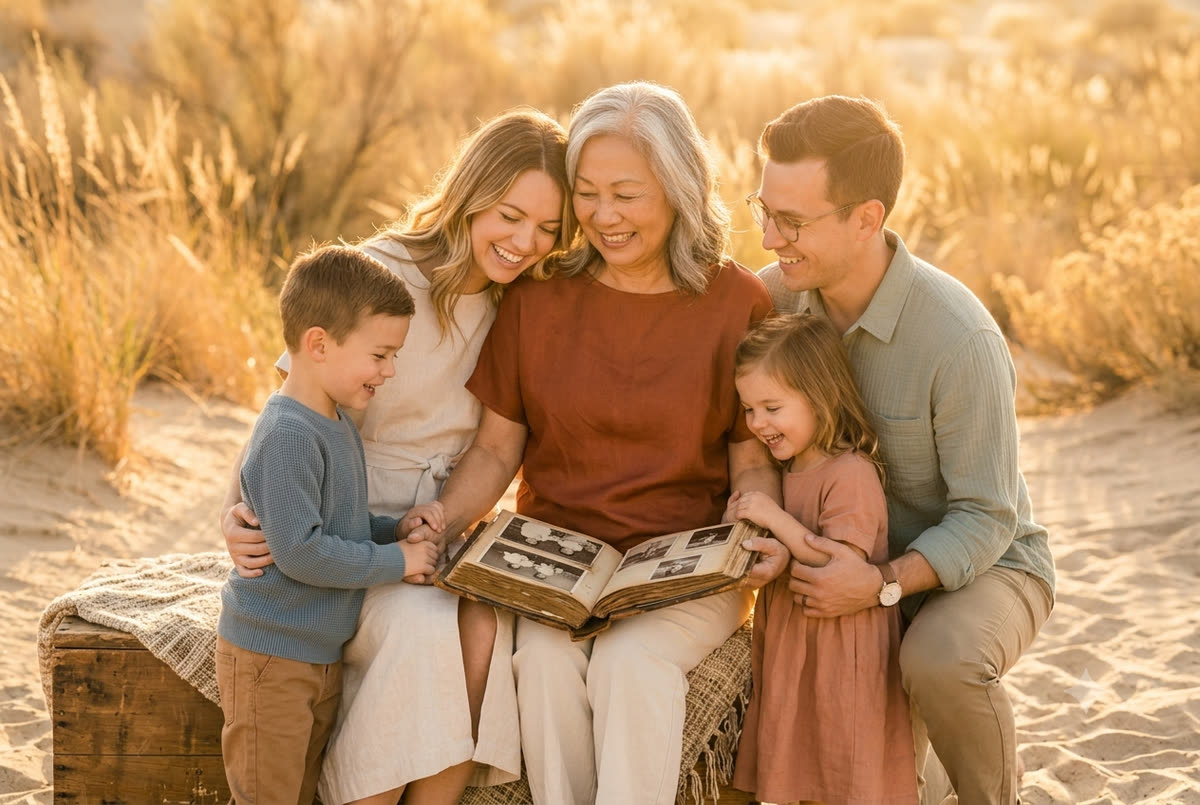
The most common, and most moving, reason families call me. A grandmother is wintering in Indian Wells, the children fly in over the holidays, and for the first time in years all three generations are in the same zip code at the same time. These are the photographs a granddaughter will one day show her own daughter. I have written more about the planning side of this in my guide to a multigenerational photo session, and it pairs naturally with everything here.
Families separated by distance
So many desert families are scattered — kids in Los Angeles or further, parents who snowbird here from November through April, relatives spread across the country. When everyone finally gathers, even for a week, that rare assembly is worth protecting. A legacy session turns a brief reunion into something permanent.
Aging parents, and the "while we can" sessions
I will be gentle but honest, because that is how I work. The hardest calls I receive — and the ones the families are most grateful for afterward — come when a parent's health is changing. A diagnosis, a move into care, a sense that the seasons are shorter now. These portraits are not morbid. They are an act of love. They say you are here, you are ours, and we want to remember you exactly like this.
Memory care and assisted living sessions
This is specialized, tender work, and I approach it with enormous care. I can come to a memory care or assisted living community here in the valley and photograph a parent or grandparent gently, on their terms, at their pace — often with family gathered close. It is gentle by design — no long standing, no harsh lights — just patient time and a few honest frames that the family will hold forever. If this is your situation, please simply tell me, and I will build the entire session around your loved one's comfort.
Milestones worth marking
A fiftieth wedding anniversary. A retirement. A patriarch's eightieth birthday. A new baby meeting a great-grandmother. These thresholds are exactly when a legacy portrait belongs, and I love being trusted with them.
A single, definitive portrait of one person
Sometimes the heirloom is one face. The matriarch. The grandfather everyone adores. A formal, beautiful, dignified portrait of one person — the kind that hangs in a hallway for generations — is one of the most powerful things a family can own, and surprisingly few people ever sit for one.
Why now, and not "someday"
The reason these portraits matter so much is the same reason people put them off. Time. We assume there will always be another holiday, another visit, another winter in the desert. And then a season passes, a grandparent's health shifts, the children grow, and the chance to capture this exact moment — these people, at these exact ages — is simply gone. It does not come back.
A legacy portrait freezes something that can never repeat. When I photograph these sessions, I am already picturing what the print will mean in twenty years — and that is the part the family often cannot fully see yet. My job is to see it for them, and to gently encourage the session to happen now, this season, rather than someday. Someday is the most expensive word in family history.
The best time of year for legacy sessions in the Coachella Valley
Living and working here, the calendar shapes nearly everything about how I plan.
Snowbird season, November through April, is prime time. This is when the desert is most generous — comfortable temperatures, soft and forgiving light, and, just as importantly, when families are actually together. Grandparents are in residence in Palm Desert, Rancho Mirage, and La Quinta; adult children fly in over the holidays and spring break; and suddenly the whole generational line is reachable. If a grandparent is only here for part of the year, I encourage families to book early in the stay rather than the day before the flight home, so we have flexibility if someone catches a cold or the wind kicks up.
Late fall and early spring give us the kindest light. October, November, March, and April are my favorite months for outdoor portraits in the valley. The golden hour stretches long and flattering, the sky has that clean desert clarity, and the air outside is comfortable enough that no one is in a hurry to get back indoors.
Summer is not off the table — we simply adapt. From June through September the heat is real, and I would never ask an older parent or a small child to stand in 110-degree afternoon sun. But early-morning sessions around sunrise are genuinely lovely, the light is gorgeous, and the desert is still cool and quiet. Indoor, in-home, and shaded settings are wonderful year-round. There is no wrong season — only the right plan for the season you are in.
Where we photograph legacy portraits in the desert
Most of my legacy sessions happen close to home — in the family's own living room, or at a familiar park or garden a few minutes away. I choose the setting around who is in the portrait and how everyone moves.
- In-home sessions. This is where I do my favorite legacy work. A grandparent's own living room, a courtyard in Rancho Mirage, a shaded patio in Indian Wells — there is real tenderness in photographing people in a space that already holds their memories, and the soft natural light through a window is beautiful on skin of every age. It is also the gentlest option for anyone with limited mobility, and the most relaxed setting for small children, who simply behave better at home.
- Local parks and gardens. When a family wants greenery, blooms, and a little room to spread out, a neighborhood park or a botanical garden in Palm Desert is a gift — easy on little ones and on older parents alike, with plenty of shade to rest in. Photographed in the long, low light of golden hour, these familiar everyday places look quietly luminous.
- A scenic desert backdrop, if you want one. Some families do want the sense of place that only the desert gives — mountains glowing behind you, that honey-colored evening light. If that is the picture in your mind, I am glad to plan a short golden-hour session at an accessible scenic spot. It is an option, not the default; I will steer you toward somewhere with easy parking and level footing rather than anywhere that asks an older parent to hike.
- Memory care, assisted living, and hospital settings. When travel is not possible, I come to you, and we make something beautiful in the space you are in.
When mobility and comfort matter most
I want to name this plainly, because in legacy work it is essential. An elderly parent and a toddler have very different needs, and I plan for both. I look for easy parking close by, level ground, shade to rest in, and somewhere to sit. A portrait where the eldest is seated — with the family gathered close and leaning in — is never a compromise. It is often the most beautiful composition of the whole session, because it naturally draws everyone together. Never let a worry about someone's mobility talk you out of these photographs. Tell me, and I will build the entire session around it.
What to wear for a legacy portrait
Because these images are made to last decades, wardrobe matters a little more than usual — the goal is to look like yourselves, but in a way that will not feel dated in twenty years.
- Build around a shared palette. Identical outfits look staged; instead, settle on two or three colors that sit happily together and let each person wear what flatters and feels like them. In the desert I love soft, warm neutrals — cream, oatmeal, camel, terracotta, dusty rose, sage — earthy tones that echo the landscape and never go out of style.
- Favor timeless over trendy. Loud logos, busy patterns, and trend-of-the-moment pieces date a photograph instantly and pull the eye away from faces. Classic and simple ages gracefully.
- Dress for comfort and the terrain. Flowing fabrics catch the desert breeze beautifully; flats or bare feet are lovely on sand. In cooler months a soft wrap is both elegant and practical for an older parent if a breeze comes off the mountains.
- Let small touches help everyone feel like themselves. A favorite lipstick, neat hair, a piece of meaningful jewelry. Someone who feels put-together stands taller, and the camera sees it.
I am always glad to help you plan this — text me photos of the outfits laid out and I will guide you. My fuller thoughts live in my guide to what to wear for family photos in the desert.
What to expect during a legacy session
I keep the pace of a shoot deliberately easy, and that is intentional. The fastest way to a stiff portrait is to rush people, so I do not. We usually begin with the most important grouping — the full family, or the matriarch, whatever we came for — while everyone is fresh. I will pose you, but lightly. I am not after rigid, chins-up formality; I am watching for the way you naturally lean toward one another, the small touches, the shared glance. Often my favorite frame happens in the half-second after a posed shot, when someone laughs.
From there we open it up — the pairings within the family, a few individual portraits while everyone is gathered and dressed, the quiet four-handed image of generations of hands together. With an older parent or a young child in the mix, I build in time for rest, water, and a moment in the shade. We are not racing a clock; I will carry the pace.
A note for the tender sessions: grief and absence are welcome here. Sometimes a legacy portrait carries the memory of someone no longer with us — we can honor that quietly, with a held photograph or a piece of jewelry. These images can hold love and loss in the same frame, and that is part of why they matter so much.
The print is the heirloom
Please let me say this plainly, because it is the single most important piece of advice on this page: order the print. The most common mistake families make is taking only the digital files. A file lives on a phone until the phone is lost, the cloud account lapses, or the format simply becomes unreadable a decade from now. That is not an heirloom. It cannot be inherited the way you imagine.
The framed wall portrait, the fine album in the drawer, the archival print tucked into a folder of family papers — that is what your granddaughter inherits. That is what survives. I help my families choose prints and albums precisely because a legacy portrait that never leaves a hard drive has not finished its job. We make the image together, and then we make it permanent.
A few questions I am often asked
Is a legacy portrait the same as a regular family session? It can look similar, but the intent is different. We plan it specifically to be kept and passed down, which changes the pacing, the wardrobe guidance, and especially the emphasis on finished prints.
My parent is frail or uses a wheelchair. Can we still do this? Absolutely, and we plan entirely around them — seated, supported, close to shade and parking, or in their own home or care community. Please just tell me ahead of time.
Can you come to a memory care or assisted living community? Yes. These gentle, on-site sessions are some of the most meaningful work I do.
We are only in the valley for a week. Is that enough time? Yes — "while everyone is together" sessions are some of my favorites. Reach out as early as you can so I can hold a date.
Will you help us with what to wear and where to stand? Always. That is my job and I genuinely love it. You bring the faces and the history; I will handle the rest.
Let's make something your family keeps
If you have read this far, someone is probably already on your mind — a parent, a grandparent, a whole family you keep meaning to gather. I would be deeply honored to make these portraits for you. We can begin wherever feels comfortable: tell me a little about your family, whose living rooms and which gatherings we might work around, and what you most want to hold onto.
The people you love are here now, in this exact season, at these exact ages — and that is the one thing a photograph can keep. When you are ready, send me a note here, and let's create an heirloom your family will treasure for generations.