Memory Care Photography in La Quinta
The calls that lead to these sessions tend to begin the same way. A son or daughter steps outside their parent's memory care community to phone me, voice a little unsteady, and says some version of: I want a real photograph of her — not the one on my phone where she looks confused, but one where she still looks like herself. What starts as a hard conversation usually softens within a few minutes. Soon we are no longer talking about the diagnosis at all; we are talking about the cardigan she always wears, or the tune he hums when he's content.
That shift is the heart of what I do when I photograph someone living with dementia or Alzheimer's. It is not a glamour shoot and it is not a clinical record. It is an act of holding on — making one honest picture of a person while they are still here, so the family has something true to keep.
If you are weighing whether to bring a photographer into your loved one's world at this stage, I want to walk you through exactly how it works, what to expect, and how I keep the experience calm for everyone in the room.
Why families ask for these portraits
Memory care photography is different from a typical session because the goal shifts. Most of the time when families hire me, they want to mark something joyful — a wedding, a new baby, a senior heading off to college. Here, the want is quieter and more urgent: I don't want to forget what she looks like when she's still herself.
The families who reach out to me are usually grappling with a few things at once:
- The recent photos don't feel right. Phone snapshots in a fluorescent-lit room, often mid-confusion, don't match the person they remember. They want an image that restores some dignity.
- A decline they can feel coming. When a diagnosis is progressing, there is a window — and everyone senses it closing. People who couldn't articulate why they wanted pictures simply knew it was now.
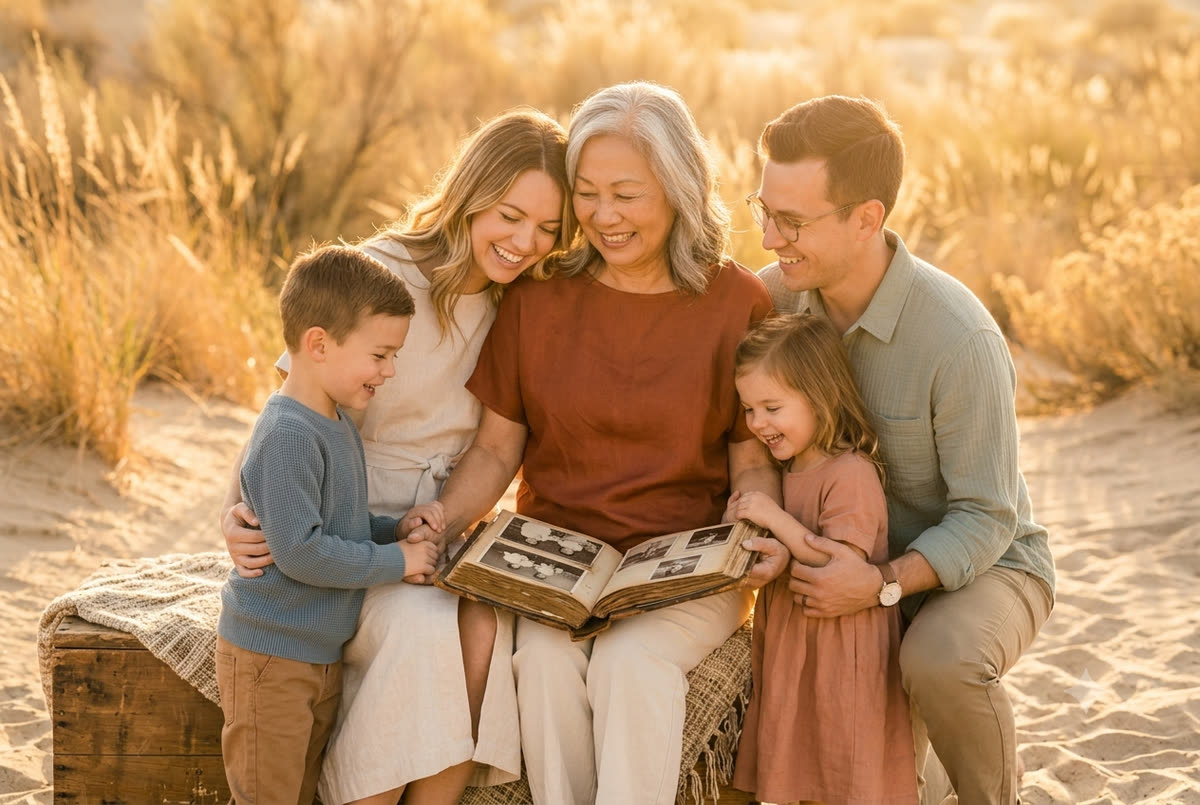
- A wish to be photographed together. Often it isn't only a portrait of the resident. It's a grandmother holding her grandchild's hand, two sisters on the patio, a husband of fifty years sitting beside his wife. These are the frames that matter most later.
I have come to think of this work as part of a larger thread I keep returning to — the photographs we make near the end of a life, and how much they come to mean to the people left holding them.
How a memory care session actually works in La Quinta
Almost all of these sessions happen on-site, inside the community, because that is where the person is comfortable and where staff can support them. La Quinta has several memory care and assisted living communities, and over the years I have photographed in a number of them, from the larger campuses near Washington Street and Highway 111 to smaller residential care homes tucked into the neighborhoods south of Avenue 48.
Here is what a typical visit looks like.
We plan around the good hours, not the calendar
People living with dementia often have a best stretch of the day — usually mid-morning, after breakfast and before the afternoon fog that caregivers call "sundowning" sets in. I always ask the family and the care staff: When is she most herself? Then we book the session for that window, even if it is only ninety minutes long.
In the desert, this works in our favor. For much of the year, and especially through the cooler months, the mornings here are mild and bright, and many La Quinta communities have lovely shaded courtyards and patios. If your loved one enjoys being outside, we can step into the garden in soft morning light rather than staying under interior fixtures. But I never force it. If the patio is overwhelming, we stay in the familiar room.
I arrive slowly and without a wall of equipment
I do not roll in with light stands and a crew. For these sessions I keep my kit deliberately small — usually one camera, a lens or two, and whatever natural light the room gives me. A stranger setting up tripods and flashes can be alarming to someone with cognitive changes. I'd rather be a calm visitor than a production.
Often I'll sit and talk first and not lift the camera at all for the first ten or fifteen minutes. I want the person to get used to my face and my voice before I become "the photographer."
Family is part of the picture, not just the audience
The single most useful thing in the room is a familiar person. When a daughter holds her father's hand or a spouse leans in to share a private joke, the resident's face changes — it softens, recognition flickers, and that is the moment I am waiting for. So I usually photograph the family interacting rather than asking anyone to pose and look at the lens. The honest pictures come from connection, not from "say cheese."
We follow the person's lead, every minute
If your mother wants to keep holding her doll or her coffee cup, she holds it. If your father only wants to talk about 1962, we talk about 1962. I work around comfort, not against it. If the person tires or becomes agitated, we pause or stop — there is no shot worth distress. I would rather come back a second time than push through a hard moment.
What to bring and how to prepare
A little preparation makes a real difference. None of this is required, but it helps me give you images that feel like them.
- Their own clothing, the real stuff. The cardigan they always wear, a favorite blouse, a watch, a piece of jewelry with a story. Authentic beats formal. If your dad lived in flannel shirts, let's photograph him in flannel.
- A meaningful object. A wedding ring, a Bible, a quilt, a fishing hat, a photo of their late spouse. Objects often unlock expression and give the hands something natural to do.
- Grooming timed for their comfort. Many communities have a salon day. A fresh haircut or a styled set can lift someone's spirits and their sense of self — but only if it doesn't exhaust them beforehand.
- A short note about who they are. Tell me their name for me to use, what calms them, what subjects light them up, and anything I should avoid. If music soothes your mother, tell me her song. I will hum it if I have to.
- Patience and low expectations on quantity. We may get one extraordinary frame in an hour. That one frame is the whole point.
Working with the community and its staff
Memory care communities have rules, and good ones, around privacy, infection control, and resident wellbeing. I am used to this and I work with the staff, never around them.
Before a session I'll coordinate on a few practical things:
- Permission and privacy. We make sure I'm cleared to photograph and that no other residents end up in frames without consent. Common areas require care; private rooms and reserved courtyards are easiest.
- Health precautions. If the community asks for masks, a wellness check, or a vaccination record, I follow it without fuss. I will reschedule in a heartbeat if I have so much as a sniffle — the residents' health comes first.
- Timing with the daily rhythm. I avoid mealtimes, medication rounds, and nap windows, and I let the caregivers tell me when their resident is at their best.
If you are arranging this for a parent and you are managing it from out of town — which is common here, since so many of our seniors moved to the desert while their adult children stayed back east — I'm comfortable coordinating directly with the community on your behalf and keeping you in the loop by phone and email.
The hardest, most honest part: managing expectations
I want to be straight with you, because this matters.
Some days, the person is present and warm and we capture something luminous. Other days, the disease is loud and they are withdrawn or anxious, and the pictures are quieter and more complicated. Both are real. Both are worth having. Years from now, you will not wish the photograph showed a person who wasn't there that day — you'll be grateful it showed who they truly were, with tenderness.
I also tell families: a portrait at this stage is rarely about a perfect smile. It is about the hands, the eyes, the particular way they tilt their head. It's about you in the frame with them. When the grief is fresh, the picture that ends up on the mantle is almost never the most "flattering" one. It's the truest one.
If you are also thinking ahead to the gathering that will eventually follow, I've written separately about celebration of life and memorial portraits, and how families use these images to tell a whole life's story.
Common questions
Is it appropriate to photograph someone who can't consent?This is a thoughtful question and I'm glad when families ask it. We rely on the family's judgment and the legal next-of-kin or designated decision-maker, and we watch the person's comfort closely throughout. If they are distressed, we stop. The aim is always dignity. I will never make an image that I'd be uncomfortable showing the person on one of their clearer days.
Can we include grandchildren and other family?Absolutely, and I encourage it. Multi-generational frames are some of the most treasured. Bringing children can also bring out warmth in your loved one that nothing else does — though I'd keep the group small and the visit short.
How quickly can you come?For memory care and hospice situations I treat the timeline as urgent and do my best to get there within days, not weeks. If you sense the window is closing, please just say so when you reach out.
What will we receive?A carefully edited set of natural, retouched-but-honest images, delivered digitally, with the option for fine archival prints and an heirloom album. Many families want at least one beautiful framed print right away, and I can help with that quickly.
Where exactly do you work?I photograph throughout the Coachella Valley — La Quinta, Indian Wells, Indio, Palm Desert, Rancho Mirage, and Palm Springs. La Quinta is very much home territory for me, so on-site visits here are simple to arrange.
Is this the same as hospice photography?It overlaps. Memory care portraits are often made earlier, when someone is medically stable but cognitively declining; hospice sessions tend to come at the very end. I approach both with the same care, and you can read more about the bedside and hospice side of this work if that's where your family is.
A quiet, lasting record
There is a particular kind of bravery in deciding to make this photograph. It means looking the diagnosis in the face and choosing to honor the person anyway — not the disease, but the person. I consider it some of the most meaningful work I'm ever asked to do, and I don't take the trust lightly.
If your mother, father, or spouse is in a memory care community here in La Quinta and you feel that quiet pull to capture them while you still can, I would be honored to help. You don't need to have anything figured out first. We can start with a phone call — you tell me about the cardigan, the song they still know by heart, the way they light up at a familiar face, and we'll take it from there, gently.
Send me a note whenever it feels right, and I'll help you find the moment that works for your family.