Memory Care Photography in Indian Wells
Families reach me with some version of the same hesitation. A parent has lived in Indian Wells for decades, and now lives in a memory care residence a few minutes from the home where they raised everyone. An adult child wonders, quietly, whether it's too late — whether a portrait of someone who doesn't always recognize them could even have a point.
It can. In my experience, when I come and sit with someone for a while — easing into an ordinary conversation, no camera in sight at first — something real tends to surface on its own. A laugh that takes over the whole face. A hand laid gently over a daughter's hand on the table. Those are the frames families end up holding onto. Not posed portraits. True ones.
This is some of the most meaningful work I do, and also some of the most misunderstood. If you're caring for a parent or spouse in memory care here in the valley and you're wondering whether photographs still make sense, I want to walk you through exactly how I approach it — honestly, with no sales pitch, just what I've learned over many sessions like these.
Why these photographs matter more than people expect
When a loved one is living with Alzheimer's, dementia, Parkinson's, or another condition that changes memory and presence, families often tell themselves a quiet story: that person isn't really here anymore, so a portrait would only capture the loss. I understand why. But I've found the opposite to be true in the room.
The point of these images isn't to pretend nothing has changed. It's to hold onto what hasn't. The shape of a smile. The way your father still tilts his head when music plays. The particular softness between two people who have loved each other for fifty years, even when the names have gone. Expression and connection live deeper than recall. They tend to be the last things to fade, and they photograph beautifully.
And these pictures aren't only for now. They become the images your family reaches for later — the ones grandchildren will know their great-grandmother by, the ones that sit on a mantel long after. A photograph taken in a memory care room in Indian Wells can outlast everyone in it. That's not a morbid thought to me. It's the whole reason to make it.
What "memory care photography" actually means
It's a gentle, on-location portrait session designed entirely around the comfort and pace of the person being photographed. I come to where your loved one already lives and feels safe — a memory care community, an assisted living suite, a private home with caregivers. We don't ask them to travel, dress up beyond what feels good, or perform.
It can include:
- Portraits of your loved one — close, honest, dignified.
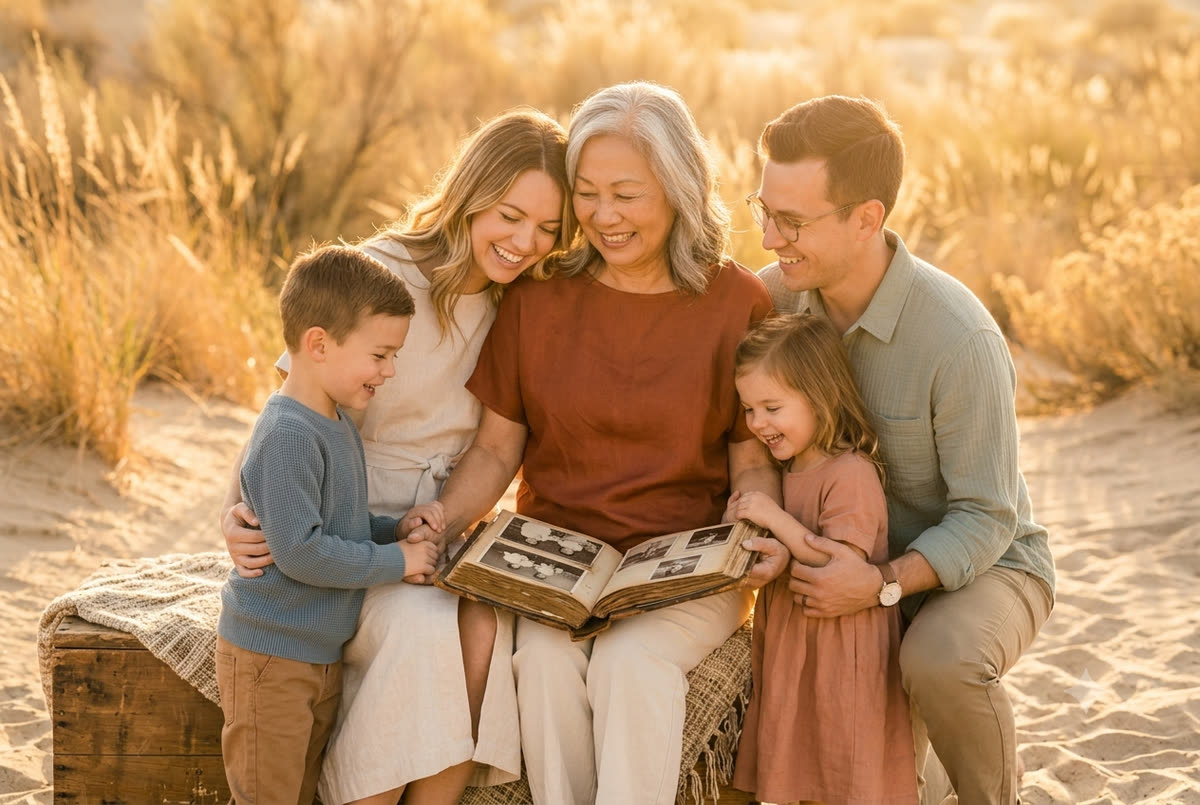
- Generational photographs — a son, a daughter, grandchildren, a longtime spouse, all together. Often these are the first family pictures taken in years.
- The small details — hands, a wedding ring worn thin, a favorite chair, the light through a window they like to sit beside.
- Quiet documentary moments — a visit unfolding naturally, rather than everyone freezing for the camera.
If your family is also thinking about end-of-life portraiture more broadly, I've written about that in hospice and bedside photography in the Coachella Valley, which shares a lot of the same gentle philosophy.
How I work in Indian Wells specifically
Indian Wells is a small, quiet city, and that actually helps. The memory care and assisted living communities here — along the Highway 111 corridor, near Eldorado, and the ones tucked just over the line into Palm Desert and Rancho Mirage — tend to be calm, well-staffed places with good natural light and pretty grounds. I've photographed in a number of them, and I know how to move through them without disrupting the day.
A few things that are particular to working here in the desert:
Light and time of day
Nearly all of this work happens right where your loved one already sits each day — beside the window they like, in a familiar chair, in a room that smells like home. Inside, I work with the natural window light a community already has rather than hauling in equipment that would feel clinical and intrusive. Many Indian Wells residences have those big west- and south-facing windows that drink in afternoon sun — lovely, though direct glare can be too much for both the photo and for sensitive eyes, so I read each room and position us in the softer, indirect light. I usually aim for mid-morning, roughly 9:30 to 11, when most people in memory care are at their best and least tired. "Sundowning" — the late-afternoon restlessness and confusion many families know well — is real, and I plan firmly around it.
If your loved one is steady on their feet and enjoys being outside, a familiar local spot can be lovely too: a shaded community courtyard, a garden path, a patio they sit on anyway, ideally in gentler early light rather than the flat glare of midday. But the heart of this work is indoors, where everything is known and nothing has to be arranged. A familiar chair is often exactly right.
When the family is together
Many valley families are only in the same place for part of the year. If your siblings or grandchildren travel in seasonally, the stretch when everyone is actually here may be your best chance to get them all in one frame. I'd gently encourage you not to wait for "a better time." With memory care, the better time is usually now, and I hold flexibility on my calendar so we can move when your people can.
Before the session: how we prepare
Most of the preparation is conversation, and it happens before I ever pick up a camera.
- We talk first, by phone or email. You tell me about your loved one — who they were, who they still are, what makes them laugh, what agitates them, the times of day that go well. I'm listening for the real person, not a checklist.
- We pick the right day and hour together, around their rhythms, meals, and medication timing.
- We loop in the care team. The staff at memory care communities here are usually wonderful partners. I coordinate with them on a good day, a quiet space, and any needs around mobility or comfort. If there are visitation guidelines, I follow them completely.
- We keep wardrobe simple. A favorite sweater, a color they always wore, a piece of jewelry with a story. Comfort over formality, always. If a hospital gown or a soft robe is what's real that day, that's what we photograph, and it will still be beautiful.
- You bring whoever should be there — or no one but the two of us, if that's calmer.
What the session is actually like
Slow. That's the honest answer. I don't arrive with a shot list and a stopwatch. I arrive, sit down, and let the room settle. Sometimes I don't lift the camera for the first twenty minutes. I want your loved one to feel like a person being visited, not a subject being documented.
I follow their lead. If they want to tell me a story I can't quite follow, I listen and we find the picture inside it. If they're tired, we pause. If a song comes on and a foot starts tapping, I'm ready. The best frames in this work are almost never the ones where someone is told to look at the camera and smile — they're the in-between moments: a hand reaching out, a glance toward a familiar face, a moment of genuine recognition that you'll want to remember for the rest of your life.
For families, my one piece of advice: be present, not anxious. Your loved one reads your energy more than your words. If you can relax and simply be with them, the photographs take care of themselves. I'll quietly handle the rest.
Sessions are usually short — often 30 to 60 minutes — because that's what's kind. I would always rather have fifteen true minutes than wear someone out chasing more.
Common worries, answered honestly
"What if they're having a bad day?"We adapt or we reschedule — no fee, no guilt. I build that flexibility in on purpose. A bad morning isn't a failure; it's just information about when to try again.
"What if they won't cooperate or look at the camera?"They don't need to. Some of my most treasured images are of someone looking off, lost in thought, or focused entirely on the grandchild in their lap. Connection reads more powerfully than eye contact.
"Isn't it too late if they don't recognize us?"No. Recognition and emotion aren't the same thing. I've watched people who couldn't name their own children still soften and lean in when those children sat beside them. That tenderness is real, and it's worth keeping.
"Won't this feel sad or intrusive?"Almost everyone tells me afterward that it felt like the opposite — like a gift, a reason for a good long visit, a few quiet hours of attention paid to someone who deserves it. I work softly and I never overstay.
"Can we still do this if they're in hospice or declining quickly?"Yes, and I'd urge you not to delay. I keep room for time-sensitive sessions and can usually come within a day or two. You can read more about how I approach those visits in creating a legacy portrait for an aging parent.
After the session
You won't have to do anything but wait for me to gently edit the images — true to life, warm, never over-processed. I deliver high-resolution digital files so your whole family, wherever they are, can have them. Many families also choose printed portraits, an album, or a small framed piece for the resident's own room, which I'm always glad to help arrange. There's something steadying about a person in memory care having a photograph of their own loved ones right there where they can see it.
I keep these files backed up and safe, too. Years from now, if you need another print, you can simply ask.
A few words about cost and care
I don't publish a rigid package menu for this work because every situation is different, and the last thing a family in this season needs is to feel processed. We'll talk about what you need and I'll be straightforward about what it costs. I also keep a small amount of room each season for families for whom the timing is hard and the money is harder — please just ask. This matters more to me than a price sheet.
If you've been wondering whether to call
Families who do this tend to come away relieved they acted when they did. Those who put it off can carry a heavier kind of feeling, and that's the one I can't undo for anyone.
If your mother, father, or husband is living in memory care here in Indian Wells, or anywhere across the valley — Palm Desert, Rancho Mirage, La Quinta, Indio — and some part of you keeps circling back to I should do this, I'd treat that quiet pull as worth acting on.
You can reach me here. Tell me a little about your loved one, and we'll take it from there, at whatever pace feels right. I'd be honored to help you hold onto them.