What Is End-of-Life Photography?
Most people come across the phrase "end-of-life photography" for the first time at a moment when they have little energy to spare for research — a diagnosis has just landed, a parent has moved into hospice in La Quinta, a spouse is fading at home in Rancho Mirage. So I want to answer the plain question directly, before anything else, because you deserve a straight answer in a season that gives you very few of them.
End-of-life photography is portrait and documentary work made during the final chapter of a person's life — while they are still here — to give the people who love them a true, warm record of their face, their hands, and the connections that defined them. That's it. It is not a strange or new idea, and it is not as heavy as the name can sound. At its heart it is a very old human instinct: the wish to remember someone well, and to be able to look at them again.
Let me explain what that actually means, what it doesn't mean, and how it tends to unfold here in the desert, so you can decide whether it's something your family wants.
What the term actually covers
"End-of-life photography" is an umbrella phrase. Families and hospice teams use a handful of names that all point at roughly the same thing:
- Legacy photography — emphasizing the life being honored rather than the ending.
- Hospice photography — when the work happens specifically during hospice or palliative care.
- Final portraits — a simple, plain description many families reach for.
- A "before it's too late" session — not a formal term, but it's often how the request first arrives.
These overlap heavily, and I don't think the exact word matters much. What unites them is timing and intent: photographs made while a person is living, however near the end, so that they can be remembered as a whole person and not only as their illness or their hardest days.
What end-of-life photography is not
A lot of the worry around this topic comes from confusing it with things it isn't. So let me draw some clear lines.
It is not funeral or memorial photography. Those happen after a death — documenting a service, a graveside, a gathering. End-of-life photography happens before, while your person can still be in the frame.
It is not post-mortem photography. Victorian families did sometimes photograph loved ones who had already died, and that's the unsettling image some people picture when they hear "death photography." That is not this. The person in these portraits is alive — resting, talking, laughing, holding a grandchild's hand.
It is not clinical or morbid. I am not documenting an illness. If anything, my whole job is to photograph past the illness — to find the look, the gesture, the warmth that the medical equipment and the thinness can't touch. Families almost always tell me afterward that they see the person, not the disease.
It is not a performance. There is no "say cheese," no stiff posing toward some future milestone. It's quieter and more honest than that.
Why families choose to do this
In ordinary life, we assume there will always be another chance for a good picture. We put it off. End-of-life photography exists because, in this particular season, there may not be another chance — and families who make the photographs are nearly always grateful, while families who didn't often carry a small, quiet regret.
A few of the reasons people give me:
- So the grandchildren remember a face, not just a story. A four-year-old won't hold many memories of a great-grandmother, but they can grow up with a beautiful portrait of the two of them together.
- So the harder final days don't become the only image. Memory has a cruel habit of fixing on the end. A warm photograph gives families something else to return to.
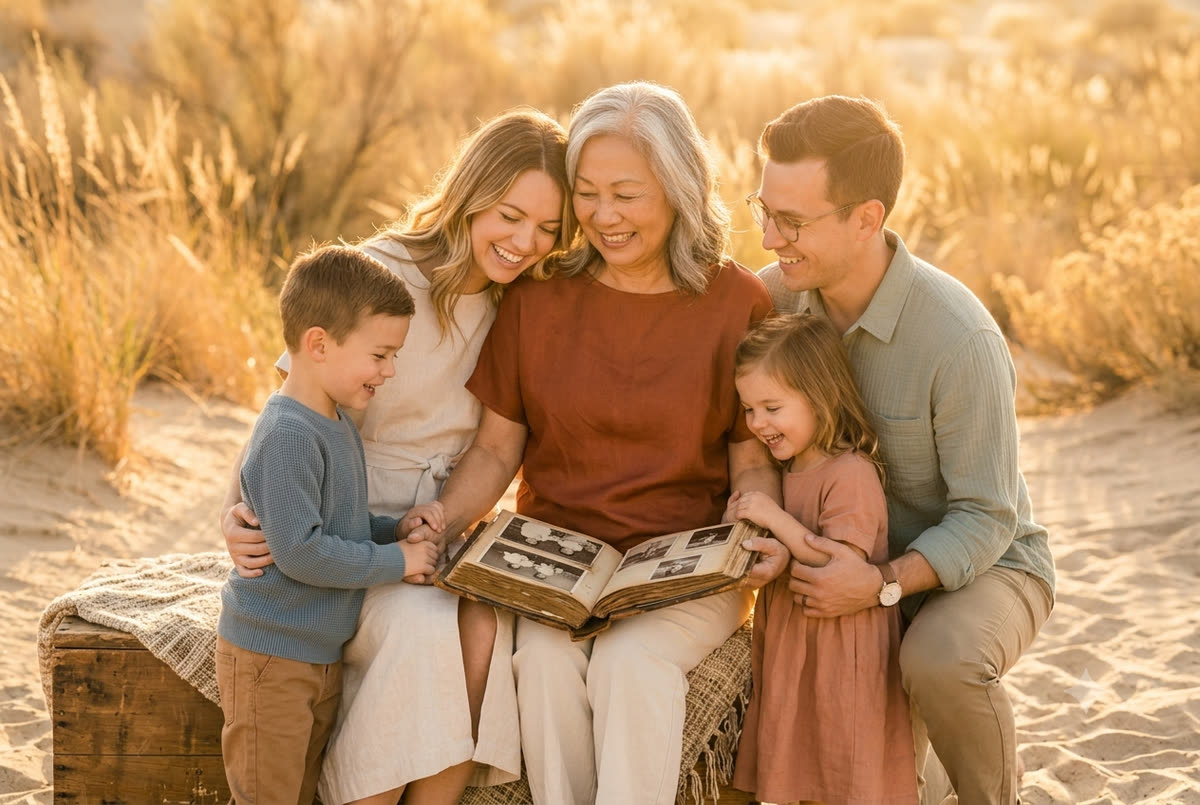
- So the love in the room is visible. The held hand, the forehead kiss, four generations crowded onto one bed — these are the frames people put by the front door and look at every morning.
- Because the person who is dying wants it too. More often than families expect, the one who is ill understands better than anyone how much these images will mean later, and is moved to be asked.
I've written more about why these pictures end up mattering so much in my piece on final portraits of elderly loved ones, if you want to sit with that side of it.
Who it's for
End-of-life photography is for the whole family, not only the person at the center of it. The most treasured images are almost always relational — two people, three generations, a houseful of people who flew in. So while there is one person the session is about, it's really made for everyone who will be looking at these pictures for the rest of their lives.
It's also for a wide range of situations. Some families call when their person is comfortable, conversational, and able to sit up and engage — a relaxed, gentle session is very possible then. Others call when things are much further along, and we adjust: shorter visits, softer expectations, portraits of hands and the quiet gathering at the bedside. There is no stage that is "too late" to make something meaningful. Earlier simply gives us more room and more ease.
What a session actually involves
People are often surprised by how little is involved on their end. A typical session looks like this:
We talk first, usually with a family member. I want to know who your person is — their name, what they love, who will be there, what time of day they tend to feel strongest, and anything sensitive like mobility, hearing, or medical equipment you'd want kept out of frame.
I arrive quietly, with very little visible gear. No big lights, nothing intimidating. I work mostly with the soft light already in the room and bring gentle light with me if the space is dark, so we're never at the mercy of a glaring window.
We go at your person's pace. If a good window lasts twenty minutes, we make beautiful work in twenty minutes. If they need to rest, we rest. I'm watching for the real thing — the way a hand reaches for another hand, the expression that crosses a face when an old song plays.
Family is welcome and encouraged. If relatives are traveling in, we try to time the visit for when the most people can be present.
Most visits run somewhere between thirty minutes and a couple of hours, shaped entirely around your person's energy. Afterward, I prioritize editing and delivery — when time is short, I can turn around a first set of images very quickly, sometimes within a day.
How this works in the Coachella Valley specifically
I photograph these sessions throughout Palm Desert, Palm Springs, Rancho Mirage, Indian Wells, La Quinta, Indio, and Cathedral City, wherever your person is most at ease — most often a private home, an assisted living or memory care community, or an inpatient hospice or hospital room. Home is my favorite, because someone is surrounded by their own things and their own light there.
Wherever your person is, most of my work happens right inside the room they already live in — beside a sofa, at a kitchen table, near a bedroom window — using the daylight that's already there. That familiarity is half the gift; people are simply more themselves at home. The desert does shape the practical side, though. In our cooler months the valley gives long, forgiving late-afternoon light, and if your person is well enough to sit on a shaded patio or in a backyard garden for a few minutes near sunset, that warm golden-hour light can be extraordinarily tender. In the deep heat of summer I won't ask a fragile person outdoors at all — we stay indoors near a north-facing window where the light is soft and the air is cool. And because valley families so often have relatives scattered between here and back home, I'm glad to help plan around travel so the right people can be in the room.
If your loved one is in a care community or under hospice care, I coordinate with staff ahead of time and work calmly within their guidance. I've written separately for hospices and care communities about how that collaboration tends to go.
Common questions
Is it disrespectful or strange to want this?Not at all. For most of photographic history, families made portraits in exactly these moments; we've simply grown unused to it. Wanting to remember someone is one of the most natural instincts there is.
Will the photographs be sad to look at?Most families tell me the opposite — that the images become a comfort rather than a source of grief. You'll see the person you love, warm and recognizable, not a record of their illness.
What if my loved one isn't conscious or able to participate?We can still make something gentle and meaningful — quiet portraits, the family gathered close, the details of hands and rings — always with your blessing and at your direction.
Who controls the photos?You do, completely. You decide what is photographed and what isn't, and nothing is ever shared publicly without your explicit permission. Many of these sessions stay entirely private to the family.
How soon can it happen?As soon as possible. I treat these requests as time-sensitive and keep room in my schedule for them. If your person is having a good morning, I'll do my best to come while that window is open.
How it fits into the bigger picture of legacy
End-of-life photography is one piece of something larger I think of as legacy work — preserving not just a face but a whole life for the people who come after. If you're thinking about this earlier, while your elder is still well and active, a generational legacy session gathers the family to celebrate a life that's still being fully lived. And if you're carrying the weight of an approaching loss right now, my anticipatory grief resource hub holds some gentler reading for this season.
If you're considering it
If you've read this far, you're probably not asking out of idle curiosity — someone you love is on your mind. I'm sorry for what you're walking through, and I'm honored that you'd even think about letting me into it.
A first message doesn't commit you to anything — it's just a conversation. Whether you want to know if a session makes sense for your family, picture how a quiet hour at home might go, or simply think out loud with someone who has done this before, you can reach me through my contact page. Tell me a little about your person, and we'll figure out the next small step from there.