Legacy Photography Guide for Palm Desert Families
Most of the legacy work I do happens in someone's living room. A grandfather in the chair he's read the paper in for thirty years, the morning light coming through the same window it always has, his family folding in around him. Not a stiff studio portrait — him, exactly as he is, in the place that already holds his life. That, to me, is where these pictures want to be made.
I call it legacy photography, and I wanted to write the most honest, useful guide I could for families here in the Coachella Valley who are thinking about it — and especially for those who aren't sure they should be, but feel a quiet pull telling them not to wait.
What "legacy photography" actually means
The phrase gets used a lot of ways, so let me tell you what I mean by it. Legacy photography is making considered, unhurried portraits of the people whose presence holds a family together — most often a parent or grandparent, sometimes an aunt who raised everyone, sometimes a couple who've been married sixty years — while they are here to be photographed, and often alongside the generations they made.
It is not a sad thing, though it sometimes gets booked for tender reasons. At its best it's a celebration: this person mattered, this person is here, and we are going to give them an hour of being seen the way they deserve. Some families do it to mark a milestone — a ninetieth birthday, a sixty-fifth anniversary, the last winter everyone's healthy enough to gather. Others do it because a diagnosis suddenly made "someday" feel like a word they couldn't afford.
The common thread is intentionality. A snapshot at Easter is wonderful and you should keep taking them. A legacy session is different: it's a deliberate decision to create images that are meant to be printed, framed, and handed down — photographs that will outlast all of us and tell a grandchild not yet born exactly what their great-grandmother's hands looked like.
If you've been reading my guide to multigenerational family portraits in the desert, this is a close cousin to that work, with the focus tilted gently toward the eldest person in the room.
Why families here wait too long (and how I'd rather you didn't)
I'll be direct, because I've learned this the hard way alongside the families I serve. The most common thing I hear is, "We kept meaning to." Health changes faster than we expect. Memory changes faster than that. By the time the decision feels urgent, the window to do it well — to do it joyfully, with everyone relaxed — has often narrowed.
This is the one place I'll push you a little. If there is someone in your family you'd ache to have pictures of, the right time is the next good stretch of weeks, not "when things settle down." Things rarely settle down. I would so much rather photograph your mother on an ordinary Tuesday when she's feeling herself than be the photographer a family calls in a hospital corridor, hoping for one frame. I've been both. The ordinary Tuesday is a gift.
There's a practical desert wrinkle here too. So many of our elders are snowbirds — they're in Palm Desert, Rancho Mirage, or La Quinta from November through April and back in Minnesota or British Columbia for the summer. That seasonal rhythm is actually useful: it gives families a natural booking window. If your parents winter here and your adult kids visit over the holidays or for spring break, that overlap is the moment. Don't let it pass thinking you'll catch it next year.
When to schedule: light, heat, and the desert calendar
The desert rewards good timing, and it punishes bad timing fairly hard, so let's talk specifics.
The season. For outdoor legacy sessions, the comfortable window runs roughly November through April — exactly when the snowbird families are here, which is convenient. From late May through September, outdoor portraits with older adults need real care. A ninety-year-old should not be standing on a sun-baked patio in 110-degree heat, full stop. In high summer I move sessions indoors, into a home or a shaded venue, or we shoot in the narrow cool windows just after sunrise.
The time of day. When we are outside, I shoot the last ninety minutes before sunset almost without exception. That low, warm desert light is forgiving and flattering — it wraps softly around a lined face instead of carving shadows into it. Overhead noon light is the opposite: it flattens features and drops the eyes into shadow, which is the last thing you want on an older subject, so I plan around it rather than fight it.
For frail or limited-mobility elders, I often recommend an in-home session regardless of season. No transfers, no walkers across gravel, no fatigue from an outing. We work in the chair your father always sits in, by the window your mother loves, and the result is more them anyway.
Where we make these portraits
Location matters more in legacy work than almost anywhere else, because place carries memory. A few directions I love here in the Valley:
- At home. My first choice for many families. The reading chair, the kitchen, the back patio with the mountain view — these rooms are full of a life already lived. Grandchildren pile onto laps where they always have. Nothing to perform.
- The senior community. Many of our elders live in places like Sun City Palm Desert, The Springs in Rancho Mirage, or one of the country clubs in Indian Wells. These often have beautiful grounds, easy parking, and shade — and we don't have to travel far or tire anyone out.
- A local park or garden. If your loved one is mobile and game, the Valley gives us lovely green backdrops with very little walking. The lawns and gardens of the Living Desert in Palm Desert, the palm groves at the Coachella Valley Preserve, a shaded courtyard at a La Quinta resort, or a neighborhood park bench at golden hour. We stay close to the car, in the shade, with the mountains as a soft backdrop rather than a hike.
- A place that tells their story. The diner they've gone to every Sunday for thirty years. The church in Palm Springs. The backyard garden they planted and still tend. Picturing someone beside the citrus tree they grew from a seedling or in the kitchen where they've fed everyone for decades can say more about who they are than any studio could.
What a session with me actually looks like
People who haven't done this before are often a little nervous, especially on behalf of an older parent who "hates having their picture taken." So here's what to expect, start to finish, so there are no surprises.
Before we shoot, we talk. I want to know who this person is. What do their hands do all day? What makes them laugh that real laugh? Is there a sweater, a hat, a ring, a chair that is them? The more I understand, the faster I can find the one true moment when we're together.
On the day, we go slowly. I budget far more time than the photographs themselves need, because rushing an older adult is the surest way to get tight, tired faces. We pause. We let people sit. If your father needs to rest, we rest, and I keep the camera close so I catch the unguarded moment when he thinks we've stopped — which is usually the best frame of the whole session.
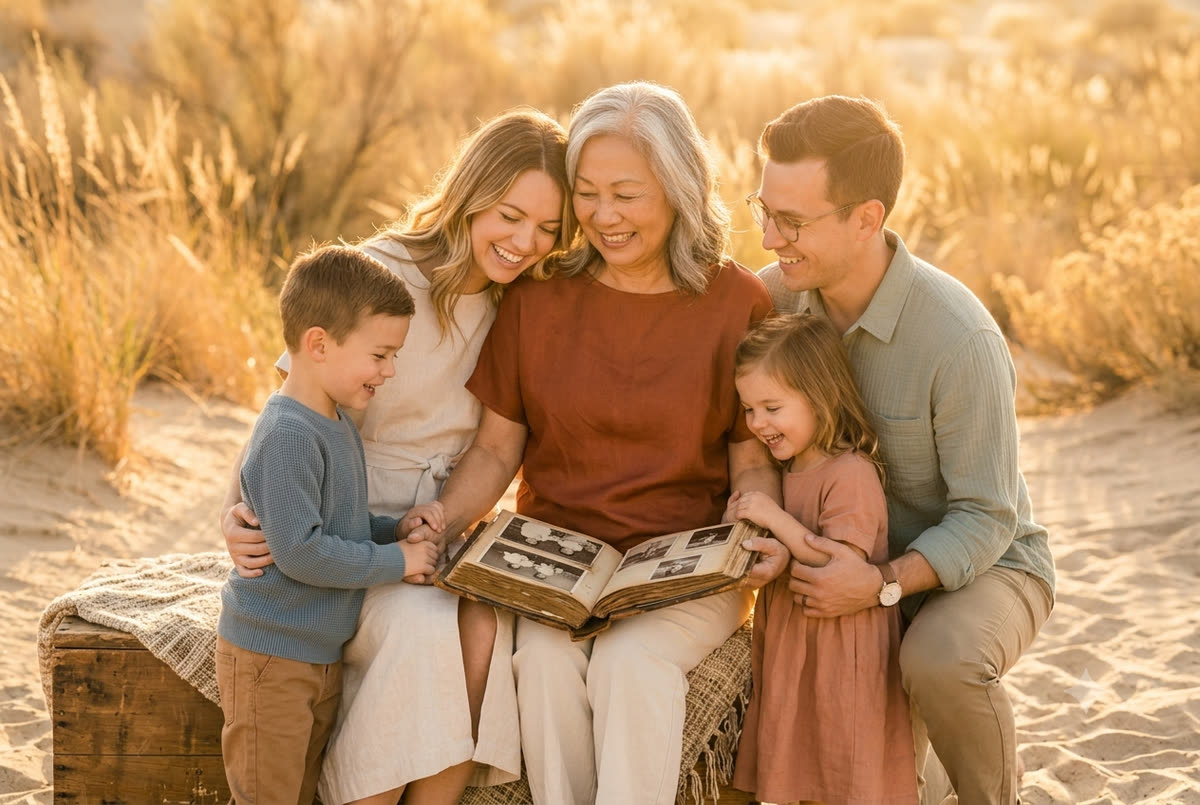
I direct, but I don't pose stiffly. I'm not going to line everyone up like a school photo and count to three. I'll set up a situation — Grandma in her chair, the kids invited to lean in and tell her something — and then I wait for the gesture that's unmistakably this family. A hand laid over a hand. A whispered joke. That's the photograph.
Mixed generations are a feature, not a complication. Toddlers will be toddlers, teenagers will be teenagers, and I genuinely don't mind. Some of my favorite legacy images have a great-grandbaby mid-wail in the middle of four laughing adults. That's the truth of a family, and the truth ages beautifully.
A typical session runs an hour to ninety minutes. I'd rather have the extra time and not need it than watch someone wilt.
What to wear, and other small things that help
Wardrobe questions come up every time, so a few honest guidelines:
- Pick a palette, not a uniform. Settle on a soft, cohesive range of colors — warm neutrals, dusty blues, creams — and let each person wear their own version of it. Identical outfits read as costume; a shared palette reads as family.
- Dress the elder in what they feel like themselves in. If your grandfather has worn a collared shirt and a cardigan every day of his life, that's what he should wear. Don't put him in something stiff and new that makes him sit differently.
- Bring the object. The pocket watch, the apron, the deck of cards, the dog. Props that carry meaning give hands something to do and give the picture a story.
- Soft fabrics, few hard logos, nothing that's all one bright color. Solids and gentle textures photograph kindest.
- Time medications and meals around the session. A small thing that matters enormously — schedule for the part of the day when your loved one has the most energy and comfort. For many elders that's late morning; for a sunset shoot we plan a good rest beforehand.
If you'd like more on dressing a crowd, I go deeper in my what-to-wear guide for desert family sessions.
The part that matters most: print it
I'll be plain about this because I care about it more than almost anything else I do. A legacy photograph living only on a phone is a photograph at risk. Phones are lost, accounts get locked, files corrupt, formats go obsolete. The portraits families treasure fifty years from now are the ones that got printed — framed on a wall, gathered in an album, tucked into a drawer to be rediscovered.
So I deliver every legacy session as finished, archival prints, not just digital files. I help you choose the handful of images that should live large on a wall and the broader set that belongs in an heirloom album. When a family hangs their grandmother in the hallway, she becomes part of the daily life of the house — the grandchildren grow up greeting her face every morning. That's the whole point. That's legacy.
If a parent has shoeboxes of old photographs, this is also the moment to fold those in. I can help you think about pairing the new portraits with the archive so the whole story lives in one place; my guide to preserving old family photographs walks through the basics of that.
Questions families ask me most
My parent is self-conscious about how they've aged. Is this going to be uncomfortable?This comes up often, and I take it seriously. My whole approach is built to put a self-conscious person at ease — we go slowly, I photograph them being genuinely themselves rather than holding a pose, and the images come back warm and dignified, not clinical. Almost every elder who dreaded the session ends up surprised by how much they like the pictures. They were never seeing what their family sees. My job is to show them.
What if my loved one has dementia or limited mobility?I've done many of these sessions and they can be deeply tender. We keep it short, familiar, and low-stimulation — usually at home, usually with one or two close family members nearby. I follow their pace entirely. Even on a hard day, the connection between an elder and the person who loves them tends to show through, and that's what we're after.
How far in advance should we book?For snowbird families, as soon as you know the dates everyone overlaps in the Valley — the November-to-April calendar fills, especially around the holidays. For health-sensitive situations, call me and we'll find a date quickly; I keep room for these.
Can you photograph just my mother alone, not the whole family?Absolutely. Sometimes the most important picture is one quiet, beautiful portrait of one person. We can also do both — solo portraits and the full gathering — in a single session.
Do you travel across the Valley?Yes — Palm Desert, Palm Springs, Rancho Mirage, Indian Wells, La Quinta, Indio, and the communities in between. If your family is here, I can come to you.
A gentle nudge, because I mean it
If you've read this far, there's probably a particular face in your mind. Someone whose laugh you'd want your great-grandchildren to know. I'd be honored to help you keep them — not as a memory that softens at the edges over the years, but as a photograph you can hold, frame, and pass forward.
There's no perfect moment that's going to announce itself. The good moment is usually just an ordinary week when everyone's well and home. If this is on your heart, let's start a conversation. Tell me about the person you're thinking of, and we'll find the right time, place, and shape for it together. I'd love to make these for your family while there's still all the time in the world to do it beautifully.