Golden Hour Desert Portraits
There is a moment, most evenings out here, when the whole valley seems to hold its breath. The sun drops toward the San Jacinto mountains, the white glare of the afternoon softens into something warm and honeyed, and for a little while everything it touches turns golden — the lawns, the palms, the faces of the people I'm photographing. After many years as a portrait photographer in Palm Desert and across the Coachella Valley, I can tell you with complete honesty: golden hour is not a marketing phrase to me. When we step outside, it's the reason these photographs look the way they do, and it's why I quietly arrange so much of an outdoor session — the season, the spot, the time we meet — around catching it.
I should say up front where most of my work actually happens, because it surprises people: the heart of what I do is close to home. A great many of my sessions take place right in my clients' living rooms, bathed in soft natural window light, or at a familiar local park, a botanical garden, a shaded backyard patio. Those everyday, comfortable places are my signature far more than any dramatic far-flung landscape. When we do decide to be outdoors, though, golden hour is the gift the desert gives us — so this guide is about how to use it well, wherever we point the camera.
If you've found your way here, you're probably wondering what golden hour portraits actually look like, why everyone talks about that light, and how to plan an outdoor session around it. Let me walk you through all of it, the way I would if we were sitting together over coffee planning your shoot.
What golden hour really is (and why the desert makes it magic)
Golden hour is the stretch of time just after sunrise and just before sunset, when the sun sits low on the horizon. Because the light is coming at us from the side rather than straight down, it travels through more of the atmosphere, which scatters the harsh blue tones and leaves behind that warm, golden, almost amber color. It's soft. It wraps around a face instead of carving shadows into it. Eyes stay open and at ease. Skin glows without a stitch of heavy retouching.
That happens anywhere on earth — but the Coachella Valley does something special with it. Our air is exceptionally clear and dry, with very little humidity or haze to mute the color. So when that low light comes in at the end of the day, it's crisp and saturated in a way you rarely see on the coast. And we have the mountains. The San Jacinto and Santa Rosa ranges that ring the valley catch a rosy alpenglow as the sun sets, and they also bring on a gentle, even twilight a few minutes earlier than a flat horizon would. The result is a soft, glowing window of light that, to my eye, is some of the most flattering portrait light anywhere.
It's also the perfect antidote to our single biggest challenge as desert photographers: the midday sun. For most of the year the noon sun here is high, intense, and merciless — it creates deep shadows under the eyes, makes everyone squint, and washes out the skin. Golden hour is the opposite of all that. It does about ninety percent of the work for me before I ever press the shutter.
What a golden hour desert portrait actually looks like
When people picture "desert portraits," they sometimes imagine something stark or styled to the point of feeling like a fashion shoot. My work is warmer and more honest than that. Here's what you can genuinely expect from a golden hour session with me:
- Light that flatters everyone. That low, warm sun is universally kind — to children, to grandparents, to anyone who feels nervous in front of a camera. It softens fine lines and gives skin a natural luminosity.
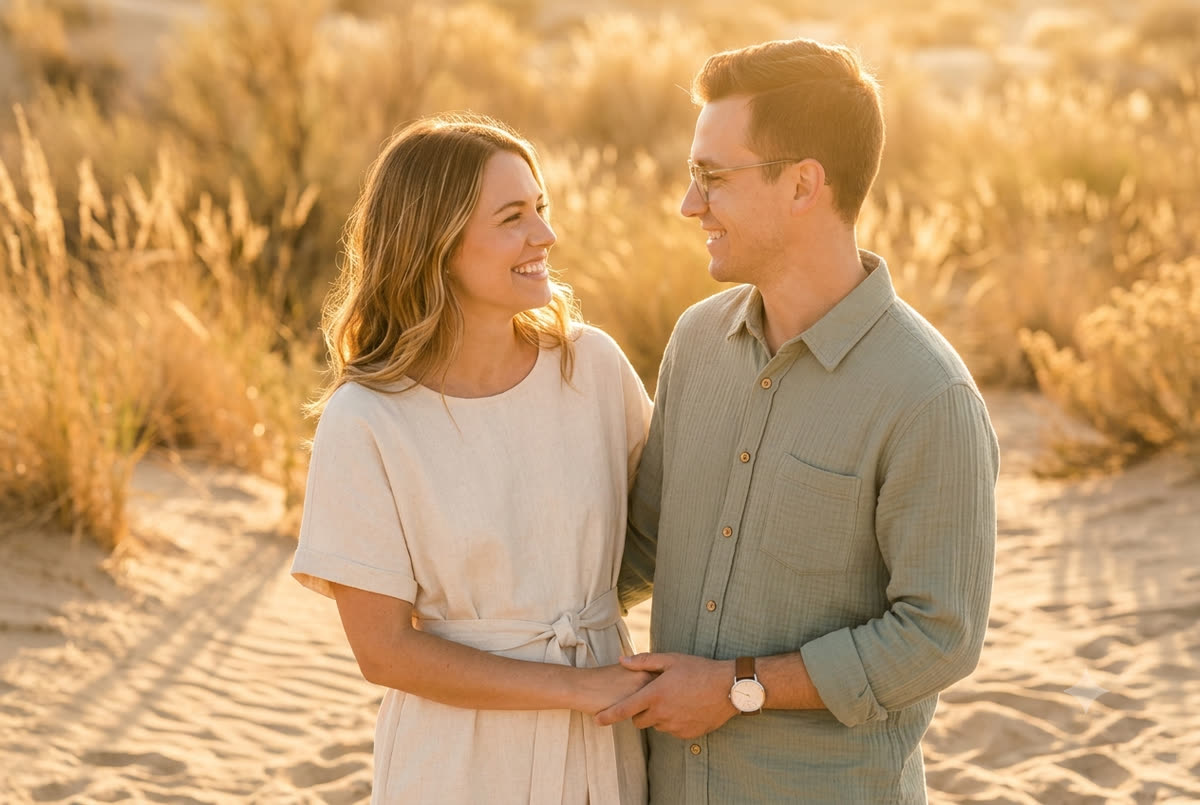
- A backlit glow. I often place the sun behind you so it haloes the edges of your hair and shoulders, with a hint of golden flare drifting into the frame. It's romantic and timeless and very hard to fake at any other hour.
- Rich, saturated color. The desert at golden hour gives us warm sand, deep green palms, purple-shadowed mountains, and a sky that can move from blue to peach to fiery rose in the span of twenty minutes.
- Long, dramatic shadows. Side light at this hour adds dimension and a little drama — wonderful for a striking couple's portrait or an editorial-feeling senior session.
- A relaxed, unhurried feeling. There's something about the end of the day in the desert. The heat eases, the crowds thin, and people simply soften. That ease shows up in the photographs.
Where I love to shoot in this light
The settings I return to again and again are the comfortable, close-to-home ones — and most of them sit a short drive from wherever you are in the valley. Part of my job is matching the right spot to your family, the season, and the angle of the light on your particular date. Here's where I most often work, roughly in the order I suggest them:
- Your own home, in window light. This is where I do some of my favorite work. Late-afternoon sun pouring through a living-room window gives us the same soft, wrapping quality as golden hour, with none of the heat, wind, or scheduling around a sunset. Familiar surroundings relax people in a way no location can, and the pictures feel like your life. (Worth saying plainly: this is indoor, window-light work — not golden hour, which lives outdoors.)
- Local parks and gardens. Civic Center Park in Palm Desert, the grounds at The Living Desert, the gardens at Sunnylands in Rancho Mirage, a neighborhood green near you — these gentle, planted spaces are my go-to outdoor setting. Lawns, mature trees, and a little shade make them easy with children, and at golden hour they glow.
- A backyard, courtyard, or shaded patio. Many families have a beautiful spot right outside their own door — a patio, a pool deck, a flowering courtyard. Late in the day these become small, private golden-hour studios with zero travel.
- Mid-century and resort settings in Palm Desert, Rancho Mirage, and Indian Wells. Clean architectural lines, manicured palms, and warm stucco walls that bounce golden light back onto your skin. Lovely for a more polished, elevated look.
If you're after something more dramatic and scenic, the wider desert is here too, and I'm always happy to advise on the best places for it — the native palm oases of the Indian Canyons, or even Joshua Tree up the hill, which I write about in my guide to family photos at Joshua Tree. I treat those as the occasional adventure rather than the everyday, but when a couple or family really wants that wide-open backdrop, golden hour out there is unforgettable.
For any outdoor spot, I scout the direction of the setting sun ahead of time, so we're never guessing in the moment. When the good light arrives, I want us positioned and ready to use every minute of it.
Golden hour isn't the same time all year
This is the detail that trips most people up. "Golden hour" is not a fixed slot on the clock — sunset in the valley swings by more than three hours across the year, so the right time to meet depends entirely on the season.
- Winter (November–April): The most comfortable stretch to be photographed here. Sunset falls early, roughly 4:45 in deep winter, so an evening session often starts around 3:30 or 4:00 in the afternoon. Perfect for families with little ones — we finish before dinner and before any meltdowns.
- Spring (April–early June): Long, generous light and pleasant temperatures before the heat. Evening sessions usually start around 5:30 to 6:00. One of my favorite windows of the whole year.
- Summer (mid-June–September): Sunset is late, near 7:45 or 8:00, and even then it can stay warm. In the hottest months I much more often recommend a sunrise golden hour, around 5:30 to 6:00, when it's cool, calm, and we have the desert almost entirely to ourselves.
- Autumn (October–November): The heat breaks, the light turns warm and clear, and the valley empties out. Evening sessions start around 4:30 to 5:00. Comfortable, golden, and uncrowded.
I go much deeper into all of this — including a simple season-by-season rule you can plan around — in my full guide to the best time of day for desert portraits. The short version: aim for the hour before sunset from October through May, and the hour after sunrise from June through September.
Sunrise or sunset? Both are golden
People are sometimes surprised to learn that sunrise gives us golden hour too, and a beautiful one at that. The two have slightly different personalities, and I'll gently steer you toward whichever suits your session.
Sunset tends to be richer and warmer — that classic glowy, romantic desert look. It's also far easier to schedule, especially with young children on a normal sleep routine. This is my default for most families and couples.
Sunrise is a touch cooler, softer, and dreamier, and it comes with a quiet the evening can't match. I'll suggest it when we're shooting in the summer heat, when you want popular spots all to yourself with no strangers in the background, or for newborns and very young babies who are often at their happiest first thing in the morning.
Neither is "better." It's a matter of mood, season, and what feels joyful rather than like a chore — because a session should always feel like an experience you enjoy.
How to make the most of your golden hour session
A little preparation goes a long way toward a relaxed, beautiful shoot. Here's what I'd ask of you:
- Arrive on time, or even a few minutes early. Golden hour is generous but not infinite — in deep winter the truly magical light may only last 30 to 45 minutes after the sun dips behind the mountains. I build in a cushion, but punctuality means we use every minute of the good stuff.
- Wear colors that live in this landscape. Soft, warm, earthy tones — cream, camel, terracotta, sage, dusty blue, warm white — glow against the desert and complement that golden light. I steer gently away from bright neons and busy patterns. My guide on what to wear for family photos in the desert covers this in full.
- Dress for the conditions. Even in the comfortable months the desert is dry, and in summer the heat is a genuine safety matter. Bring water, especially for children, and think in breathable layers. Hats and sunglasses for the waiting moments between setups.
- Mind the wind. The valley — particularly toward the Palm Springs and Cathedral City end near the pass — can get gusty in the late afternoon, especially in spring. If you're planning an elaborate hairstyle or a flowing dress, tell me, and we'll choose a more sheltered spot or lean into the movement.
- Come ready to relax. The best golden hour photographs happen when people forget the camera is there. I work with a light hand — a nudge here, a bit of staging there, and a lot of room for you to simply be together. The light handles the rest.
What if golden hour doesn't fit your schedule?
Sometimes life doesn't hand us a perfect slot — a destination couple has one free afternoon, a family reunion only overlaps at midday. Can we still make beautiful portraits? Yes, and I'll be honest about how.
My honest first answer is usually to come indoors. A session in your own home, using the soft daylight from a big window, gives us beautiful, flattering portraits at almost any hour — it's one of the reasons in-home work is such a large part of what I do. When we do need to be outside and golden hour is off the table, I lean on open shade — the deep eaves of a resort, the shadow side of a tall wall, the canopy of a mature palm or olive tree — to give us soft, even light even at high noon. I'll backlight to keep the sun out of your eyes, and where it suits the mood, we can embrace a bold, graphic desert shadow for a more editorial portrait. But if it's the outdoor golden-hour glow you're picturing and you have any flexibility at all, choose that window of light. It's worth building your day around.
A few questions I hear often
"How long does golden hour actually last?" In practice, the truly magical light is a window of about 30 to 60 minutes. It leans longer in summer and shorter in deep winter, which is why arriving on time matters more in January than in June.
"It's supposed to be overcast — should we reschedule?" Almost never. We get so few cloudy days here, and when we do, the clouds act like a giant softbox: soft, even, forgiving light that's kind to every face. It's quietly one of my favorite conditions.
"Can we get that fiery sky?" Often, yes. I usually photograph faces a little before the sun touches the horizon, while there's still light in your eyes, then save the silhouette-and-sky frames for the final few minutes. You get both — glowing portraits and a dramatic desert sky.
"We have young kids. Will golden hour work for them?" Beautifully, in the right season. A late-afternoon winter session that finishes before dinner is usually the sweet spot, and in summer an early sunrise before the day turns hot. Good light and good moods, together.
Let's find your light
Whether it's golden hour spilling across a park lawn or the quiet afternoon glow through your own living-room window, the right light is what turns a nice photo into one you'll keep on the wall for years. Most of the time we find it close to home — and when a scenic desert sunset is what you're after, I know just where and when to be ready for it.
So tell me what you're imagining. If you're somewhere in Palm Desert, Palm Springs, Rancho Mirage, Indian Wells, La Quinta, or Indio and you'd like warm, honest portraits — at home, at a favorite park, or out under a desert sky — send me a note. Share a little about your family or your story, and we'll plan the place and the hour that suit you best.