Legacy & End-of-Life Photographer in Rancho Mirage
Some of the most important phone calls I get start with an apology. A son or daughter has just gone looking for a good photograph of a parent — one worth framing, with the two of them in it together — and come up empty. The realization tends to arrive quietly, often after a move or a diagnosis, and it usually carries a question underneath it: is it odd to want this now? It is not odd at all. To my mind it is one of the wisest, most loving things a person can do — to make a real portrait of someone you love while they are still here to sit for it.
That is what legacy photography is, and it is the work I hold most closely. If you are in Rancho Mirage and you have been carrying a quiet thought — we should do this before it's too late — let me walk you through what these sessions are, how I work here in this particular city, and how to approach it without any sense of dread. This page is meant to be the honest, complete answer to what you are searching for.
What "legacy" means, and why I no longer call it "end of life"
Legacy photography is portrait and documentary work made in the later chapters of a person's life — sometimes years out, sometimes in a final season. People search for it under a few different names: end-of-life photography, hospice photography, final portraits, heritage sessions. They all point at the same tender thing. I have come to prefer the word legacy, because "end of life" puts the emphasis on the ending, and these sessions are not about an ending. They are about a person — who they are, what they have meant, the particular way they still light up when a grandchild climbs into their lap.
A legacy session can take many shapes, and we decide the shape together:
- A dignified portrait of your person — a true, warm likeness, made patiently in soft light.
- Connection frames — hands held across two or three generations, a forehead kiss, an old couple on the sofa they have shared for fifty years.
- The details that hold a whole life — the worn wedding band, the reading glasses, the garden they tended, the recliner by the window where the afternoon light comes in.
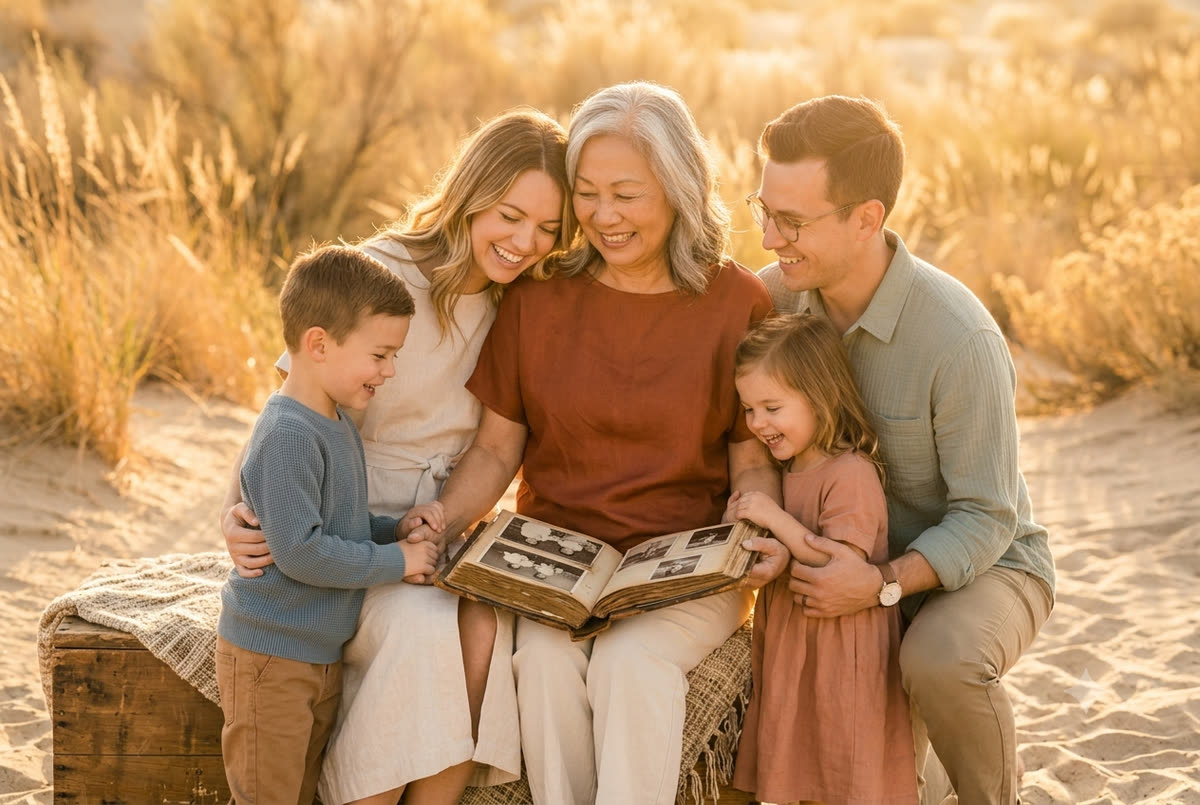
- Multigenerational portraits — the eldest at the center, everyone they made gathered around them, the photograph the family will reach for at every holiday afterward.
There is no single correct version. Some families want a handful of quiet frames of two people together. Others want an afternoon documented. We can change course at any moment, and we often do.
Why Rancho Mirage families come to this work
Rancho Mirage is, in a real sense, built around the generation legacy photography exists to honor. So much of this city is given over to a graceful later chapter of life — the country clubs, the gated communities, the medical campuses, the winter residents who have made this their second home for decades. I photograph a lot of families here precisely because this is where the elders are, and where the grandchildren fly in to visit them.
A few patterns I see again and again in this city:
- A parent has moved here to be cared for nearby. Adult children in Rancho Mirage and across the valley bring a mother or father out from somewhere colder, and suddenly the family is together in a way it has not been in years. That is a window.
- A grandparent winters here and the family gathers in the cooler months. From November through April the part-time residents are in town and visiting children arrive for the holidays. For many families this is the only stretch all year when everyone is under one roof.
- Someone is receiving care at Eisenhower Health or in a nearby community. Rancho Mirage is the medical heart of the desert, and many of my legacy calls come from families navigating an illness or a memory diagnosis here.
If any of that is your situation right now, please take it as the nudge it is. Families far more often wish they had reached out sooner than worry they did it too soon. I have never once heard that a portrait was made too early.
Where we make these portraits in Rancho Mirage
The setting follows your person, not the other way around. The whole point is comfort and truth, so we go wherever they are most themselves.
At home
Most legacy sessions I photograph in Rancho Mirage happen at home — in a condo at The Springs, a house in Thunderbird Heights, a place at Rancho Las Palmas or Mission Hills. Home is where the favorite chair is, where the light they love comes through their own windows, where the objects of a lifetime sit on the shelves. I work quietly and with natural light wherever I can, so there is no production crowding the room. You will barely notice the camera.
In memory care and assisted living
Rancho Mirage has some of the valley's most established senior communities, and I photograph in them regularly. If your person is in memory care or assisted living, I am completely at home in those settings — I know how to keep things calm, work around rest and meal schedules, and read the room when a good moment is happening. I am gentle, unrushed, and unfazed by wheelchairs, oxygen, or a short attention span. I write more about this in my notes on memory care and assisted living sessions.
At Eisenhower Health or in hospice
When someone is at Eisenhower or receiving hospice care at home, we simply meet them where they are. These sessions are softer and shorter, built entirely around what your person can comfortably do that day. I keep room in my schedule for these requests and treat them as the priority they are — sometimes that means a same-day call. There is more on how this unfolds in my piece on hospice photography.
In a garden, on a patio, or out in the desert they love
And sometimes — when health allows — the right place is just outside the door. A favorite spot is the backyard or patio, with the Santa Rosa mountains behind and a chair waiting; another is a short, gentle visit to a local garden such as Sunnylands. If your person would love a little of the wider desert that drew them here, we can do that too, kept brief and shaded with somewhere to sit. Outdoors I plan around golden hour — the soft, forgiving light of late afternoon — so the setting is a gift and never a strain.
How I keep these sessions gentle
The thing families worry about most is that a session will be exhausting or awkward for their elder. It will not be. Here is how I protect that.
- We talk first. Before I arrive I want to know who your person is, what they can manage, what time of day they are at their best, and what you most hope to come home with. That conversation costs nothing and shapes everything.
- We work on their clock. Mornings are often best after a good night's rest; some are brightest right after lunch. We pick the window that is kindest to them and keep the whole thing short.
- No performance is required. There is no "say cheese," no holding a smile. The frames families end up treasuring most are almost always the unplanned ones — a laugh, a glance, a hand settling on a shoulder.
- Dignity is the rule. I photograph people as the whole, warm person they are. Nothing about illness or age has to be the subject unless you want it to be.
What you do with the photographs afterward
These images are meant to be held, not left on a phone. I help families turn a legacy session into something permanent — a printed heirloom album, framed wall art, prints for each of the children and grandchildren so the same true face hangs in every house. Years on, that is what survives: a real likeness on the wall that a great-grandchild can point to. If you want to think about the finished pieces, I have written about heirloom albums and wall art, and about the broader idea of generational legacy sessions when the goal is to gather the whole family in one frame.
A few honest answers to common questions
Is it too late if my person is very frail or no longer very communicative? It is almost never too late to make something meaningful. We adjust — shorter, softer, more rest. Even a quiet portrait of resting hands, or two people simply being together, becomes irreplaceable.
Will this be morbid or sad? It is far more tender than sad. These sessions tend to feel like a warm visit. Families often tell me afterward that it gave them a good day they did not expect.
How quickly can you come? Often within the week, and for hospice situations frequently the same day. If you reach out and your person is having a good morning, I will do everything I can to come while that window is open.
Do you photograph the whole family too, while you're there? Yes, and I gently encourage it. The grandchildren with grandma, three generations on one bed — those frames matter as much as the solo portrait. I wrote more about that in capturing grandparents with grandchildren.
When you're ready
If someone you love is here in Rancho Mirage and you have felt that quiet pull to preserve them properly — to have a real, warm, honest photograph while they are still here to give it — I would be honored to help. The hardest part is usually just naming the wish out loud. So start there: tell me a little about your person, and we will find the gentlest way forward together, on whatever timeline their days allow.