Legacy & End-of-Life Photographer in Indian Wells
There is a particular kind of phone call I always make room for. It usually comes from an adult daughter or a son, often calling from another time zone, and the voice is careful because the situation is tender. A parent who has wintered in Indian Wells for thirty years is slowing down. The family wants pictures while there is still time — not a polished holiday card, but something truer than that. Something to keep. If you are the one holding that thought right now, I am glad you found this page, and I want to walk you through it without any hurry.
Legacy and end-of-life photography is the most meaningful work I do, and Indian Wells is one of the places I do it most. This is a town full of long histories — people who bought a place off Eldorado in the eighties and have been coming back every season since, couples who raised a family elsewhere and chose the desert for the gentlest chapter of their lives. When that chapter starts to close, photographs become one of the few things you can actually hold onto. Below is everything I want a family here to understand before they reach out.
What "legacy photography" actually means
Legacy photography is a wide and gentle term, and it covers more than one moment in a life. I use it for two related kinds of work:
- Legacy portraits made while someone is living fully — an elder who is still active, still telling stories, still the center of the family, captured deliberately so that the next generations have a real, warm likeness rather than a snapshot.
- End-of-life photography — sometimes called hospice photography or final portraits — made during the last season of a person's life, whether they are alert and conversational or resting and quiet.
Both are about the same thing: making sure a person is remembered as themselves. Not as an illness, not as a date on a stone, but as the particular human they are — the way they hold a grandchild, the hands that built a life, the expression the whole family would recognize from across a room.
This is not the same as the memorial slideshow or the funeral photography that can come later. Legacy work happens while your person is here, and that is exactly what makes it precious.
Why families in Indian Wells reach out
Indian Wells has its own rhythm, and it shapes the work in ways worth naming.
Most of the families I photograph here are multigenerational and spread across the country. The grandparents are the ones rooted in the desert; the children and grandchildren fly in. That geography is the whole reason these sessions matter so much. When everyone is finally under one roof — over the December holidays, around a March visit, during a quiet week when the snowbird crowds have thinned — it may be the only window in the year, or the only window left, to gather everyone in front of one camera.
There is also the quiet of this town to consider. Indian Wells is built around space and ease — wide streets, mature landscaping, the Santa Rosa Mountains close behind the south end. That calm is a gift in this kind of work. We are never fighting crowds or scrambling. We can move at the pace your person needs, which is most of what gentle photography requires.
When to call — and why a little earlier helps
More than once, a family has told me afterward that they wished they had begun a little sooner. I never want anyone to feel pressured, and at the same time I owe you honesty: health can shift quickly, and the earlier we connect, the more choices we have.
If your loved one is comfortable and able to sit up, talk, or move a little, that is a beautiful time — the session can be relaxed and full of life, and we can even gather the wider family. If things are further along, we simply soften everything: shorter visits, fewer expectations, more rest. There is no point that is truly "too late" to make something that matters, but earlier almost always means easier on everyone, your person most of all.
In practical terms, for Indian Wells families that often means a same-week or even same-day call. I hold space in my schedule for these requests and treat them as the priority they are. If you reach out and tell me your person is having a good morning, I will do everything I can to come while that window is open.
Where these sessions happen here
Legacy and end-of-life sessions take place wherever your person is most at ease. In and around Indian Wells, that usually means one of a few settings.
At home
The homes here lend themselves to this beautifully — a sunroom off a courtyard, a bedroom with the blinds drawn just so, a shaded patio looking toward the mountains. Home is where someone is surrounded by their own things and their own light, and it nearly always makes the most honest pictures. A worn reading chair, the view they have looked at every winter for decades, the kitchen where the family always gathers — those rooms carry a whole life, and I photograph them along with the person.
In care and hospice settings
Many Indian Wells families coordinate care through Eisenhower Health just over in Rancho Mirage, or through hospice services and the assisted living and skilled nursing communities scattered across the valley. I am comfortable and unobtrusive in these spaces. I work quietly around medical equipment, I am respectful of staff and other residents, and I can frame to include or gently leave out tubes, monitors, and the harder visual details — entirely as you wish.
A nearby park, garden, or patio, when health allows
When your person is up for a little fresh air, we rarely go far — the back patio, a neighborhood park, or a quiet corner of a local garden is usually all we need. A wheelchair rolls easily onto a tidy lawn, a garden path, or a shaded courtyard, and in the cooler months the late-afternoon golden hour off the Santa Rosas is kind and forgiving — a lovely window for a portrait outdoors. I never ask a fragile person to sit in heat or glare; in the warmer months we stay inside near a bright north-facing window and step out only in the gentle early or late edges of the day. I also bring soft, flattering light with me, so we are never dependent on whatever the sky happens to be doing.
What a session actually looks like
A typical visit is slow and calm. I arrive quietly, usually without much visible equipment, and I spend the first while simply being in the room — letting your person settle, letting your family relax, letting me understand the way you all are together. Then I photograph softly around the edges of ordinary life: the conversation, the holding of hands, the small rituals, the laughter that still comes.
The images take whatever shape fits your family:
- Quiet portraits of your person — a real, dignified likeness made with patience and gentle light.
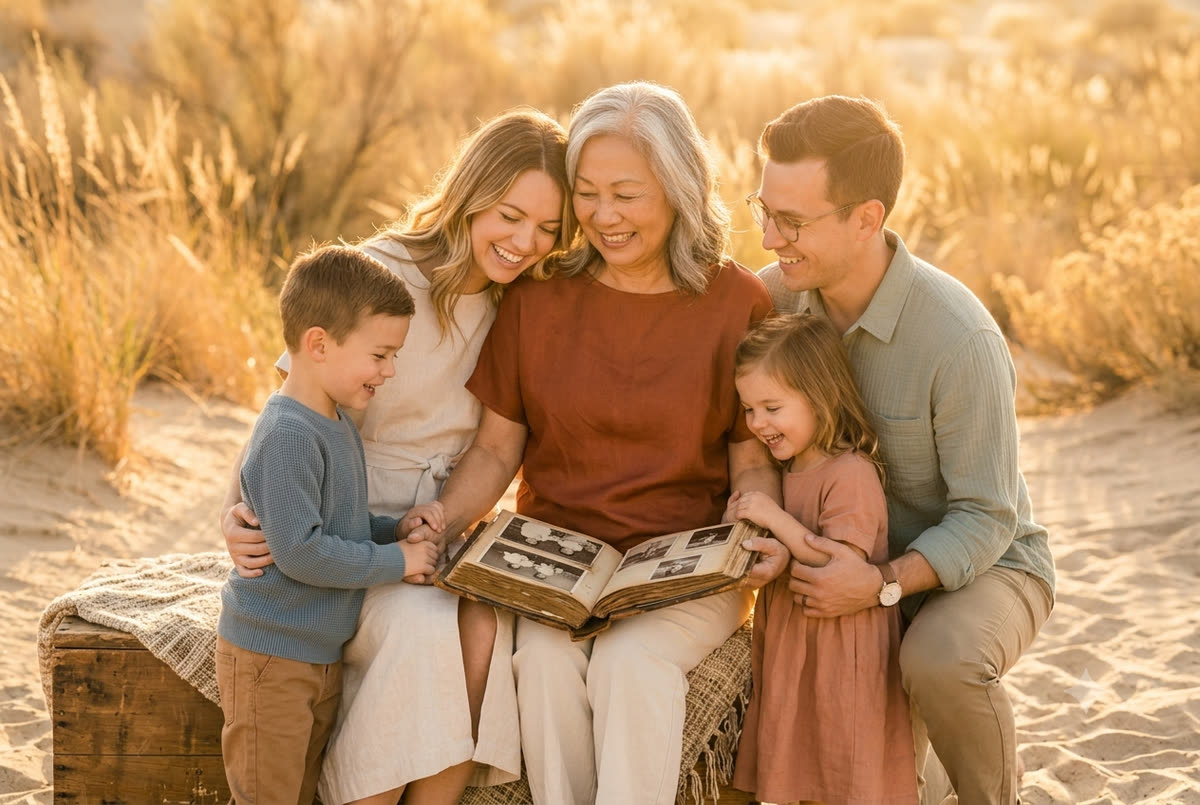
- Connection photographs — a forehead kiss, three generations on one bed, a granddaughter reading aloud, the adult children gathered close.
- The details that hold a life — the wedding ring worn thin, the hands, the garden tended for forty years, the reading glasses, the medals or rosary or photographs on the dresser.
- Story and voice — some families pair the session with a short audio recording of their loved one talking, so the photographs arrive with a sound.
Most visits run somewhere between forty-five minutes and two hours, but I follow your person's energy rather than a clock. If fifteen minutes is all the day allows, that is a complete and worthwhile session. We can also stop and resume, or change course entirely, at any moment.
How to prepare — for the family
You do not need to do much, and please do not wear yourself out tidying or arranging. A few small things help, though:
- Note a few objects or settings that matter — a favorite chair, a quilt, a window with good light, the patio that looks toward the mountains. Tell me, and we will weave them in.
- Think about who you want in the frame. Spouse, children, grandchildren, the dog. If family is flying into Indian Wells, this is a lovely reason to gather everyone at once.
- Choose soft, comfortable clothing, not formal wear. Solid, muted colors photograph kindly. But if your person is most themselves in a particular old cardigan, that is the right choice.
- Let go of "looking sick." Families often worry about thinness, a hospital gown, or medical equipment. With the right light and angles, the love in the room always reads louder than the illness — and we can keep certain things out of frame entirely.
- Pick the best time of day. You know your person's rhythm and when they are most alert. We build the whole visit around that, and mornings are often best.
What to say to your person
If your loved one is aware, a warm and simple framing usually lands best: "We'd love to have some beautiful pictures of you, and of all of us together." Most people are genuinely touched to be asked. If someone is shy about the camera, that is completely fine — I work softly enough that it fades into the background, and connection photographs rarely ask anyone to perform.
If your person is no longer responsive, families still find deep meaning in images of held hands, a kiss on the brow, the family gathered at the bedside. We approach that with the utmost gentleness, and only ever with your blessing.
Questions families in Indian Wells ask me
Is it strange to want this? Not at all. It is loving and quietly brave. For generations, families made portraits in exactly these moments. We have simply grown unused to it — but wanting to remember a face is one of the most human things there is.
Will the pictures be sad to look at? Most families tell me the opposite. The images become a comfort, the photo they put by the door and look at every morning. You will see the person, not the diagnosis.
What about privacy? Your trust is everything to me. Nothing is ever shared publicly without your explicit permission, and many of these sessions remain entirely private to the family. You decide who ever sees them.
Can you work with hospice staff and around medical equipment? Yes. I coordinate easily with nurses and caregivers, I move quietly and respectfully in clinical settings, and I frame to include or quietly exclude medical details as you prefer.
How fast can we get the photographs? I prioritize this work. When time is short, I can turn around a first set of edited images very quickly — often within a day or two, sometimes the same day for a few key frames — so you have them while they matter most.
A word on cost and care
In these circumstances I keep the conversation about money simple and humane, and I never want it to stand between a family and what they need. When you reach out, tell me what you are facing, and we will find a way that works. More than a transaction, this is a calling for me.
If you want to read a little further
As you think this through, you may find these companion pieces helpful: my fuller overview of end-of-life photography services across the Coachella Valley, my thoughts on generational legacy sessions for an elder who is still living fully, and a gentler look at final portraits of elderly loved ones when you are weighing whether the time is right.
When you are ready
If you are reading this for someone you love, I am so sorry for what you are carrying, and I am honored that you would even consider letting me into this moment. Legacy photography is a small, steady act of devotion — a way of saying you were here, you mattered, and we will not forget your face.
Whenever you feel ready — today, this week, or simply to ask a question with nothing decided — I am here. Send me a note through my contact page, tell me a little about your person and where they are in Indian Wells, and we will take the next small step together, at exactly the pace you need.