In-Home End-of-Life Photo Sessions
The first thing I notice when I step into someone's home for one of these sessions is rarely the person I have come to photograph. It is the room around them. The reading glasses folded on a stack of paperbacks. The grandchildren's artwork held to the refrigerator with magnets gone weak. A particular chair angled toward a window, worn exactly to the shape of one body over many years. A home holds a life in a way no hospital room or studio ever can, and that is precisely why so many families ask me to come to them when a loved one is nearing the end of life.
If you have been searching for in-home hospice photography here in the desert, you are likely weighing something tender and practical at the same time: you want these photographs to exist, and you want them made somewhere your person feels safe. I want to walk you through exactly how that works — what an in-home end-of-life session looks like, why home so often turns out to be the right setting, and the small things that make the day gentle instead of one more thing to manage.
Why families choose home over a facility or studio
A studio is a wonderful place for a senior portrait or a headshot. It is the wrong place for a goodbye. When someone is frail, tired, or anxious, the energy it takes to be dressed, transported, and settled somewhere unfamiliar can use up the very reserves we want to spend on the photographs themselves.
Home solves that almost entirely. There is no car ride, no waiting room, no strangers in the hallway. Your loved one stays in their own bed or their favorite chair, in clothes that smell like home, with the light they have watched move across the wall every afternoon for years. And the photographs carry all of it. Years from now, you will not only see your mother's face — you will see her kitchen, her quilt, the view of the mountains from the window she always sat beside.
There is also a quieter reason families choose home. It is private. Grief does not have to be performed for anyone here. You can cry, step out to the patio for a minute, refill the coffee, and come back. I am the only outside person in the room, and my whole intention is to feel less like a guest and more like a piece of the furniture you forget is there.
If you are still deciding between settings, I wrote separately about what these sessions look like in a memory care or assisted living community, which is the right answer for some families and the only option for others. There is no wrong choice — only the one that fits your person.
What an in-home session actually looks like
People are often surprised by how little equipment I bring and how unhurried the whole thing feels. Here is the honest shape of a typical visit.
We talk before I ever arrive. Usually with you, not the patient. I want to know their name and a little of who they are — what they did for a living, what they love, the song that still reaches them. I want to know who will be there, how their energy runs through the day, and anything sensitive: oxygen lines you would like kept out of frame, a hospital bed you would rather not feature, a side of the face they prefer. None of this is a complication. It is how the session becomes theirs instead of generic.
I arrive quietly, with almost nothing. A camera and a couple of lenses. No rolling cases banging down the hall, no light stands taking over the living room, nothing that makes a home feel like a set. I would rather work with your space exactly as it is than rearrange it.
I work with the light already in the room. This matters more in the desert than almost anywhere. Our homes are built for light — big west-facing windows in Rancho Mirage and Indian Wells, sliders opening onto a patio in Palm Desert, that low gold that pours in across the valley in the last hour before sunset. I will often simply soften a harsh afternoon beam through a sheer curtain rather than fight it. I rarely use flash indoors; it flattens the warmth we are trying so hard to keep, and it is jarring in a quiet room.
We move at your loved one's pace. If they need to rest, we rest. If the good window of energy lasts twenty minutes, we make beautiful work in twenty minutes. I never ask anyone to "say cheese" or hold a pose that hurts. I am watching instead for the true things — the way a husband smooths his wife's hair, the laugh that still sounds exactly like it always did, a thumb moving slowly across the back of a held hand.
The light in desert homes, and timing your day around it
Because so much of this work depends on natural light, when we schedule matters. In the Coachella Valley, I usually steer in-home sessions toward mid-to-late morning or the soft stretch of late afternoon, for two reasons.
The first is your loved one. Most people in hospice have a window when they are most comfortable and most awake, often mid-morning after medications have settled and before afternoon fatigue arrives. Your nurse or aide will know that rhythm better than any calendar. We build the session around their best hour, not mine.
The second is the light itself. Our brightest midday sun comes in hard and white, especially in summer, and it can feel clinical on skin. The early and later hours give us that forgiving, honey-colored light the desert is known for — the same glow that makes our golden-hour portraits outdoors so lovely, except here it is falling across a familiar bedspread. If your loved one's room faces straight into the afternoon glare, we simply diffuse it. If a north-facing room stays soft and even all day, sometimes that becomes our best spot regardless of the clock.
Desert families are often scattered across the country, with children and grandchildren who put down roots somewhere else years ago. If relatives are flying in, we coordinate the session for when the most people can gather, and we work around travel so no one who matters is missing from the frame.
Preparing your home — gently, and not too much
I want to lift this worry off you right away: you do not need to clean the house. You really don't. A lived-in home photographs beautifully, and the small honest details are often the ones families treasure most.
That said, a few light touches help the day flow:
- Clear the immediate frame, not the whole room. It is enough to move cups, tissues, and clutter off the bedside table and set aside anything you would not want in a picture. I work around everything else.
- Decide about medical equipment ahead of time. Oxygen, a hospital bed, an IV pole — these can be part of the honest story or kept entirely out of frame. It is your call, and telling me beforehand means I can compose around it from the first shot.
- Pick one or two meaningful objects. A wedding ring, a worn Bible, a beloved quilt, an instrument, the dog who has not left their side. Objects carry a whole life into a single frame.
- Think about comfort, not formality. A favorite cardigan, a soft familiar shirt, the jewelry they always wore. What looks like them matters infinitely more than what is dressy. For everyone else joining, soft solid colors keep the eye on faces.
- Have water and a place to pause. These sessions are emotional. It is normal to need a tissue, a breath on the patio, a minute. Build that in and the day stays gentle.
If you would like a fuller walkthrough, I keep a separate guide on getting your home ready for an in-home session that goes deeper into light and tidying.
Who should be in the room
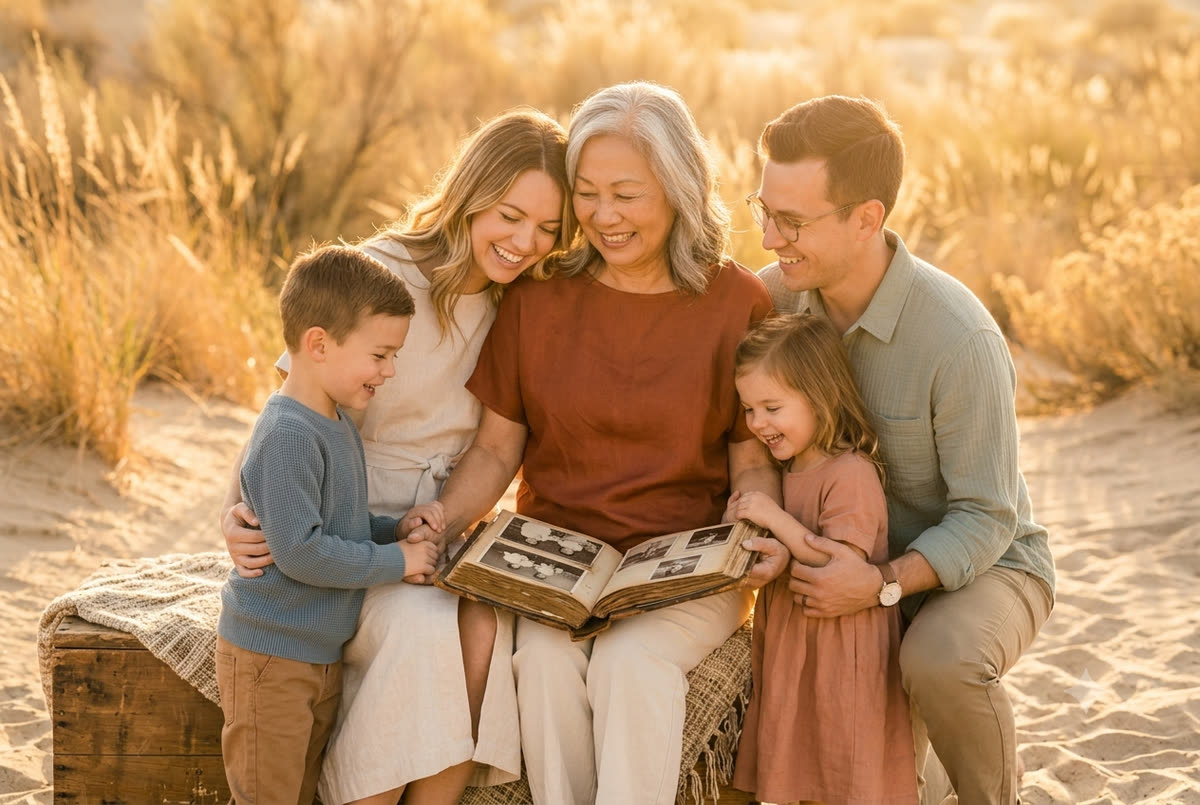
This is entirely your family's decision, and there is no right answer. Some families want everyone — children, grandchildren, the great-grandbaby meeting their namesake for the first and only time. Others want it intimate: just a spouse, just the kids on the edge of the bed the way they sat when they were small. Most want a little of both, and we make a few of each.
A few things worth thinking through:
- Children can be a gift and a handful. Including little ones is often beautiful. It also helps to have one adult whose only job is to tend to them, so the rest of you can be present.
- The family photographer needs to be in the picture this time. In nearly every family there is one person, often the primary caregiver, who has taken every photograph for thirty years and is therefore in none of them. Please let yourself be in the frame. You will want to be there later.
- Make at least one generational frame. If you have three or four generations available, even for a few minutes, we should photograph all of them together. Those images become anchors a family returns to for the rest of its history.
The fear underneath, and why I hope you won't wait
Almost every family I work with tells me the same thing afterward: I wish we had called sooner.
It is completely understandable to wait. In the middle of medications and appointments and the sheer emotional weight of it all, photographs can feel like the least urgent item on the list. There is also a quiet fear that asking for pictures means giving up hope, or that it will upset the person who is ill.
In my experience the truth is gentler than the fear. Being photographed — being seen, deliberately and lovingly — tends to feel affirming to the person at the center of it. It says: your face is still the one we want, you still matter, you are still ours. I have watched a tired parent rally with real joy at being the center of their family's love for an hour rather than the center of its worry. If you would like to read more honestly about that hesitation, I wrote about whether photographing a dying loved one is morbid, because so many people carry that question silently.
So my gentle, honest counsel is this: if the thought has crossed your mind, that is the signal to reach out. Conditions in hospice can hold steady for a long while and then change quickly. I keep room in my schedule specifically so I can come fast for desert families — often within a day or two, and same-day when that is the only window we have.
Questions families ask me
What if my loved one is sleeping most of the time?We can still make something beautiful and respectful. Some of the most moving images I have ever made are of a parent resting peacefully with their children gathered close and hands held. We will talk it through honestly first, and I will follow your lead entirely.
Will it be strange having a stranger in our home at such a private moment?I do everything I can not to feel like one. I move slowly, I follow your family's lead, and I keep myself small and quiet at the edges of the room. Most families tell me afterward that they forgot I was there, which is exactly what I hope for.
Do you serve my area?I photograph in-home sessions throughout the valley — Palm Desert, Palm Springs, Rancho Mirage, Indian Wells, La Quinta, Indio, Cathedral City, Coachella, and the surrounding desert. If you are nearby, I can almost always come.
What about the photographs afterward?I edit these with particular tenderness. My work is warm and honest rather than heavily retouched — I am not trying to erase a life or smooth away every line, only to render your person as the people who love them see them. I will quietly attend to anything distracting, like medical tubing or harsh coloring, while keeping them fully, recognizably themselves. I deliver a gallery of finished images and am always glad to help you choose a few to print, because a photograph on the wall or an album in the hands is what the next generation will actually hold.
What does it cost?We will talk that through simply and privately, without it ever being a hurdle. Right now the point is the people, not the paperwork.
When you're ready
There is no perfect script for this season, and you do not need to have it all figured out before you reach out. If some quiet part of you wants these photographs to exist — made at home, in the light your person knows, surrounded by the life they built — that is reason enough to begin the conversation.
I would consider it an honor to step softly into your home and help your family hold onto this time. Whenever some quiet part of you says it is time — even if "ready" is too strong a word for where you are — you can reach me here, and we will figure out the next small step together.