Yearbook Photo Requirements & Tips
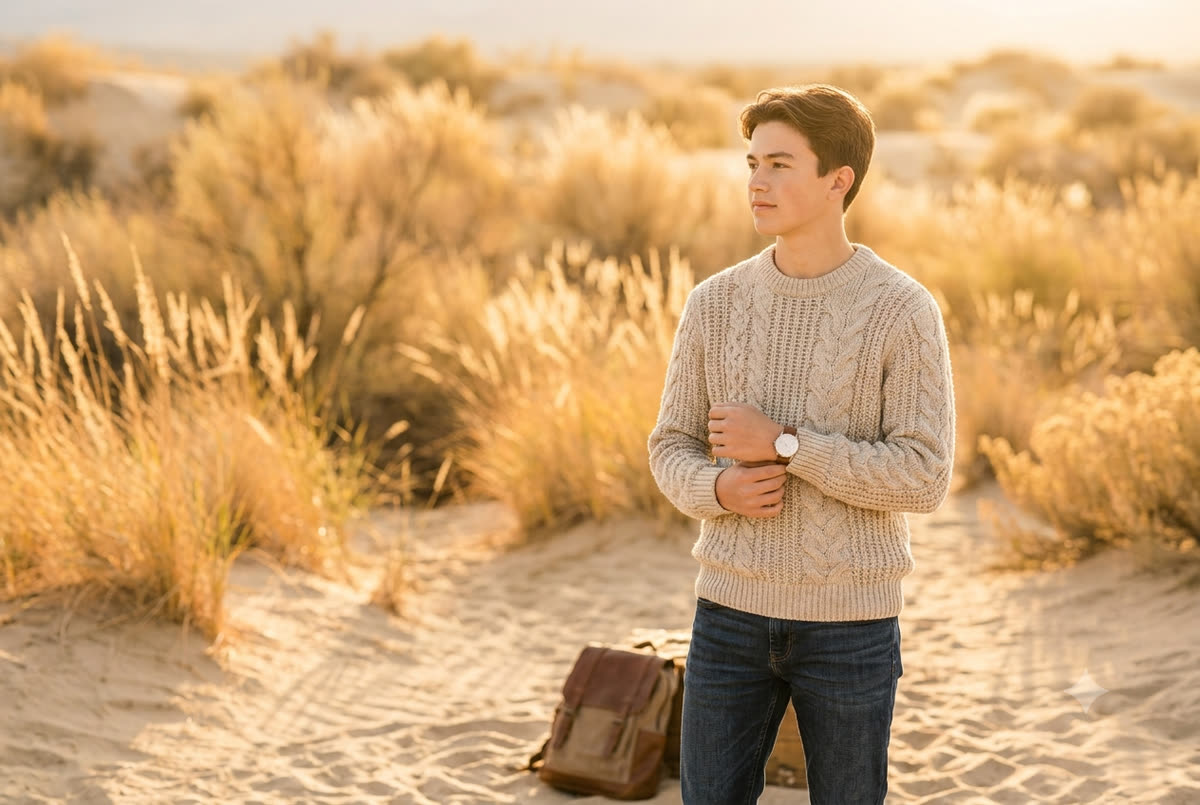
The yearbook photo is sneaky. It looks like a simple errand — a small square in a big book — and then it outlives almost every other picture you take of your teenager. So when a parent emails me with some version of "My son is a senior this year, what do we actually need?" I always slow down, because the honest answer has two halves. There's the part the school cares about: an image that meets their exact technical requirements so it doesn't get rejected. And there's the part you'll care about for the rest of your life: a portrait that actually looks like your child, captured in this exact season of who they are right now. My job is to make sure you get both, without the stress.
I've been photographing families and graduating seniors across Palm Desert, Rancho Mirage, La Quinta, and the rest of the Coachella Valley for many years. Most of my sessions happen right in a family's own home — by a big window where the light is soft — or close by at a local park, garden, or shaded patio. That setting matters here, because the yearbook photo carries more weight than people expect. It's a tiny picture, but it's the one that gets passed around at reunions for decades. So let me walk you through all of it — the requirements first, because those are non-negotiable, and then the tips that make the difference between a photo that's merely accepted and one you frame.
First, the part that trips everyone up: every school is different
There is no single national standard for yearbook photos. Each school — and often each yearbook company the school contracts with (Jostens, Lifetouch, Herff Jones, and Balfour are the common ones around here) — publishes its own specification sheet. Before we do anything else, you need to find that sheet.
It usually lives in one of a few places:
- The senior packet your student received at the start of the year
- The school counseling office or yearbook adviser
- An email from the yearbook staff (check spam — these always land in spam)
- The yearbook company's online portal, if your school uses one
If you can't find it, email the yearbook adviser directly and ask for the "senior portrait submission specifications." Don't guess. I've had families spend money on a beautiful shoot only to discover the school wanted a vertical crop on a plain background and they'd planned something else entirely. Five minutes of asking up front saves all of that.
The technical requirements schools typically ask for
While every school differs, the specifications cluster around the same handful of things. Here's what you'll almost always see, and what each one really means.
Orientation and crop
Nearly all yearbook portraits are vertical (portrait orientation), head-and-shoulders, with the eyes positioned in the upper third of the frame. Schools want consistency across the page, so they specify how much of you shows — typically from mid-chest up. Some give an exact aspect ratio (2x3 is the most common) so the photos tile neatly.
Resolution and file size
This is where digital submissions get rejected most often. Schools usually want a high-resolution JPEG, often a minimum of 300 DPI at the print size, which in practice means an image at least 640 x 800 pixels and frequently much larger — 1200 x 1500 or more. They'll also set a file-size range (say, 1MB to 10MB). A photo pulled off Instagram or screenshotted from your phone will not meet this. When I deliver senior portraits, I provide a file specifically formatted to the school's spec so you never have to think about it.
Background
Many schools require a plain, neutral background — often light gray, white, or a soft graduated gray — so the page looks uniform. Others are relaxed and allow outdoor or environmental backgrounds. This is the single most important thing to confirm, because it dictates where we shoot. If your school requires studio gray, a gorgeous golden-hour photo at the Indian Wells tennis gardens won't be accepted for the yearbook (though it'll make a stunning print for your wall).
Clothing and appearance rules
Schools frequently restrict:
- No hats, sunglasses, or props in the official yearbook image
- No logos, slogans, or distracting graphics on clothing
- Sometimes a required drape or tux (more common for traditional schools, less so out here)
- Modest necklines and appropriate coverage
Read these carefully. A beautiful off-the-shoulder top, for example, is exactly the kind of thing some dress codes won't permit for the official yearbook image — an easy thing to plan around once you know, frustrating to discover after the fact.
File naming and submission method
Some schools want files named a specific way (LastName_FirstName_StudentID.jpg) and submitted through a portal or emailed by a hard deadline. Others have the photographer submit directly. I'm happy to handle the submission on your behalf when the school allows it.
The deadline — the requirement people underestimate
Yearbook deadlines are early. Far earlier than graduation. Many Coachella Valley schools want senior portraits submitted by late September or October of senior year, sometimes even the prior spring. The yearbook goes to print months before the cap and gown come out. If your student is entering senior year in the fall, the time to book is summer or very early fall — which, conveniently, is also when our desert light starts getting beautiful again.
Now the fun part: tips that make your yearbook photo genuinely great
Meeting the requirements gets you accepted. These next things get you a photo you actually love. This is where having someone who does this for a living, rather than the rushed school picture-day line, really shows.
Tip 1: Match the light to the setting
Most of the seniors I photograph sit for their portraits at home, beside a large window. Soft, indirect window light is wonderfully forgiving — it wraps gently around the face, flatters every skin tone, and lets us work at whatever time of day suits your family, no sunrise alarm required. If your school requires a plain studio-gray background, this is also the easiest, calmest way to get it: a quiet corner of your living room, controlled light, no heat to fight.
When we do step outside — to a shaded park, a garden, or a patio nearby — the desert rewards good timing. We aim for golden hour: the first hour after sunrise or the last hour before sunset, when the light goes warm and low and the San Jacinto mountains glow. In the hottest stretch from late June through September, that early-evening window is also simply more comfortable. The point is to fit the light to where we're shooting, rather than forcing a setting that fights it.
Tip 2: Wear something that looks like you — in solid, simple colors
For the yearbook crop, only your top half shows, so focus there. Solid colors photograph best. Avoid tight stripes, small checks, and busy patterns, which can shimmer or distort at print size. Skip large logos. Jewel tones, soft neutrals, and classic colors tend to flatter most skin tones in our bright desert palette. Bring a second option — a slightly dressier and a more casual top — so we have range, especially if we're also capturing portraits beyond the official yearbook shot.
Tip 3: Mind the things that date a photo
You'll look at this picture for decades. Trendy, of-the-moment choices can age quickly. I gently steer seniors toward timeless over trendy: classic necklines, natural makeup that looks like a great version of an everyday face, and hair styled the way they genuinely wear it. The goal isn't to look like someone else on picture day — it's to look unmistakably like you, at your most confident.
Tip 4: Get the small grooming details right
These tiny things make a surprisingly big difference at high resolution:
- Fresh haircut about a week before (not the day of — give it time to settle)
- Hydrate; our dry desert air shows on lips and skin
- Bring a comb, blotting papers, and any touch-up makeup
- For glasses wearers, ask your optician for anti-glare lenses or bring an empty frame, since reflections are a common rejection reason
- Manage breakouts gently rather than over-concealing — I can soften skin tastefully in editing without making anyone look plastic
Tip 5: Relax — that's literally my job
The best yearbook photos don't come from holding a stiff pose. They come from a real, easy expression. So I keep things conversational — we'll chat, I'll give a little simple direction, and somewhere in there your actual personality wanders into the frame. A natural, slightly-smiling, eyes-engaged expression reads as confident and warm. If you've ever felt like school picture day rushed you into a frozen grin, this is the opposite of that. Being at home, in your own space, tends to help that happen faster.
Tip 6: Capture more than just the required shot
Here's the thing about booking a proper session: while we're getting the compliant yearbook image, we can also create the portraits you want — in the rooms of the home you grew up in, out in the backyard or on the patio, or at a favorite local park or garden during golden hour. One sitting, two purposes: the small approved photo for the book, and the real keepsakes for your family. Many of the seniors I work with treat this as the start of their broader senior portrait session, not a separate errand.
Common mistakes I see — and how to avoid them
- Submitting a cropped phone snapshot. It won't meet resolution requirements and looks flat next to professional portraits on the page.
- Missing the deadline because you were thinking about June. The book prints in winter. Book in summer or early fall.
- Ignoring the background rule. Confirm whether it's studio-only before planning an outdoor shoot.
- Heavy filters or trendy editing. Schools often reject overly edited images, and they age badly anyway.
- Wearing busy patterns or big logos. They distract at small print size and can be disallowed.
- Forgetting glasses glare. Anti-glare lenses or an empty frame solve it.
- Booking the last week. Hair, weather, retakes, and submission portals all need breathing room.
A quick word for families with a full calendar
Senior year is busy, and plenty of valley families split time between here and somewhere else. If your student is only in town for stretches, the simplest fix is to plan the session around when they're actually home — and because so much of what I do happens indoors by a window, we're not at the mercy of the weather or the time of day. If you're new to the area, you might also enjoy my guide to the best spots for senior photos in the desert, several of which make lovely senior portrait backdrops when we do head outside.
In short
Get your school's specification sheet first and treat the requirements — orientation, resolution, background, dress code, file naming, and especially the deadline — as the non-negotiable foundation. Then layer on the things that make it yours: the right light for our desert, simple flattering clothing, timeless styling, easy grooming, and a relaxed, real expression. Do both, and your yearbook photo will be the one your student is glad to see every time that book comes off the shelf.
If your senior is graduating this year, the most useful thing you can do is start with that specification sheet and a target date — then let me carry the rest. Tell me a little about your student: their school, their deadline, and what they're actually like. I'll plan a session that clears every box the yearbook requires and, in the same sitting, gives your family the portraits you'll keep long after the book goes on the shelf. Send me a note here whenever you're ready to talk it through.