What Is Golden Hour & Why It Matters
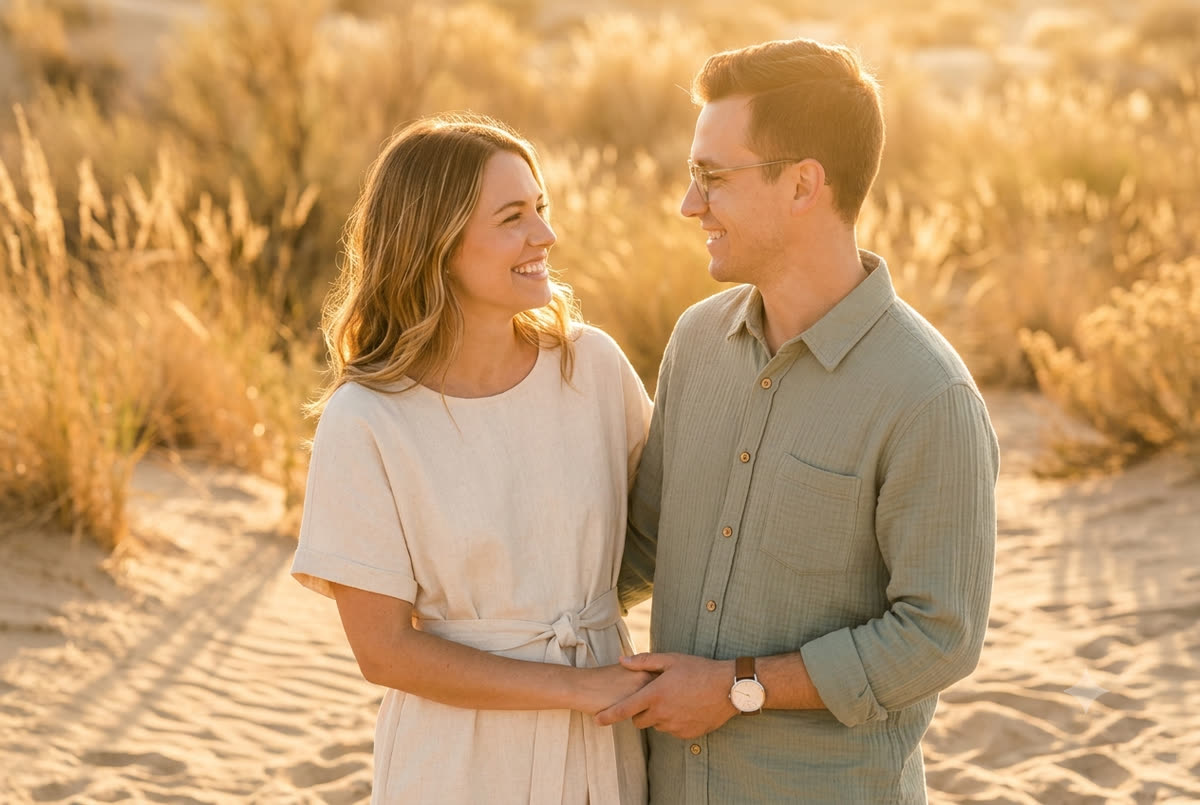
If you have ever looked back at a photo and felt your breath catch — the light soft and warm, everyone glowing, the whole moment looking the way it actually felt — there is a very good chance it was made during golden hour. After many years of photographing families and couples across Palm Desert and the Coachella Valley, I can tell you that the single most powerful tool I have is not my camera. It is the light. And golden hour is the most generous, most flattering, most quietly magical light the desert gives us.
So let me walk you through what golden hour actually is, why it matters so much for your portraits, and how we use it here in the Coachella Valley — where, honestly, the light is one of the best-kept secrets of this whole corner of California.
What is golden hour?
Golden hour is the stretch of time shortly after sunrise and again shortly before sunset, when the sun sits low on the horizon and its light turns warm, soft, and golden. Instead of beaming straight down from overhead, the sunlight travels at a low angle through more of the atmosphere. That longer path filters out the harsh blue tones and leaves behind the warm ones — gentle gold, amber, peach, and rose.
The result is light that is:
- Soft and diffused, so shadows are gentle instead of hard and unflattering.
- Warm in color, which makes skin tones look healthy, glowing, and alive rather than washed out.
- Directional, coming from the side rather than straight above, which gives faces and bodies beautiful, natural dimension.
- Low and wrapping, so it can backlight hair into a soft halo or rim-light a couple from behind.
You will sometimes hear it called the "magic hour," and photographers are a little protective of it for good reason. It is the difference between a snapshot and a portrait you will want to print and hang on the wall.
Is golden hour really an hour?
Not exactly — and this matters here in the desert more than almost anywhere. "Golden hour" is a friendly name, not a precise measurement. Depending on the season and how far you are from the equator, the genuinely golden, usable window can be anywhere from about 30 minutes to a bit over an hour.
In the Coachella Valley, our golden hour is often on the shorter, more dramatic side because of the mountains. The San Jacinto and Santa Rosa ranges rise steeply right at the valley's edge, so the sun tucks behind them earlier than the official sunset time you would see on a weather app. That means our practical golden light can wrap up 20 to 40 minutes before the listed sunset, especially the closer you are to the mountains in Palm Springs, Rancho Mirage, or the south end of La Quinta. It is one of the first things I check when I plan a session — not just when the sun sets, but when it actually disappears behind our particular skyline.
Why golden hour matters for your photos
It is the most flattering light there is
Overhead light at noon is a difficult partner for portraits. It falls straight down, carving shadows under eyes, noses, and chins, and it tends to blow out the highlights on skin so that everyone looks a little flat and tired. Golden hour does the opposite. The low, soft, warm light smooths skin, softens fine lines, brings a natural warmth to every complexion, and lets people relax their faces. Nobody is working against the light, and that ease shows up in the photos.
It makes color and emotion sing
There is an emotional quality to golden light that is hard to put into words until you see your own gallery. Warm light reads as warm feeling — comfort, closeness, tenderness. A father lifting his daughter, a couple leaning into each other, a toddler barreling across a sunlit lawn — all of it feels softer and more loving when it is bathed in gold. The light does some of the storytelling for us.
It creates depth and that "glow"
Because the sun is low and to the side, it sculpts. It separates people from the background, rims hair and shoulders with light, and gives the whole frame a sense of dimension. When I backlight a family — placing the sun behind them — that glow around their edges is pure golden hour, and it is the look most people are picturing when they tell me they want "those dreamy, glowy photos."
It is forgiving and unhurried
Golden hour light is even and gentle, which means I am not battling extreme contrast. That lets me focus on you — on the real moments, the laughter, the quiet in-between glances — instead of wrestling with technical problems. It is a big part of why my sessions feel calm rather than rushed.
Golden hour in the Coachella Valley specifically
This is where it gets fun, because our desert does golden hour a little differently than anywhere else.
The desert haze and our famous light
The Coachella Valley is known for clean, dry air and enormous open skies. On most evenings that gives us a long, clear runway of warm light with very little of the gray, hazy flatness you get near the coast. But we also get those soft atmospheric evenings — a little dust or high cloud catching the last sun — and those can be the most spectacular of all, turning the sky over Mount San Jacinto into bands of pink, coral, and lavender. Either way, the light here has a particular clarity and warmth that photographs beautifully.
Our mountains are part of the picture
I mentioned the mountains affect timing, but they also affect mood. As the sun lowers, the Santa Rosa and San Jacinto ranges light up — the rocky faces glow amber and then deepen to violet during what photographers call the "blue hour" just after sunset. Shooting with those mountains as a backdrop, especially from spots in Rancho Mirage, Indian Wells, and La Quinta, gives portraits a sense of place that says this is the desert without anyone needing to ask.
Seasonal light through the year
When golden hour happens — and how pleasant it is to be outside for it — shifts dramatically with our seasons, and it changes how I plan every session.
- Snowbird season (roughly November through April): This is our peak portrait season for good reason. The temperatures are gorgeous, the light is clean and warm, and sunset comes early enough that we can do an evening session and still have you home at a reasonable hour. In December and January, the sun sets in the late afternoon — often around 4:30 to 5:00 — so golden hour is a comfortable, civilized time to be outside at a park or garden without anyone overheating.
- Spring (March–May): Wildflowers, warm light, and longer evenings. A beautiful, slightly underrated window before the heat arrives.
- Summer (June–September): The desert heat is very real, and golden hour becomes a strategy as much as an aesthetic. In midsummer, the sun does not set until well past 7:30, and even then the air holds its warmth. For summer sessions I lean almost entirely on the very end of the day — the last 30 to 40 minutes before the sun drops — or occasionally on sunrise, when it is cool, quiet, and the light is just as lovely. If you are local and braving a summer shoot, dressing in breathable fabrics and bringing water is part of the plan.
- Fall (October–November): One of my favorite times. The brutal heat breaks, the light turns rich and golden, and the valley starts to fill up again. Beautiful all around.
Sunrise golden hour in the desert
We talk about sunset because it is when most people are free, but desert sunrise deserves a mention. In summer especially, the early morning is cool, the valley is hushed, and the eastern light spilling across the sand is soft and clean. For newborns, for couples who love calm, or for anyone who simply cannot do an evening session, a sunrise shoot is a genuinely special option — and we will usually have the location all to ourselves.
How I use golden hour in a session
Most of my work happens close to home — in your own living room, where soft window light does the work, or at a neighborhood park, garden, or shaded patio nearby. When a session is outdoors, golden hour is the part of the day I plan everything around, and getting the most from it takes a little craft. "Show up when it is pretty" only gets you partway; a little planning goes a long way.
- We time the session backward from the light. I figure out when the sun will actually dip behind our mountains at your chosen location, then build the start time around it — usually beginning 60 to 90 minutes before that, so we warm up in slightly brighter light and finish in the very best glow.
- We choose settings that work with low, warm light. My outdoor sessions usually happen somewhere easy to reach and comfortable — a local park, a botanical garden, a quiet greenbelt, a palm grove. Each of these catches side and back light beautifully, and a spot with the mountains behind us can add a sense of place when you want it. I think about which direction the light will be coming from and where the mountains sit.
- We chase the changing light, not fight it. Early in the session the light is brighter and great for full-family group shots; as it softens, we move into the intimate, glowy, backlit images everyone loves.
- We embrace blue hour. Just after the sun is gone, that cool, soft afterglow lingers for 15 or 20 minutes. It is gentle and moody and lovely, and I often save a few quiet frames for it.
Common golden hour mistakes (and how we avoid them)
After many years of desert sessions, here is what I gently steer people away from:
- Booking too late in the day "to be safe." If we start at sunset, we have already missed the best light. The magic is in the build-up, not the final minute.
- Trusting the app's sunset time literally. As I said, our mountains move the real finish line earlier. I plan for the desert's actual horizon, not the theoretical one.
- Wearing neon or very busy patterns. Golden light is warm, so soft, earthy tones — creams, terracotta, sage, dusty blue, warm neutrals — photograph beautifully and feel at home in the landscape. I am always happy to help you plan outfits.
- Over-scheduling the day. Golden hour is short. If everyone arrives frazzled and late, we lose it. I build in a calm buffer so the session itself feels relaxed.
- Underestimating the heat. In the warmer months, even a "golden hour" evening can be hot. Water, light fabrics, and realistic expectations for little ones keep everyone comfortable and smiling.
A few questions I hear often
Can we still get great photos if it is cloudy?Yes — and sometimes the photos are even better. A thin layer of cloud acts like a giant softbox, spreading the warm light evenly. Heavy overcast is rarer here, but even then, soft light is kind to skin and we make it work.
What if my kids melt down right at golden hour?They sometimes do, and that is completely normal. This is why I keep my sessions unhurried and follow your child's lead rather than forcing a schedule. Some of my favorite frames come from the "in-between" moments, not the posed ones. We have a little buffer in the timing for exactly this.
Is golden hour only for couples and engagements?Not at all. Families, children, maternity, generational portraits with grandparents in town for the season — all of it shines in golden light. If you want to understand more about why I work this way, you might enjoy my thoughts on why I photograph families outdoors in the desert and on the best times of year for Coachella Valley portraits.
What if we would rather stay home, or the heat makes outdoors hard?That is often my favorite way to work. A great many of my sessions happen right inside the home, where soft, indirect window light does indoors what golden hour does outdoors — it wraps around everyone gently and keeps skin looking warm and natural. Instead of chasing the sun on the horizon, we simply follow the best window in the house. For in-home newborn and family sessions in particular, it is comfortable, unhurried, and there is no watching the clock against the sunset.
What about the blue hour I keep hearing about?Blue hour is the soft, cool, glowing window just after the sun has set. It is moody and beautiful in its own right, and it pairs wonderfully with golden hour. I touch on it more in my piece on desert light through the seasons.
The bottom line
Golden hour matters because it is the closest thing photography has to a secret ingredient — light that is soft, warm, flattering, and full of feeling, all at once. Here in the Coachella Valley, with our clear skies, dramatic mountains, and long desert evenings, we are lucky enough to have some of the most beautiful golden light anywhere. My job is simply to know when it will arrive, where it will fall, and how to place you inside it so that the photos feel as warm and honest as the moment itself.
If you are dreaming of those soft, glowing portraits — whether that means window light in your own living room, an unhurried evening at a park near you, or a couple leaning into each other as the San Jacinto mountains turn from amber to violet — I would love to help you make them. Tell me a little about who you want in the frame and where you picture being, and we will sort out the right light together.
Reach out and say hello here — let's catch the light together.