Best Time of Day for Desert Portraits
Long before we ever talk about what to wear or where to meet, almost everyone lands on the same first question: "When should we actually do this?" It's the right instinct, because in the Coachella Valley time of day isn't a small detail. Out here, light is the whole story. Most of my sessions happen in the comfort of a family's own home, where soft daylight through a window does quietly beautiful work, or close by at a favorite local park, garden, or shaded patio. And the moment we step outside, timing becomes everything: the same stretch of desert that feels flat and bright at noon turns soft, golden, and almost unreal an hour before sunset. After many years of photographing families, couples, and children across Palm Desert, Palm Springs, Rancho Mirage, Indian Wells, La Quinta, and Indio, I've learned the desert's light has a rhythm all its own. Let me walk you through it, honestly and in plain terms, so you can plan a session you'll treasure.
The short answer: golden hour
If you remember only one thing about photographing outdoors in the desert, remember this. The best time of day is the hour just after sunrise and the hour just before sunset — what photographers call golden hour. The sun sits low on the horizon, the light comes in at a gentle angle instead of straight down, and everything it touches turns warm and flattering. Skin glows. Expressions stay soft and relaxed. The desert mountains catch a rosy alpenglow that you simply cannot fake. (If we're working inside your home instead, the rules are different and far more forgiving — I'll come back to that.)
Of the two, I most often recommend the evening golden hour here in the valley. It's easier to schedule (no one loves a pre-dawn wake-up with small children), the air has settled, and the light leading into sunset over our western mountains is genuinely spectacular. But sunrise has its own quiet magic, and for certain sessions I'll gently steer you that way. More on that below.
The rest of this guide is really about the details — because "golden hour" means something different in January than it does in July, and the right answer for your family depends on the season you're booking, who's in the photos, and what you want them to feel like.
In your home, you can almost ignore the clock
Here's something I tell people who feel boxed in by golden hour: if we photograph in your home, you barely have to think about the time of day at all. Indoors, we don't chase the sun — we chase a window. Soft, indirect daylight spilling through a north-facing window or a sheer-curtained sliding door is endlessly flattering, and it's available across a wide stretch of the day rather than one fleeting hour. For a newborn in the nursery, three generations gathered on the sofa, or a quiet maternity session, mid-morning through early afternoon is often ideal — that's when interior light tends to be brightest and most even. So if a perfectly timed sunset feels impossible with naps and work and school, an in-home session lifts that pressure entirely. We simply make the most of the natural light your home already has, and we shape it from there. The same is true on a covered patio or under the dappled shade of a backyard tree: the structure and the trees soften the light for us, so the window of good light opens up.
Why the desert is different
I've photographed in Los Angeles and along the coast, and I can tell you the desert plays by its own rules. Three things make our light unique:
- The air is incredibly clear and dry. With so little humidity and haze, the light here is crisp and the colors are saturated. Shadows are sharp. That's beautiful at golden hour and brutal at midday.
- The sun is intense and high. We're at a low latitude with very little cloud cover. For much of the year the midday sun is nearly overhead, which creates deep raccoon-eye shadows and makes people squint. It's the least flattering light of the day, full stop.
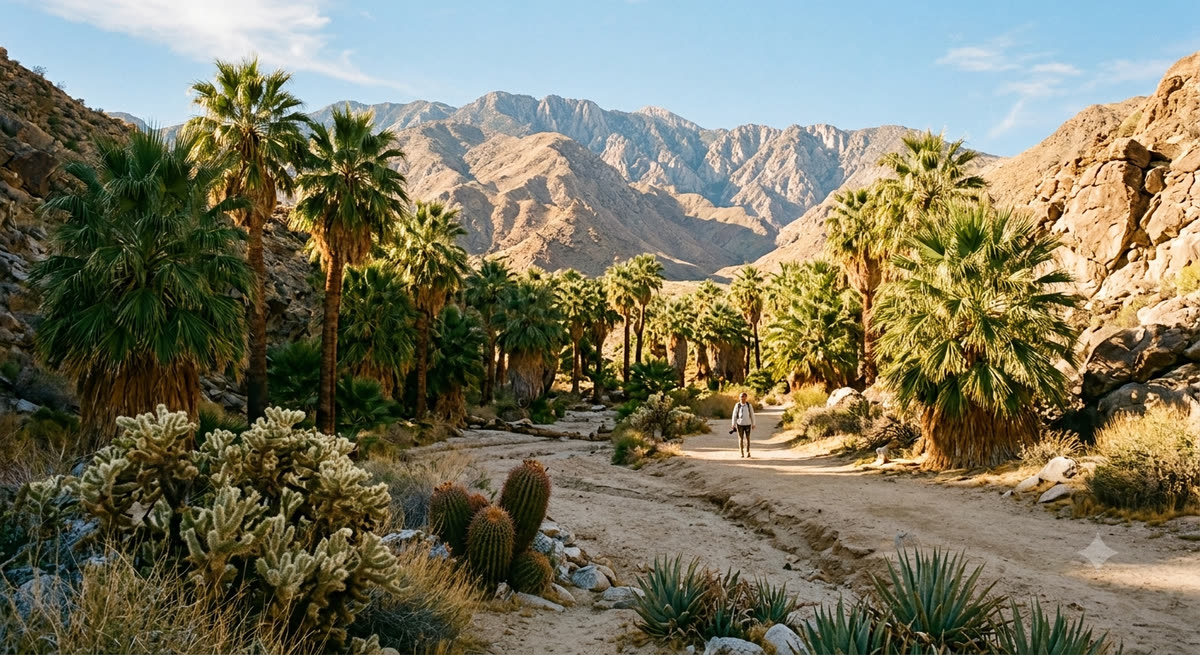
- The mountains shape everything. The San Jacinto and Santa Rosa ranges that ring the valley actually give us a gift: they bring on a soft, shadowed "civil twilight" a little earlier than a flat horizon would. As the sun drops behind the mountains, we get a stretch of even, glowing light that's wonderful for portraits — and it can extend your beautiful window by precious minutes.
Understanding those three things is really all you need. We chase the low, angled light and we avoid the high, direct light. Everything else is just timing.
Golden hour by season in the Coachella Valley
This is the part most generic articles get wrong, because "golden hour" is not a fixed time. Sunset in the valley swings by more than three hours across the year. Here's roughly what to plan for, season by season. (Always confirm the exact sunrise and sunset for your specific date — I'll do this for you when we book.)
Snowbird season (November through April)
This is our high season, and honestly the most comfortable time of year to be photographed in the desert. Daytime temperatures are mild, the light is gorgeous, and the valley is full of life. The trade-off is that the days are short.
- Sunset falls roughly between 4:45 and 5:30 in the deep winter (December and January), creeping later toward 6:30–7:00 by April.
- That means a winter evening session often starts around 3:30 or 4:00 in the afternoon. Wonderful for families with young children — we're done well before dinner and meltdowns.
- The winter sun never climbs as high, so even the late-morning and early-afternoon light is softer than in summer. Your "good light" window is a little more forgiving this time of year.
If you're a snowbird visiting for the season, this is your moment. The light is kind, the weather cooperates, and the desert is at its most photogenic.
Spring (April through early June)
A beautiful in-between season. Wildflowers can still be lingering in March and April, the light is lengthening, and temperatures are pleasant before the real heat arrives.
- Sunset moves from around 7:00 in April to nearly 7:45 by early June.
- Evening sessions typically start around 5:30 to 6:00.
- This is one of my favorite windows of the year — long, generous golden light and comfortable enough that no one is rushing.
Summer (mid-June through September)
Let's be honest about the heat. From June through September, daytime highs regularly sit between 105 and 120 degrees. I don't sugarcoat it, because your comfort and safety matter more than any photo. Summer sessions absolutely can be stunning — but timing is non-negotiable.
- Sunset is late, around 7:45 to 8:00 in June and July. That pushes golden hour to roughly 6:45 to 7:45 in the evening.
- Even at that hour it can still be very warm, so for summer I much more often recommend sunrise sessions. Sunrise falls around 5:30 to 5:45, and the hour right after is not only the coolest, most bearable part of the day — it's also beautifully calm and quiet, with the desert all to ourselves.
- I keep summer sessions short, bring water, and we find shade between setups. With a little planning, a summer sunrise in the desert is something special.
Autumn (October through November)
The valley exhales. The heat breaks, the snowbirds start to return, and the light gets that warm, clear quality I love.
- Sunset retreats from about 6:30 in early October to around 4:45 by late November.
- Evening sessions start around 4:30 to 5:00.
- Comfortable, golden, uncrowded — a lovely time to book.
When sunrise beats sunset
I default to evening for most clients, but here's when I'll suggest we set an early alarm:
- Summer, always if we can. The heat makes sunrise the kind, comfortable choice.
- When you want solitude. Popular outdoor spots — a well-loved community park, a public garden, a scenic overlook near La Quinta — are simply emptier at dawn. If you dream of photos with no strangers in the background, morning is your friend.
- For newborns and very young babies who are often at their happiest and most settled in the early morning.
- When you love soft, cool, dreamy tones. Sunrise light tends to read a touch cooler and gentler than the rich warm gold of sunset. Both are beautiful; it's a matter of mood.
And evening wins when you have young children on a normal sleep schedule, when you want that classic warm-and-glowy desert look, or when an early morning would simply feel like a burden. A session should feel like an experience you enjoy, never a chore.
What about midday? (And shooting in harsh light)
Sometimes life doesn't hand us a perfect golden-hour slot. A destination couple has one free afternoon. A family reunion only overlaps at lunchtime. So can we still make beautiful portraits at 1:00 in the afternoon? Yes — but it takes intention, and I want to be straight with you about it.
Direct overhead desert sun is the hardest light to work with. Left unmanaged, it creates squinting, shadows under the eyes, and blown-out highlights on the skin. So when we have to work midday, I rely on a few honest tricks of the trade:
- We find open shade. The covered architecture of a mid-century building, the deep eaves of a resort, the shadow side of a tall wall, the canopy of a mature palm or olive tree. Shade gives us soft, even light even at high noon.
- We backlight. I'll often place the sun behind you so it haloes your hair and shoulders rather than glaring into your face. It's a beautiful look when done well.
- We embrace it stylistically. A strong desert sun and a graphic shadow can make a bold, editorial portrait if that's the vibe you're after.
All of that said — if you have the flexibility, choose golden hour. It does ninety percent of the work for us, and it's why I build my schedule around it.
A few desert-specific things to plan for
The light is the headline, but a great session in the valley depends on a couple of supporting details.
- Heat and water. Even in the "comfortable" months, the desert is dry. Bring water, especially with children, and dress in breathable layers. In summer this is a genuine safety matter, not a suggestion.
- Wind. The valley — particularly around the Palm Springs and Cathedral City end near the pass — can get gusty in the late afternoon, especially in spring. It's worth knowing if you're planning an elaborate hairstyle or flowing dress. We can choose a more sheltered location or lean into the movement.
- Sun protection between setups. Hats, sunglasses, and sunscreen for the waiting moments. We can tuck them away when the camera comes up.
- Buffer time. Golden hour is generous but not infinite, especially in winter when the usable light may only last 30 to 45 minutes after the sun dips behind the mountains. Arriving on time means we use every minute of the good light. I always build in a little cushion, and I scout the angle of the setting sun for your specific location ahead of time.
If you'd like help thinking through location and wardrobe alongside timing, you may enjoy my guides on choosing the perfect desert portrait location and what to wear for your desert session. And if you're visiting for the cooler months, my overview of photographing during snowbird season walks through the best dates to book.
Common questions I hear
"How long does golden hour really last?" In practice, the truly magical light is a window of about 30 to 60 minutes. In summer it leans longer; in deep winter it can be shorter, so punctuality matters more in January than in June.
"It's overcast — should we reschedule?" Rarely. We don't get many cloudy days here, and when we do, the clouds act like a giant softbox. Overcast light is soft, even, and forgiving — quietly one of my favorite conditions, and every expression relaxes under it.
"Can we photograph right at sunset for that fiery sky?" Sometimes, yes — but I usually photograph faces a bit before the sun actually touches the horizon, while there's still light in your eyes, and save the silhouette-and-sky shots for the final few minutes. You get both: glowing portraits and a dramatic desert sky.
"We have a toddler. When is best?" A late-afternoon winter session, finishing before dinner, is usually the sweet spot — good light and a child who's still in good spirits. In summer, an early sunrise before the day gets hot and cranky.
So, when should you book?
If you want the simplest possible guidance: aim for the hour before sunset from October through May, and the hour after sunrise from June through September. That single rule will serve you beautifully almost every time. Everything else in this guide is just me helping you fine-tune it to your family, your season, and the kind of images you're dreaming of.
Whether we end up in the warm afternoon light of your own living room or chasing a Coachella Valley sunset across a favorite park, the right timing is the quiet thing that makes a portrait sing — and working it out with you is genuinely one of my favorite parts of the job. When you're ready, tell me about your family: where you picture the photos, who will be in them, and what you hope they'll feel like. We'll settle on the time and the place that fit your life, and I'll handle the rest.