Finding Meaning at the End of Life
There is something people tend to describe near the end of life, and after years of this work it has stayed with me. The strangest part of dying, more than one person has told me in one way or another, is not the fear. It is that the days suddenly feel enormous. With most of the future taken away, the small ordinary hours that remain grow heavy and bright, the way a room looks different in late afternoon light. A plain, unremarkable Tuesday — the kind no one ever pays attention to — becomes everything.
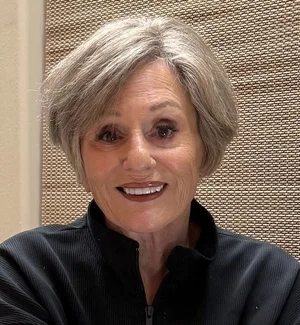
I am Margot, a portrait photographer here in the desert, and I want to be honest about what I am and am not. I am not a chaplain, a hospice nurse, or a grief counselor. What I am is someone who has spent many years sitting quietly in rooms with families in their last seasons together, often with a camera, sometimes with it set down on the table while we just talked. From that vantage point I have watched a lot of people search for meaning at the end of life — and I have watched them find it, more often than you might expect. This is some of what I have learned from them.
What "meaning" actually means when time is short
When we say we want to find meaning at the end of life, we are usually circling a few different questions at once, and it helps to separate them. People near the end of life — and the families walking alongside them — tend to be asking some version of:
- Did my life matter? Was it worth something to the people in it?
- Am I still myself? Even as a body fails or a mind slips, is the essential person still here?
- What do I want to say, and to whom, before I can't?
- What will remain of me? Not just possessions, but the part that the people I love will carry.
Notice that none of these are abstract or philosophical in a heady way. They are intimate and specific. Meaning, at the end, almost never arrives as a grand theory of life. It arrives in a granddaughter's laugh, an unfinished apology, a recipe written out in shaky handwriting, the smell of a particular casserole. Researchers who study this — particularly the work behind something called dignity therapy — found the same thing: what gives people a sense that their life mattered is remarkably concrete and relational. It is rarely about achievements. It is almost always about love and connection.
So if you are reading this hoping for a tidy answer to "what is the meaning of my mother's life as it ends," I want to gently redirect you. The meaning is not something you have to invent or argue your way into. It is mostly something you uncover, together, by paying attention.
The shift from doing to being
One of the cruelest tricks of a terminal illness is that it strips away the things we used the most to feel valuable. The career. The cooking. The driving, the gardening, the hosting of every holiday. Many of the people I photograph were, for decades, the doers in their family — the ones who showed love through action. When the body can no longer do, it is easy to feel useless, like a burden, like the meaning has already drained out.
But I have watched, over and over, a quieter kind of worth take its place. A father who can no longer fix anything becomes the person his adult children finally sit still long enough to actually talk to. A grandmother who can't cook the Thanksgiving meal anymore becomes the one who tells the stories while everyone else cooks, and suddenly the kitchen is full of history instead of just food.
If you are the one who is ill, this is worth saying plainly: your presence is not a lesser version of your usefulness. It may be the most important thing you have ever offered. The people around you are not keeping score of what you can still do. They are memorizing you.
If you are a family member, you can help with this shift. Tell them out loud, specifically, what they still give you. "I love just sitting here with you" is not a small sentence. For someone who fears they have become only a list of needs, it can be a lifeline.
Practices that help people find meaning
These are not assignments, and there is no need to do all of them. Think of this more as a menu. On a good day, one of these might be exactly right. On a hard day, none of them will be, and that is fine too.
Telling the life story
There is real, studied value in helping someone narrate their own life — the turning points, the people, the things they are proud of, the lessons they want to pass on. Sometimes this happens informally, just by asking better questions: not "how are you feeling" but "tell me about the day you met Dad," or "what were you like at twenty?" Sometimes it becomes a more deliberate project — a recorded conversation, a written letter, an audio file of a voice that the family will want to hear again someday. I have written more about that in recording the voices and stories you don't want to lose, because a voice is one of the first things memory blurs after a loss.
Putting things right
A great deal of end-of-life meaning lives in the territory of forgiveness — given and received. The hospice physician Ira Byock describes four phrases that carry an enormous amount of this work: please forgive me, I forgive you, thank you, and I love you. They are simple and they are not easy. But families who manage some version of these conversations, even imperfectly, often describe a peace afterward that nothing else provided. If there is an estrangement, a long silence, an old wound — this is the season people most often choose to reach across it.
Leaving something made
Many people find meaning in creating something that will outlast them. It does not have to be elaborate. I have seen:
- A box of letters, one for each grandchild, to be opened at future weddings and graduations
- A handwritten cookbook with the stories behind the recipes, not just the ingredients — something I love so much I wrote a whole piece about preserving family recipes and traditions
- A recorded reading of a favorite book, so a grandchild not yet born can be read to in that voice
- A simple list of "things I want you to know" — about money, about faith, about being a person
Staying connected to place and beauty
Meaning is not only found in words and projects. Sometimes it is found by being wheeled out to watch the light go gold over the Santa Rosa Mountains, or by sitting under the misters at a quiet table at a favorite spot on El Paseo, or by visiting the date palms one more time. The desert has a way of making people feel small and held at the same time, and for many of my clients, that is its own kind of comfort. Do not underestimate an afternoon outside.
Where photographs fit — honestly
I am a photographer, so of course I believe images matter. But I want to be careful here, because the last thing a person at the end of life needs is to be told they "should" do a photo session.
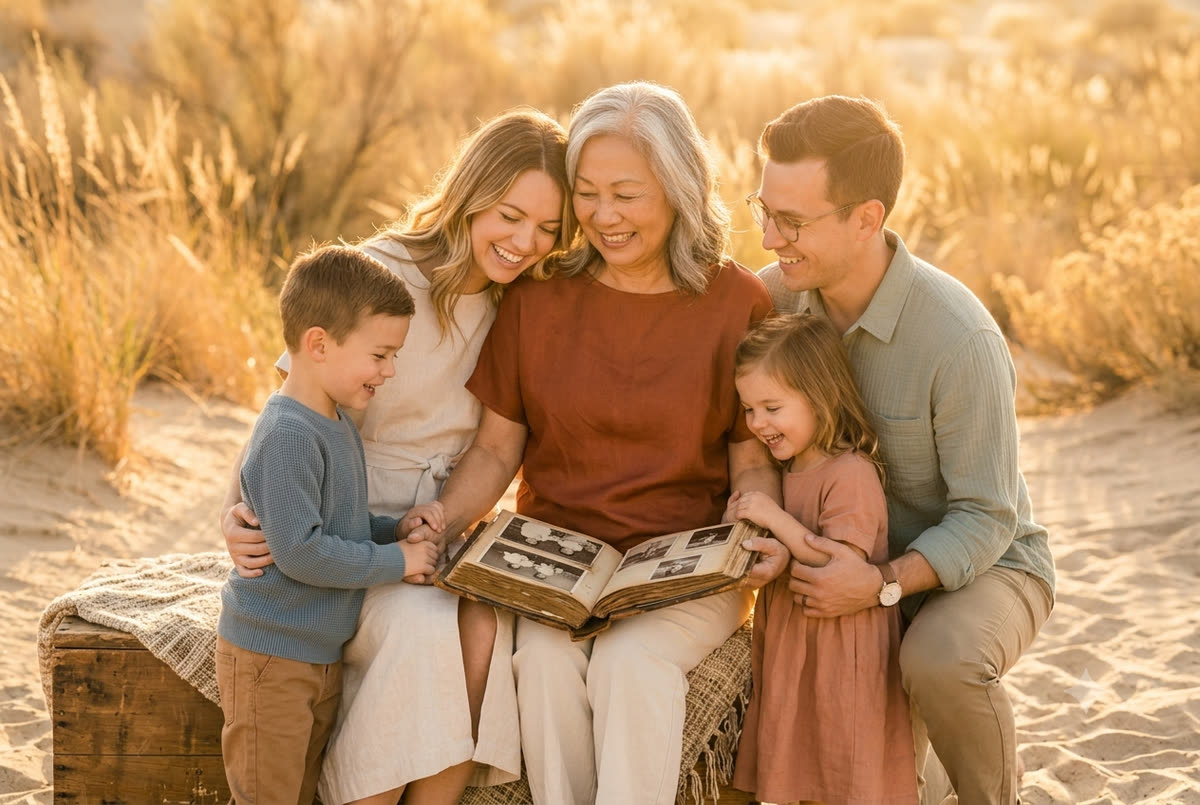
Here is what I actually believe, after years of this work. When someone is dying, the people who love them are slowly losing access to the small physical truths of that person — the exact shape of their hands, the way they tilt their head when they're amused, how they look at a spouse across a room. Words and stories preserve a great deal, but they don't preserve this. A photograph does. Not a stiff, posed portrait that looks like everyone else's, but an honest frame of who this person genuinely is, right now, with the people they love close enough to touch.
What I try to find in these sessions is the one true, telling moment — the gesture or glance that the family will look at in ten years and say "that is exactly her." Often it is not the smiling-at-the-camera shot at all. It is the in-between: a hand being held, a forehead kiss, two people laughing at a private joke. Those are the frames that end up framed.
These sessions move slowly, at whatever pace the day allows. We work around medication schedules, energy levels, and dignity. Most of the time I come to you: this is, by nature, in-home work — a living room in La Quinta where the afternoon window light falls soft across a familiar chair, a bedroom, the back patio where someone has taken their morning coffee for thirty years. When the person has the energy for it, a nearby park or garden in the golden hour can be a gentle change of scene, even for just twenty minutes. And when a hospice room in Rancho Mirage is simply where the person is, that is exactly where we make the pictures. The setting matters far less than the people in it. If you want to understand the practical side of how this works, I've laid it out in what to expect from a Legacy session. But the practical side is never the point. The point is having something to hold afterward that says: this person was here, and they were loved, and look at the proof.
When the meaning feels hidden
I do not want to paint this as a serene, golden process. For many families it is not. There are deaths that come with dementia, where the person you are looking for seems already gone. There are estrangements that do not get repaired. There are deaths that are sudden, or angry, or so full of physical suffering that "meaning" feels like an insult.
If you are in one of those harder places, a few honest things:
- Meaning can be found later, in retrospect, even when it could not be found in the moment. Grief has a long tail, and people often locate the significance of a death years afterward, when the rawness has loosened its grip.
- You do not have to force a beautiful ending. Some endings are just hard. Refusing to pretend otherwise is its own kind of integrity, and the people who loved that person will not love them less for it.
- With dementia, meaning often lives in the body, not the conversation. A person who cannot remember your name may still relax when you hold their hand, still hum to old music, still smile in the sun. That is not nothing. I've written specifically about finding personality and connection in memory care, because there is more presence there than people often expect.
For the family: your meaning matters too
Most of what is written about the end of life focuses on the dying person, as it should. But you, the daughter or husband or son sitting in the recliner at 3 a.m., are also in the middle of finding meaning — and grieving someone who has not yet gone. That experience has a name, anticipatory grief, and it is real and exhausting and entirely normal. If you have not heard the term before, I keep a gentle, practical overview of it in our anticipatory grief resource hub, with local Coachella Valley support listed.
The meaning you are looking for is not only your loved one's. It is also the meaning of this time — these strange, heavy, luminous weeks where a Tuesday is everything. You are allowed to find beauty in it even as it breaks your heart. The two are not enemies. In my experience, they almost always arrive together.
A few practical starting points in the desert
If you want somewhere to begin this week, here are concrete steps that families here have found helpful:
- Ask one real question a day. Not "do you need anything," but "what's a decision you made that you're proud of?" Let the answers be the conversation.
- Write things down or record them. Memory edits and softens. Your phone's voice memo app is enough.
- Reach out to hospice early, not late. Organizations across the valley — in Palm Springs, Rancho Mirage, and Indio — offer not just medical care but chaplaincy, social workers, and counseling for the whole family, often for longer than people realize.
- Don't wait for the "good" day to make memories. The good day may not come, and the ordinary days are the ones you'll miss most anyway.
- Let beauty in. A drive to see the wildflowers, the sunset over the mountains, the cool of an early desert morning. These are small meanings, and small meanings add up.
If you'd like me to be part of it
If, somewhere in all of this, you find yourself wanting honest photographs of someone you love while they are still here — not to perform happiness, but simply to keep the truth of them — I would be glad to talk it through with you. Ask your questions, change your mind, reach out just to think out loud. What I will say plainly is this: of everything I do, this is the one kind of session that cannot be rescheduled indefinitely. If some part of you suspects these images will matter to you later, that instinct is usually worth trusting sooner rather than later.
You can reach me through my contact page. Tell me a little about your person. We'll figure out the rest together, gently, at whatever pace this season allows.
Whatever you decide about photographs, I hope you find what you are looking for in this time. In my experience, it is closer and quieter than people fear — usually sitting right there in the room with you, in a held hand and an ordinary afternoon.