Preserving Family Stories for Future Generations
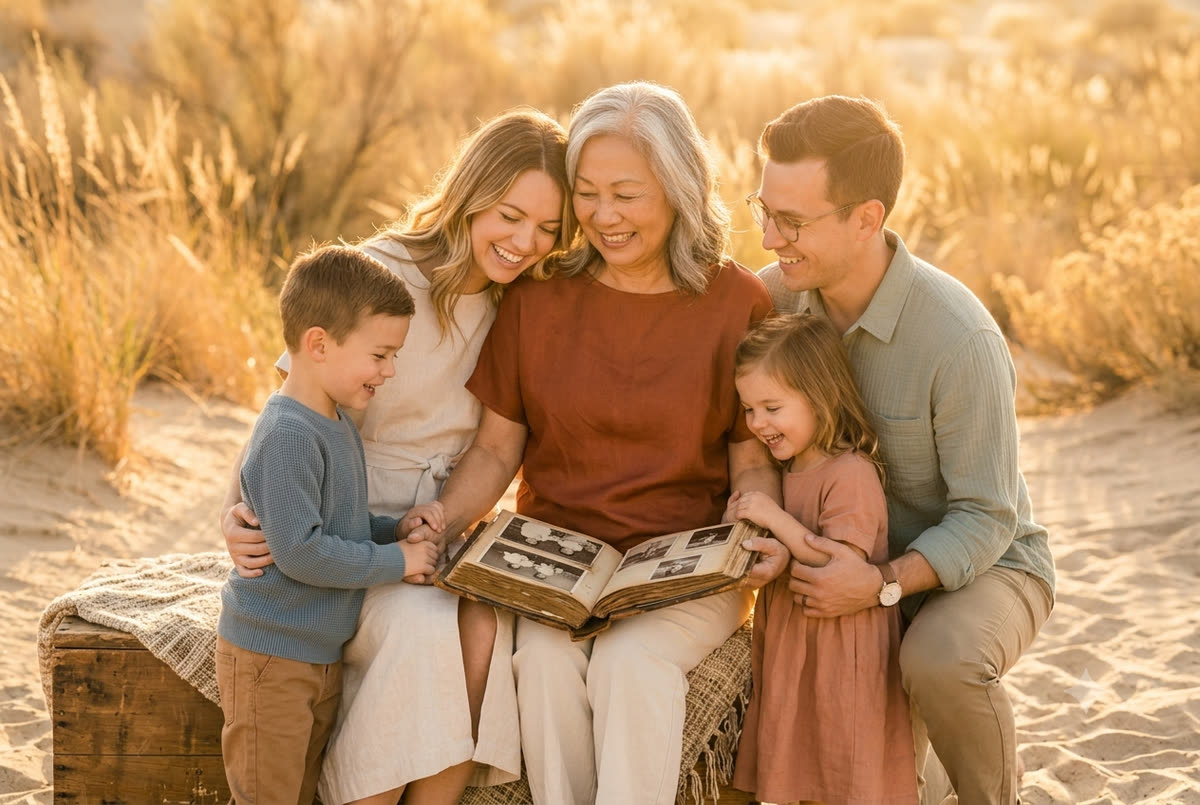
I think often about the stories that surface only by accident. I've sat at kitchen tables across the valley, setting up to photograph four generations under one roof, and watched a grandmother mention, almost in passing, some piece of her life that no one else in the room had ever heard — a job she'd held, a long-ago journey made before the highways were built, a person she'd once loved. A grandchild stops mid-sentence at the counter: you did what? It had simply never come up. And it nearly didn't come up that day either — it surfaced only because we were sitting still, with nowhere to be, in the quiet before the camera came out.
Those moments stay with me, because they are the whole thing in miniature. The stories that hold a family together are rarely written down anywhere. They live in one person's memory, and when that person is gone, the story usually goes quiet with them. Preserving family stories is the work of catching them before that happens — and then keeping them somewhere the next generation can actually find them.
I want to give you a real, usable guide to doing that. Some of it involves photography, because that is my craft and I believe images carry memory in a way words alone cannot. But a lot of it has nothing to do with hiring me at all. It is about what you can do at your own kitchen table, this season, with the people you love.
Why "someday" is the enemy
Almost everyone I meet intends to do this. They mean to sit down with Dad and record his Navy years. They mean to scan the shoebox of photos before the colors shift any further. They mean to ask Grandma to write down the recipes she keeps in her head.
The problem is that there is never an obvious deadline — until suddenly there is, and it is the wrong kind. I have photographed too many families in the season right after a loss who told me, gently and with real grief, that they wished they had a recording of the voice. Not just a face in a photo. The voice. The way he said a particular phrase. The laugh.
Here in the Coachella Valley this has a specific shape to it. So many of our families are split across the country. The grandparents winter in Palm Desert or Indian Wells from November through April, and the kids and grandkids fly in for a week at the holidays and again maybe in March. That means your windows to do this work are short and scheduled, and they are surrounded by the bustle of a visit. It is easy to let a whole season pass telling yourself you'll do it next time everyone's together.
My honest advice: treat the next gathering as the deadline. Not because anything is wrong, but because the gatherings themselves are finite, and they are the natural container for this kind of work.
Start by recording a voice
If you do only one thing after reading this, do this one. Sit down with the oldest person in your family and record them talking. Your phone is enough. The Voice Memos app on an iPhone or any free recorder on Android produces audio that is perfectly good for this.
A few things I've learned from being the person in the room while families do this:
- Don't make it a "formal interview." The minute someone feels they're being interviewed, they perform, and performance flattens the truth out of a story. Pour coffee. Let it be a conversation.
- Ask about objects and photographs, not abstractions. "Tell me about your life" gets you nowhere. "Whose ring is that?" or "Who's this in the photo, and why is everyone laughing?" opens a door every time.
- Ask the questions only that person can answer. How did you and Grandpa actually meet — the real version? What was your mother like? What were you afraid of when you first moved here? What do you know about your own grandparents?
- Let the silences sit. People often add the most important sentence right after a pause, when they think you've moved on.
- Record more than you think you need. You are not editing a podcast. You are catching a voice. An hour of rambling is a treasure; a tidy ten-minute summary is not.
Then — and this is the part people forget — get that file off the phone. Email it to yourself, drop it in a shared family folder, name it with the person's name and the date. A recording that lives only on a phone that gets dropped in a pool is not preserved. It's borrowed.
Rescue the photographs you already have
Most families are sitting on the single richest archive they will ever own and treating it like clutter. The shoebox. The albums with the sticky plastic pages. The slide carousels in the garage that nobody owns a projector for anymore.
Two real risks here, and they are both quiet:
- Physical decay. Color prints from the 1970s and 80s are shifting toward red and magenta as we speak. Our dry desert air is actually gentler on paper than a humid climate would be, but heat is not your friend, and a garage in Indio in July is brutal on anything stored in it. Get irreplaceable prints out of the heat and into the air-conditioned part of the house.
- The unlabeled-photo problem. Every family has a stack of beautiful black-and-white photographs of people no one alive can name. Don't let your generation become the one where that happens again.
So, practically:
- Scan, even imperfectly. A flatbed scanner at 600 dpi is wonderful, but a phone scan in good window light beats a photo that exists in only one copy. There are free apps that flatten and de-glare a snapshot in seconds.
- Sit an elder down with the prints and the voice recorder going. This solves two problems at once. You capture the scan and the story of who's in it. This is, hands down, the most valuable afternoon you can spend.
- Back it up in two places. A cloud folder and a physical drive. One copy is not a backup.
If you want a deeper walk-through of handling and digitizing old prints, I wrote a companion piece on digitizing and protecting old family photos that goes further into the technical side.
Make new pictures that are actually about the people
Here is where my own work comes in, and I'll be plain about what I think a photograph is for in this context.
A portrait made well is not a record of how someone looked on a Tuesday. It's a held moment of who they were — the particular tilt of a grandfather's head when he's pretending to be stern, the way a four-year-old leans into her great-grandmother's side without being asked. Fifty years from now, the people in that frame may be gone, and the photograph will be doing the work the voice recording can't: it will let a child who never met them feel, in their body, that's where I come from.
When families come to me wanting to preserve their story rather than just "get a nice photo," I steer the session a little differently:
Photograph the generations together
The four-generation portrait — great-grandmother, grandmother, mother, child — is the single most requested heritage image I make, and for good reason. That configuration is often only possible for a narrow window of years. If you have four living generations right now, do not wait. That is the photograph your family will fight lovingly over someday.
I shoot a lot of these during snowbird season, precisely because that's the only time the whole line is in the same zip code. If your family converges on the desert in March, build the session into the trip on purpose, the way you'd book the dinner reservation.
Let me photograph people in their own places
This is where most of my legacy work happens: in your own home. A studio backdrop gives you a clean portrait, and there's a place for that — but I'd far rather photograph your father in his workshop, your mother at the piano she's played for forty years, the family in the kitchen where every holiday actually happens, in the soft natural light coming through the windows. Context is memory. The room tells the story alongside the face, and nobody has to leave the place that already holds it.
When we do step outside, my favorite settings are close to home: a shaded local park, a garden full of blooming desert plants, a patio in the late afternoon. In the golden hour before sunset, that warm low light is genuinely flattering to every age, and it places your family unmistakably here, in this valley, in this chapter. If you'd like a "best spot" recommendation, I'm glad to suggest somewhere lovely and easy in Palm Desert or nearby — but the setting that matters most is usually the one you already live in.
Don't over-direct the children
The honest pictures of kids come from letting them be kids and being ready when the real thing happens. I'd rather catch a genuine giggle between cousins than line everyone up for ten "everybody say cheese" frames that all look the same. If you want more on that, I keep a running set of thoughts in getting natural photos of children who won't sit still.
Gather the things that aren't photos or voices
A family story is bigger than its images. Some of the most treasured things I've seen families preserve:
- Recipes in the original handwriting. Scan the index card with the splatters on it. The stains are part of it. Typing it up loses something.
- Letters and postcards. Even mundane ones. The handwriting and the everyday voice in a 1962 postcard are pure gold to a great-grandchild.
- The provenance of objects. That ring, that watch, that quilt, the painting in the hallway — write down whose it was and how it came to you and tape the note to the back, or keep a simple document. Objects without their stories become estate-sale anonymous within one generation.
- Maps of where people came from. A simple note: "Your grandmother's people farmed outside this town." Kids hold onto geography.
Put it somewhere that will outlast a hard drive
This is the unglamorous step that determines whether any of the above survives, so I'll be direct.
- Make a physical book. Of everything I've watched families do, the printed album is the one that actually gets pulled off the shelf and looked at across generations. A file on a drive requires someone to go looking. A beautiful book on the coffee table teaches the grandchildren the faces and names without anyone trying. I help my clients design heirloom albums for exactly this reason — the print is the preservation, not the afterthought.
- Print the important ones, large. A photograph on the wall enters daily life. A child grows up knowing the face of a great-grandfather because it has hung in the hallway her whole life.
- Keep a digital archive too, redundantly. Cloud plus a drive, organized in plain folders by family and decade. Tell more than one person in the family where it lives and how to get into it. The best archive in the world is useless if it dies with the one person who knew the password.
- Write a one-page "who's who." Future generations won't recognize faces you find obvious. A single sheet naming people and relationships, tucked into the album, is a gift to someone not born yet.
A gentle word about doing this with aging parents
A lot of the people who reach out to me about legacy work are quietly worried. A parent is slowing down, or a diagnosis has changed the timeline, and there's a tenderness and an urgency mixed together. I want to say something to that directly, because it deserves more than a checklist.
You do not have to frame this as "we're doing this because we're running out of time." For most elders, that framing is painful and they'll resist it. Frame it as honoring them — we want to keep your stories, because they matter to us. People light up at being valued. They shut down at being managed.
And go at their pace. If an afternoon of recording tires your mother out after twenty minutes, twenty minutes is plenty; do it again next week. Some of the most moving sessions I've photographed were short and quiet, and ended the moment she'd had enough. The goal was never volume. It was truth.
The simplest version of all this
If the full project feels like a lot, here is the whole thing compressed into what you could start this weekend:
- Record one elder talking for one hour.
- Scan ten photographs nobody has copies of, and write down who's in them.
- Book one portrait of the generations while they're all in town.
- Put all of it in two places, and tell someone else where.
That's it. That's a family story preserved better than 95 percent of families ever manage. Everything beyond it is depth, not necessity.
If you'd like help with the photography part — a multi-generation portrait while the family's together this season, or an heirloom album built from the pictures you already have — I would be honored to be part of it. I work all across the valley, from Palm Springs to La Quinta, and I'm happy to talk through what would matter most for your particular family before you commit to anything. You can reach out to me here, and we'll figure out the right shape for it together.
The stories are already in your family. They just need someone to decide, this season, to keep them.